Window into our activities
The second-generation Holocaust survivors (i.e. the children of survivors) are already retirees, at least for the most part.
It is not possible to characterize the lifestyle of a child of Holocaust survivors, just as it was not possible to do so for their own parents. There is no typical figure of a Holocaust survivor. Each person bears their suffering and their memories in their own way, each person reacts differently to the data that was dictated to them from above, and of course the test of faith and trust plays a decisive role in the way of life at any age, and also in old age.
Over the years, many phenomena in the lives of second-generation members have been studied in light of the impact of the events of the Holocaust on their childhood and development. However, it is clear that the experience of growing up in a home of Holocaust survivors varied greatly from family to family, despite common patterns that researchers have identified among young people of the “second-generation,” and we will list some of them:
Anxiety and overprotection – Many homes were characterized by high existential anxiety – a huge emphasis on eating (“finish off the plate”), separation anxiety, and suspicion of the outside world.
Compensation for loss – Many children felt that they had a duty to compensate their parents for the loss, to be perfect, not to worry or grieve their parents (“they have suffered enough”). This phenomenon is sometimes referred to in psychology as “reverse parenting”, in which the child worries and protects his parents’ feelings.
Furthermore, while in some homes there was complete silence (“they don’t talk about it”), which created in the children a feeling that something terrible and mysterious was hanging in the air, in other homes there was a flood – repeated stories about the horrors and loss.
What is astonishing is that many homes of Holocaust survivors were characterized by cheerfulness, even extraordinary cheerfulness. This is expressed many times in the testimony department of Ganzach Kiddush Hashem: When Holocaust survivors were asked by interviewers, “How did you manage to build such a happy and cheerful home, full of hope and optimism after going through what you went through and losing everything you had,” the answers were always short and to the point: “We had no choice, we had to move on”; “We had to ‘play it’ for the children,” “We had Divine help, it wasn’t our strength, it’s a fact, we would cry at night.” But what is clear is that in the childhood homes of the second-generation, there was no fluent and free conversation about those dark days. In meetings with Ganzach Kiddush Hashem, they talk about everything, and openly. They talk about everything from a faith-based and Torah perspective.
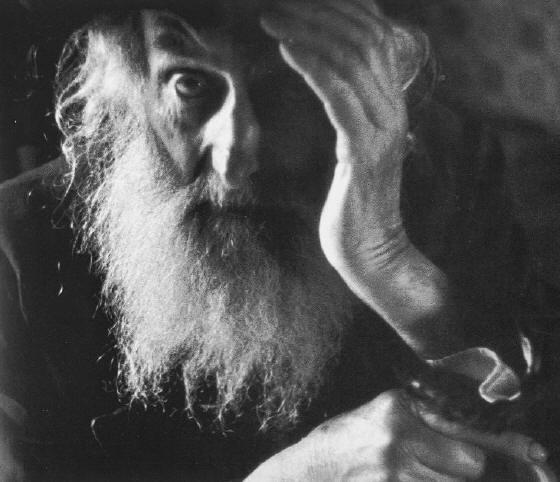
“These eyes are fixed on us like arrows in the heart.” An old chassid in the Carpathian Mountains, on the eve of World War II. From Roman Vishniac’s camera, 1938, “A Vanished World,” Ganzach Kiddush Hashem.
Meetings of Tears and Longing
The activities of the Ganzach Kiddush Hashem among the whole spectrum of the Israeli public mainly encompasses teenagers or members of the third generation of the Holocaust, people in their thirties and forties and around there. They come open to hear, learn, receive and internalize. They are less emotionally connected to this story, and when the material is given to them in the right way, it produces the desired benefit. There is much to learn from the holiness and heroism of the millions of Holocaust victims and survivors, each of whom is an inspiring human story. Things are different when they are presented to the second-generation, those who carry in their hearts and souls the figure of their father or mother, or both, and the expression of their pain, which they would have experienced in their childhood, as insiders.
Holocaust survivors, even the heroes among them, were human beings. In their homes, at various times, memories would float before their eyes and torment them. These childhood memories are carried by today’s adults, and when they come to hear about the Holocaust and Holocaust survivors, something awakens in them.
It may also be that in the first decades of their lives, when the Holocaust was alive and well in their homes and in daily conversation with their parents, they saw no point in going and hearing about the Holocaust through lectures or visual displays. They knew this story too well and had had enough of what was available, like what the sages said: “We regret the first, and you come to add to them?”
This becomes more acute for us, the people of Ganzach Kiddush Hashem, every time a second-generation person takes part in an activity. Seventy teenagers can sit in front of us and all of them will be moved and gather themselves in the face of what we are conveying to them, but the reaction of the staff member accompanying them – the rabbi, the teacher, the principal, etc. – whose father or mother came from “there” will be completely different. We often see them tearful, and sometimes even agitated and angry. Indeed, the second-generation members went through this together with their parents, and this must be taken into account.
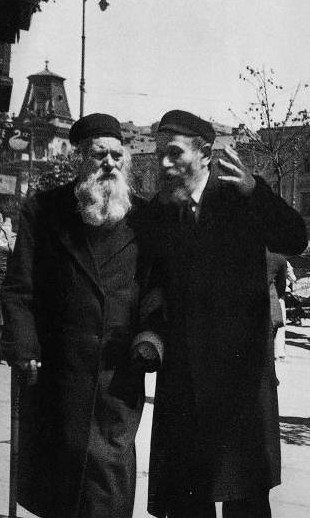
Warsaw 1938, Roman Vishniac, A Vanished World. Ganzach Kiddush Hashem Archive
“Torturous Memories”
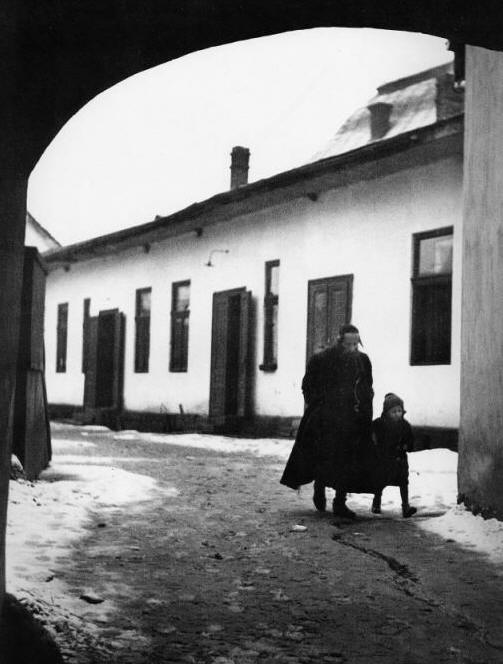
A father and son on the way to chedder early in the morning, Munkacs, 5698 (1938), Roman Vishniac
Tearful Eyes and Stirred Heart
This week, we, the content staff of Ganzach Kiddush Hashem, sat with fifty retirees in Bnei Brak. All of them are charedi (ultra-Orthodox), all of them are rationale and restrained people, essentially Torah followers. They sat quietly for a long time, as if captivated and intrigued, but also alert and tense. Thank G-d, we were up to the task and the things we shared opened hearts and lifted souls. It is unbelievable how eyes wept and how hearts beat with excitement. We realize how heavy and complex this subject is at this age. These are people who, for many years, since they were born, walked under this mysterious black shadow that, in most homes, was not talked about, but rather lived and breathed.
The pensioners’ participation in this activity was a different challenge for us, the people of Ganzach Kiddush Hashem, but it was worth it. The veiled gaze, the nod in understanding, the memories that suddenly surface, the emotional conversations and the lively sharing. This activity also added a lot to us, as lecturers. The participants asked to make contact and provide fragments of documented testimonies or relevant documents, and some have already managed to pass on priceless testimonies and memories to us. We are constantly engaged in describing the figure of the Holocaust survivor, which we try to sketch in the eyes of young people so that they understand what we are talking about, in a generation that hardly ever sees Holocaust survivors and the baggage they brought with them from the old Jewish home, from the Jewish town that caught fire and was reduced to ashes. Today, this is largely the role of the second-generation, sons of spiritual heroes who spoke little, but the new generation must know what was, what we lost.
The reason for the silence that characterized so many of the Torah-observant Holocaust survivors stems, among other things, from a different perspective on what is happening. These are Jews who were raised and educated not to ask questions but to accept everything with love and faith.
One of the lecturers at Ganzach Kiddush Hashem often quotes what he heard from his grandfather z”l, a chassidic Jew from Poland who went through the horrors of the Holocaust and also went through very difficult things afterwards, but he was never sad; he was full of joy. And this is what he would say (the chassid, Rabbi David Leib Krakowski, Radomsk – Tel Aviv – Bnei Brak):
“I don’t ask questions (Ich freg nisht kein kashes) because there are answers to everything up there, and if I ask questions, they’ll want to give me answers up there, and they’ll call me there… I still want to be here, so I don’t ask.”
This is a Polish joke that has some meaning.
For over five years, the grandfather suffered in camps and ghettos. He was beaten, lost family members and his Rebbe, to whom he was so attached, but he was not accustomed to talking about all the bad. He always had a mischievous smile on his face and only told things that needed to be learned from. Here is one of the things:
“I remember Kiddush on Shabbat nights well. It wasn’t easy. The bread was burning in our pockets and we just wanted to swallow it like that, whole. We received the bread early in the morning and I would see the erlicheh Yidden (dear Jews) spread out to the side, blessing the Torah, reciting the Shema, and then eating. There was no other option. We had to go to work at dawn until evening, without the bread we wouldn’t survive. That was the whole week. But Fridays were different. My friends and I would take the bread and put it in our pockets. We would go to work hard, hungry and weak; the bread in our pockets tortured us and threatened to drive us crazy. But we waited until evening so we could make Kiddush on the loaf. Oh, how difficult it was, but my friends and I made it through…”
We so need this kind of testimony, and it is precisely the second generation that has it. Testimonies from people who were not interviewed or made public, but who walked along (the survivors) and rejoiced in their share.
What characterizes the believing public is the faith-based perspective, and therefore the events of the Holocaust, like everything that happens in our world, are processed through pure observation of faith and Divine Providence. The emphasis in Holocaust remembrance has never been on theological questions of “where was G-d,” G-d forbid, but on “sanctifying the Name of G-d” and on “spiritual heroism” – keeping the commandments, studying the Torah, and preserving one’s Jewish identity in the midst of hell.
“The Concept of Rehabilitation and Rebirth”
And to the point: The concept of rehabilitation and the rebirth of families after the Holocaust among the charedi sector is unique and noteworthy.
The central concept of revival after the destruction was the restoration of the world of Torah and the building of families blessed with children. For the charedi Holocaust survivors, establishing a large family and ensuring that their descendants would continue in the path of Torah and commandments was seen as a complete and direct victory over the enemy. The second generation grew up with a deep sense of mission to be a connecting link in the broken chain of generations.
The social life that characterizes the charedi community, and especially the chassidim, also played a crucial role in the way Holocaust survivors coped.
The chassidic community served as a huge social and emotional support system for the survivors. The cohesive community structure, the holidays, and the leadership of rabbis and rebbes (some of whom were survivors themselves) provided a framework of belonging, protection, and a pleasant and sacred experience; an envelope that helped them recover quickly.
Another very important point.
Contrary to what was commonly understood from the silence of the generation of survivors in the 1950s and 1960s, which was often perceived as repression or oppression (“like a lamb to the slaughter”), in charedi society, silence was seen as a deliberate and conscious tool for “pouring the tears inward” in order to focus on action, building, and looking forward to the future, without sinking into despair.
Even in the practice of “Shoah Remembrance,” there is a uniqueness in the form of charedi commemoration of the Holocaust that focuses on studying Mishna, writing Torah scrolls to commemorate the souls of the victims, reading chapters of Tehillim (Psalms), naming babies after the victims, and publishing reading and study materials that document the glorious spiritual life of the towns that were destroyed. Remembrance is woven into everyday life and prayer, and not just on specific dates.
Therefore, the activity with the second generation is so important, and our call is addressed to them: “Do not withhold good from its rightful owners.” Send us testimonies, documents, diaries. We will publish them and sanctify the Name of Heaven.