Introduction (from Hidden in Thunder, by Rebbetzin Esther Farbstein) Post-war religious Jewish education served as the guarantee for the people’s continuity in the spirit of the Torah. Under the auspices of rabbinical committees, an extensive network of yeshivas, Talmud Torah schools, and girls’ schools was established; the initial teachers were survivors themselves, and subsequently, emissaries from the Land of Israel also engaged in education. This activity was extensive and played a pivotal role in shaping Jewish society in the aftermath of the Holocaust. The [Read more]
Introduction (from Hidden in Thunder, by Rebbetzin Esther Farbstein)
Post-war religious Jewish education served as the guarantee for the people’s continuity in the spirit of the Torah.
Under the auspices of rabbinical committees, an extensive network of yeshivas, Talmud Torah schools, and girls’ schools was established; the initial teachers were survivors themselves, and subsequently, emissaries from the Land of Israel also engaged in education.
This activity was extensive and played a pivotal role in shaping Jewish society in the aftermath of the Holocaust.
The process of returning to Torah study was complex and fraught with difficulties for various reasons—primarily because the vast majority of the Torah world, including its scholars and leaders, perished. Young people were destitute; concerns regarding their immediate survival and future prospects dominated their lives, leading many to prioritize vocational training or learning a trade. Furthermore, the very prospect of returning to intensive, sustained academic study was daunting for them; nevertheless, the yeshivas continued to expand. Many returned to their studies through the influence of siblings, friends, and rabbis who helped them appreciate the significance of reconnecting with the Torah world and their family heritage.
In contrast, Talmud Torah schools for young children were few in number, as only a small number of children survived the Holocaust; those who did were taken to children’s homes in Poland and subsequently transferred to France, England, and the Land of Israel.
Following repatriation, families with children arrived; classes were opened for them, or they too were placed in the children’s homes. The first Talmud Torah schools for young children also stirred deep emotions.
The Yeshiva in Celle
The Yeshiva in Celle
Day after day, from the walls of the Jewish school in Celle, voices and melodies emerge that are familiar to us from ancient times, and that touch our hearts… In this city, where not long ago the sound of Jewish despair was heard, a Jewish voice has triumphed over Hitlerism… For this blessed undertaking, we must thank first and foremost the young and prolific rabbi of Celle, Rabbi Yisrael Moshe Olevsky.
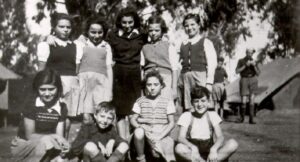
2nd grade students in a detention camp, Cyprus
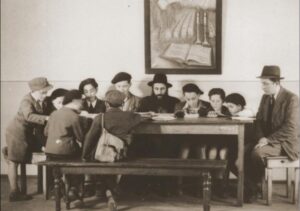
A Gemara class in the Stuttgart DP camp, Germany
Judith Hemmendinger - The First Smile in the Home for the "Children of Buchenwald" in France

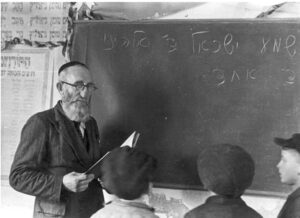
A lesson in the Radenburg DP camp, Austria
Yechiel Gerenstein - Redeeming Children in Lodz (Lublin, Poland)
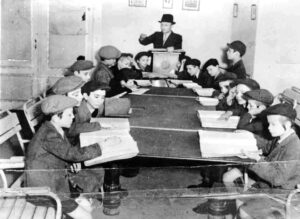
A Torah lesson for surviving children in a DP camp in Germany
Chaim Lornetz – The Children of Buchenwald in France (Jarugosz, Hungary)
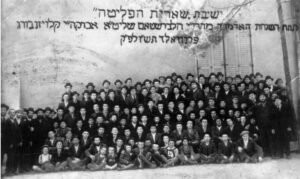
Students of the "Shearit HaPleita (Survivors) Yeshiva" in the Foehrenwald DP camp
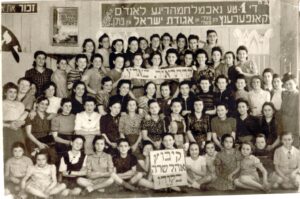
The Ohel Sarah survivors kibbutz in Lodz, 1946
Rabbi Yosef Bramson – In the Jewish Institute Postwar (Franeker, Holland)
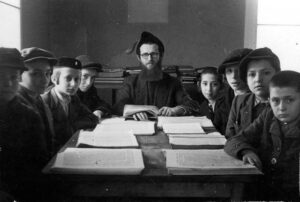
Torah studies in the Hiedenheim DP camp, Germany
Hela Kluger – Rehabilitation in the “Bnos Yerushalayim” Institute in Sosnowiec (Poland)
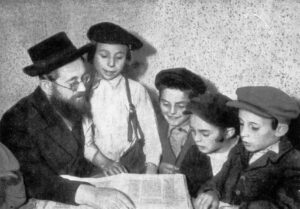
A teacher and his students in a DP camp
Bais Yaakov in Bergen-Belsen
Bais Yaakov in Bergen-Belsen
With zero appropriate conditions and a complete absence of promising data to start with - with only a burning spirit and ardent faith - Bais Yaakov was established in the Bergen-Belsen DP camp:
Our Zehnerschaft (group of 10) took the responsibility of gathering these tiny sparks which, though covered with ashes, still glowed in the emaciated bodies. We saw it as our duty to rekindle the fire: to teach these apathetic young survivors to live, to work, and to fight to go to Eretz Yisrael (the Land of Israel), the only place where we might make our home.
Fortunately, quite a few of us were experienced teachers and leaders, who eagerly, with renewed strength, threw ourselves into this work. Thus, just a few weeks after liberation, the Bais Yaakov system was re-established in Bergen-Belsen. The girls flocked to us, to learn, to strengthen their faith, to renew their hope for a better future. They drew encouragement from each other and helped each other cope with the problems of their new reality.
Bais Yaakov groups sprouted one after the other in this fashion. They had no buildings, no schoolyards, no offices. The girls gathered in barracks rooms, sitting on bunks and on the floor, eagerly drinking the life-restoring words, the timeless lessons of Jewish History.
(To Vanquish the Dragon, Pearl Benisch, page 412)
Bais Yaakov in Bergen-Belsen, which began as a small school with a small group of girls, expanded rapidly, and even added a second branch within Bergen-Belsen within a few months. The number of students in the two branches reached hundreds of girls, and a year later a seminary was established there to train teachers and instructors for the movement!
Moshe Weiss – Like a Father to His Sons/The Klausenberger Rebbe in Foehrenwald (Hungary)
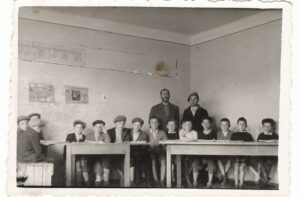
A class in a DP camp near Bergen-Belsen
Frieda Borenstein – The Children’s Institute in Ulm (Jaroslaw, Poland)
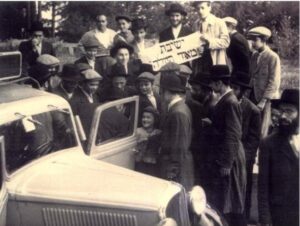
Students of the Meor HaGola yeshiva in Rome, Italy, led by Rabbi Ephraim Oshry
The Yeshiva in Foehrenwald (1)
The Yeshiva in Foehrenwald (1)
Foehrenwald was a large camp that spanned an extensive area.
The site contained a small number of large buildings; one of them, the most suitable, was designated, in accordance with our Rebbe’s instruction, to serve the camp’s residents as a Beit Midrash (study hall) for prayer and Yeshiva study.
That same day, upon our arrival in Foehrenwald, our Rebbe, the Klausenburger Rebbe, hastened to gather all the yeshiva students. There were older students as well as younger ones, though the majority were between the ages of fifteen and seventeen. Adult men joined the students at the gathering as well. The Rebbe began with an impassioned address, urging the students to study with great diligence and dedication, declaring, "Si kumt heilige vinter necht"—"Holy winter nights are approaching." He decreed that the yeshiva’s daily study schedule would commence each morning at five o'clock, during the early hours of the dawn.
The few books we possessed were brought from the Munich cemetery; initially, Jews traveled to the Munich burial grounds—where, they claimed, there were many books—and indeed returned with a rich haul of volumes and tallises (prayershawls).
The Rebbe resolved the question of which tractate to begin studying on the spot: we would start with the tractate for which we had the largest number of Gemara volumes. Accordingly, we began with Tractate Gittin, of which there were the most copies - nine in total.
(MiMachashechim Hoshi'ainu - Rabbi Yeshayahu Glick)
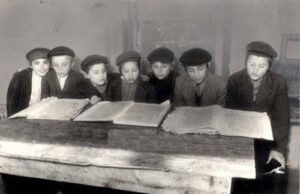
The Tomchei Temimim yeshiva in a DP camp
Judith Hemmendinger - Coping with Memories with the "Children of Buchenwald" in France
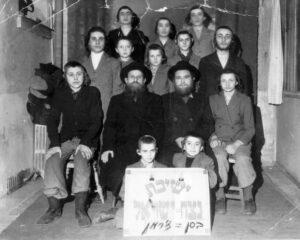
The Netzach Yisrael yeshiva for Holocaust refugees in Saint Germain, France
Ephraim Elkichen - Liberation from the Monastery in Brussels (Brussels, Belgium)
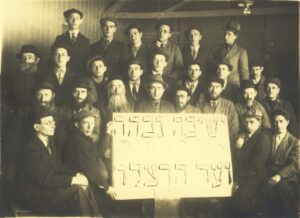
The Vaad HaHatzala yeshiva
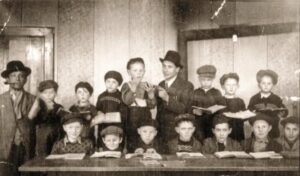
A Talmud Torah school in the Feldafing DP camp, Germany
Avraham Yaakov Frisch – The Teacher after Liberation (Hajdanunas, Hungary)
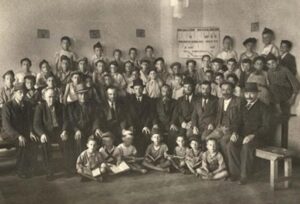
The Talmud Torah school in the Ansbach DP camp
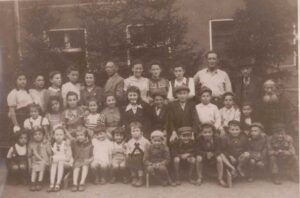
Child survivors and staff of the orphanage in Gluszyca, Poland
Pesia Nugelblat – In Ms. Lederman’s Children’s Home (Poland)
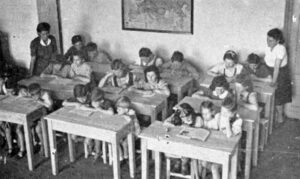
Children in a class in an orphanage in Czestochowa
Leah Nevenzahl – Return to Life in the Children’s Home in Zabrze (Apta, Poland)
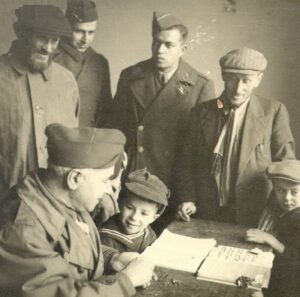
Children in their classroom in the DP camp in Bad Iburg, with members of the Camp Council
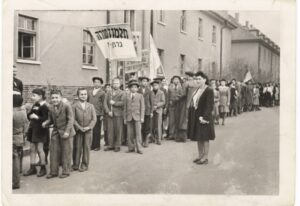
A procession in the Bergen-Belsen DP camp. One can see children from the camp's Talmud Torah school in the photo.
Moshe Ackerman - In the Aix-les-Bains Yeshiva with War Refugees (Strasbourg, France)
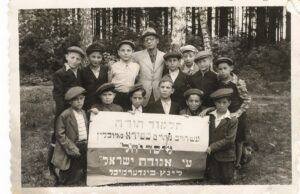
Children of Talmud Torah Austria
Moshe Weiss – The Klausenberger Rebbe’s Education of the Youth (Hungary)
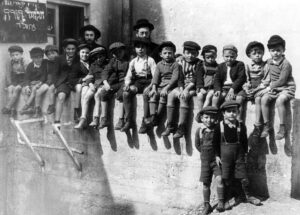
Children of the Talmud Torah school in the Foehrenwald DP camp, Germany
Pinchas Yeshurun - The Struggle for Jewish Education in Switzerland (Antwerp, Belgium)
The Power of a Tune
The Power of a Tune
It was no easy task to "deal with" a youth like me. I rejected any overture of closeness or warmth; thus, when Reb Leibel Kutner recognized that I was in need of correction, he knew I required "dealing with from the roots," in the form of a frank conversation. He assigned this task to one of the group members, Reb Chananiah Kuzhitz, instructing him to keep an eye on me and discern what lay in my heart. From the very first words we exchanged, Reb Chananiah sensed that I was a tough nut to crack; consequently, he let the matter drop. I naively assumed he had abandoned the idea of talking to me. Then, during one of the Shabbat meals, as the older men sat at our table, mingling with the youths and joining in the singing, a melody was started; I did not recognize it, yet I was captivated by it until the very end. When it concluded, I asked the person sitting next to me who had composed such a wondrous piece. The musical sensibilities I possessed, dormant since the war years, were suddenly stirred to life within me.
I asked to hear the melody again. Reb Chananiah promised to repeat it after the meal. We went out alone onto the paths of Santa Cesarea, descended to the bay, and sat on a rock facing the shore; with the waves murmuring in the background, Reb Chananiah began to sing "Kel Adon" in a pleasant voice, this time weaving the words of the liturgical poem into the notes of the melody in wonderful harmony.
I was captivated. I gazed at the moon in the darkening sky and heard his hushed voice concluding the passage: "He endowed them with strength and might to rule over the inhabited world." Deep-seated emotions stirred within me. As the melody ended, Reb Chanania began to sing the "Zochreinu" tune, a melody sung in the Rebbe’s beit midrash (study hall) back in 5696 (1935-6). Distant memories stirred in my mind; who knows, perhaps my father used to sing this very tune at home? The melody swelled, my mind grew clear, and my heart opened wide; that night, Reb Chanania accomplished the greater part of my spiritual upbringing, through the power of a melody.
(Techayena HaAtzamot Ha'Eleh - El Lev HaNaar - Baruch Lev)
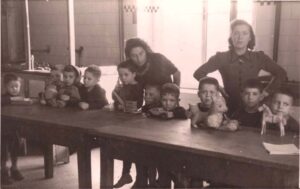
Kindergarten children in the DP camp in Vienna, Austria
Leah Balint - Memories from the Children's Home (Radom, Poland)
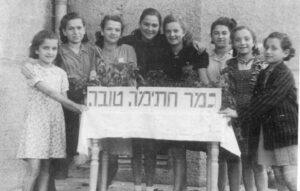
Girls from the "Kinderheim" orphanage, Poland
The Yeshiva in Bergen-Belsen
The Yeshiva in Bergen-Belsen
With absolutely no resources and a complete lack of promising starting conditions, armed only with a burning spirit and fervent faith, the Bais Yaakov school was established in the Bergen-Belsen DP camp:
Our Zehnerschaft (group of 10 young women) took the responsibility of gathering these tiny sparks which, though covered in ashes, still glowed in the emaciated bodies. We saw it as our duty to rekindle the fire... Fortunately, quite a few of us were experienced teachers and leaders, who eagerly, with renewed strength, threw ourselves into this work. Thus, just a few weeks after liberation, the Bais Yaakov system was re-established in Bergen-Belsen. The girls flocked to us, to learn, to strengthen their faith, to renew their hope for a better future. They drew encouragement from each other and helped each other cope with the problems of their new reality. Bais Yaakov groups sprouted one after the other in this fashion. They had no buildings, no schoolyards, no offices. The girls gathered in barracks rooms, sitting on bunks and on the floor, eagerly drinking the life-restoring words, the timeless lessons of Jewish History. (To Vanquish the Dragon, Pearl Benisch, page 412)
The Bais Yaakov school in Bergen-Belsen, which began modestly with a small group of girls, expanded rapidly; within just a few months, a second branch was opened within the camp. The total number of students across both branches reached hundreds, and a year later, a seminary was established there to train teachers and counselors for the movement.
Rabbi Yisrael Jacobson - The Establishment of the Lidingo Institute for Girls (Copenhagen, Denmark – Sweden)
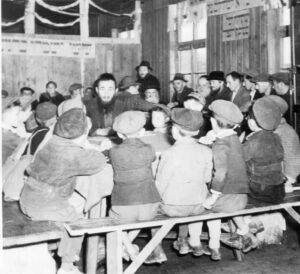
Torah classes in a DP camp
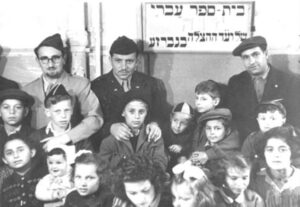
The Yavne school in the Gabersee DP camp, Germany. Rabbi Aviezer Burstein, one of the heads of the Vaad HaHatzalah (Rescue Committee) appears in the photo
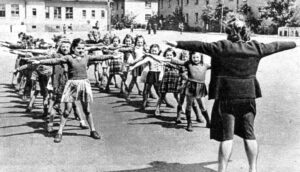
An exercise class in a DP camp
Moshe Nachum Kanner - The Children's Home in Ulm (Poland)
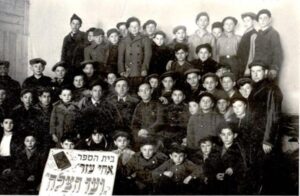
The Achiezer school in the Ansbach DP camp, Germany
Avraham Faluch - The First Page of Gemara in the Aix-les-Bains Yeshiva (Lodz, Poland)
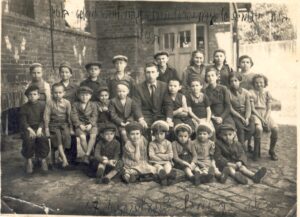
An Agudath Israel orphanage in Poland under the auspices of Reb Leibel Zamosc, Sivan 5706 (Spring 1946)
Baruch Merenstein - Educating the Children Postwar (Poland)
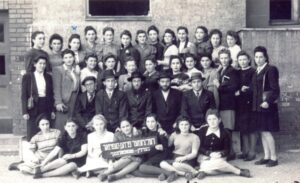
A Bais Yaakov School in a DP camp in Berlin
Rabbi Yisrael Jacobson - The Girls of Lidingo (Copenhagen, Denmark – Sweden)
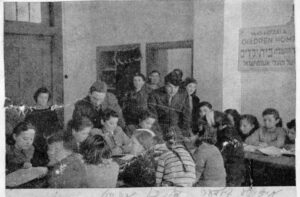
A children's home in a DP camp
The Yeshiva in Foehrenwald (2)
The Yeshiva in Foehrenwald (2)
The yeshiva in Foehrenwald was the first in a series of yeshivas established in the displaced persons camps in Germany, France, and Italy. In a short time, the number of students grew remarkably, and the spiritual thirst was astonishing: "Abaye and Rava (rabbis from the Talmud) were expelled from Warsaw and arrived in Feldafing with the Jews," wrote Dr. Yitzchak Levin, an emissary of the Vaad Hatzala, in 5706 (1945-6).
"As I entered the yeshiva hall, I stood rooted to the spot, filled with wonder and bewilderment: here was the very same yeshiva that lived in my memory from my youth. It had not changed in the slightest. One might ask: Was there really a world war? Was there truly a ghetto? Was there really a Majdanek? I stood there, not knowing what to marvel at first. Should I marvel at the sight of those long tables from the yeshiva of my past? Or should I marvel at the sound of that melody—swaying, rocking, rising and falling? Am I in Foehrenwald, a displaced persons camp on cursed soil, or back in the Slobodka of old?"
(Lichiot U'Lelamed, HaChinuch HaYehudi BeGhetta'ot Polin V'Lita B'Tkufat HaShoah, Documents Collection)