Introduction By: Rebbetzin Esther Farbstein “When we were liberated, the few remnants, one from a city and two from a family, without the spirit of life and without any will to live, we said to ourselves: ‘We are lost, we are all lost.’ We did not see on the horizon how these people would naturally restore themselves. People, clothed in skin and flesh, asked in great astonishment: ‘Have these bones come to life?!’ And from Heaven they answered calmly: ‘Will these bones come to life!’ We intuitively saw the grace of G-d showering us [Read more]
Introduction
By: Rebbetzin Esther Farbstein
“When we were liberated, the few remnants, one from a city and two from a family, without the spirit of life and without any will to live, we said to ourselves: ‘We are lost, we are all lost.’ We did not see on the horizon how these people would naturally restore themselves. People, clothed in skin and flesh, asked in great astonishment: ‘Have these bones come to life?!’ And from Heaven they answered calmly: ‘Will these bones come to life!’ We intuitively saw the grace of G-d showering us with dews of life. The voice of the prophet of G-d echoed in our ears: ‘Awaken, awaken put on your strength’! Everyone strengthened and strived to begin – from nothing – to create a new world!” (Rabbi Aharonson – Alei Merurot, pg. 293)
Despite the grim reality, despite the gloomy predictions and against all logic, while the body and mind fluttered in an effort to cling to life – a renewed bridge was built that slowly connected the person to himself, to his faith, and to his way of life. In a gradual and astonishing process and with spiritual powers that awakened with surprising speed, survivors rose from the “remains” and grew an infrastructure that was impressive in its strength.
They continued. Fighting all the difficulties – emotional, practical, mental.
They saw a mission in restoring the human image that had been stolen from them.
They saw a mission in adhering to Judaism, in carrying the banner for future generations.
They saw a mission and revenge in establishing families and in the continuity of generations.
They saw a mission in the struggle for aliyah (immigration) to the Land of Israel, the land of their ancestors and their home.
Shabbat in the Landsberg DP Camp
Shabbat in the Landsberg DP Camp
In the Landsberg DP camp, the following proclamation was published in favour of Shabbat observance:
Regulations for Shabbat
Dear sister!
It is in your power and ability to bring Judaism into your home by observing Shabbat!
Honour your parents who tragically perished in sanctification of the Name of G-d when you institute Shabbat observance in your home.
Remember, as you stand with your head covering to light the holy Shabbat candles, your home is filled with the holiness of Shabbat.
Join your pure friends who proudly observe Shabbat.
Remember, you can influence your husband to keep Shabbat properly.
Prepare yourself to build a home filled with Jewish pride in the Land of Israel by observing Shabbat.
Landsberg, 19 Tammuz 5706 (July 18th, 1946)
The Committee for Shabbat
The First Passover Seder - Shulamit Schultz (Wieliczka, Poland)

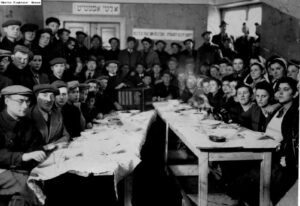
A dining room for survivors in Bendin
The First Rosh Hashana after the War - Reuven Campagnono (Italy)
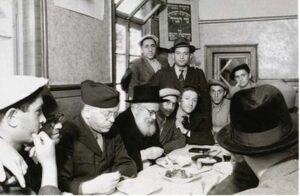
Rabbi Herzog visiting the Zeilsheim DP camp
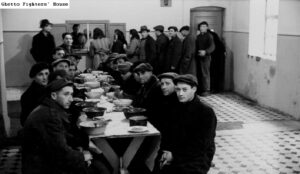
The kosher dining hall for the Czestochowa community
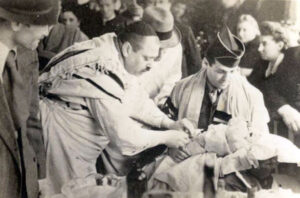
The circumcision of Yosef Lichtenstein, the first baby born in the Heidenheim DP camp, Germany
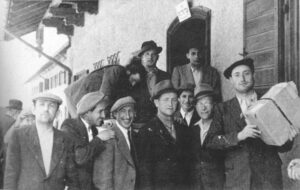
Survivors in the Feldafing DP camp hold packages of food and judaica that they received from American Army Lieutenant Meyer Birnbaum
Asher Amsterdam – With the Klausenberger Rebbe at Liberation (Jawisznow, Poland)
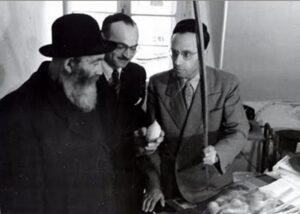
Examining an etrog (citron) before the holiday of Sukkot in a DP camp in Germany
Yechezkel Shikman - Chassidic Clothing Postwar (Sosnowiec, Poland)
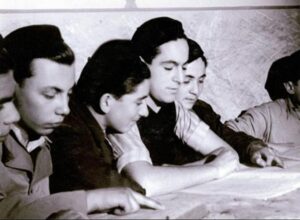
Yeshiva boys Holocaust survivors learning Gemara in the Foehrenwald DP camp
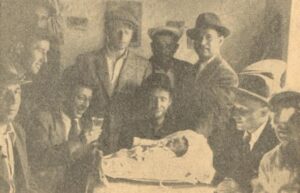
A circumcision in the Foehrenwald DP camp
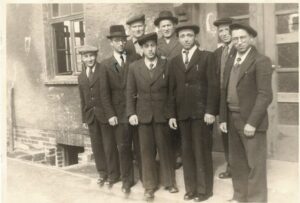
Young surviving men in the Eschwege DP camp, Germany
Esther Dawidowicz - The Return to Jewish Life (Hajdunanas, Hungary)
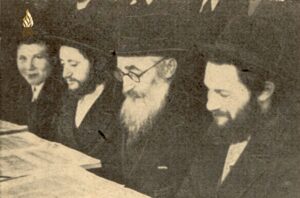
Holocaust survivors learning Torah in a DP camp
Dov Silber - The First Prayer after Liberation (Piotrkow, Poland)
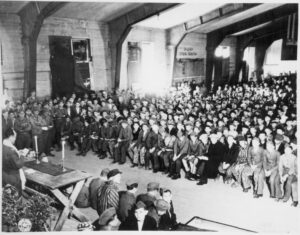
Shavuot holiday prayers, the first prayers after liberation, Buchenwald camp
Shlomo Wakstok - Bar Mitzvah Celebration with the End of the War (Kalisz, Poland)
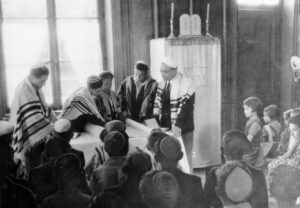
Reading the Torah in the synagogue in a DP camp
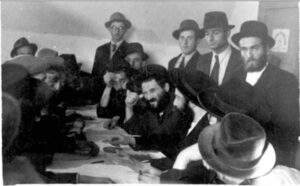
Rabbi Yekutiel Yehuda Halbserstam. the Sanz-Klausenberger Rebbe, gives a speech at a gathering in a DP camp
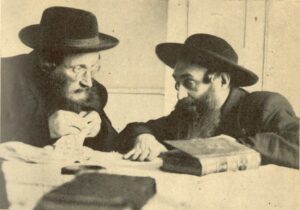
Rabbis in a DP camp
Shabbat Chazon (the Shabbat before the Tisha B'Av Fast Day) in Bergen-Belsen
Shabbat Chazon (the Shabbat before the Tisha B'Av Fast Day) in Bergen-Belsen
"On Shabbat Chazon, the most serious Shabbat of the year, a day of soul-searching, which was a heavy summer day, the charedi (ultra-Orthodox) survivors gathered in barrack number three. Few in number, there in the corner stood the survivors, what remained of yeshivas, shtieblach (small synagogues), rabbis, and mesivta (yeshiva for high school age students). Their steps were uncertain, their heads still bowed. For so many years they had been subjected to beatings, kicks, oppression and humiliation – without being able to respond. Here, the remnants of the spirit of Judaism of old gathered to contemplate and say Kaddish in memory of the most beautiful and exalted on earth, in memory of Polish Jewry. Not a Kaddish of ordinary words, but a Kaddish of actions, the kind that leads to reviving the Jewish splendour of yesteryear. A Kaddish in the world, that will say that charedi Judaism is alive, that there are brave young people who feel the power to restore its former glory, a Kaddish of a life far from the filth and decay that foreignness in general and haters in particular have instilled in the Jewish camp. They experienced all the trials in the world; until now they were isolated, stood in a corner, no one understood them. Now they are gathering from all the camps, and the news is starting to flow: 'A yeshiva has been created under the direction of C. L. Lubinsky,' 'A kosher kitchen is being established,' etc. Applause is heard. In any case, Jews are happy! A Jewish heart beats within them! The historical process, which unfolds as a cycle for the Jewish People, declines and rises. Young men are preparing for a new life. And the women? We also join in: the voice of the Bais Yaakov teacher is heard! We live and want to live a pure Jewish life, in the meantime we are counting on a little, but with the spiritual strength of young charedi women, who express Jewish unity and call here in this camp to work with a common goal, to elevate the morality and standards of Jewish youth in general!"
(Shabbat Chazon in Bergen-Belsen)
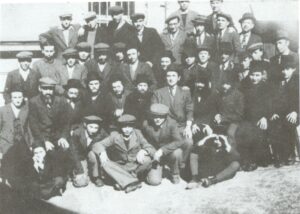
Students of the Beit Meir yeshiva in the Bad Gastein DP camp, Austria. Sitting in the centre of the photograph is Rabbi Aharonson.
Yosef Zalman Kleinman – Jewish Life in the DP Camp in Italy (Silica, Czechoslovakia)
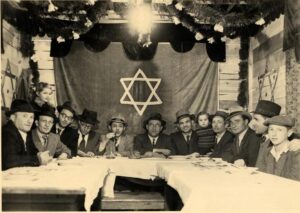
Survivors on Sukkot in Hamburg
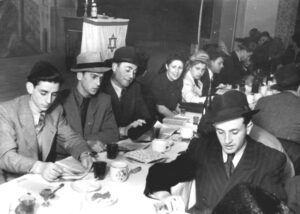
A Passover play in the Feldafing DP camp, Germany
Abba Halperin – In the DP Camp with the Klausenberger Rebbe
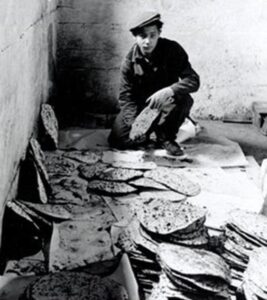
A Jewish boys helps bake matzah in a DP camp in Austria
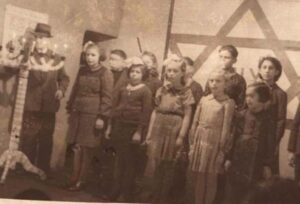
Surviving Jewish children participating in a Chanuka candle lighting ceremony in the Gluszyna DP camp, Poland
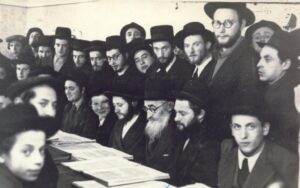
Learning Torah in a DP camp
The Klausenberger Rebbe in Feldafing
The Klausenberger Rebbe in Feldafing
Synagogue, praying in a minyan, reciting Kaddish – all these concepts that disappeared in the depths of the Holocaust were revived in the DP camps and reconnected with the familiar spiritual experience. The Jewish calendar with its Shabbats and holidays also gradually, and not easily, returned to being the clock of life. In the Feldafing camp, the Klausenberger Rebbe managed to form a group of people on the first Shabbat after liberation and lead the Shabbat prayers with them as they were supposed to be held:
"When only three days had passed since the liberation, the Rebbe, may his merits protect us, began to prepare for the Shabbat Queen. On Friday, the 21st of Iyar, he called several young men from among the survivors and asked them to help him organize a suitable place of prayer and a beit midrash (study hall) for the Jews of the camp. After a thorough search, they found a large, spacious hall, which stood completely empty, and which had previously been used for musical performances by the Hitler Youth. The place seemed to him to be suitable for a beit midrash. He therefore sent the young men to announce and spread the news among the Jews in all corners of the camp that the first synagogue after the liberation would be opened, and that evening public 'Kabbalat Shabbat' prayers would be held there. The news, of course, caused great excitement. Under his personal guidance, the young men cleaned the hall and prepared it for prayers, brought in a few benches and tables from wherever they could, and prepared 'kippahs' made of paper to cover their heads. The Rebbe gave advice on where to obtain a 'tallis' (prayershawl) for prayer. They brought him a sheet from the camp storerooms and designated it as a tallis. From a ball of wool, which happened to be in front of him by Divine Providence, he spun with his own hands the threads for the tzitzit (ritual fringes). The weaving work was very difficult, taking hours, until, due to lack of time, he did not even have time to tie the bindings on the tassels properly, and was content with only the first knots. Today was a good day; it was the first Shabbat of the redeemed. As the day began to be consecrated, hundreds of Jews gathered in the music hall, broken, everyone who wanted to remember that they were Jews. The Rebbe wrapped himself in his 'tallis' and descended in front of the ark, and began to pray the Shabbat evening Mincha prayer in a heartbreaking voice: "Give thanks to G-d, for He is good, for His kindness endures forever…" The audience stood without prayerbooks and cried. No one was able to make up for this. The Rebbe was very weak and his voice was trembling, but from moment to moment his voice grew louder and rolled like thunder, spreading and filling the air space throughout the hall, until the heavens burst: 'Let the redeemed of G-d say, Who redeemed them from the hand of trouble…', and he would lengthen and intensify his prayer with tears and great tenacity: 'Those who dwell in darkness and shadows, prisoners of poverty and iron… and they will reach the gates of death…': and in the turmoil of his spirit, he cried out bitterly, 'And in the storm of their soul, they screamed bitterly 'Their soul melted in its misery… and they will cry out to G-d in their trouble…', and the entire congregation joined him in great weeping, and the thresholds shook, fountains of tears burst forth, and so on throughout the entire duration of the prayer, which lasted more than an hour and a half without a break…"
(Lapid HaEsh, pg. 256)
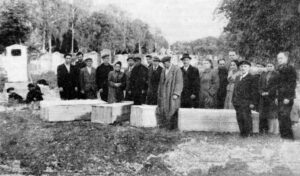
Surviving Jews burying bodies following liberation
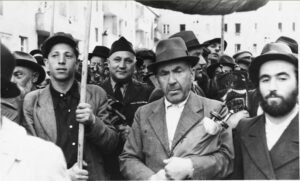
Surviving Jews marching under a canopy at a Torah inauguration ceremony in a DP camp
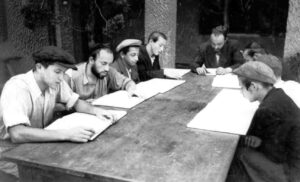
Surviving Jews participate in a class given by Rabbi Shlomo Tzvi HaKohen Strasser in the Santa Cesarea DP camp, Italy. Amongst the students is Mendel Levy.
Devorah Berger – The First Rosh Hashana Postwar (Lodz, Poland)
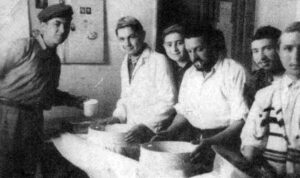
Young survivors in the Santa Cesarea DP camp in Italy baking matzah, guided by Rabbi Leibel Kutner
Edith Weiss - The Klausenberger Rebbe in the Fohrenwald DP Camp (Szollos, Hungary)
Avraham Yaakov Frisch – Putting on Tefillin for the First Time in Budapest (Hajdunanas, Hungary)
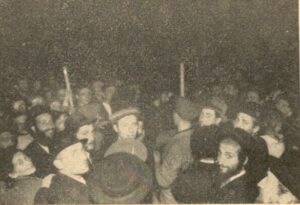
Survivors dancing hakafot shniyot (dancing with the Torah on the second day of Simchat Torah) in the Foehrenwald DP camp
Moshe Weiss - Burying the Dead with the Klausenberger Rebbe (Hungary)
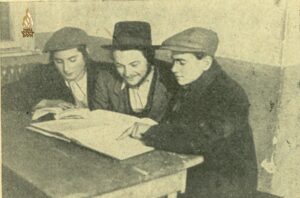
Holocaust survivors learning Torah in a DP camp
Nachman Bistritz - In the DP Camp with the Klausenberger Rebbe (Krasna, Romania)
Mordechai Edell - The Kol Nidrei Prayer with the Imrei Chaim Rebbe of Vizhnitz
Yechiel Glickstein – Saving a Torah after the War (Zarnowiec, Poland)
Shmuel Braude - Saving Holy Books from the Gentiles (Ruzhin, Poland)
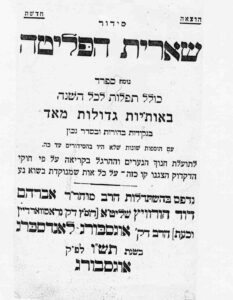
The opening page of the "Siddur Shearit HaPleita" (Survivors' Prayerbook) that was printed in the DP camp in Landsberg, Germany
Menachem Mendel Brickman - Passover in Italy with Rabbi Leibel Kutner's Group (Pabianice, Poland)
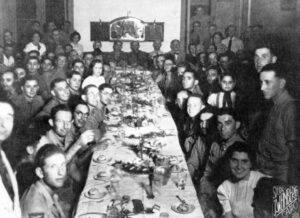
A Shabbat meal in a DP camp
Chag HaMatzot (Passover) 5706/1946
Chag HaMatzot (Passover) 5706/1946
For several months, since mid-winter, the Klausenburger Rebbe had been busy preparing for the upcoming Chag HaMatzot.
The Rebbe had purchased a quantity of wheat with the intention of baking matzah from it.
For the purpose of baking, they built a special oven and for several months they were busy baking matzah so that there would be a sufficient quantity for all the people in the camp. Not only that, but people from other camps also had the opportunity to eat kosher and luxurious matzah thanks to these matzahs that were baked with dedication in the Foehrenwald camp, due to the Rebbe's efforts.
In the forest near Foehrenwald there was a river of fresh water whose waters were clear and good, fit for drinking. We would go to this river for ritual immersion during the first days of our stay in Foehrenwald, until the construction of the mikvah (ritual bath) was completed within the camp.
Now, for the purpose of baking matzah, we would go out to the river every day at dusk, to draw from its pure waters for “mayim shelanu” (water that has been left overnight for the use of baking matzah).
The Passover holiday itself arrived.
The feeling of coming out of darkness into light and of slavery to redemption was vivid and tangible for us.
It was not difficult for us to uphold the saying of our sages of blessed memory: "Every man must see himself as if he had come out of Egypt," even though we were liberated from the world of the Germans, but we were still very far from reaching rest and the inheritance. We were all afflicted with troubles and torments, mourning and bereavement. We were all Jews who left our loved ones behind in the camps of Auschwitz, Birkenau, Dachau, and the other chambers of hell of the Nazi angel of death.
On the first night of Passover, a Passover seder was held, which the Klausenburger Rebbe conducted before a large audience.
Three hundred young men and yeshiva students sat together at this seder. The women and girls also sat at the foot of the hall and participated in this seder.
At the head of the table sat the Rebbe, the merciful father, described as an angel of G-d, explaining the Hagada and the symbolic foods one by one in his language, Yiddish.
Yosef David Farkas - Bar Mitzvah Postwar (Arad, Romania)
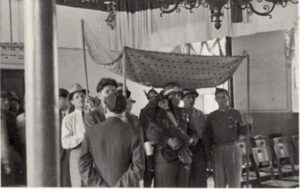
A Torah inauguration ceremony in the synagogue of the Crombach DP camp in Germany
Hella Kluger - Returning to the Jewish Nation (Poland)