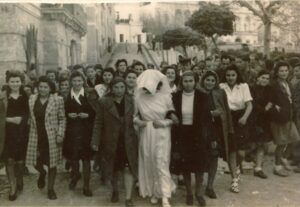
My Sister Rivka
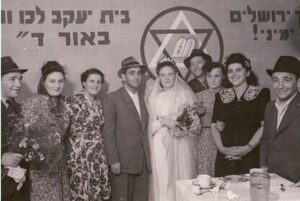
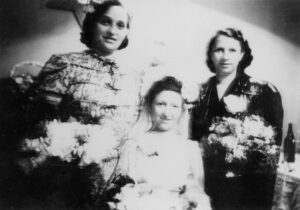
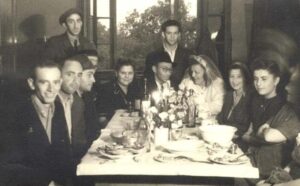
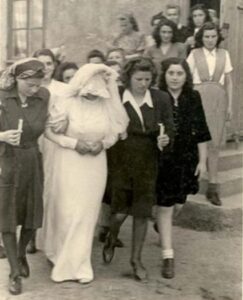
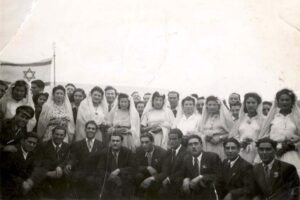
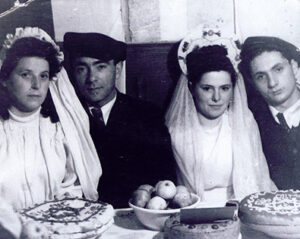
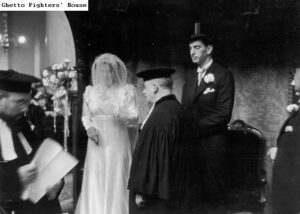
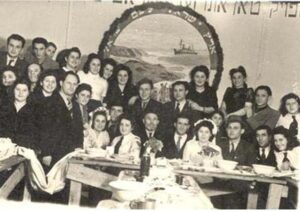
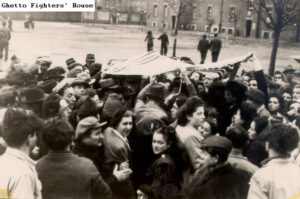
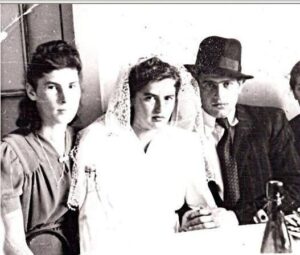
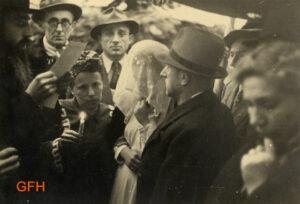
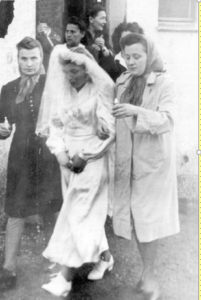
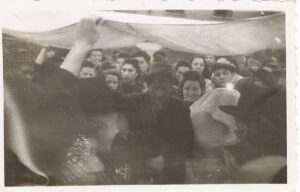
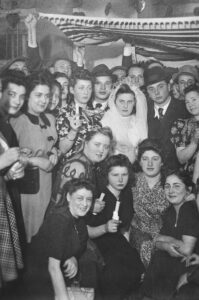
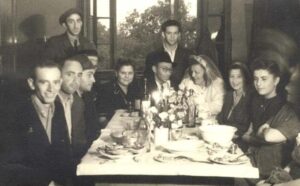
My sister Rivka got engaged. It's wonderful to think that our little family is going to expand. A wedding is a great experience for us. In all the years of the war, we didn't see a wedding. Although here in Zeilsheim, there have already been four weddings. Jewish weddings according to Jewish law. But the joy could not be complete…
"Now," I said to my sister Rivka, "I understand the common saying: 'A happy heart brings joy.' It's not obvious, is it?"
"No," my sister looked at me, "not at all obvious"…
We made preparations for my sister's wedding with great enthusiasm. Everyone took part in the preparations, some in baking, some in cooking, and some in sewing. Personally, it was important to me that the wedding would also be beautiful, similar to the old days.
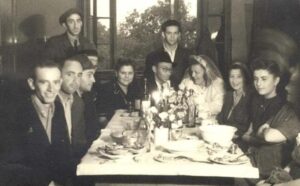
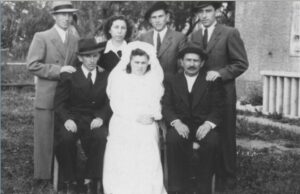
The wedding was special. The bride had a family. She had three sisters, a brother, and even an uncle. The groom, who was the only one left of his seven siblings, also found two cousins.
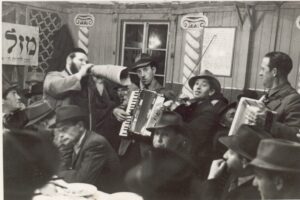
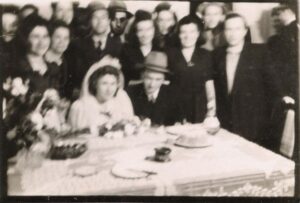
And so the wedding took place, which at first was accompanied by tears, but then there was dancing until midnight.
"Lord of the Universe," I prayed over and over again, "please bless the couple in their life together, that they may succeed in establishing a faithful home in Israel."
I couldn't help but make a painful reckoning: before the terrible destruction, the number of uncles and aunts on my parents' side, together with the older cousins, reached about a hundred people… Where are they today?… "Better stop thinking about that!" I scolded myself and went out dancing again.
Thus, out of the upheaval, the new houses arose. Each married couple served as companions to the new couples "in place" of the absent parents.
(BeHaftzia HaShachar - Ruth Zeidman)
Yaakov Potash's Wedding Story
"I will tell you the story from the beginning," said my grandfather, the son of Zaidy (Grandpa) Yaakov.
And he began to tell the story from the beginning. "My father, of blessed memory," Saba (Grandpa) Potash began to tell, "was born in a town called Radzymin, which is twenty kilometers from Warsaw. Besides my father and his nine brothers and sisters, four other orphans who had no home grew up in the house, and this house was their home."
"His father and mother wanted with all their hearts for him to grow up to be a Torah scholar, and he himself wanted it and loved the Torah. At the age of eleven and a half he traveled to the city of Baranavichy, the city of the genius Rabbi Elchanan Wasserman z"l, may G-d avenge his blood. There he studied in a yeshiva, and after a certain period of time the boy – almost a young man – continued on to the city of Stolin, where he studied in a large and important yeshiva led by Rabbi Moshe of Stolin, together with young men and Torah scholars who came to study Torah there from all over the region. In 1939, a terrible war suddenly broke out, World War II. A war in which six million Jews were killed in sanctification of the Name of G-d."
"The boy Yaakov was already thirteen years old, right after his bar mitzvah, and together with a large group of students heeded his rabbi's instruction and fled. The group of students – including Saba Yaakov – fled to the city of Vilna. There, many yeshiva students who had fled the war that had broken out in their city gathered. In the city was the righteous Rabbi Aharon Kotler z"l, who studied with the many students in the yeshiva that had quickly been established, and the sound of Torah filled it from wall to wall."
"One day, the days of peace also ended in this new yeshiva. German soldiers and evil men came and broke into Vilna. With sad faces, the young men closed their Gemaras and holy books, kissed each other quickly and quietly made plans for escape. Who knows when they will meet the Gemara again… The farewell was difficult, but there was no time to cry."
"Saba Yaakov's tears remained inside and on a dark night – even the moon was ashamed to show itself in this confused and sad world – Yaakov and other young men crossed the border into Russia. It was a long and difficult journey, along the way they whispered to each other, that they must keep a safe distance from each other, so that they would not be noticed, but that the distance would not be too great so that they would not lose each other."
"They arranged to meet together on the Russian side of the border, in a place that seemed safer to them. The young man crossed the border, and here he finds himself – alone.
Alone in an unfamiliar place. He has no idea where he is and where all his friends have disappeared. Alone. Yaakov’s feet continued walking without knowing where to go. The young man was afraid. He was shaking. He had no one to talk to nor anyone to tell how much he was shaking. Only God was with him, and he knew that He was watching over him. Suddenly, out of nowhere, an old man appeared in front of him, with a long white beard.
The grandfather – Yaakov – asked him: Do you have any idea where I am? The old man did not understand his language. He took out a sheet of paper and paint, drew a road map, gave him the sheet, nodded and disappeared."
"Yaakov was left alone. Only sky and earth and mountains and night wind and morning sun. He survived on the last drops of water that remained with him and hunger tormented him. He passed through forests and ate of the fruits that grew there. He walked for a day, and another day; at night he fell asleep on stepping stones, hiding among the trees, and when the sun rose again, he continued walking. According to the map the old man had given him, he walked until he reached the village. 'This must be the end of the world.' He thought."
"Yaakov's hair had grown in the meantime, and with his casket hat on his head, no one saw him as a Jewish young man. He decided to hide his identity and live in this village until the war was over. It was a 'kolkhoz' (collective farm). All the members of the village had to work very hard growing crops and other hard work for the government, and in return they received bread to eat, water and tea to drink, and once a week - coupons to buy meat. Of course, Yaakov abstained from the meat he had eaten, and he did not want to eat the rest of the food either. He subsisted only on fruits and vegetables and saved the coupons for himself in the hope of using them in the future."
"For many days he remained dressed in the same clothes that had been torn in the meantime, counting the days and not getting confused. He remembered when Shabbat came and did everything to keep it. He made Kiddush on slices of bread that he had collected during the week and remembered his loving mother, crying in front of the Shabbat candles, praying for him, her Yankeleh."
"The young man Yaakov quickly got involved in the work on the collective farm. He received a tractor from the villagers to work with in the field; during the days he worked hard and stayed away from the company of the gentiles. He did not talk to them, he only sang. Songs of longing for home, songs of Torah, and memorized chapters of Mishnah by heart."
"At night he did not want to sleep next to the gentiles. He went far into the fields outside.
And in the open field there were predatory animals. Wolves, foxes. He slept among the trees with matches and kerosene. When he heard the rustle of an approaching animal, he immediately lit the fire and the animals fled in fear."
"Yaakov continued to mark on a sheet of paper each day that passed. In this way he knew about Shabbat, about holidays, remembered them and did not desecrate them. It was difficult for him to be alone, a lonely Jew among clumsy and evil gentiles. Only the memories of the good old home that he might yet have the privilege of returning to filled him with strength."
"Like an evil spirit, the rumors reached the remote village. Rumors of severe troubles that were befalling Jews in all the cities of Europe. Worry filled the heart of the boy Yaakov, a worry that hung inside his heart like a heavy sack, and no one knew."
"And night after night, alone on the tractor, when the longing in Yaakov's heart for his good home, for his father and mother who remained somewhere, for the stand in the yeshiva and for the sweet words of the Gemara, he would take a harmonica out of his pocket. He would light a small fire and sing. The songs seemed to cry out from his loneliness, saying what he could not say because he had no one to say it to. The people of the village came like butterflies to the flower. They sat in a semicircle around Yaakov, and with open eyes they listened to his magical singing."
"Un zingen flegt er, lider geshmak in di necht / ess haben di lider geklungen un veit zich gehert / es flegen fil shatnes shtil kumen tzu gein, shtein un nisht kenen forshtein"
(And he used to sing, songs sweet in the nights/ the songs sounded and could be heard far away/ many shadows used to come quietly to walk, stand and not be able to understand)
"All the children of the village called him 'strange man.' Although none of them knew where he came from, the songs filled them with nostalgia, and he sang them in some strange and unfamiliar language. Yaakov's mouth was sealed, and because of the long days in which he lived only on a few fruits and vegetables, he was very thin, and his hair grew wild. He was silent for a long time and only his heart wept in disgust."
"This evening was like all evenings. Yaakov prepared for the night, he wanted to move away into the field. Suddenly, some of the villagers stopped him. 'The head of the kolhkoz wants to talk to you,' they told him."
"It was the village ruler, like a bad-hearted poritz (landowner). Everyone was afraid of him. Confused, Yaakov followed them. He had no idea what he wanted from him. The head of the kolkhoz asked him to sit down and then threw the bomb into the room. 'I like you, young man.' He said. 'I have a successful daughter and I want you to be her groom.' The young man was frightened. He lowered his eyes and did not know what to say. 'You will get all my sheep and a whole chicken coop!' Thus promised the 'head,' and went on to promise many more gifts of great value."
"And before Saba Yaakov could even speak, the head of the collective farm said: 'Everything is closed, right? Tomorrow we will have a big engagement party.' Like a howling winter wind, the rumor spread among all the villagers. 'Tomorrow, a party,' they said to each other, not silently. Everyone waited excitedly. Birds circled around his head in a circle as long as Yaakov's hair. 'Son-in-law for the head of the collective farm,' they sang excitedly. You will no longer be the strange, anonymous man of the village. You will no longer sleep in the fields, at the mercy of the bad animals. You will have a beautiful house. The most beautiful in the village. You will be like the king's son-in-law."
"You will have money. And lots of it. You will be able to buy kosher meat. And bread, and decent clothes to wear. How long has it been since you had a hot, decent meal? Saba Yaakov's stomach turned inside him. His emotions spun like a carousel.
He can live a good life. He can be the next ruler of this village. He will be a good ruler, doing only good with his great wealth. And his good father and mother from faraway Radzymin? And the pages of the Gemara that were left somewhere? What would they say about the offer? But they remained there. Beyond the mountains of darkness. Who knows if he will ever see them again."
"Tomorrow had already arrived. The sun, which had sent him encouraging rays in the morning, began to slip between the mountains. Darkness began to envelop Yaakov, who was sitting alone on a tractor in the field. Cheerful melodies could be heard in the distance.
His stomach turned inside him. Maybe he would approach the place of celebration, just take the money that the head of the collective farm had promised him, and then sneak out and run away? Maybe he would just drink a little and eat? And he was so hungry and thirsty."
"In a few minutes, the collective farm chief's emissaries will arrive to take him by force to the party, where he, the wandering and lonely Jew, the one who learned Torah from the elders of the generation, whose Gemara and its letters filled him with holiness, will be the groom to the bride… a gentile."
"Suddenly, Yaakov left the tractor and began to run, run, and run to the place where he had left his belongings. He picked up his backpack, the smell of the yayin nesach (wine poured in the service of idolatry) spread through the air, and he began to flee in the opposite direction from the place of celebration."
"When he opened the backpack, he noticed the dozens of meat coupons he had collected, and he knew what he would do. Yaakov spent the whole night deep among the trees of the forest. Trembling with fear of the gentiles who were looking for him and perhaps they would find him and capture him. In the distance he heard the sounds of the orchestra and up close the breathing of the evil animals that filled the forest. 'And maybe I am the last Jew left in the whole world?' The thought suddenly occurred to him and he shuddered."
"Er zehet zein Mameh bentschet licht / un zogt a techina mit / hit mein Yankeleh beshefer, er zol bleiben dort a yid"
(He sees his mother blessing the light/ and says a plea with/ save my baby, Creator, let him stay there as a Jew)
"Suddenly, images flashed before his eyes. Images from the good old house in Radzymin. A warm home and a devoted mother preparing the kishka for the Shabbat chulent. When had he been in this house? He remembers himself as a little boy standing in front of his mother as she tended to the sick on Shabbat, her hands swollen from labor. A mother who worked as a miller all week. He looked at his hands and asked: 'Mother, why are you working so hard?' And mother answered him: 'Whoever wants 'erlicheh kinder' (virtuous children) must work hard!' When did he talk to mother like that? A hundred years ago? Maybe two hundred?
Will he ever see her again, and father, and his nine brothers and sisters?"
"The forest trees that the night had painted black, blurred with tears as he remembered how he stood before his mother and listened to her prayer in front of the Shabbat candles. He heard how she asked the Master of the World to protect her children, that they would grow up to be good Jews, scholars of Torah. How tears wet her swollen hands. His mother's kind, wet eyes that looked at him from such a distant past suddenly gave him strength. He wants to answer them, his mother's crying eyes. To promise her: 'Mother, your Yankeleh will remain a Jew!' He will run away from here. He will remain as Jewish as possible."
"Yaakov yoibt zich oif, un ruft zich hoich an: ich bin a Yid, un ich ken ess nisht tahen. Mein Torah erlibt mir nisht nemen a froi / Vos geloibt nisht un tracht nisht vi ich azoi"
(Yaakov gets up and calls out loudly: I am a Jew, and I can't do it. My Torah does not allow me to take a wife / Who does not believe and does not think like me.)
"The long and scary night was finally over. The sun rose from the edge of the forest and shone on the sleepy village, all of whose people were still tired from yesterday's festivities."
"The drone of a helicopter was heard."
"It was a tiny helicopter that landed in one of the fields, bringing food to the villagers. Once a month it regularly arrived from the outside world to the isolated village. Yaakov knew yesterday that the helicopter would arrive today. He approached him, and in front of the pilot's surprised face he presented the dozens of food stamps. 'This is all yours, if you agree to get me out of here,' he said to the pilot, who had never seen so many stamps, and who was also hungry during these days of war and scarcity. He immediately agreed to Yaakov's request, who boarded the helicopter, hid among the food boxes, and disappeared from Uzbekistan."
"The tractor remained there alone in the fields, missing the young man's singing."
"Yaakov arrived in Samarkand, in Bukhara. There, in the synagogue, he met a warm Jew named Rabbi Yom Tov Erlich, a Stoliner Hasid. Rabbi Yom Tov took pity on the lonely young man, took him into his home and took care of all his needs."
An Emotional Wedding
"After a while they both moved to Paris, France. There was an emotional wedding between Saba Yaakov, and Savta (Grandma) Yentel, a survivor of the Auschwitz camp. It was a happy and sad wedding at the same time. The bride was lonely and the groom was lonely. The souls of the parents, brothers, sisters, and grandparents looked down on them and gave their blessing. They were not with them to lead them to the chupa (wedding canopy)."
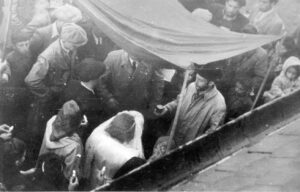
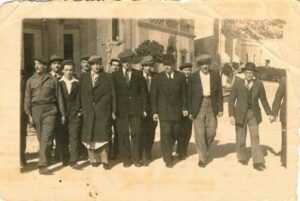
"Around the chupa stood the groom's friends, each bereft of his family. Sadness hung in the eyes of the bride's friends who stood by the women. The memory of all the Jews who were killed in sanctification of the Name of G-d hung in the air. After the bride and groom left the yichud room (room just for the bride and groom to eat and spend time alone) and the singing of 'Od Yishama' stopped, the hall suddenly fell silent."
"Rabbi Yom Tov Erlich took out his took out his violin and began to play the song of the happy groom. A song that he composed and composed especially for the wedding. A song that told the difficult journey that Saba Yaakov went through until he established his home. After Rabbi Yom Tov finished the song, not a single eye remained dry."
"This is the song of our grandfather, who, if it were not for his dedication, and if G-d had not brought him out of his own private Egypt, somewhere in a village near Uzbekistan, we would not all be here today. We would not be sitting around the Seder table, thanking and praising G-d for the redemption from Egypt, and praying for the complete redemption, may it come soon."
The Wedding before the Journey to the Land of Israel
In Lodz, we all joined Agudath Israel's kibbutz with the hope of rehabilitating our lives postwar.
About a week after our return to Lodz, I gathered courage and proposed marriage to Kayla. Although we had only known each other for a short time, I felt that this was enough time to know that she was indeed the woman I wanted to marry. That very day, we celebrated our engagement with friends and family, and the joy was great. I finally felt how I was managing to rebuild my life after the great loss, and how the Jewish People as a whole were rising from the dust and awakening to a renewed resurrection. Despite the great joy, I felt that this was not our place and that we should move on. "I think it is time to immigrate to the Land of Israel." I told Kayla my fiancée the day after the engagement.
"If you want us to start preparing to immigrate to Israel, then we need to get married first," Kayla stated.
"Absolutely," I replied happily, "we'll get married before we leave."
That same week, preparations began for one of the first post-war weddings in the city of Lodz. The kibbutz prepared food, looked for nice clothes for the bride and groom, and even renovated the ruined mikvah in honour of the occasion.
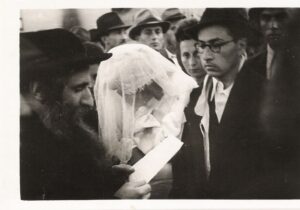
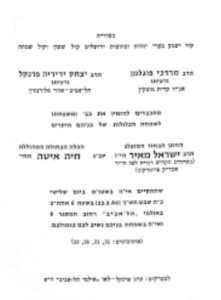
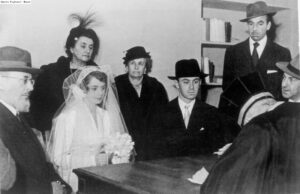
The wedding was held on the 25th of Shvat, 5706. There was great joy among the Jewish community in Lodz, but a great lacking was also felt in every corner - a lack of parents, siblings, and community members who had not returned from the war.
The wedding officiant comforted us and reminded everyone of the thought in the Zohar about the participation of deceased relatives in their children's weddings.
Translation:
When it is written: "Israel will rejoice in His works," the meaning is the same joy that Israel has, not his own but 'in His works.' If so, it should have been written 'in His works,' and why is it written 'in His work'? Rather, G-d, the Divine Presence, and his father and mother arrive, even though they died, G-d uproots them from the Garden of Eden and brings them to that joy to share in the joy of their descendants together with the Holy OneG-d and His Divine Presence.
Thanks to these words of the Zohar, we felt that all of our family members are here with us today on this great day, some in body and some in spirit, some visible to the eyes and some felt in our great faith.
(HaChassid HaAcharon - Rabbi Yisrael Yitzchak Kihen z"l)
A Wedding Certificate, A Hat, and A Suit
It was not long before we merited to hear "Chamisha Kolot" (a wedding song) in the camp...
There were Jews among us who were naturally involved in "shadchanut" (matchmaking) and were successful, and thanks to them many weddings were celebrated in the camp. They came to talk to the camp residents and did not move from them until they obtained their consent and willingness to establish a Jewish home.
Every time we were lucky enough to participate in "breaking a plate" (done upon the engagement), the joy overflowed. All the people in the camp, from young to old, felt like "real in-laws," real family members.
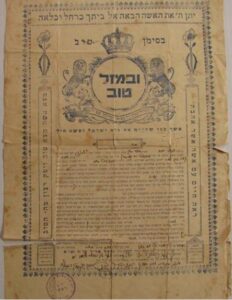
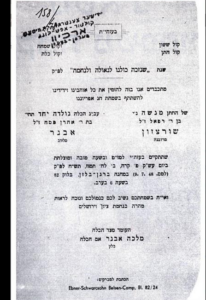
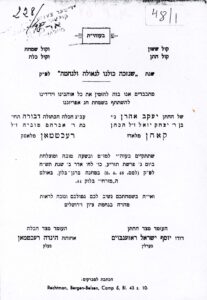
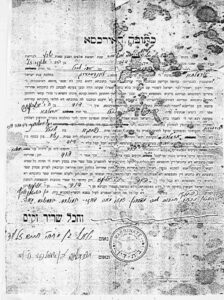
There were a number of weddings held on Cypriot soil, and there were those who wrote the "Shtar HaTanaim" (engagement contract) in the camp and the wedding was celebrated afterwards in the Land of Israel.
To almost all the grooms whose wedding was celebrated in the camp, I was privileged to lend my suit and hats that I brought from Italy, and now these clothes were privileged to serve as grooms' attire.
There was also such a story in the camp:
Before Passover 5707 (1947), a family from Camp 64 approached me and asked me to try to ensure that their son-in-law, who was in the "summer camps" (tent camps), could come to our camp, so that he could get married.
I approached the English headquarters with a request that they allow the groom to come to the camp where his bride was, but I was refused. As a member of the current camp, I could not try to do so for a resident of a different camp. The English arrangement did not allow this.
I was deeply disappointed, the fact that the wedding would not take place due to the restrictions of ridiculous and strict laws disturbed my rest and did not let me relax for a moment. I therefore hurried to travel to the "summer camps" with the validity of my certificate that allowed me to move from camp to camp, where I intended to meet the groom and see what could be done.
I met with the intended groom, and there he was none other than my friend from my days in Bari, the chassid Rabbi Leibel Yud. He arrived in Cyprus with the group of Rabbi Leibel Kutner z"l's, who had already immigrated to Israel in the meantime, after staying in Cyprus for nearly a year. The groom lived in the same tent with my friend Rabbi Leibel Zilberberg, z"l, also from Italy.
I didn't hesitate for a moment, I gave him the certificate I had. Since the certificate didn't have a photo attached, Rabbi Leibel identified himself as "Mordechai Deutscher," and went with her to Camp 64. There the wedding was celebrated with great joy, and I too, from where I was staying at the summer camp, rejoiced in his joy.
(HaNerot Sheloh Nichbu, Mordechai HaKohen Deutscher, Tel Aviv)