An intergenerational meeting project led by the Ganzach Kiddush Hashem team in collaboration with JNF and Ezer MiZion.
Beit Yaakov “Ohel Chasia” School in Telz Stone held an intergenerational meeting of seventh grade students with elderly Holocaust survivors who come to the Ezer MiZion club. The event took place on Monday, the 30th of Sivan 5786 (15/6/26) in the school auditorium.
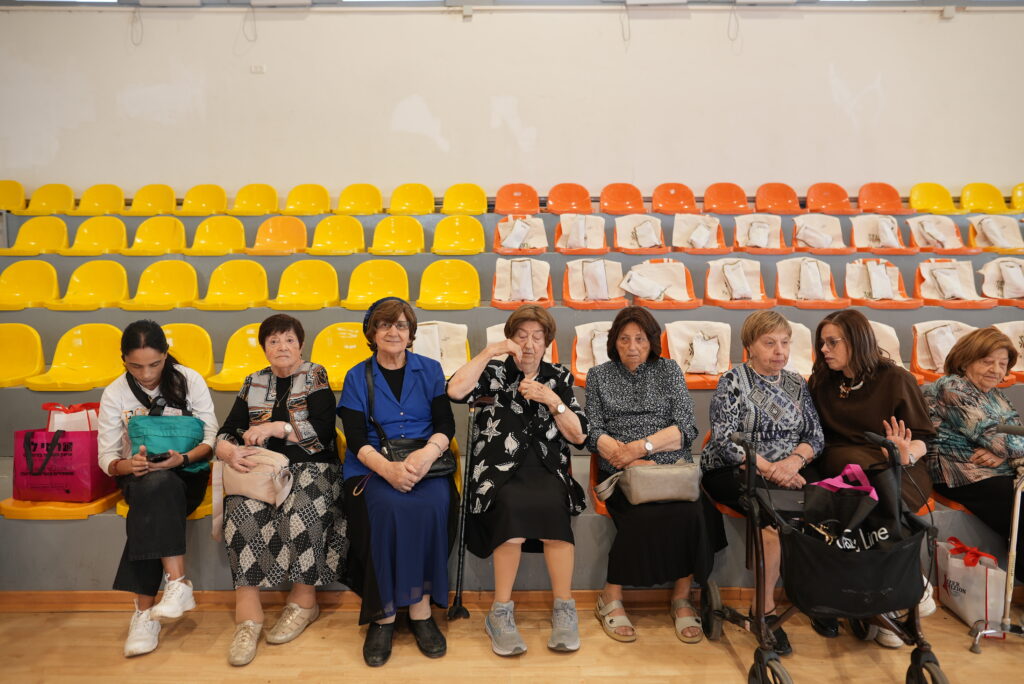
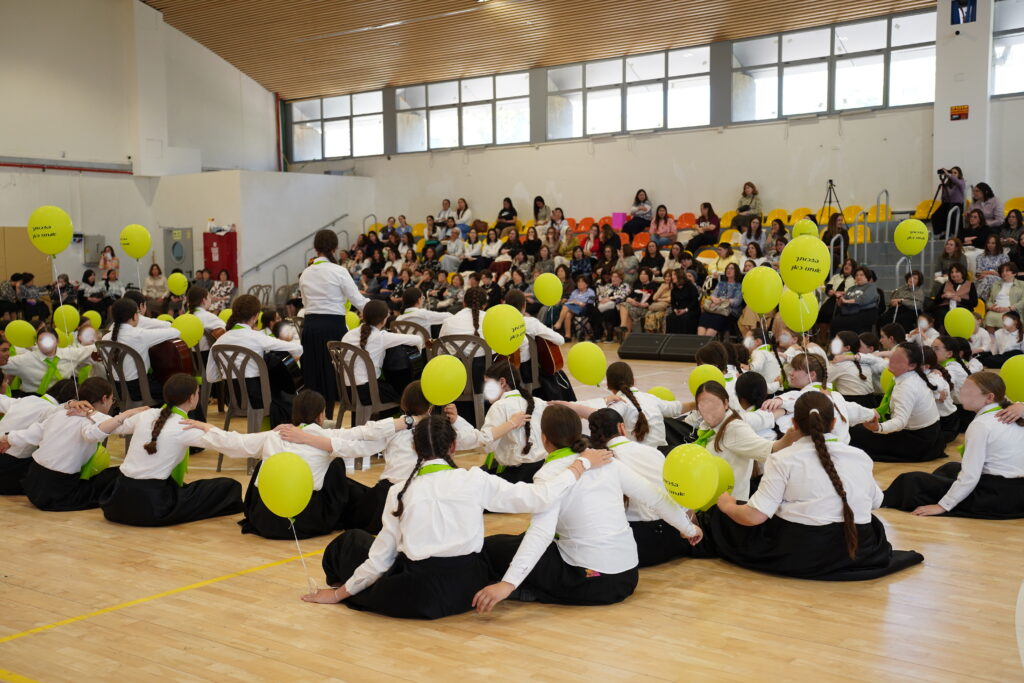
At the event, the girls put on an artistic performance and a special and enthusiastic welcome in honour of the elderly women. During the performance, the girls performed a series of songs, with movements, that dealt with the stages of a Jew’s life from a tender child to old age. They were joined by artist Ahuva Cohen, who sang songs appropriate to the theme of the meeting with the elderly women and the students, and by a violinist and guitarist who performed the song “Al Abba Lo Sho’alim She’alot.”
The elderly arrived in Telz Stone with the assistance of Ezer MiZion, with the school students welcoming them by singing “She’u She’arim,” in two parallel rows, dressed in blue and white and holding balloons that read: “Because of you we are here.” The elderly women passed between the rows, and all the way from the schoolyard to the auditorium, they did not stop thanking, rejoicing, and being very moved by this welcome.
The morning began with speeches by Mrs. Friedman, the school principal, and Mrs. Hoffman, the seventh grade teacher and project coordinator. On behalf of Ganzach Kiddush Hashem, Mrs. Ita Fried gave over words of blessing.
After the performance, three survivors told their life stories by prior arrangement:
Mrs. Necha Barzel told the story of her rescue from Russia and her aliyah to the Land of Israel. Two of her great-granddaughters also took the stage, one of whom is a seventh grade student.
Mrs. Penina Chefer, who is over 100 years old (may she live to 120!), greeted everyone and told about her time in Auschwitz.
At her request, Mrs. Gavra, a social worker at Ezer MiZion”and responsible for the project, read from the elderly woman’s book an anecdote of dedication to the siddur that she “bought” in Auschwitz in exchange for her portion of bread. Thanks to it, she and her sister were able to pray the Rosh Hashana prayers. It was moving to hear the end of the story from her mouth – when they arrived by ship in the Land of Israel, they asked the passengers to throw all their belongings into the sea because of the heavy load, and to her great pain, the siddur was also thrown into the sea. Then, when she built a home, her husband z”l bought her the most beautiful siddur in the store…
Mrs. Freund told her life story. She was three years old when the war broke out, and thanks to the kindness of her aunt Rivka, she and her sister were saved and established homes and generations of descendants. Mrs. Freund hosted her aunt in her home in her late years to repay her for the kindness she had shown them. She gave the girls insights into life, and at the end of her speech she noted that kindness always accompanies her family – her son is Rabbi Chaim Freund, responsible for Ezer MiZion.
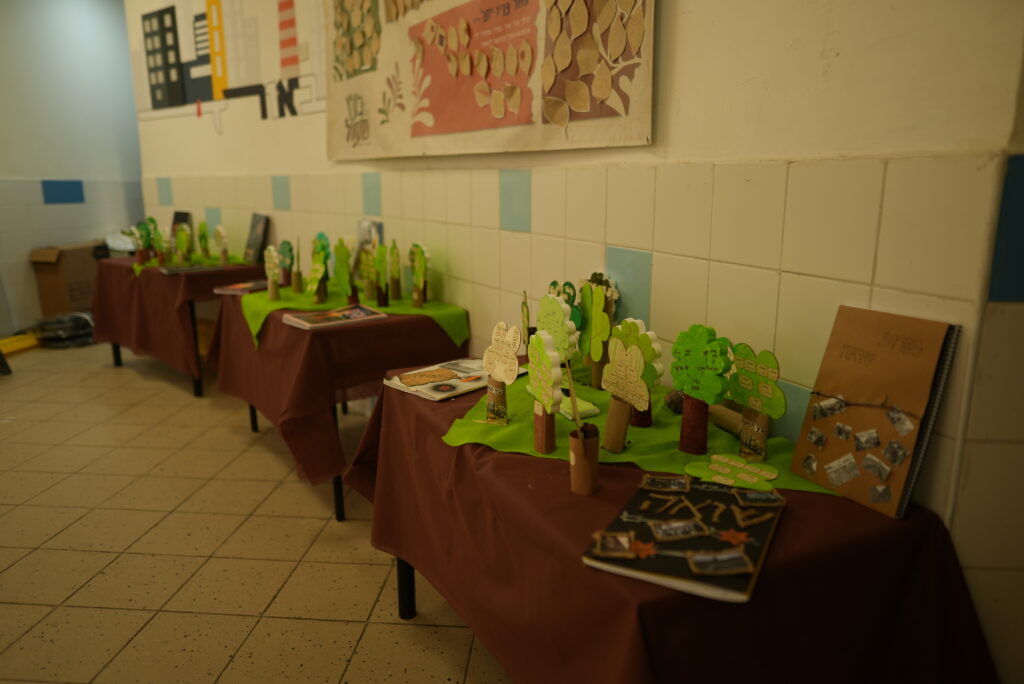
At the end of the event, the students accompanied the elderly women, talked with them and showed them the family trees they had prepared for the exhibition. Two of the elderly women stopped by one of the trees. On the cover was a picture of the yellow patch. One said to the other: “Come, come here. Do you remember? I was ten years old when I had to put this on me.” They stood with tears in their eyes, and the students stood there beside them, moved. This experience made them understand a tiny bit of what was going on in the war.
The mothers of the students, who experienced the entire year of activities with them, were also invited to the meeting – the highlight of the year.
In order to experience the meeting without barriers, the girls did not stand on a stage, but on the floor of the hall right in front of the seniors, and the highlight of the show was when several seniors got up on their own initiative and began to dance with the girls. Soon a large circle of students and seniors was formed, dancing and singing the song “Aleh Le’Ma’alah Aleh”. This majestic sight of seniors, whose faces show life stories full of heroism, strength and self-sacrifice, with young girls the age of their great-grandchildren – cannot be described in words!
The girls had an exciting experience and gained particularly powerful strength and insights. One meeting is worth a thousand lectures, tours, and books…
Mrs. Ora Levy from Ganzach Kiddush Hashem was a significant part of the event:
In addition to the assistance she provided with filming, photography, and documentation leading up to the meeting, she essentially accompanied the program throughout the year. Over the course of the year, the girls engaged in classes on Judaism and literature, the family tree, and the Holocaust. Mrs. Chana Rotenberg from the Ganzach Kiddush Hashem team gave a lecture leading up to the meeting, and Mrs. Ora Levy created the exhibition with the girls following research on their families and told them about the entire project and the meeting.
Throughout the year, she guided them on a variety of topics: the tree and man, building a family tree, the role of the JNF in cultivating forests, the importance of the encounter at a time when the number of survivors is dwindling, and of course, Ganzach Kiddush Hashem – its founders, goals, methods of operation, documentation and memory, and its motto – to know how the Jew lived, and not focus on how the gentile killed…
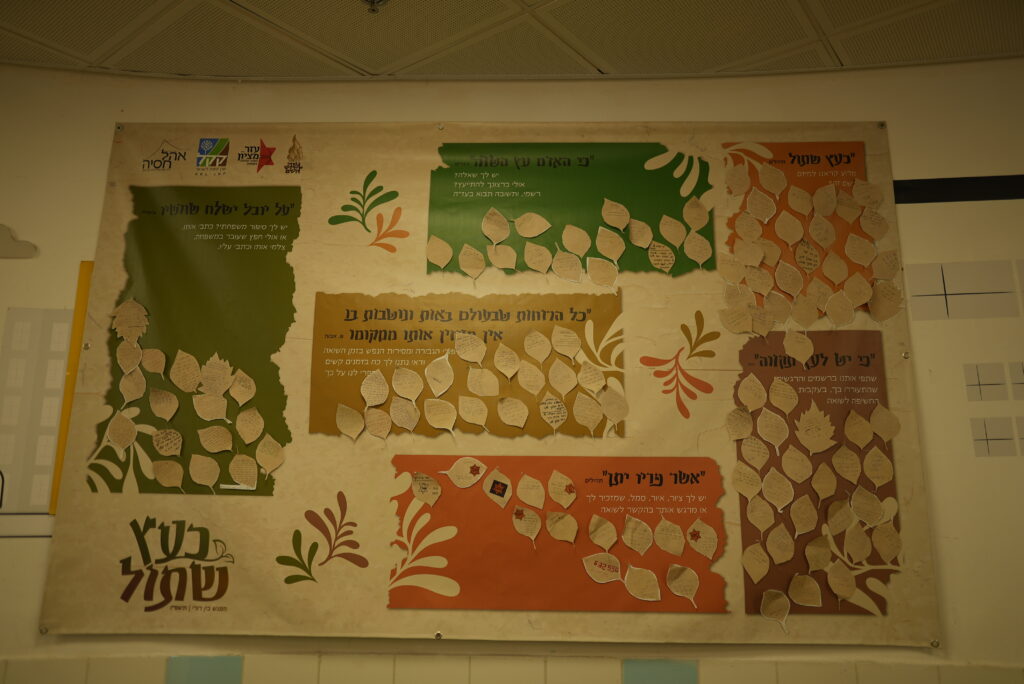
The girls watched documentaries from Ganzach Kiddush Hashem – “Lidingo” and “Shema in the Forest” and really connected, especially to the segment of the meeting between the Lidingo girls and their granddaughters. They received a family tree sheet, filled it out, and then created a 3D family tree. The exhibition was set up at the entrance to the school and included a wall panel on the topic of “Roots” and family trees of all the students, which looked like an entire forest…
The meeting left a taste for more – an aspiration to hold more and more such meetings and to have the privilege of cherishing a generation that is disappearing.