A Father’s Blessing
A story for the parsha (weekly Torah reading) by Yaakov Rosenfeld
On Shabbat eve, the week of Parshat (the weekly Torah reading) Toldot, when we read and learn about our forefather Yitzchak blessing his son Yaakov from his deathbed, I would like to tell you about a father’s blessing to his daughter, eighty-five years ago, in the closed Lodz Ghetto, stricken with bereavement and grief.
Leah Wroclawski is the girl’s name, and her testimony is written with all her heart in a small book she wrote nearly fifty years ago, called “Tikkun Chatzot Sheli.” (Translates as “My Tikkun Chatzot” – Tikkun Chatzot is a midnight prayer lamenting the destruction of the Temple in Jerusalem)
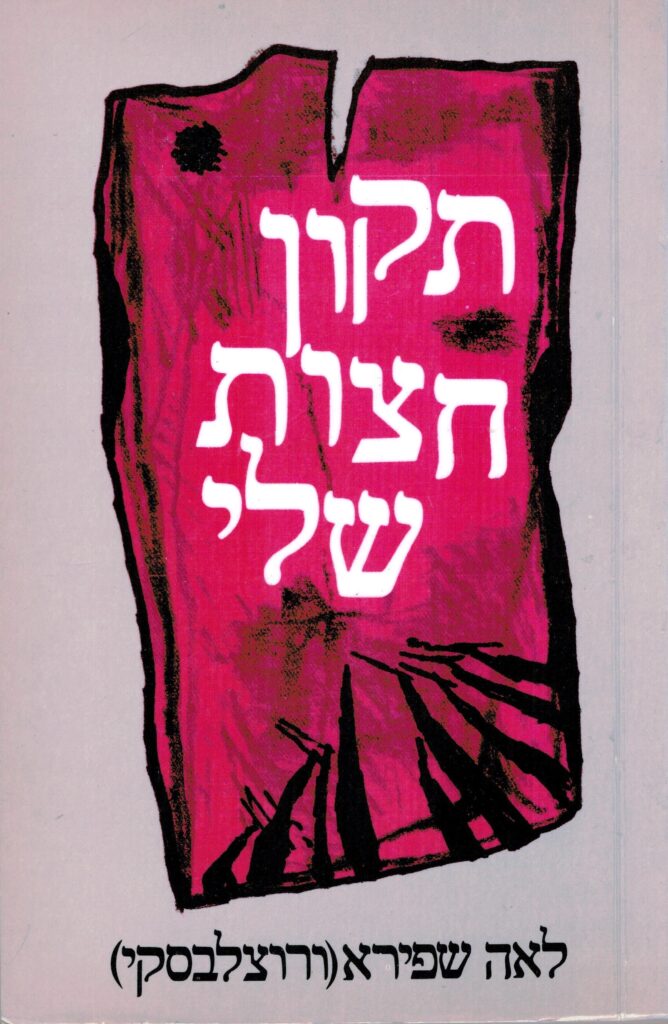
A volume of the book Tikkun Chatzot Sheli
Tikkun Chatzot
Leah writes in the introduction:
I know that I am not the only Holocaust survivor who suffers from nightmares, but this does not comfort me. What comfort is there in the suffering of many? I try to help myself on nights like these (…)
Until the idea came to my mind to sit down and put everything that is on my mind on paper.
Maybe I will be able to live together again with my loved ones who are gone and no longer exist.
I am not a writer, I have never tried to be one, but I can archive the written word, to be kept with me, for myself alone.
A wonderful idea.
Tomorrow, bli neder (literally: “without a promise,” meaning one has the intention to fulfill something but does not want to make a vow in vain), I begin…
As long as my family members don’t see me in this state.
I will get up to conduct a “Tikkun Chatzot” as my holy father, the God-fearing man, used to do.
With a change of wording.
And I, every time I read her diary hidden in the collections of Ganzach Kiddush Hashem, thank Mrs. Leah Shapira in my heart for not shelving the writing, for not keeping it with her, just for herself… I don’t know what happened to Leah, or where she lived. She published her book with the “Moreshet” and “Sifriyat Poalim” publishers and I thank them.
This diary, every line in it, every chapter, the entirety of it, constitutes an invaluable document, for understanding the concept of self-sacrifice; for understanding the life of a chassidic Jew somewhere in the Valley of Tears, towards the terrible end, facing the gaping maw of the corrupting Satan, and also, for gaining some idea of the commandment to honour one’s father by a heartbroken, powerless girl who did everything within her capability and beyond for her father, until his bitter end, until that night when he lay with his eyes closed, blessing her from a loving and pure heart.
Leah merited to survive. She was already terminally ill at the end of the war, and she survived. She was hospitalized for months, on the verge of death, and she survived. She suffered murderous blows and survived, everyone around her in the camps and ghettos died and she survived, and in the end, on the burning ship, surrounded by fire and billows of smoke, she survived.
From Within the Fire
I’m already down the stairs, peering into the “belly” (of the ship. Y.R.) where a huge fire is raging inside. (…) and I immediately regret it. The desire to stay alive burns in me now more than ever. I’m burned by the raging fire and I immediately regret it.
I try to hold on to the wall of the stairs and climb, but I can’t.
I am seized with fear and shout:
“Help!”
And I feel two hands pulling me up with force…
The hot, searing fire is now behind me, the sea breeze cools my face and restores my spirit.
This is a description of the fire that engulfed the ship on which the Germans loaded the remaining prisoners of the Stutthof camp. It was the last dying gasp of the Nazi beast, and after it, the ship’s guards, who had survived the fire, raised a white flag in the eyes of the British soldiers who arrived too late.
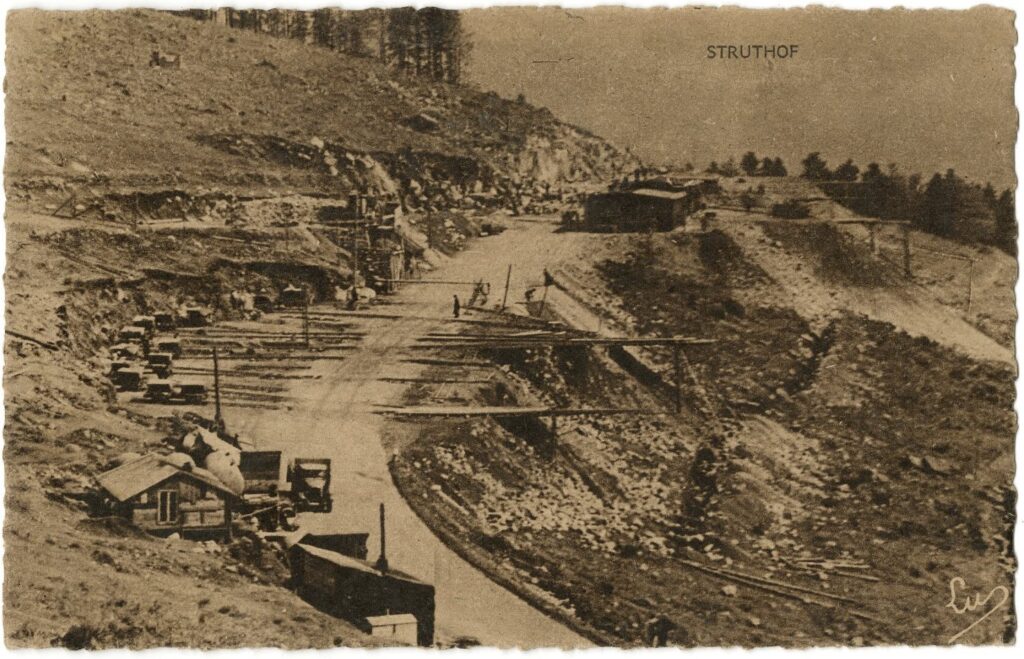
The Stutthof camp
The Germans – may their name be blotted out – set the ship on fire with their own hands.
Suddenly we hear cries of “Shema Yisrael” (Hear Oh Israel).
Cries that quickly grew weaker.
Shema Yisrael, they are burning there!
There was no hope of staying alive. We, on deck, would last perhaps half an hour, no more.
And when the Shema Yisrael chanting below grew fainter, a mighty Shema Yisrael shout suddenly rose from the mouths of the women standing here, on deck.
Where did we get the strength to shout such a loud and bitter cry? It was like an echo of the muffled voices that were still coming from below.
And the echo spread as if over the entire sea…
I can hardly bear the feeling of doom. The women, all covered in soot, wave their hands like black bats, or demons from fairy tales. In the twilight, it seems like a spectacle of horrors out of this world. I close my eyes so that I do not have to see…
Leah survived this too, as well as the Germans’ criminal “barrack burning” a few days earlier, and even then, in the face of the intoxicating smell of the sea, the troubles of Leah Wroclawski, the pampered child from Dubrovskaya Street in Pabianice, were not yet over. All those dear to her died in her arms, terrible troubles surrounded her, and then, precisely towards the end, she fell ill; and how she fell ill, she tells about it in such a sad and gloomy chapter called “I Was Afflicted with Ten Diseases.”
It was after the liberation, exactly eighty years ago, and she lay in the hospital, suffering and groaning, occasionally entertaining herself with the hope that someone dear to her was still alive, and would suddenly come to visit her.
I would surely jump for joy, and then, in an instant, I would recover…
She remained alive even after all the patients in the hospital passed away.
One morning I wake up and here I am, the one and only of all those who survived the extermination camp…
And sometimes, when she already felt the sword of the Angel of Death on her neck, she would see her righteous father’s blessing and it would come before her eyes:
Only when I remember my father’s blessing that in the end, after much torment and torture, I would be granted the merit to immigrate to the Land of Israel and build a home there, does the hidden hope awaken in me that my father’s blessing will come true one day, that the great miracle will still happen and that I will still be granted the right to see the land and even enter it…
For some reason, I believe in the power of a father’s blessing. I have often compared him in my thoughts to our forefather Yaakov blessing his sons before his death…
To stifle every quarrel before it breaks out.
Leah’s descriptions of her father’s righteousness and his service to G-d are breathtaking. He was persistent, a servant of G-d and a man of kindness. In the most difficult times, he would not even think of eating unkosher foods that were distributed in the ghetto. In the most difficult times, his house was full of guests of all types, and about one of the guests who stayed in their house with all her children and ate everyone’s food and did not lift a finger to help in any way, the father said:
In this crowding, every little spark can ignite a flame, a fire we cannot put out. It is better to stifle any quarrel before it even breaks out.
Decades later, Leah, the good, hungry, and tortured girl, answered her father in the dead of night, at home, in the Land of Israel, while writing her “Tikkun Chatzot”:
Yes, father! Every time I understand you more! Where there is Torah, there is also wisdom and kindness. From all the teachers I have learned during all the years of my difficult and suffering life, and from you more than from all of them. Good night, father.
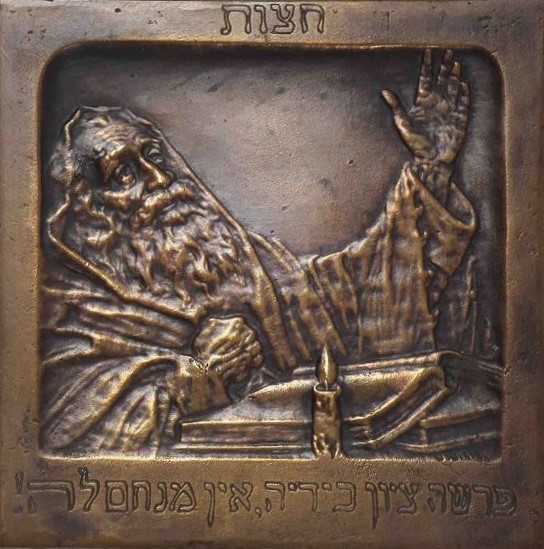
Tikkun Chatzot, by the artist, Boris Schatz
In the midst of the war, disaster struck. On a cold, gloomy night. The weak father lay in bed and called out to Yosef David, the son he had endless expectations of. He had hoped that he would grow up to be great man in the Jewish community.
“Come near, I will bless you, my son.”
And Yosef David, still a child, understood what was going to happen. He recoiled. He did not dare to approach. Then, Leah approached.
And the father whispered to her, weak and exhausted:
You, my daughter Leah, who cared for me with loyalty and devotion, and did good to my people, and even saved me from the hands of the gentiles, know that you will still go through many difficulties and suffering in your life, but with all this, never despair of calamity. You will still be blessed to live in the Land of Israel and raise a family…
Father finished his blessing, and with his last strength he raised his eyes upward, asking the Master of the World for his last prayer, and then his head fell on the pillow. He returned his soul to his Creator…
Mother, Mother…
The image of her father and his blessing accompanied Leah throughout the years. When they were still in the ghetto, she would visit his grave and cry and sob. She would talk to him and implore him to plead before the Throne of Glory because her strength of endurance had failed.
And one day, after she saw Nazis throwing children from high places into carts, some of whom died on the spot or were seriously injured, and heard their weak cries of “Mother, Mother,” she ran to the grave of her righteous father and said to him:
Father, why don’t you raise a great and bitter cry up there on high? (…)
Father! I once asked you why you get up at night and sit on the floor and pray with silent tears. I didn’t understand everything you told me, Father. But I remember only one sentence: You cry about the destruction of the Temple (…)
Father, if I remain alive, I too will get up at midnight to lament the destruction of the Temple. Our house, the house of all Jews…
In Tikkun Chatzot, Leah writes with all her heart:
The voices of children calling for their mothers haunt me all day long. “Mother”… and there is no helper and no saviour.
Mother… Mother!!!
Hallel (prayer praising G-d, reciting on holidays)
The book “Tikkun Chatzot Sheli” is difficult to read, but there are not many such documents in the world. This book tells about the Holocaust as it happened and contains things written in a storm of emotions, which we understand but do not quote.
Throughout all the difficult times, her father’s words and blessings stood before her eyes. “Do not despair of the calamity,” she whispered to herself over and over again, even when she was at the bottom of a pile of corpses.
I will quote a few more lines from the wonderous diary. Leah tells of a terrible period in the life of the ghetto. Hunger brought everyone down, and diseases were rampant. Despair gnawed at her and threatened to drive her insane, and then:
“Be strong and courageous, Leah”… Leah encouraged herself.
The wisdom is to live and not die. The dead help no one. Even my father, when he prayed and said Hallel, explained to me afterwards the meaning of the words “It is not the dead that will praise G-d, and not those that go down to silence. But we will bless G-d…”
Then, among all the dying and sick, Leah falls asleep, with the words of Hallel between her lips, and about that night of terror she writes:
I did not know that I slept so long that the night would be dark for me…
This verse appears again and again in the chapters of Leah Wroclawski’s Tikkun Chatzot. There is much to learn from the personality and strength of this Jewish girl, and I will end my article with a heart-wrenching quote in which Leah describes her fatal illness in the midst of the war, the “appendicitis” she contracted. This is how the doctor diagnosed it.
The pain was inhuman and I was tossing and turning in bed between life and death. I am bedridden. The pain does not let up. My health is getting worse and worse day by day. It also hurts me that my mother and everyone in the house are feeling my pain and suffering perhaps no less than I am. My condition is truly desperate. My heart is certain that tonight I will take my last breath. Who will go to inform the chevra kaddisha (burial society) of my death? Maybe Yosef, my brother, in the ghetto you can still walk with a beard and peyos (sidecurls) on the street. But despite the pain I fell asleep. I dreamed that my father was standing under a tree, wrapped in his shawl, praying. I listened: What is father praying for? Of course.
He is reciting Hallel.
“I will not die but rather I will live and tell over the acts of G-d. G-d has surely chastised me, but He has not given me over to death. Open up for me the gates of righteousness; I will enter them, thank G-d. This is the gate of G-d, the righteous will enter it. I will thank You, since You answered me and You have become my salvation…”
And what, I don’t know that this is the Hallel prayer? Once, when my father taught me the prayer in the siddur, I learned the whole passage by heart. I liked the words. My father was very happy about that.
I see myself approaching my father, kissing the tassels of the tallis (prayershawl) and saying the prayer aloud…
When I woke up, I felt a great relief. In the morning I got up. I got out of bed and here I am completely healthy. No pain or discomfort. Someone removed all the illness and pain from me like a magic trick.
My dear father, are you the one who brought me healing in your prayer? In your prayer “I will not die, but rather I will live” that was received before the throne of His glory – and behold, the gates of righteousness, the gates of life, were opened before me, and I will enter through them…
My dear father! See, your complete faith in G-d has also clung to me. How good and how pleasant it is to pray with you! I also believe in the coming of the Messiah, father. Many sing this in the ghetto. It has become our anthem.
Identity and Details, Please
I do not know who Leah’s father was; the book does not provide any details about him or his family. I searched for a long time for the family’s origins, if only so that we could learn Mishna for the upliftment of the pure soul of a uniquely righteous man, whose family I do not know nor where their path led.
What is true is that at the beginning of the book it says that he was “ordained by the Rebbe of Sochaczew, the author of the Avnei Netzer” and the “Eglei Tal,” and his lineage: he was a seventh generation descendant of the ‘Magen Avraham’ rabbi, and another thing: he also wrote two Torah scrolls and he woke up at night to recite Tikkun Chatzot…
May his soul be bound in the bonds of life, and whoever knows details about him or his family, as well as about Leah Shapira (Wroclawski), please send them to us, and it will be meritorious for you.