A Wellspring of Faith and Joy
The Rebbe who Lost Everything in the Holocaust and was a Bubbling Wellspring of Faith, Leadership, and Joy
By: Yaakov Rosenfeld
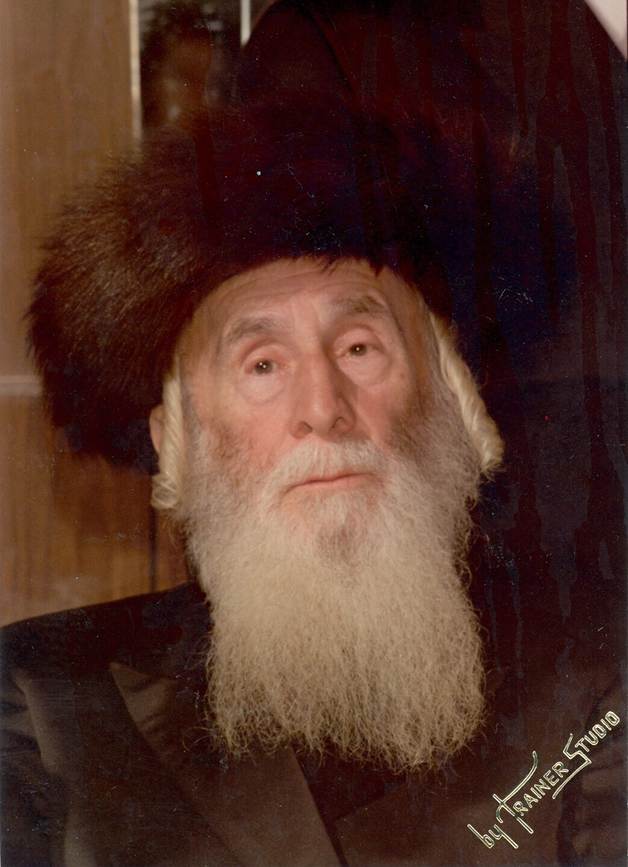
On Monday, the 1st of Cheshvan, the yahrzeit (anniversary of passing) of the holy Rebbe of Bluzhov, Rabbi Yisrael Shapira, I was a guest speaker on behalf of Ganzach Kiddush Hashem at a gathering in Bnei Brak.
The attendees wished to learn about this extraordinary tzaddik (righteous man), who illuminated the world for decades following the Holocaust, right up until the day of his passing, which coincided with his hundredth birthday. Yes, the Rebbe passed away on his hundredth birthday!
Much can be said regarding the Rebbe’s activities during the Holocaust and in the years that followed. We, too, here on the Ganzach Kiddush Hashem website and through various other channels, have written extensively and taken significant action to commemorate his name and legacy. Furthermore, we plan to produce an educational resource covering the full scope of the life, work, and legacy of the Bluzhover Rebbe, with G-d’s help, in the near future.
Few are familiar with this chapter in the history of this legendary figure, a man who, for many years in the United States, was regarded as a preeminent leader and pillar of Orthodox Judaism. He was a lofty tzaddik whose blessings brought salvation to many; he performed—both consciously and in ways beyond human perception, extraordinary deeds for the sake of the Jewish People as a whole, as well as for every single individual in need of a blessing, deliverance, or assistance.
At the outbreak of the Holocaust, he was already around fifty years old and served as an Rebbe revered by many followers. He had an only daughter, Sirka Mindel — married to Rabbi Shaul Rapaport of Bielitz (son of Shaul HaKohen). His two other sons had passed away in their youth. Sirka Mindel, her husband, and their son were murdered, as was his wife, the Rebbetzin Perl (may G-d avenge her blood). The Rebbe was left entirely alone in the world, yet he remained full of vitality and a spirit of active engagement, even throughout the years of suffering and torment he endured during the Holocaust: first in Lvov (“Lemberg”), subsequently in the Janowska camp, and finally in Bergen-Belsen.
The stories that flowed from my lips, and from the lips of others, have, in part, already been published here on the site. However, since Rabbi Menashe Reisman, the renowned maggid (storyteller) from Jerusalem, delivered a wonderful lecture that day regarding the Bluzhover Rebbe, from which one of the attendees shared several anecdotes and accounts concerning the Rebbe’s life during the Holocaust. I will quote excerpts from Rabbi Reisman’s lecture about the Bluzhover Rebbe z”l:
I did not die in the Holocaust – so that I can recount the deeds of G-d
The Rebbe was liberated on Rosh Chodesh (the first day of the month of) Iyar 5705 (April 1945). Then, the liberated prisoners gathered for communal prayer; they ascended a mountain and recited the Hallel prayer, as is customary on Rosh Chodesh. Later, the Rebbe recounted what he had felt at that moment. When they reached the verse, “The L-rd has chastened me, yet He has not given me over to death,” the words emerged from his lips with an entirely different tone: “Master of the Universe – ‘The L-rd has chastened me’ — but if so, why ‘has He not given me over to death’?” He uttered the verse as a profound, bewildered question: his wife was gone, his only daughter was gone, his son-in-law, his grandchildren — the entire next generation — had all perished. For four consecutive years, the Rebbe had drained the cup of bitterness to its very dregs; and so, from the depths of his heart, he cried out: “Why, then, has He not given me over to death?”
Regarding the preceding passage, he continued: “I shall not die, but I shall live.” What, then, is the reason that “I shall not die”? — why was I not taken to the World to Come? It is “so that I may live and recount the deeds of the Lord” — so that I might be among the survivors, able to tell the entire House of Israel what we endured, and how the Jewish People held fast to the spark of faith, even in the face of such a terrible exile.
He had countless stories about this — tales of how they stood firm in their faith. He also experienced overt miracles—events that truly boggle the mind. He possessed a bekishe (traditional long coat) that had been passed down through generations, originating from the holy Rabbi Baruch of Medzhybizh z”l. He wore it constantly, testifying that he felt it served as a shelter and a source of protection for him.
And subsequently, he said: “For I lift up My hand to Heaven” — meaning, “Master of the Universe, it is fully revealed and known before You that when the holy ones ascended the pyre day after day for the sanctification of Your Name, I too — Yisrael, son of Tziporah — lifted up my eyes; for I, too, longed to be there with them in the Heavens.” Yet, despite this, he declared: “And I said, ‘I shall live’—for the sake of the ‘world.'” He chose to remain alive so that he might become one of the builders of Judaism and chassidism, establishing them firmly upon their foundations. Thus, even though he had “lifted up his hand to Heaven” — experiencing a yearning to depart with the holy ones toward the celestial realms — he nonetheless affirmed: “And I said, ‘I shall live’—for the sake of the world,” for the benefit of the world.
It happened during Chanuka, on a Chanuka night. It was in the aftermath of grueling labour and massacres, following an Aktion (roundup), a bitter and harrowing day. Yet, the camp detainees fashioned a menorah to fulfill the mitzvah (commandment) of Chanuka. Here is how they constructed this menorah: they took a potato peel and fashioned it into a vessel. They pulled threads from their clothing to serve as a wick, and for oil, they scraped off the black, greasy residue that clung to the wooden clogs they had been issued in the labour camps. In this manner, the menorah for the mitzvah was prepared.
Late that night, hundreds of Jews gathered together and invited the Rebbe of Bluzhov to kindle the Chanuka menorah. Everyone yearned to hear something of Judaism. When a person finds himself in such circumstances, the soul awakens in a way that defies rational explanation, much like what we hear now from some of the captives who have returned from Gaza: how deeply they thirsted, their very souls pining to hear something Jewish.
The Rebbe of Bluzhov recited the first two blessings: “to kindle the Chanuka light” and “Who performed miracles for our ancestors.” He then paused, looked to his right and to his left, this way and that, and proceeded to recite the Shehecheyanu blessing (“Who has granted us life, sustained us, and enabled us to reach this time”). He lit the candle, and those present sang “Ma’oz Tzur” and “Chasof Z’roa Kodshecha,” after which everyone returned to their planks.
Among the people present was a man who was entirely secular, a Jew named Dushimatkovsky, who was one of the leaders of the “Bund” in Warsaw. After the lighting, he approached the Rebbe and asked: “The blessings ‘to kindle’ and ‘Who performed miracles’ — that I can understand. But the Shehecheyanu blessing — ‘Who has granted us life, sustained us, and enabled us to reach this time’ — is this really the place for such a blessing? Jews are being killed here every single day! How, then, can a God-fearing Jew — a man who loves his fellow Jews — recite the words, ‘Who has granted us life, sustained us, and enabled us to reach this time’?”
The Rebbe replied: “Listen to me – this question weighs heavily upon me as well. Did you not notice that I paused before reciting the Shehecheyanu blessing? I simply could not bring the words past my lips. Yet, when I beheld hundreds of Jews crowding around me to witness the lighting of the Chanuka candles—despite the inherent danger, and despite the fact that no food was being distributed—when I saw that their sole focus was to witness this act with faith and to stand present during the lighting, that is why I recited the blessing: ‘Blessed are You… who has granted us life, sustained us, and enabled us to reach this time.’ To see the Jewish People in such a state, pressing forward for the sake of the Chanuka candles, this is a phenomenon the likes of which had never been seen before, and will never be seen again. These were five years during which the Jewish People were able to reveal such a profound spark of faith from within themselves. And although, strictly speaking, one does not recite Shehecheyanu over times of suffering, nevertheless, when ‘this time’ arrives, it brings forth a unique dimension – something that never existed before and will never recur – and it is for this that I recited the blessing. Do you think I was referring to those past days? No, I was referring to ‘this time’ — to the scene unfolding right here, where I see Jews pushing forward to fulfill the mitzvah of the Chanuka candles. Such a sight warrants the blessing: ‘Blessed are You… who has granted us life, sustained us, and enabled us to reach this time.'”
That man, one of the heads of the “Bund”, survived the war, and it was he who recounted the story he had heard back then from the Bluzhover Rebbe z”l.
Preserving the Torah so the Holocaust is Not Forgotten
On the 6th of Tammuz, 5735 (June 1975), that tzaddik delivered the keynote address at the Siyum HaShas (the celebrating of the completion of the entire Talmud), marking the conclusion of the seventh cycle of the Daf Yomi (daily Talmud study program). The event took place in Manhattan, New York, and was attended by thousands of Jews from across America, a gathering dedicated to the memory of the six million victims of the Holocaust:
In the Holy Torah, in the Torah portion of Vayelech, the verse immediately preceding the commandment “Now, therefore, write down…” states: “And he will forsake Me and break My covenant… and he shall become food [for others], and many evils and troubles shall befall him.” This implies that the Children of Israel will literally become food for their enemies. Immediately thereafter, it is written: “Now, therefore, write down this song for yourselves, and teach it to the Children of Israel; place it in their mouths.” It further states: “And it shall come to pass, when many evils and troubles befall him, that this song shall testify before him as a witness — for it shall not be forgotten from the mouths of his descendants.” This serves as the preamble to the writing of a Torah scroll.
One must ask: what did the Torah intend to convey by placing the commandment to write a Torah scroll precisely at this juncture? After all, we often carry a Torah scroll through the public thoroughfares during the joyous celebration of its dedication; yet, when examining the verses where this commandment appears, it seems somewhat out of place, situated, as it is, in the immediate context of calamities (G-d forbid). Indeed, a careful look at the passage preceding the words “Now, therefore, write down…” (ve’atah kitvu) reveals a clear allusion to the Holocaust, unfolding, as it were, right before our eyes. The text speaks of “forsaking Me and breaking My covenant” — a point noted by the author of the Meshech Chochmah on the Torah portion of Bechukotai. It is then that G-d declares: “Now” — that is, after all that has transpired — “write down for yourselves this song, and teach it to the Children of Israel.” This implies that the Jewish People must be taught the words of the holy Torah, “so that it may serve as a witness for Me… for it shall not be forgotten from the mouths of their descendants.” In other words: for those who lack a connection to the Torah —who do not engage in the study of Shnayim Mikra Ve’echad Targum (reviewing the weekly Torah portion in small segments over the week in order to complete it by the end of the week, twice in Hebrew and once in Aramaic) or the study of a page of Gemara — the memory of all that the Jewish People have endured will very quickly fade away. Only among those Jews who fulfill the directive, “write down for yourselves this song, and teach it to the Children of Israel,” can the promise “it shall not be forgotten from the mouths of their descendants” be realized. And this refers not merely to the Torah itself, but to the fact that the many great tribulations and hardships experienced by the Jewish People will not be forgotten by their descendants.
For one who does not study and is not connected to the Torah gradually becomes detached from the collective body of the Jewish People. The moment his connection to the “Eternity of Israel” (Netzach Yisrael) weakens, he inevitably loses his sense of belonging. Consequently, when told about the events of Auschwitz, he might respond: “What are you talking about? What does this have to do with me?” In contrast, those Jews who remain connected to the “Eternity of Israel” through the holy Torah will forever carry this in their hearts — fully grasping and understanding what the Jewish People endured during those dark days.
Sponsoring a letter in a Torah scroll from the “Valley of Slaughter”
Then the Rebbe took a note from his pocket and said: “This note, which I am about to read to you, is something I carried with me – at the risk of my very life — wherever I went, from the valley of slaughter all the way to here.” Now, carrying a note with one for five years was an incredibly difficult feat. And we are not speaking here of the Jews of Hungary, who spent about a year in the camps and in Auschwitz; rather, we are speaking of the Jews of Galicia, who bore the burden of the war from its very inception—from the year 5699 (1939) until the year 5705 (1945). It is truly staggering to contemplate how these people managed to retain their presence of mind.
And he spoke as follows:
The event I am recounting to you took place on the 7th of Shevat, 5703 (January 13th, 1943). At the time, I was in a labour camp located in a forest near the Janowska labour and extermination camp. Suddenly, one of the camp guards approached me and thrust a short letter into my hand, a note written for me by a Jew from another district who was also working in the camp. The non-Jew said to me, “I am bringing this to you because I received three hundred dollars from that Jew to ensure this note reached you.” Before that Jew was taken out to be killed, he wrote the note and gave instructions for it to be delivered to me. It is truly remarkable that the non-Jew proved trustworthy regarding the three hundred dollars and delivered the note; clearly, it was the will of G-d that this note should survive.
And this is what was written in the note, in black pencil:
With God’s help—dearest, beloved Rebbe, Rabbi Yisrael:
The Germans have now surrounded the brush factory where we, nearly eight hundred Jews, are located, and they are preparing to exterminate us; they have not yet decided, however, whether to kill us by gunfire right here or to take us to the crematoria.
I ask of you, my beloved Rabbi, that when you merit to arrive in the Land of Israel, you place a small stone monument somewhere upon the holy soil, inscribed with my name and the name of my wife, so that our names may not be forgotten or erased from among the Jewish People. Alternatively, you might have a letter inscribed in a Torah scroll on our behalf.
I am sending, via the messenger, the fifty dollars I have with me. I am mindful of the instruction to divest myself of worldly possessions. I shall convey regards to your holy ancestors and ask them to intercede on your behalf, that you may merit a long life and many years.
Your servant – Aryeh, son of Leah.
P.S. My sister’s children are with the Christian Vishlevsky in Greiding (the Yiddish for Grodek Jagiellonski, Poland – now Horodok, Ukraine).
Please get them out of there and place them in Jewish hands. Let them be raised however one wishes, but ensure they remain Jewish. My wife, Sheva, daughter of Chaya, was shot to death last night.
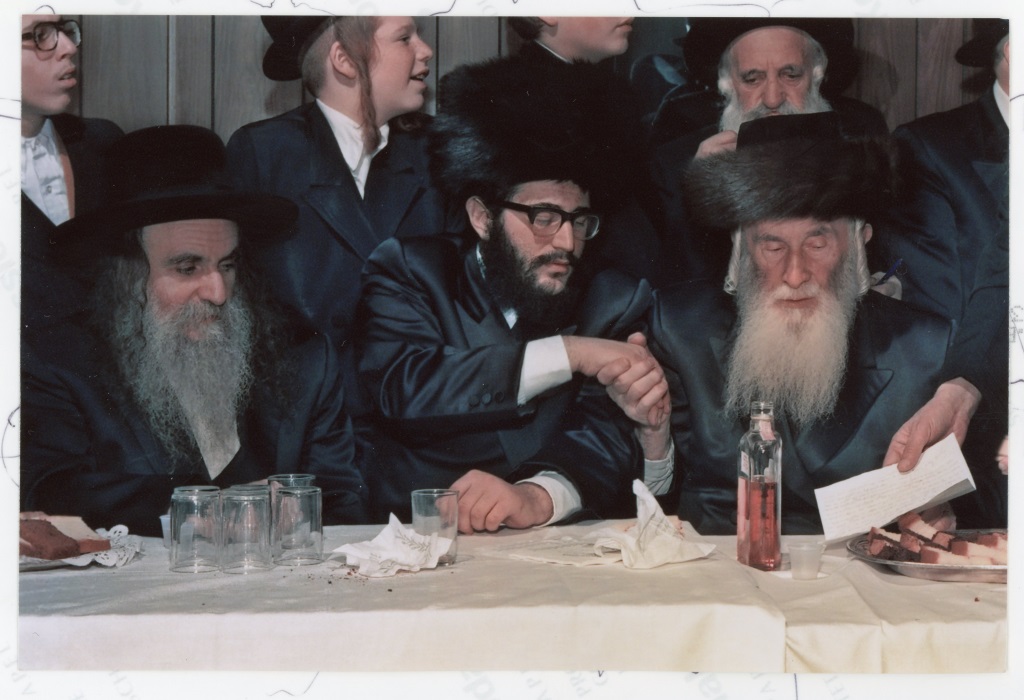
The Bluzhever Rebbe, Rabbi Yisrael Shapira, at a wedding, seemingly with the Amshinover Rebbe, USA
The Rebbe said: A Jew wrote this at the very moment he was ordered to strip off his clothes before being shot to death. His sole desire was that his name and the name of his wife, who had already been killed the day before, be inscribed within a Torah scroll. It was then that I understood the meaning of the phrases: “and they will be consumed,” “and many evils and troubles shall befall him,” and “now, therefore, write this song for yourselves.” It is truly staggering to contemplate how, in that final moment, he managed to hold onto this aspiration — to have a letter of his own within a Torah scroll.
These are sentiments that have never departed from the Jewish People throughout any era — profound, hidden feelings, embodying the spirit of the verse: “Behold, let Him kill me, I will hope for Him” (Job 13:15). Furthermore, even in that moment, his thoughts were occupied with his sister’s children, who were there in the hands of non-Jews; it was of the utmost importance to him that they be brought back to the Jewish fold. This is the essence of “and they will be consumed” and “many evils and troubles shall befall him” — the imperative to rescue them from the hands of the non-Jews, so that they might be raised as Jews.
When he recounted this there, at the Siyum HaShas, floods of tears poured forth from many of those gathered, and the place was filled with a profound sense of awe before G-d.
Tens of thousands attended the funeral of the world’s eldest Rebbe. A description of the funeral, taken from the periodical HaPardes — from the Ganzach HaShem archive.
The genius holy Rabbi Yisrael of Bluzhov z”l
Tens of thousands from the American charedi (ultra-Orthodox) community — spanning all its various circles and strata, and led by renowned Torah and chassidic luminaries, marched in Brooklyn amidst a massive funeral procession and torrential rain, accompanying the coffin of the eldest Rebbe of our generation, the Bluzhover Rebbe z”l, as it began its journey toward its final resting place in Jerusalem.
The bitter news of the passing of the Rebbe, revered by multitudes across the United States, cast a heavy pall of mourning and a profound sense of being orphaned throughout the entire charedi community. Shortly after his soul departed at the Jewish Rambam Hospital in Brooklyn, many of his chassidim and admirers, traveling on foot and by vehicle, made their way to his beit midrash (study hall) on 58th Street in Boro Park. There, surrounding the casket placed in the center of the hall, they began to recite Psalms, their voices choked with emotion and tears. From every direction, the sounds of weeping and sobbing could be heard from close associates and chassidim, lamenting the departure of a “cloud of glory,” a figure whose Torah, righteousness, and radiant majesty had illuminated and graced the world of Torah-observant Jewry for many decades, first in Galicia and subsequently in America.
The profound sense of mourning was palpable in the streets of Boro Park long before the funeral, as thousands upon thousands began streaming toward the beit midrash of the Rebbe z”l to participate in the final rites and pay their last respects to a magnificent remnant of a bygone era of profound wisdom. He was one of the towering giants of Torah and chassidism in our time, who has now departed to the Heavenly Yeshiva.
At the forefront of the vast crowds that gathered in the courtyard of the beit midrash were the foremost Torah leaders of America – prominent rebbes, rabbis, roshei yeshiva (heads of yeshivas), and members of the Moetzes Gedolei HaTorah (Council of Torah Sages), a body in which the Rebbe z”l had served as the senior-most member for many years. Accompanying them were thousands of avreichim (married Torah scholars) and bnei Torah (Torah students) from yeshivas across New York and beyond, representing both chassidic and Lithuanian (charedi but non-chassidic) traditions. Among them were students who had traveled from distant cities such as Boston, Baltimore, Lakewood, and Philadelphia, arriving in organized bus convoys.
Additionally, prominent figures from the worlds of Torah and chassidism arrived by plane from Canada and other countries to attend the funeral. Large numbers of schoolchildren from cheder and the Bais Yaakov school system were also present. Among the attendees, thousands of members and supporters of the Agudath Israel movement, including its activists and leaders, stood out; for many years, they had been privileged to draw inspiration from his teachings and to gather in his presence, particularly at Agudah-affiliated assemblies and conferences, which he frequently graced with his participation.
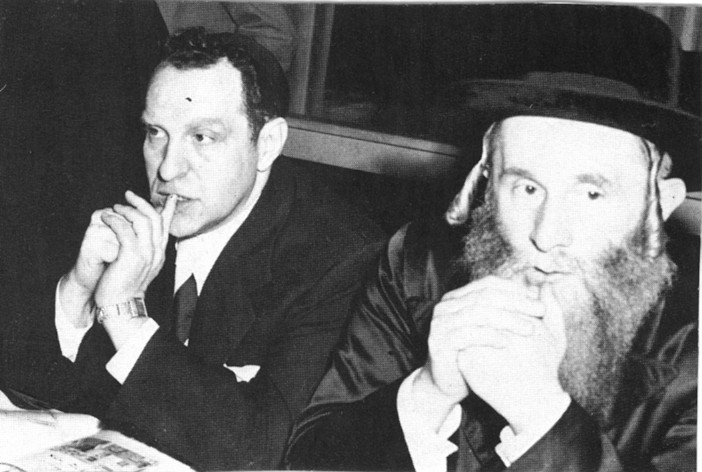
The Bluzhover Rebbe, Rabbi Yisrael Shapira, with the activist, Michael Tress
At 2:00 PM, the scheduled time for the funeral procession to depart, the streets surrounding the beit midrash turned black with people. A vast sea of umbrellas covered the entire area, which was packed with tens of thousands of individuals, all soaked to the bone by a heavy, unrelenting downpour. The New York Police Department, having deployed a large number of officers, blocked off traffic and maintained order throughout the funeral. The event became a deeply moving and poignant tribute to the honour of the Torah, a dimension of the occasion that went entirely unreflected in the American media.
For a long while, the masses stood in the streets, on surrounding balconies, and upon rooftops, reciting the Psalms, verse by verse, as a heavy, mournful silence descended over the large Jewish enclave of Boro Park. Its residents ceased their work and paused their Torah study for the duration of the funeral. In keeping with custom, no eulogies were delivered. As the casket was brought out from the beit midrash, the pious Rabbi Shlomo Intrater, an elder among the Bluzhov chassidim and a disciple of the author of Tzvi LaTzadik, announced that, in accordance with the oral testament of the Rebbe z”l, his eldest son [biological son of the Rebbe’s second wife], Rabbi Tzvi Yehuda Shapiro, would succeed his father in leading the illustrious Bluzhov dynasty. Following a plea for forgiveness on behalf of the entire holy congregation, the funeral procession moved slowly and solemnly along 13th Avenue. A group of students and family members carried the coffin toward the outskirts of Boro Park, aided by police officers who struggled to clear a path for the casket and the mourners. Traffic congestion stretched for ten blocks from the site of the funeral. From the edge of the Jewish neighbourhood, the procession continued as a massive convoy of buses and vehicles toward JFK Airport; there, the casket, accompanied by approximately forty mourners, departed for Israel aboard an El Al flight.
Long before the scheduled landing of the El Al flight, which was bringing the coffin and those accompanying it from New York, a distinct stir could be felt in the vicinity of the airport in Lod. Thousands of people, primarily from the central region of the country, began arriving via organized buses and private vehicles to pay their final respects to one of the exemplary tzaddikim of the previous generation as he made his way to his final resting place. Significant traffic congestion ensued, and airport police forces worked intensely to ensure the continued, smooth operation of the airport.
At 5 p.m., the coffin arrived on an El Al flight from New York, via London, accompanied by dozens of family members and associates of the Rebbe z”l, led by his son who was replacing him as Rebbe, Rabbi Tzvi Yehuda Shapira of Bluzhov, who came from far and wide to accompany their crown of glory, and a little over an hour after the funeral procession ended, they returned to New York on a night flight.
The funeral procession in Lod
Standing by the aircraft ramp upon landing were members of the Rebbe z”l’s family and leaders of Agudath Israel. They worked alongside the police on-site to coordinate the logistical arrangements for the funeral procession, and oversaw the removal of the casket from the plane and its transfer to the chevra kadisha (burial society) vehicle.
Once the arrangements were finalized, the procession soon made its way to the plaza in front of the airport terminal. There, a vast crowd, representing a diverse cross-section of the public, waited. Among them were dozens of prominent rebbes and renowned rabbis. Most notable were the Vishnitzer Rebbe, who had traveled specifically to Lod for the occasion, as well as the Rebbes of Alexander, Pittsburgh, Nadvorna, Shomrei Emunim, Biala, Radzin, Machnovka, Chernobyl, and Sasov. These and other distinguished figures from the world of Torah and chassidism accompanied the casket, joined by throngs of their own followers, all the way to the entrance of the airport complex.
The arrival of his cousin, the Klausenburger Rebbe, may he live a long and good life, stirred deep emotion among the mourners. The Rebbe arrived in a specially equipped medical vehicle and, at his own insistent request, continued to travel behind the hearse all the way to the center of Jerusalem.
From the airport, the hearse and the accompanying procession made their way toward Jerusalem in a long convoy of hundreds of vehicles, led by police cruisers that directed traffic along the entire route.
Meanwhile, charedi Jerusalem ceased its daily activity, and tens of thousands of its residents began streaming from all directions toward Kikar HaShabbat (Shabbat Square) to participate in the funeral for the Rebbe. The main thoroughfares, Malchei Yisrael and Mea Shearim, which had been closed off in advance by the Jerusalem Police, quickly filled with vast throngs of men, women, and children who had arrived from every corner of the city and its various neighborhoods, both near and far. For nearly two consecutive hours, the massive crowd, packing the streets and alleyways adjacent to Kikar HaShabbat until they were a sea of humanity, awaited the arrival of the coffin, which was delayed. Prominent among those present were the great Torah leaders of the generation, members of the Council of Torah Sages, as well as leading chassidic rebbes, rabbis, heads of yeshivas, members of rabbinical courts, thousands of Torah scholars and educators, public figures, and the leadership of Agudath Israel and the Independent Education system.
The funeral procession passed through Geula and Mea Shearim, where the eminent Torah authority, Rabbi Shlomo Zalman Auerbach, may he live a long and good life, arrived and paused for a few moments beside the casket. The massive procession continued through the Old City, escorted by police forces along the route. During the procession, prominent chassidic rebbes recited the Kaddish.
The Rebbe z”l was laid to rest in the Kollel Galicia section on the Mount of Olives, in the presence of thousands who recited Psalms with deep emotion and tears. Following the burial, the Skulener Rebbe (currently visiting Israel from the United States) delivered brief farewell remarks, in which he asked the Rebbe z”l to serve as an advocate on high. The Shomrei Emunim Rebbe then offered words of consolation to the Rebbe’s son, his successor, and blessed him as he continues the “golden chain” of the dynasty. During this moving ceremony, the chassid, Rabbi Mendel Reichberg reiterated the announcement made at the funeral in the United States, confirming the acceptance of the eldest son’s authority as the Rebbe of the Bluzhov dynasty.
*
Sidebar: What was the Only Sermon that Caused the Bluzhover Rebbe to Weep?
Translated from Yiddish (from Der Shrift) to Hebrew by Yaakov Rosenfeld, and from Hebrew to English by Ricki Prince
When writing about Bergen-Belsen, one cannot fail to mention Mrs. Rivka Pinkeszewicz, a woman to whom hundreds of young girls owe their continued devotion to the Jewish People and their steadfast fear of Heaven.
As a young woman, she studied at Sarah Schenirer’s renowned seminary in Krakow. During the war, she and a group of girls were tasked with sewing uniforms for the Germans, may their names be blotted out. They worked exceptionally hard throughout the week, specifically so that they would not be forced to work on the Sabbath. After the war, upon arriving at Bergen-Belsen, the very first thing she requested was a Chumash (Pentateuch) and other books, so that she might teach the girls.
An assembly for all the Jews was held in the camp, where certain unsavory groups sought to draw the unsuspecting Jews toward them. Rivka arrived, and in a moment when no one was watching, she sprang onto the platform and began to cry out: “Is this our purpose in life? Is this the only reason we were saved, merely to reach the Land of Israel? We are here to perpetuate the Jewish eternity! Do not forget that you are the children of kings; you must continue the golden chain — we must sanctify G-d’s Name!”
The short but poignant sermon, which came from the depths of the heart, left a deep impression on those present, some of whom stood to say Kaddish.
Among those who heard it was the Rebbe of Bluzhov, Rabbi Yisrael Shapira z”l, and he cried and testified that this was the only sermon that made him cry!
Another story is told, that when they did not want to provide kosher food, she announced that she and her entire group would not touch any cooked food! The committee demanded that if they obtain 100 signatures of people requesting kosher food, this will be settled. On the same day, the girls obtained 800 signatures! A short time later, a completely kosher kitchen was established there!