Agudath Israel’s Compass
The genius tzaddik (righteous) Rabbi Dov Ber Friedman of Czortkow
The genius, tzaddik, and leader who passed away suddenly two years before the outbreak of the Holocaust
Ninety years ago, a wondrous tzaddik and great leader passed away suddenly, leaving behind a profound void. This occurred on the 24th of Elul, 5696, in the capital city of Vienna — two years before Kristallnacht.
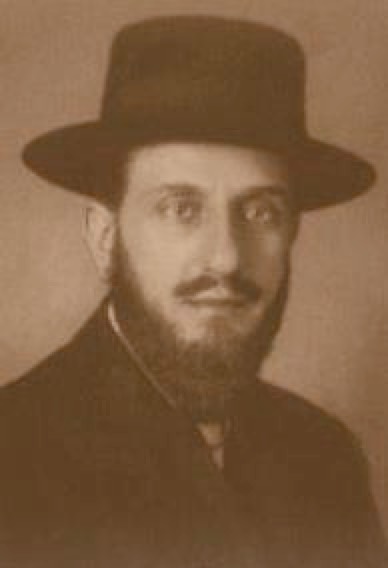
The Rebbe Berinu
The rivers of blood that flooded Europe and the pillars of smoke from the holy victims rising heavenward in the ensuing years caused survivors to lose sight of the harrowing ordeals that befell the Jewish People in the pre-Holocaust era. Today, ninety years later, we look back at the events of that time with awe. There were leaders of exceptional stature – holy and pure figures – of whom little is known today; yet, in those days, they stood at the forefront of the Jewish People’s struggle for survival during the interwar period, serving as the “central bolt” in the monumental effort to uphold everything sacred and cherished.
The genius, Rabbi Binyamin Ze’ev Jacobson, known today primarily for his monumental work with “Lidingo” on behalf of Holocaust-surviving orphan girls (having served as Rabbi of Copenhagen and Stockholm), eloquently articulated this sentiment in memoirs written immediately after the Holocaust. Rabbi Binyamin Ze’ev’s words are painfully true, for he was intimately familiar with the various strata of authentic Jewish life across Eastern and Central Europe. He stood at the very heart of public rabbinic activity, and his work, particularly within the framework of Agudath Israel and its “Keren HaTorah” fund, had a truly global reach.
Thus writes Rabbi Jacobson after the Holocaust, with a pen dripping blood and tears as bitter as wormwood:
One thought grips and shakes my very being: everything, everything is lost. The communities and their leaders, the distinguished figures and the common folk (…) Where is the soul of the Vaad HaYeshivot (yeshiva commmittee)? Where are all the teachers of Bais Yaakov? Where are the chassidim, men and women alike? Where are they all, the beloved and the cherished…
When Miriam Stern, the only daughter of Rabbi Yosef Naftali Stern, a cherished and beloved figure in the Bais Yaakov movement and a brilliant young woman, passed away, we all raised a cry of mourning and weeping; yet today… hundreds of thousands have perished! When the son of the great and wondrous Rabbi Menachem Ziemba died in the prime of his youth, at the age of twenty, profound Torah insights he had innovated were recited before his coffin, and all the Torah scholars of Poland wept; yet today, we ask after the fate of hundreds of thousands of Ziembas, after the fate of that gentle, precious youth who knew only how to study the Torah of life and to die for its sake; we ask after them, after their fathers and mothers, after their rabbis and mentors; we ask and ask… When Eliyahu Kirschenbaum passed away in the midst of his monumental service to the community, countless voices cried out: “Who will replace him?” Yet today, men of faith have been lost, and who shall bring us their replacements?…
We, the Jews of Ashkenaz and the other lands of the West, seeing our ranks depleted and witnessing crime and betrayal within our midst, placed our trust in the East (Eastern Europe -Y.R.) and in the boundless heritage we held there. Yet now that this heritage has passed to foreigners and our homes to strangers, we are left as orphans without a father. Polish Jewry, specifically the charedi (ultra-Orthodox) Jewry of Poland, was the symbol of our eternal strength and our constant renewal; it once was, and now is no more.
Such was the wondrous tzaddik Rabbi Berinu Friedman, a Torah genius of the highest order, an exalted righteous man, and a leader of immense strength and fortitude who commanded respect and admiration across all circles and communities.
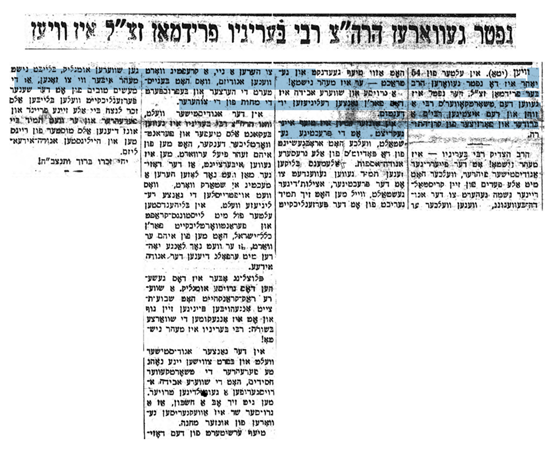
At the age of fifty-four, he was swept up to the Heavens following a brief illness that struck him around the festival of Shavuot that year. His passing stunned the faithful community worldwide, a fact evident from a cursory glance at the press of the time, portions of which are preserved in the Ganzach Kiddush Hashem archives. The wider world was unaware of the illness that had afflicted the tzaddik; media coverage was not as instantaneous or sharp as it is today, and consequently, some newspapers described his passing as “sudden.”
Who was Rebbe Berinu, and why did his untimely death so deeply sadden the faithful Jews during that harrowing era, a time when the sword of the Nazi Angel of Death was already poised over the Jewish People, and hundreds of thousands of German Jews were acutely feeling the heat of that blade and tasting the bitterness of persecution, expulsion, and arrest?
Rabbi Dov Ber of Czortkow z”l was born in Czortkow in the month of Sivan 5642 (1882). He was the son of the Rebbe, Rabbi Yisrael of Czortkow and the Rebbetzin Sheva Ruchama, herself the daughter of the elder Rebbe of Sadigura. During his childhood, his father engaged Reb Zalman Bruder as his tutor; Reb Zalman would later go on to serve him faithfully.
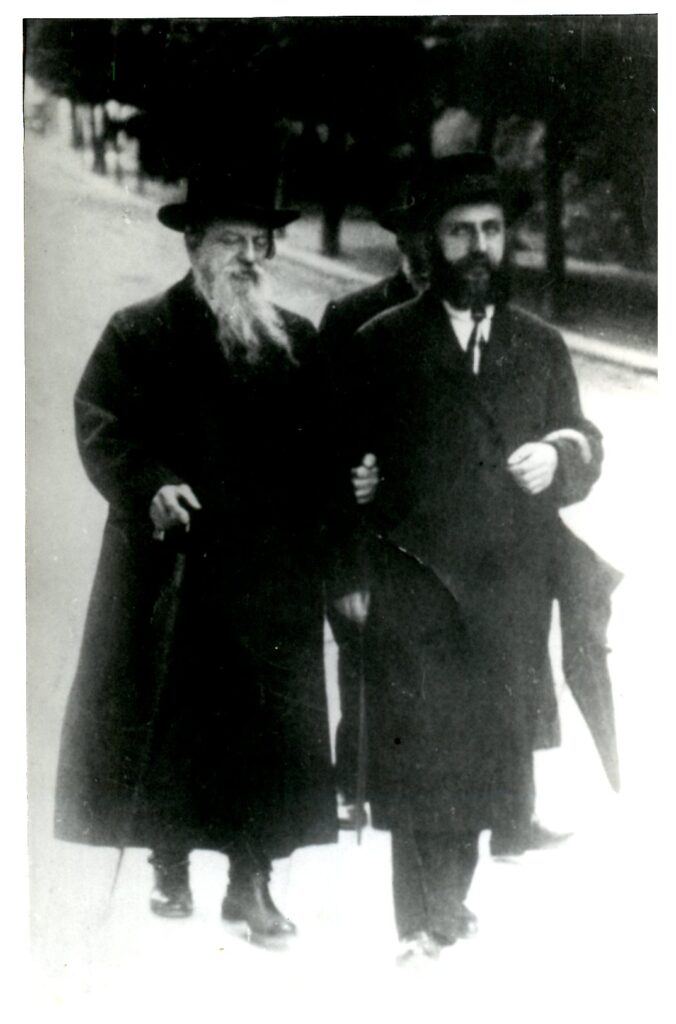
Rabbi Yisrael of Czortkow with his son, Rabbi Dov Berinu
On the 17th of Sivan 5659 (May 26th, 1899), he married Miriam, the daughter of his uncle, the Rebbe, Rabbi Yitzchak Friedman of Boyan. The wedding took place in the town of Boyan, where he resided following the marriage. Upon the outbreak of World War I, he relocated to Vienna alongside his father and father-in-law. During this period, he amassed considerable wealth; he established a free-loan fund for war refugees and managed an orphanage in Vienna, all while serving as his father’s right-hand man in public affairs.
When the Agudath Israel movement was founded, his father instructed him to serve as a member of the movement’s World Executive Committee. He devoted himself wholeheartedly to this work, and the Czortkow chassidim dubbed him “the Agudah compass.”
Following his father’s passing on the 13th of Kislev 5694 (December 1st, 1933), the chassidim asked his sons, Rabbi Nachum Mordechai and Rabbi Dov Ber, to serve as rebbes. Initially, they refused; however, after their mother instructed Rabbi Nachum Mordechai to accept the role, he agreed, on the condition that his brother, Rabbi Dov Ber, would lead alongside him. Rabbi Dov Ber managed the court in Vienna together with his brother but declined to establish a court of his own. He also rejected an offer to serve as the rebbe of the Shtefanesht chassidic community following the death of his relative, Rabbi Avraham Mattityahu Friedman.
Incidentally, the press of the time, reporting on the passing of his holy father, describes Rabbi Dov Ber as a potential successor, lauding him with extraordinary praise.
He was renowned as a Torah giant, a level of greatness that even his staunchest opponents admired.
Out of humility, he would not read the kvitelach (notes with requests for blessings) himself, passing them instead to his brother; however, he did agree to accept pidyon nefesh (charity to help annul a decree) and bestow blessings, saying: “Now that I am not a Rebbe, I can bless you, for our Sages taught: ‘Do not regard the blessing of a commoner lightly.'”
Rabbi Dov Ber passed away at a young age following a severe illness on the 24th of Elul 5696 (September 11th, 1936) and was laid to rest in his father’s ohel (building surrounding a grave) in Vienna. In accordance with his will, no titles were inscribed on his tombstone.
His son, Avraham Yaakov, passed away at the age of 12.
His son, Rabbi David Moshe (born in 5674/1913-4), fled from Vienna to England following the Anschluss. After the Holocaust, he refused to assume the mantle of leadership as rebbe, despite the entreaties of the chassidim; he passed away on the 27th of Shevat 5748 (Feb. 15th, 1988). Two of his sons carry on the dynasty’s legacy: the distinguished Rabbi Dov Ber Friedman in Antwerp, and the distinguished Rabbi Yisrael Friedman in Manchester.
As the driving force behind the “Keren HaTorah” fund, he accomplished great and remarkable things; as attested by his friend Rabbi Binyamin Ze’ev Jacobson — with whom he worked on the “Executive Committee” — he served as the “compass” for the organization’s educational initiatives and its outreach efforts to bring the unaffiliated closer to the faith.
“Keren HaTorah” — established by Torah giants following the devastation of the Torah world during World War I and managed by the leaders of Agudath Israel — accomplished truly monumental feats. The fund, which supported yeshivas and Torah institutions throughout Poland, Lithuania, and beyond, served as the central pillar of the Torah world; its activities even extended to supporting institutions in the Land of Israel at that time. Tens of thousands of dollars were distributed during the fund’s very first year of operation, with a significant portion of the funds raised through the tireless efforts of the tzaddikim (i.e. the rebbes) of the Ruzhin dynasty, most notably the holy Rabbi Mordechai Shalom Yosef, who, despite being a young man at the time, already served as the fund’s president.
A month after his passing, his colleague Rabbi Jacobson wrote of him:
Thirty days have passed since the passing of Rabbi Ber Friedman. Thirty days during which we were stirred by the “Days of Awe” (the High Holidays), celebrated the “Zman Simchateinu” (the time of rejoizing, i.e. Sukkot), and felt the spiritual elevation of Simchat Torah. Throughout those days, his image stood before us, and we restrained our impulse to mourn or weep, striving to uphold the injunction of the wisest of men: “On good days (the holidays), be joyful.” But now that the ordinary weekdays have arrived, days of labour when each of us sets out to his tasks, the activist of the Agudah, resuming his work for the organization, is confronted with the reality of “in the day of adversity, consider.” He sees that day of adversity anew, and his soul is pained: I must carry on with my work, yet he, the dearest, the most devoted, the most genuine among us, is gone. The pain is immense, the bitterness profound; for all of us who knew the man, and who were honoured to have known him, realize that “the Ark of God has been taken.” Rabbi Berinu is no more, and with him, the compass of Agudath Yisrael has been taken from us.
We mourn him just as Bnei Yisrael mourned Moses; for when he witnessed manifestations within our camp that compromised or obscured the pure ideal of Agudath Israel, he stood in the breach, like Moses, G-d’s chosen, and spoke with powerful conviction. His words, born of the depths of his pure heart, found their way directly into the hearts of others.
We mourn him just as the entire Israelite community mourned Aaron; for he was filled with love for every person, young and old, man and woman alike. Even upon his sickbed, amidst his most intense suffering, he remained deeply concerned for the sanctity of the home and the purity of the family.
We mourn him just as that generation mourned “Rebbi” (a talmudic character), he for whom eulogies were delivered in every city. For, much like our holy rabbi, he too was deeply concerned with Torah study. He dedicated all his time to the education of the youth, pouring his pure soul into the chedder system. He constantly urged the administrators of the Keren HaTorah to strengthen, improve, and build Talmud Torah schools. He pressed for the development of vocational training for the youth, trades that would safeguard both their Jewish identity and their personal integrity. Like the ladder set upon the earth with its top reaching the heavens, so too was the youth, the Agudah youth.
When he departed from our midst, this great son of a great father, the son of the holy Rebbe of Czortkow, Rabbi Yisrael Friedman z”l, we recalled the moment our holy rabbi passed away. We recalled the words he spoke at that hour, and we understood their meaning: “I need my sons.” His sons entered his presence, and he told them: “Be careful to honour your mother; let the lamp remain lit in its place, the table set in its place, and the bed made in its place” (Ketubot 103).
We hear the final words of the dear and beloved Rabbi Berinu. His words are not addressed solely to his son and daughter, his cherished offspring, calling upon them to honour and sanctify his memory through their love for their mother and by upholding the sanctity that pervaded his exalted home; rather, his words are directed to all those who were united with him in the work of the Agudah. They are addressed to all those who loved the Agudah as he did, and who, like him, saw the salvation of the Jewish People within it; in them, he saw his own children. “I need builders,” he seemed to say, “and if I myself can no longer build our edifice, let them come and complete what I began but did not finish.”
Guard the honour of your mother: Agudath Israel is your mother; uphold her honour and safeguard her charge. Ensure that her ideals are not supplanted, that strangers do not invade her sanctuary, and that her strength is not weakened nor her radiance dimmed. Persevere in your efforts – may your hands be strengthened – for the Jewish People need her in their arduous battle for the truth.
Let the light burn bright in its place: You know that all my life I have laboured for the “Light of the World” [Torah]. All my days, I fought to ensure that our youth would study. I always emphasized that the yeshivas are the source of our life; yet, their strength and influence depend upon the state of the chedders. The finest chedders are the gateway to the finest yeshivas. “Do not touch My anointed ones” – these refer to the schoolchildren; “and do no harm My prophets” – these refer to the Torah scholars (Shabbat 119).
“A table shall be set in its place”: Remember, and do not forget, what I have always expounded upon at the meetings of the Executive Committee: “If there is no flour, there is no Torah.” We are duty-bound to shoulder the burden of the young men after they leave the chedder or the yeshiva, to prepare the pasture that will sustain them “with dignity.” The Agudah is obligated to carry out its work in this regard as well, for in the Temple, the Menorah and the Shulchan (table storing the showbread) stood side by side.
“A bed shall be made in its place”: “Your camp shall be holy, that He see no unseemly thing among you.” Be scrupulous regarding the laws of family purity, for only purity draws the Divine Presence near. Family purity is the guarantee for the future of the family, and for the future of the entire community.
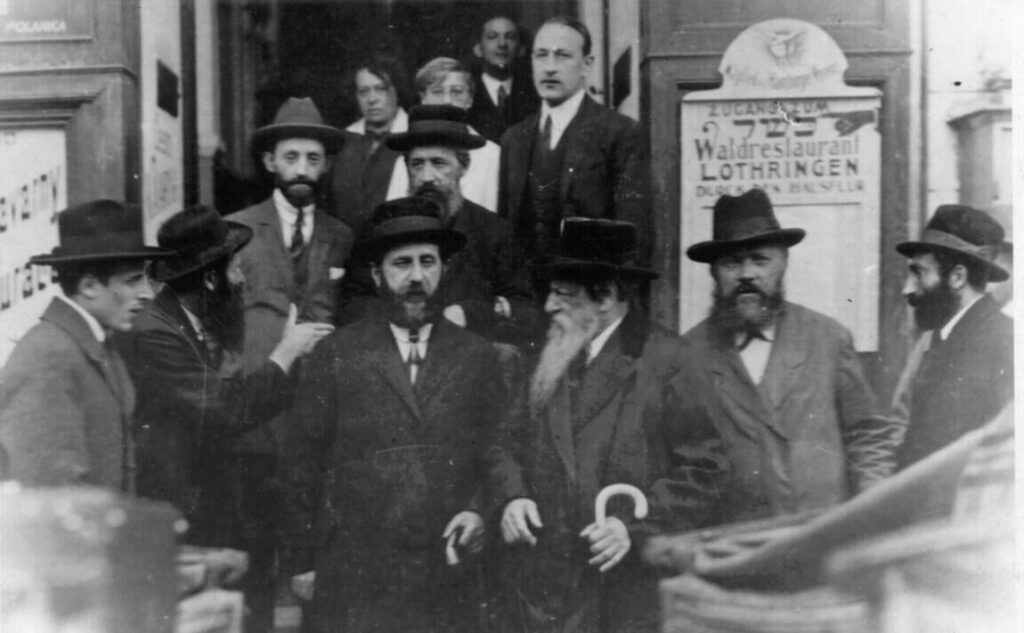
Rabbi Yisrael of Czortkow with his son, the tzaddik, Rabbi Dov Berinu
Yes, we hear the voices speaking to us in the name of Rabbi Ber, speaking to us from the sanctity of his life and deeds. Even after his passing, he warns, urges, and inspires us.
And so, we hear the voice of our holy teacher: “Return to the yeshiva after thirty days.” Great figures do not wish to remain the focal point of our thoughts and emotions. Once we have mourned the loss, we are called upon to return to life and to the activities of life, to the pursuit of a life of great purpose. Just as our holy teacher instructed the Sages to return to their studies and the yeshiva after the thirty-day mourning period, so too does Rabbi Ber call upon us to return to our work. He calls out: Return to the work of the Agudah—each of you to your post; this is the way to show gratitude to me, and the way to uphold the trust and the covenant of love we share.
“For the sake of Heaven!” – this was the driving force of his life. From it stemmed the meticulousness of his conduct, his love and gentleness toward others alongside his strictness with himself, his boundless energy, his unparalleled devotion to the Agudah, and his magnificent personality. We all loved this pure man, loved him with a reverence born of deep respect.
“A righteous man who walks in his integrity—happy are his children after him.” If we follow in his footsteps as children and builders, if his integrity, nobility, refinement, and piety come to live within us too, then we shall all, in honour of his name and memory, become a source of true fulfillment.