And He Said: Here I Am – Part 1
The final journey, filled with tears, of the holy Rebbe of Karlin, Rabbi Avraham Elimelech, may G-d avenge his blood, to the Land of Israel, on the eve of the war’s outbreak.
A terrible journey that left a bitter mark on hundreds of chassidim of the Old Yishuv (original Jewish immigrants to pre-State Israel in the modern era), who throughout their lives never forgot the tears, the cries, the farewell words and the dedication of a Jewish leader, who with saw everything with his holy eyes in advance, and could have saved himself, but preferred to be with the sheep of his flock in the “years we have seen evil.”
In honour of his yahrzeit (anniversary of passing) on the 14th of Cheshvan, when the holy rebbe and his entire family perished, may G-d avenge their blood.
By: Yaakov Rosenfeld, Ganzach Kiddush Hashem
Part 1
Karlin chassidism is among the first holy courts that operated in Ukraine from the second generation after the emergence of the light of chassidism, the light of Rabbi Yisrael Baal Shem Tov (chassidism’s founder)
Karlin chassidim numbered thousands throughout Russia, Poland, and Ukraine in the last generation before the Holocaust, and the six holy brothers, sons of Rabbi Yisrael z”l (known as the “Yinuka” and whose honorable resting place is in Frankfurt, Germany) served as Karliner Rebbes in various cities across Eastern Europe.
Karlin chasidism has its own unique characteristics, centered on the passionate prayer accompanied by loud voices and heartfelt roars. In Karlin, whenever there is a need, joy breaks boundaries and there are special “dance melodies” for it, stormy melodies that are now sung in many places, not necessarily in Karlin.
Karlin chassidism is also known for the famous moving melody “Kah Echsof Noam Shabbat,” which is sung with longing in many Jewish homes every Friday night. This melody was written by Rabbi Aharon HaGadol (the great) of Karlin, the father and founder of the dynasty.
In the city of Karlin, which at that time was under the rule of the State of Poland, the holy rabbi, Rabbi Avraham Elimelech Perlow z”l, served, and thousands of chassidim followed in his light. Rabbi Avraham Elimelech was a holy man, great in Torah and a lover of his fellow Jews. His chassidim adhered to him and were bound to him by love and commitment, renowned yeshivas stood under his presidency in Poland, and among his followers were great men of the world, including a large and high-quality group who lived in the Land of Israel. The rebbes of Karlin always encouraged immigration to the Land of Israel, and supported in many ways the developing Jewish settlement in the country.
His chassidim in Jerusalem, Safed, Tiberias, Tel Aviv, and more were closely connected to him and they would travel to Karlin on various festive occasions despite the conditions of those days.
The Karliner Rebbe, who always radiated joy and optimism, influenced thousands of his followers with serenity and trust in G-d, and each of his letters, and hundreds or perhaps thousands, remained like that, full of faith and closeness to G-d and with dews of revival of endless joy and enthusiasm.
A Change in the Letter Style.
The chassidim in the Land of Israel, who, due to the distance, were the primary addressees of his letters, began to notice from 5796 (1936) onwards changes in the Rebbe’s letter-writing style.
The Rebbe suddenly began to write in sorrow about the situation of all of the Jewish People, “especially in these countries” (Poland and all of Eastern Europe), and in many of the letters he writes with anxiety that can be seen between the lines in the face of “terrible decrees that have never befallen the Jewish People since they became a people.”
In his letters to the Land of Israel, he urged the inhabitants of the “Four Holy Lands” (Jerusalem, Hebron, Tiberias, and Safed) to prostrate themselves at the holy places and intercede for the Jews of Europe, and the public still did not grasp exactly what danger lurked for the millions of Jews living in Europe, what the Rebbe was talking about.
In those years, the Jewish community in Eastern Europe was the center of the Jewish People. In Poland, Lithuania, Hungary, and other Eastern European countries wheremost Jews lived; there were the yeshivas, all the chassidim, the rabbis, the rebbes. In Europe, a tremendous spiritual life was in full swing, a fierce spirit of action and activity pulsed in the large cities of Poland, Hungary, and Lithuania; Warsaw, as a proverb, was the “capital of the Jewish people”; in Lithuania, there were the great yeshivas – the center of the Torah, in Poland, tens of thousands of chassidim buzzed like beehives with burning enthusiasm and filled the courtyards of the righteous, which burned like a blazing fire; who could have imagined that all of this was about to end with a sword strike? Who could have imagined that in Europe a magical melody was playing that was just moments before its final chord, and after it there would be silence, a deathly silence.
Four times during his years as Rebbe of Karlin, Rabbi Avraham Elimelech traveled to the Land of Israel for extended visits. The first three visits were unforgettable days of celebration for the Karlin chassidim. During these days, the chassidim and their families forgot all their troubles and the poverty and sorrow that had been their lot, and were all swept away by the Rebbe’s special presence, who brought with him endless joy and enthusiasm.
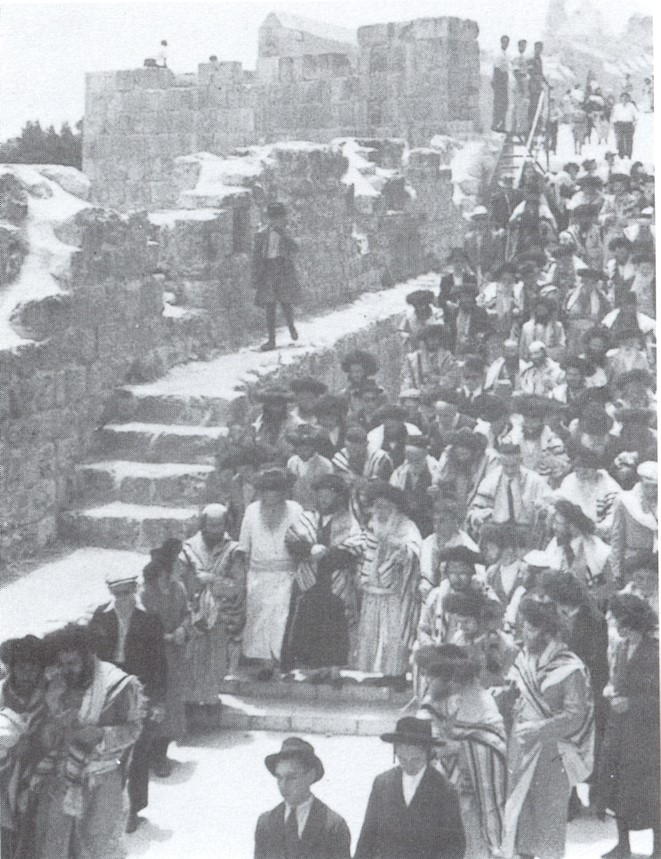
The Karliner Rebbe, Rabbi Avraham Elimelech Perlow, on his way to the Kotel (Western Wall) on Shavuot, surrounded by his chassidim
The last visit that the Rebbe of Karlin made to the Land of Israel in 5699 (1939) was different, and we will dedicate this article to that visit.
The elders of the daughter of Zion sit on the ground in silence (Lamentations 2:10)
The end was bitter. The revered Rebbe and all his family members – his wife, sons, daughters, grandsons and granddaughters – were all killed in sanctification of G-d’s Name. At first, the Rebbe would still send letters to the Land of Israel from burning Europe; later the letters stopped, and the chassidim in the Land of Israel did not yet know what had happened, and hoped that good news would come. But, to their sorrow, about six months after the war, the news reached the Land of Israel, and then, in the ancient “Beit Yisrael” synagogue of Jerusalem synagogue, where the Rebbe sat during all his visits to the Land of Israel, the elders of Karlin chassidism sat on the floor, weeping over the fire that God had burned.
The words of those days rose before their eyes; terrible words that were recorded, as was the custom of chassidim, immediately after they were heard from the mouth of the holy one (the Rebbe); words that at the time sounded like prophecies of wrath that were hallucinatory and disconnected from reality, were read with tearful eyes and hearts torn with astonishment and gloomy grief.
The Rebbe knew and saw, and warned, and cried, and wailed, and pleaded, and his words did not enter the heart. Who thought in those days of peace that all of glorious European Jewry was on the verge of complete annihilation? Who believed that within a short period of time the knife would rise against the largest Jewish settlement in the world? Who imagined that the fate of huge Polish Jewry was sealed, to be “raised upon its alter” with all its great ones, its rabbis, its young and its elders, “young men and women, old and young”?
Let us walk the paths of that visit, accompany the holy Rebbe on his journeys, participate in prayers, listen to hair-raising words, and understand the power of the “self-sacrifice” of a Jewish leader, who could have stayed here, in the Land of Israel, far from the horror that was about to unfold, far from the calamity that was affecting all of the Jewish People, but preferred to return to his flock in the dying Poland, where he gave his soul as an innocent sacrifice, and he and all that he had ascended in the heavenly storm.
The Welcome
The Tune that was Stopped
As we mentioned earlier, the Rebbe of Karlin’s previous visits to the Land of Israel were like a long holiday for the chassidim and their families.
And so, on this occasion too, in the summer of 5699 (1939), when the chassidim heard that the Rebbe was planning to come to the Land of Israel for a long visit, excitement enveloped everyone, and on the appointed day, the eve of Rosh Chodesh (the first day of the month) Sivan 5769, hundreds of chassidim, young and old, gathered at the new Tel Aviv port, where the Rebbe’s ship was docked.
And immediately, at the appointed hour, when the ship docked and the Rebbe’s figure was seen, clear and shining, everyone began to dance vigorously to the sounds of a cheerful tune. However, the Rebbe, whose simple and pure joy frequently characterized his image and captivated those around him, stood in front of the joyful chassidim and with a stern face ordered the singing to stop immediately, saying:
This is not an appropriate time for joy.
And he added:
There is no reason to dance right now.
This visit is not like all my visits here so far, now we have come here only to prostrate ourselves in the holy places with tears and supplications to remove the evil of the decree…
The Rebbe repeated the clear instruction again:
Stop the singing and dancing!
The Rebbe went down to the port and all the chassidim surrounded him. They all wanted to approach and shake the tzaddik’s (righteous man) hand. However, before extending his hand in greeting, he announced with an emotionless facial expression:
We did not come here to visit.
We came to arouse the mercy of Heaven for our Jewish brethren in Poland and throughout Europe, who are in great trouble.
Black clouds are hovering over the skies of Europe!
This is not a time of happiness and joy!
I have come to ascend to the holy places and to arouse the mercy of Heaven,
Perhaps He will have pity on the poor and needy, perhaps He will have mercy.
Panic spread throughout the community, and many chassidim pondered the meaning of the harsh words the Rebbe had just uttered. Some recalled the strange language the Rebbe had used in his recent letters, and feelings of anxiety rose in their hearts.
The buses that brought the revered Rebbe’s guests turned back, carrying a “heavy” human load, much more than a panic… Everyone sat collected in themselves, hoping that this was just a difficult beginning to a noble and exalted holy journey, at least like the Rebbe’s previous visits, which left a strong mark of transcendence and love.
But no.
The continue was even harder.
Over the years, when the chassidim, most of whom are no longer alive, would sit together at chassidic gatherings and recall those days of terror and anxiety, their eyes would well up with boiling tears and their hearts would be torn with sorrow and grief, because everything was so transparent and so clear, and yet people refused to believe, they would not accept it.
A Day of Fasting and Awakening
The eve of Rosh Chodesh Sivan.
The Rebbe declared a day of fasting and awakening. Hundreds gathered at the Karlin chassidic synagogue. The Rebbe instructed the entire congregation to gather again at midnight at the Kotel for “Tikkun Chatzot” (midnight prayer lamenting the destruction of the Temple in Jerusalem) and said in a mournful voice:
It is a time of trouble for Yaakov (i.e. the Jewish People), and we have no other choice but to pour out our hearts in a place from which the Shechinah (G-d’s presence) has never moved; “Arise, cry out in the night, at the beginning of the watches; pour out thy heart like water before the face of G-d; lift up thy hands toward Him for the life of thy young children, that faint for hunger at the head of every street.” (Lamentations 2:19)
Many notes were piled up on the Rebbe’s desk, notes from chassidim who wanted the Rebbe to intercede on their behalf at the remnants of the Temple. However, the Rebbe refused to look at them at all. He said with pain: “This is not the time for private requests. This is a time of trouble for all of the Jewish People, and we must cry out for the mercy of Heaven.”
Many of those present were astonished by the anxiety that shone from the Rebbe’s eyes and words. Some wondered whether, according to what was published in the press, on the contrary, there was a certain calmness felt among the European countries in those days, and certainly no one imagined the terrible disaster that was taking place and coming upon European Jewry.
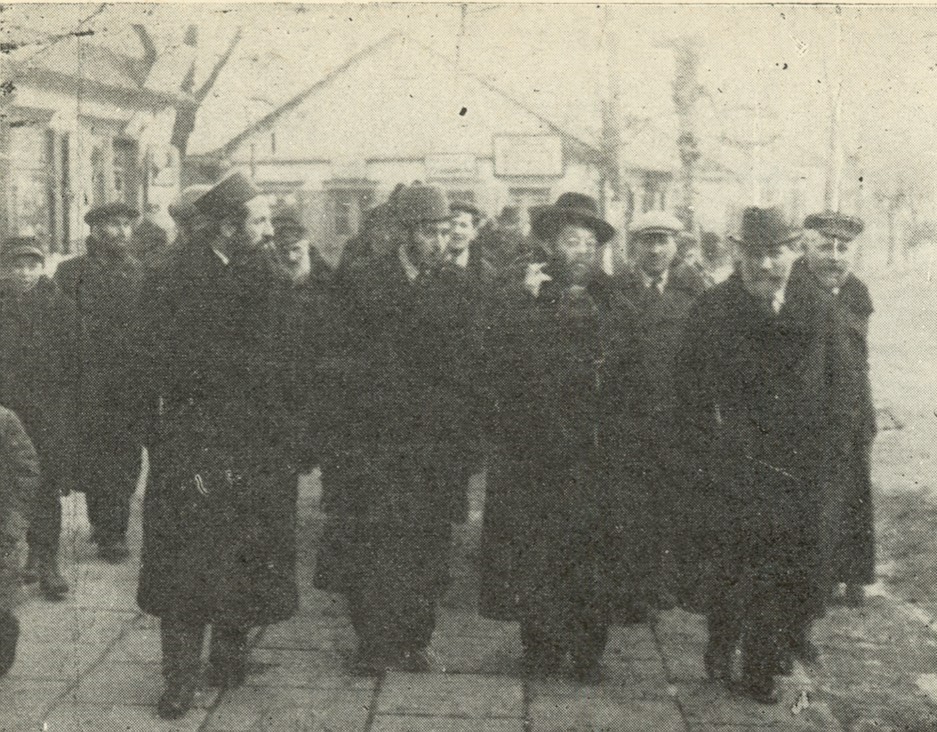
Rabbi Avraham Elimelech Perlow, the Karliner Rebbe, visiting the town of Sarny (then in Poland, now Ukraine). Next to the Rebbe is the Rosh Yeshiva (head of yeshiva), Rabbi Yisrael of Pinsk
After the assembly, the Rebbe called the elders and leaders of the community to an urgent meeting. As they entered the room, his head was bowed, his face as pale as chalk, and in pleading way he expressed his heart’s desire:
To gather advice and find ways to awaken the whole Jewish People to cry out and beg for the harsh and terrible decrees that are about to happen to our brethren throughout Europe to be overturned. We need to awaken the mercy of Heaven so that the vile plots of our enemies who plan and seek to destroy, kill, and wipe out the entire Jewish People, may God help us.
His words were sharp and hard as sinews, and they pierced the pure hearts of the pure-minded in Yerushalayim, until one of them, the eminent Rabbi Fishel Bernstein z”l, who was the head the beit din (rabbinical court) in Jerusalem, dared to ask the Rebbe:
Why does the Rebbe scare us so much?
And the Rebbe sighed and answered quietly:
The entire terrible description that we discovered and described in public is quoted from what we saw, black against white, in a terrible letter that I have from the Baal Shem Tov z”l.
The judge Rabbi Fishel asked the Rebbe to show him the letter, but the Rebbe refused, claiming:
I would show it to you. It says much worse than what I discovered, but what good would reading it do you? It will only disturb you and you will not find peace for your soul!
One of the participants in the gathering, who was very emotional and could not control his spirit and calm down from the intensity of the terrible things he heard, blurted out:
According to the Rebbe’s description of the gloomy situation that the Jewish People are in, and what is to come upon all of the Jewish People, since the destruction of the Temple, there have not been such troubles for the Jewish People!
The Rebbe sighed and said:
Since the destruction of the Temple?! Such troubles that are emotional and coming upon all of the Jewish People have not existed since the creation of the world!
The Rebbe clapped his hands with strange emotion, fell silent, and asked the elders of the chassidim sitting across from him:
What should we ask for, whether there will be a war or not?
One of the elders of the chassidim answered and said: As long as there will be no war!
However, the Rebbe did not agree… He looked at that chassidim and said quietly:
May it be as you say. However, if the oppressor conquers without war, who knows what will happen… because if there is war, then the nations of the world will ultimately prevent the complete disaster of all of the Jewish People, and there will be a complete salvation for the remnant of the Jewish People, which is not true if there is no war… who knows what will happen? What will remain of all the Jewish People?
And as he spoke, the Rebbe stood up to his full height, his appearance terrible, and his eyes shining with horrible fear, and said:
You in the Land of Israel will not lick honey, but nevertheless the Land of Israel is different from all other lands. But we are outside the land – who knows what will happen? What will happen to the Jewish People, what will happen to them? Shake the worlds and ask for mercy, and see that each one corrects himself. Perhaps G-d will have mercy on His people.
Oy! Hiding from him!
In the days following the gathering, the Karliner Rebbe sent several people close to him to the Rebbes and tzaddikim of the Land of Israel, to hear their opinions on the difficult situation. There were tzaddikim with whom the Rebbe met personally, but they did not understand “what this storm was about.” Many of them felt that the Rebbe had entered into an unnecessary panic and even tried to calm him down. After parting ways with one of the great tzaddikim who did not see eye to eye with him about what was to happen to the entire Jewish People and even tried to argue with him, the Rebbe left his residence and said in pain:
Oy, mivehalt gun Him (Oy, you are hiding from him).
And after another tzaddik met with him and expressed his astonishment at the great storm that the Rebbe was stirring up for nothing, the Rebbe said with bitter tears:
Oycht fun him behalt men. Oy. (They hide from him too. Oy.)
On one of those days, he traveled to Tel Aviv to meet with the Rebbe of Husiatyn, Rabbi Yisrael z”l, the “Elder of the Rebbes of Ruzhin.” He closed himself off with him and spoke with him about the world situation following the developments in Germany. It was clear that the Rebbe was calmer than before, and that he was trying in every way to arouse the peace of the faithful Jews and the righteous of the generation to cry out a great and bitter cry.
Terror and Trembling – The Terrible Journey to Meron
On the holy Shabbat of Parashat (the weekly Torah reading) Pinchas, 21 Tammuz 5699 (1939), the Rebbe was staying with the chassidim in Tiberias, and the plan was to go to Meron on Sunday, the 22nd of Tammuz.
At that time, Meron was completely closed, no one could go out or come in. The place, and especially the road leading to it, was taken over by the Ishmaelite murderers, and for several years, since 5796 (1936), almost no Jews had gone up to prostrate themselves at the Rashbi’s (Rabbi Shimon Bar Yochai) tomb. At that time, riots were rife, and there was a real danger to the lives of those who went to the Rashbi’s tomb in Meron.
Fear of death reigned on the winding climb to Meron, in whose crevices Ishmaelite murderers hid and would often shoot at vehicles that reached the top of the mountain, and therefore the Rebbe’s associates tried to dissuade him from traveling to Meron. However, the Rebbe would not give in. He firmly argued that when the future of all of the Jewish People was at stake, there was no choice but to tear down the gates of Heaven at the holy place, tomb of the Rashbi, may his merits protect us.
Motzei Shabbat Kodesh (Saturday Night) in Tiberias
It is two o’clock in the morning. Several chassidim are standing at the foot of the Rebbe’s inn. They are discussing the strange statements that the Rebbe has been making lately, sometimes with terrible, interrupted, heartbreaking, and shocking cries.
The Rebbe has long since gone to bed, ostensibly, and the chassidim are speaking in whispers so as not to disturb the Rebbe’s rest, G-d forbid, or the rest of the neighbors, at this late hour.
Suddenly, a noise was heard from the balcony on the first floor. A door opened and the Rebbe’s figure appeared in the doorway.
The Rebbe did not look well. His face was pale and his eyes were red, and he quietly whispered to the few chassidim standing below:
When I think about where I am going to enter tomorrow morning, and what we need to do, I cannot fall asleep (from too much tension and emotion).
His close chassid, the pious Rabbi Aharon Haltovsky, said: “Please, Rebbe, take a sleeping pill!”
The Rebbe replied: I have already swallowed two and they were of no use.
The chassidim were horrified. They saw the terrible mental stress the Rebbe was under and the inhuman efforts he had been making in recent days, and they said to the Rebbe: “G-d forbid the Rebbe will not bear this! (meaning he is about to collapse from exhaustion),” and the Rebbe replied in a voice that was not his own:
Halt men nisht oys! (So I won’t withstand it…and what?)
The chassidim were terrified by the Rebbe’s situation, perhaps more than by the mysterious “decree” about which he was making the world tremble.
Indeed, the winds of war were already in the air, but who could have imagined what was to happen to the Jews of Europe, the great community of world Jewry.
Finally, morning arrived, and the crowd sat on the bus that was to leave for Meron, but the horror show was not over. The Rebbe got out of his vehicle and asked to get on the bus. He got on and with a strange expression moved from seat to seat, asking to survey the faces of the passengers, and asked them to mentally prepare for the prayer in Meron, since we are facing an existential danger for all the Jewish People, and concluded: Rabbi Shimon is worth leaning on in a time of need.
They arrived in Meron.
The Rebbe entered alone into the holy tomb of Rabbi Shimon Bar Yochai and asked everyone to wait outside.
After a long hour of solitude in the tomb of the Rashbi, everyone entered, and the sight that unfolded before their eyes was terrible. For decades and more, the chassidim would have difficulty remembering this horrific vision, let alone talking about it.
The tomb was full of dust. They could see almost nothing but a fairly thick layer of dust, as no one had entered the Rashbi’s tomb for a long time due to riots. In a corner stood the Rebbe, pale as chalk and his eyes swollen from crying. His appearance was that of a dead person, there was not a drop of life on his face.
The Rebbe shook and cried out with a groan:
Call upon the Lord with strength!
(The verse stems from Book of Jonah, when it describes the residents of Ninveh when they received a decree of desctruction)
The crowd erupted in terrifying roars until they began to fear that the cry would reach the ears of the inhabitants of the surrounding Arab villages, and then, G-d forbid, they would be swallowed…
The chassidim who were present at this prayer would say all their lives that such a prayer turned their insides and broke their hearts. It was not forgotten by them until the last days of their lives.
After the prayer in Meron, the Rebbe turned to the congregation and ordered them to travel to Safed, to the ancient cemetery.
Standing at the foot of the mountain where the holy Ari, the Beit Yosef and the other righteous are buried, the Rebbe raised his eyes and began to recite the well-known elegy of Rabbi Elazar HaKallir:
Then Yirmiyahu went to the tombs of his ancestors
And there were many beloved trees
Why do you lie down?
Your sons are exilees and their houses are ruins
And what is the right of fathers in the land of sorrows:
They all have come to their nests
For the lacking of the children
They cried out with a voice of supplication
In the face of a oppressed man
And where is Your promise? And I Remembered My first covenant with them…
The Rebbe prostrated himself on the tombs of the righteous and wept bitterly, and after returning from the tomb of Beit Yosef he looked at those around him and said:
Oh, we thought we had done something… We thought we would do something…
Oy Poylishe Yidden (oy Polish Jewry), Poylishe Yidden zenen farloyren (Polish Jewry is lost)! Ma yihiyeh al yehudei Krakow, oy azo Krakow (What will be with the Jews of Krakow, oh Krakow)?
His lips muttered again and again about the Jews of Poland, and the anxiety was indescribable. And so in silence the Rebbe returned to his car and drove to Jerusalem.
After that prayer, the Rebbe sent the chassid Rabbi Zalman of Brizel (who passed away in 5760/1999-2000 in Jerusalem) to one of the tzaddikim of the generation who lived in Jerusalem and asked him to ask him if he saw what was going to happen to the Jews of Europe. Rabbi Zalman returned to the Rebbe and informed him that the tzaddik had answered him that with the help of G-d everything would be fine and that he did not see any special decree regarding the Jews of Poland and Europe.
The Rebbe heard and a tremor gripped his entire body. He sighed deeply and said: Oh, they are hiding it from him too!
Black Clouds Over Europe
The days dragged on, and the Rebbe’s visit turned into days of anxiety and anguish for the hundreds of chassidim who loved the Rebbe and waited impatiently for the words of encouragement and joy that, in regular times, would flow from his mouth and shower them with the dew of revival.
The chassidim waited for a refreshing breeze of joy and optimism, but in vain. The Rebbe was in terrible anxiety and did not cease to stir up worlds so that would be repentance and petitions in prayer because a decree had already been made. Over and over again he repeated the terrible sentence: I see black clouds over Europe.
Thus the days of Tammuz and Av passed, and the month of Elul arrived. On the 14th of Elul, the Rebbe planned to board a ship bound for Poland, his country of residence.
On one of the days of the beginning of the month of Elul, the influential men and leaders of the community gathered for an urgent meeting, in which it was decided to prevent the Rebbe from returning to Poland at all costs. They decided on a course of action on how to obtain entry visas to the Land of Israel for all members of the Rebbe’s family, matters that required the Rebbe’s approval and cooperation.
The chassid Rabbi Alter Shiffman approached the Rebbe and asked:
Is it permissible for the Rebbe, from a halachic perspective, to return to a “dangerous place”?
The Rebbe heard the question, got on a chair and took down a book from the high cupboard, leafed through it, and read from it: “The Holy One, blessed be He, hates a leader who abandons the flock of his shepherd in times of trouble and danger”…
And he said: All my desires and all my will on earth is to fulfill the will of my Father in Heaven and to find favour in His sight. Now, if a decree has been issued, will I do something that will cause the Holy One, blessed be He, to hate me?
When the devoted chassidim in the Land of Israel realized what the Rebbe was planning to return for, they decided in their hearts to prevent the Rebbe from returning to Poland at all costs. Even if the Rebbe got angry, and even if the execution required them to lie under the wheels of a car.
The Chassidim discussed among themselves the desired courses of action, they were energetic and decisive and decided that nothing in the world would prevent them from stopping the Rebbe from returning to Poland, after such gloomy prophecies that he himself had uttered.
They were still discussing their plans, when the Rebbe came out of his room. With measured steps he approached the chassidim who were whispering at an angle and said to them with a strange expression: If you do so, you will tear out the hairs of your heads! I am going to my city to be with the members of my community and with the Jewish People who will be in trouble and captivity, and I warn you not to bother me.
The last day arrived.
The Rebbe’s farewell to his followers was heartbreaking. The feelings were difficult, and as if what the Rebbe had said so far during his visit to the Land of Israel were not enough, the Rebbe suddenly took off his upper rabbinical robe, handed it to his chassid Rabbi Aharon Haltovsky, and said to him: There, when we have to run and escape, it will be easier for us without this robe!
Then he took off his gold glasses, a priceless inheritance from his father, the Rebbe of Stolin, and his pocket watch, also made of gold, handed it to Rabbi Aharon and said: The wicked should have fewer valuables than us…
The Rebbe said goodbye to his chassidim and boarded a car that made its way to the port of Jaffa. The atmosphere in the car was very charged, and when they arrived at the port, it became clear that they were late and that it was no longer possible to board the ship.
The Rebbe ordered the driver to drive to the port of Haifa, perhaps they would make it there, but one of those present indicated that they would apparently miss that station as well. The Rebbe heard and said, “If only we were late.”
One of the assistants sat in the back and decided to throw the Rebbe’s passport out of the car, so that he would not be able to board the ship and G-d willing his life would be saved.
The thought only crossed his mind and the Rebbe immediately turned to him and said with a stern face:
Alein tot men gornisht mir zenen bei G-tt in di hent! (Alone we do nothing. We are in G-d’s hands!)
It was the night of the 14th of Elul 5699, three days before the outbreak of WWII, the ship sailed for Europe, and after a arduous sea voyage, it anchored in the port of Castaneda in Romania, and that same day the cursed Germans had already invaded Poland. Rumours of the outbreak of war had also reached Romania, and for this reason many of the ship’s passengers preferred to remain there. But the Rebbe and his companions still managed to board the last train that went to Poland.
This ship was the last to leave the Land of Israel. The holy Karliner Rebbe did indeed arrive in Poland at the last minute, and even then the chassidim did not stop doing everything in their power to smuggle him out of the Valley of Tears, and through the efforts of Rabbi Herzog, a permit to enter the United States was obtained for him. However, a decree had already been made and the Rebbe’s end was the same as the fate of most of the Jews of Europe, and he and his entire family were killed in sanctification of the Name of G-d on the 14th of Cheshvan 5703 (Oct. 25th, 1942), just over 80 years ago.
In the following articles of this series, we will present information about the Rebbe’s experiences under the Nazi regime and their Ukrainian collaborators, and various revelations about the Rebbe’s final days.
To read part 2, please click here.