And He Said: Here I Am – Part 2
Part 2 of the series commemorating the Karliner Rebbe, Rabbi Avraham Elimelech Perlow z”l, may G-d avenge his blood.
To read part 1 in the series, please click here.
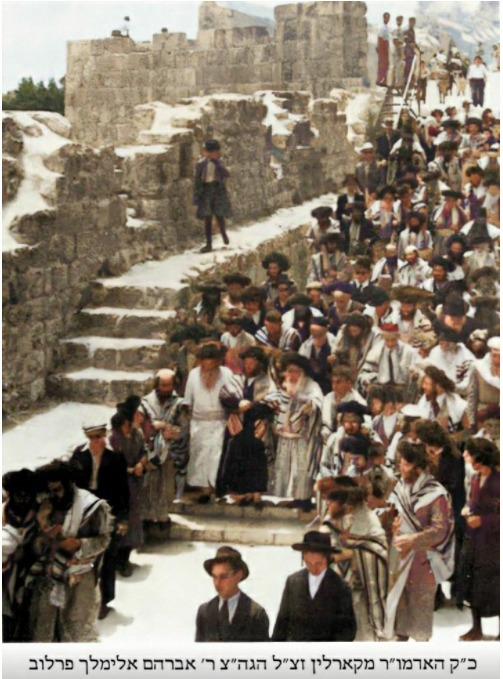
The Rebbe and his followers on the way to the Western Wall
Before I continue with the description I have collected from various places and from the lips of veteran chassidim, I will present an interesting testimony, a newspaper clipping in which a Polish Jewish writer tells of his visit to the city of Pinsk in the interwar period, with an emphasis on his visit to the synagogue of the Karliner Rebbe.
Below is the document from Ganzach Kiddush Hashem, accompanied by background information by Yaakov Rosenfeld, writer at Ganzach Kiddush Hashem.
Under the title “The City of Pinsk is Dead,” a popular magazine in Kalisz, Poland, describes the impressions of a writer who toured the city of Pinsk-Karlin after World War I and saw its poverty and sorrow.
Before the war, Pinsk was a rich city, surrounded by forests and bordered by a large river that imported and exported goods and cargo.
Until the war, before the huge forests that bordered it came under Russian rule, Pinsk was a rich city in the full sense of the term.
Many ships docked there every day from all over Russia, Ukraine, and Poland. In Pinsk there were countless Jewish merchants, manufacturers and brokers. Many Jews worked in factories, there were hotels, restaurants, shops; in short, there was life.
A few years had passed since the First World War and the Jews, as the author, a Jew from Poland, describes, were mourning the glorious city as one mourns a deceased person.
According to him: All the fury of the war had descended on Pinsk. The city, which had already been rebuilt after the great fire of 5681 (1920-1), was full of sorrow, hunger and poverty. Poor vendors were trying to sell their wares, and there were no buyers…
The author then describes the yeshiva students, around a hundred in number, giving up their lives to study Torah, while poverty is evident on their faces.
But he expresses his greatest admiration for the sights he saw in the beit midrash (study hall) of the great Rebbe, Rabbi Avraham Elimelech, may his merit protect us, things he never imagined he would see, and these are his words:
For me, as a “Poylisher” (Polish Jew), it is hard to believe that what I saw in Pinsk actually happened in reality, and that I was not dreaming…
Among us, Polish Jews, it is accepted that Lithuanians (very strictly Orthodox, yet not chassidic Jews) are dry, oppositional people, people with “intellect” without emotion (…) and here I enter the Stoliner Rebbe beit midrash and I see the sight that that Polish chassidim were allowed to come and learn from…
Lithuanian Jews sit at a long table, around a rabbi who is adorned with a shtreimel (chassidic fur hat) on his head. The Jews play chassidic tunes, very happy, and then, they move on to mournful, sad songs, emotional songs, and again burst into happy tunes… Little children hang on to their fathers, and watch.
The majority here are poor, destitute, “derschlogineh” (“beaten”), and only near the Rebbe are there a few Jews who look like rulers. There is even one here (…) a hotel owner, I was told.
Among the adults are “yungeleitlach” (a nickname for young married yeshiva students) with peyos (sidecurls) as big as a puppy…
And suddenly, everyone gets up and starts dancing, and the place shakes. Jews come in droves, young men, yeshiva students, and children dance in a frenzy while looking at the Rebbe who stands aside with devotion, with closed eyes (…)
I see a Jew who is old, with a long white beard, and he is dancing devotedly with a youth. Hand in hand.
Jews from Pinsk tell me about him: He is poor, a poor Jewish tailor, he works very hard for a loaf of bread, and the young man with the peyos is his son who sits and studies and his father supports him.
If I hadn’t seen it with my own eyes, I wouldn’t have believed it. With so many troubles, wars, sorrow and poverty, will there still be such Jews in these regions?

The Karliner Rebbe, Rabbi Avraham Elimelech Perlow z”l
This list was written a few years before the Holocaust, which, as mentioned, the Rebbe foresaw and made a world of noise about. In the previous article, we read about the pleadings of the chassidim that were of no avail, and how the Rebbe sailed on the last ship from the Land of Israel to Poland. Straight to bloody Poland went the Rebbe, who had Ruach HaKodesh (a Divine Spirit) and foresaw everything.
Five years passed, and the chassidim in the Land of Israel were torn apart by worry and longing. No one knew what was happening to the Rebbe, who was all love and devotion, all heart.
And when in 5705 (1945), at the beginning of the summer, the bitter news reached the Land of Israel, news that was confirmed by witnesses, and also had an approximate date, the 14th of Cheshvan, the chassidim were struck with astonishment.
Heartbroken, the chassidim sat in the old synagogue in Jerusalem, a place where the Rebbe had served his Creator during his four visits to the Land of Israel; a place where he had tearfully parted ways with them and revealed what they did not want to believe at the time.
The veil of the Torah ark was removed, and as on the night of the Tisha B’Av fast day, the people wept, mourning and sitting alone…
There had been almost no contact with the chassidim since the Rebbe consciously set sail for his final journey, the Valley of Trials in Poland, except for a few telegrams that he initially sent to his chassid, his confidant, Rabbi Aharon Haltovsky z”l.
What is known is that the ship docked in Constanta – a Romanian port city on the coast of the Black Sea, the capital of the Constanta district. The Rebbe hoped to be able to reach Karlin quickly from there, but due to the outbreak of war, the Rebbe was forced to delay in this city, and from there he sent a letter to the chassidim in Jerusalem.
The letter is addressed to Aharon Haltovsky in the Beit Israel neighborhood, and it is clear that the Rebbe seemed to have read what was going to happen in Poland in the coming years. What at first seemed perhaps the beginning of a war, as difficult as war is, the Rebbe saw as a terrible calamity for Polish Jewry. This letter is a continuation of the Rebbe’s piercing cry during his visit to the Land of Israel, a visit that ended only a few days prior.
To all my beloved friends, residents of the holy cities of Jerusalem, Tiberias, Safed, Tel Aviv, Haifa, peace and all the best to all.
I am still in Romania …(?) May G-d help me reach my desired destination easily and not with sorrow, G-d forbid.
Upon your acceptance of this, immediately cause a great awakening among all the rabbis, and also send a messenger to the rebbes who reside there, to stand in prayer and supplication, and in particular before the remnant of our Temple, on behalf of our brethren, the children of Israel in Poland, who are in great trouble, that G-d may have mercy on them and bring them out of suffering to relief and from darkness into light and from bondage to redemption soon.
For every moment will be counted as a year.
They will also declare a public fast so that G-d have mercy on them, and may I also be worthy to be among the saved,
And may we still be worthy to see G-d’s return of of His people (…) with great mercy.
And may we still be worthy to come to the Holy Land soon.
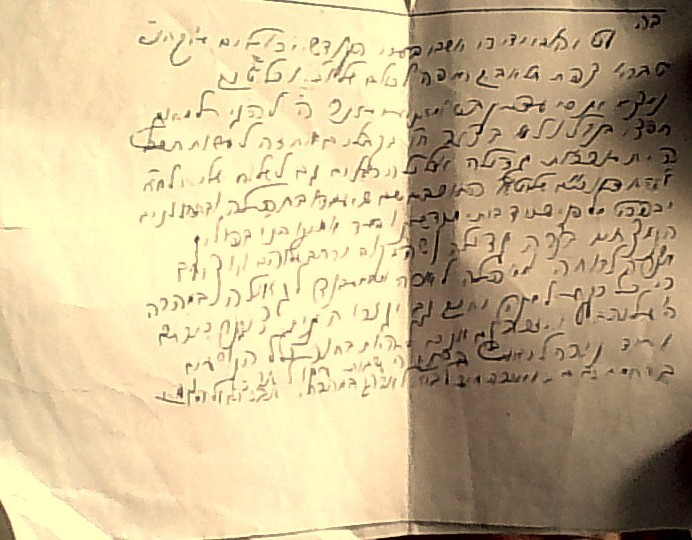
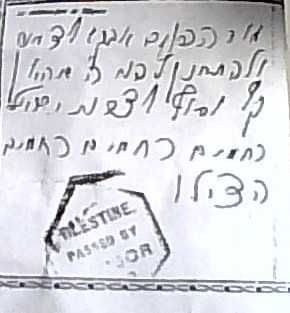
On the opposite side of the letter, the Rebbe wrote:
Once again I will cry out and beg G-d to put an end to the Jewish People’s troubles.
Mercy, mercy, mercy, save us!
When the letter reached the Land of Israel, it caused great anxiety, and from the day it was received until the end of the war, the Karlin chassidim, organized by the head and elder of the chassidim, Rabbi Yehoshua Heshel Haltovsky z”l, gathered every day for prayer and supplications and the recitation of Selichot and chapters of Psalms. Every Rosh Chodesh (the first day of the Jewish month) evening, they would visit holy places and Rachel’s Tomb and shed tears like water to save the great Jewish community in Poland. However, a decree had already been made…
After a long stay of perhaps a few weeks, the Rebbe managed to board a train and arrived in Pinsk.
On the 7th of Tishrei 5700 (Sept. 20th, 1939), the city passed under Russian control in accordance with the Ribbentrop-Molotov Pact, for a year and a half. At the beginning of winter, the Rebbe was put on a train en route to Siberia, as part of the Soviet regime’s persecution of rabbis. The Rebbe was already sitting on the train, and finally, after much effort, the chassidim managed to pull him off.
Testimony from the shochet (ritual slaughterer) of Karlin, Rabbi Shlomo Gaier z”l, that was sent to Siberia together with the rabbis and other religious workers.
All that time, the Rebbe sat in silence and did not cooperate with the efforts to free him. It seemed that he was surrendering himself to G-d and was not doing anything himself. Only when the chassidim managed to stop the train and delay it for a while did the Rebbe yield to the entreaties of those close to him and got off the train. Only after a long time did we realize that this was not a rescue, and if only the chassidim had not succeeded in their efforts, for in Siberia the Jews suffered but remained alive, compared to those who remained in Poland, whose end was bitter.
The Rebbe remained in Pinsk, under the watchful eyes of the Soviet secret agents who followed him non-stop. The Rebbe was frequently called for interrogation at the notorious NKVD headquarters, but he never ceased to be a beacon of light for the Jews of the area. He would comfort the brokenhearted and shower them with joy, and would whisper words of Torah and consolation in their ears, and would shine a light on Shabbat and holidays, which for him, even in the darkness of those days, were a source of endless life and joy.
Additional and fascinating documents from our archives will be added to the third article of the series. To view part three, please click here.