And He Said: Here I Am – Part 3
The third installment of our series about the Karliner Rebbe, Rabbi Avraham Elimelech Perlow z”l
By: Yaakov Rosenfeld
To read part 1, please click here. For part 2, click here.
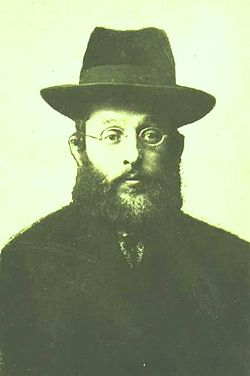
A Life of Self-Sacrifice
In the previous chapter, we told about how the Rebbe remained in Russian-controlled Karlin. Under the watchful eyes of the NKVD agents, he continued his work, shining a light of joy and faith in the hearts of the Jewish People. His actions were a disgrace to the government officials, but he did not for a moment think of stopping. Leaving the Jews exposed to decrees without spiritual support and a source of chassidic vitality – this was not an option for him at all.
We know of at least one interrogation he experienced at the NKVD headquarters that cast terror on everyone, to which the Rebbe alluded in a letter to Rabbi Aharon Haltovsky, which we are reprinting here exclusively (courtesy of the Pinsk Karlin Chassidic Publishing Institute):
With G-d’s help
All the best to my dear friend Rabbi Aharon Haltovsky
The honourable sender of this letter, Mr. Gershon, will deliver everything. It is impossible to write much, even a little, what is written here is too much and he and all our friends in the Holy Land will certainly understand that it is a danger to lives. And they will hasten to do all the advice to save. Once again I am writing because it is impossible to write any more. I hope this reaches you.
Whatever the letter sender tells you, do quickly.
I wish peace to all our friends in the Holy Land.
Avraham Elimelech of Karlin
To arouse compassion in holy places for the sake of the community and for our own sake.
Rambam (Maimonides), Hilchot Yesodei HaTorah, Chapter 5, Law 4
Chassidim who knew the Rebbe’s style and his way of thinking were horrified by the last line. Maimonides speaks in chapter 5 of Hilchot Yesodei HaTorah about the law of “he shall be killed and not transgress.”
When the letter reached its destination, the chassidim did not know or understand what this line implied. They only understood that the situation was on the verge of “sacrificing one’s soul,” and it is easy to imagine what feelings these few words evoked in the hearts of the chassidim who saw themselves as sons of the revered Rebbe.
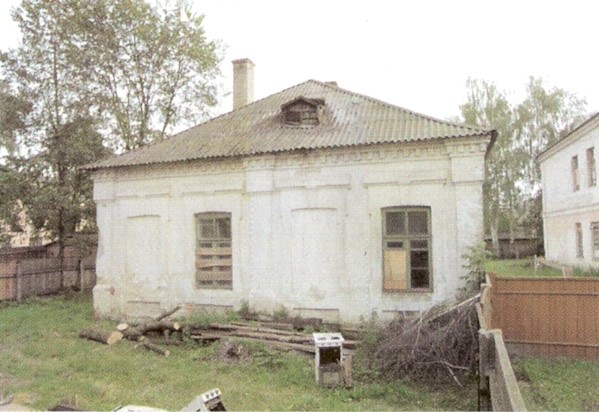
Rabbi Aharon the Great of Karlin’s synagogue in ruins
Only years later, when the evidence had been woven into a grim picture; when the terrible reality slapped the chassidim in the face and was spread out before them as it was, terrible and blood-curdling, only then did they understand what the few and vague words were referring to.
Indeed, the Rebbe experienced a life of self-sacrifice to the point of death in that episode, and for the chassidim who were deeply and lovingly attached to him, the things were indigestible.
Many years after the Holocaust, when the chassidim would sit together and talk about the Rebbe, their eyes would flow like a river of tears. These were tears of longing for the beautiful days they experienced in the Rebbe’s shadow during his visits to the Land of Israel and on their frequent trips to Karlin, longing for the pleasantries of the Garden of Eden that were in the surroundings of the wondrous man of G-d, whose pure, crystal-clear eyes shone from the depths of his face and illuminated hearts, setting souls ablaze.
But these were also tears of piercing sorrow and grief, for the terrible loss, and even more so for the terrible days that were the lot of the beloved Rebbe at that time, in the days of the decline of glorious Eastern European Jewry, between the evenings, between the sunsets, before the terrible end that left Europe scorched and emptied, devoid of all goodness.
New Residents in the Rebbe’s Home
Let’s go back to that period, when Karlin was under Russian control, when its residents followed the Rebbe who did not surrender but continued to spread the light of Torah and chassidism precisely in the Soviet cold, and illuminated the hearts of countless broken-hearted Jews who waited for his words and the expression of his pure eyes, in which a spark of hope and vitality frequently sparkled.
One bright day, the Rebbe, who lived in a handsome and well-kept house, was informed by the housing department of the city council that a government official, a gentile of course, would be sharing the house with him in the immediate future.
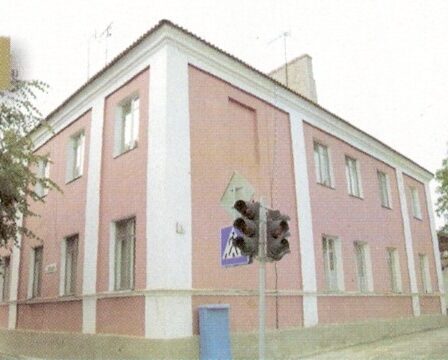
The home where the Rebbes of Karlin lived in the Pinsk suburb of Karlin, today in Belarus
The clerk was then told that the kitchen of the Rebbe and his family would also be at his disposal, and of course, the Rebbe would also be allowed to use it. There is room in the kitchen for two families, and in times of war it is not appropriate to be strict about such things.
So the clerk and his family moved in to live with the Rebbe’s family, and soon he took over the kitchen, and the household was forced to breathe the air of the non-kosher meat of the falcon, which had been roasted in their oven.
The family members began to adapt to life without a kitchen, as sharing the same kitchen with people who eat other things, scavengers, and prey was not an option.
But this was only the beginning of an era, a bitter medicine like wormwood.
Because in the meantime, as during a war, and another world war, the money in the house ran out, and the Rebbe and his family began to suffer the shame of hunger. The household members began to sell furniture and belongings, and very soon there was almost nothing of value left in the house, except for a narrow, long, and heavy table; a bare and empty table, a table that had known better days than these, for around it sat ardent chassidim on Shabbat and holidays, singing praises to G-d, in unity and with love for one another.
In the center of the spacious room, which was empty and gloomy, stood this long table, a memorial to the good old days, a living monument to the memory of the days that were and are no more.
Holocaust survivor Rabbi Feivel Ginzburg, zt”l, said:
It was in the month of Elul of 5700 (1940), when I stumbled upon the Rebbe’s house on Karlinska Street. The morning was gray and gloomy and the Rebbe had not yet returned from morning prayers. When I entered, I discovered a very disturbing picture of poverty and misery, poverty oozing from every corner of the house. What stood out to me most was the lack of furniture. Only a long, narrow table, uncovered, the one that was once used for chassidic gatherings on the holy Shabbat and holidays, for shaleshudis (the third Shabbat meal) and for melaveh malkas (the post Shabbat meal), while they prolonged the singing of “Un Gezogt Nigunim” (“They said nigunim,” this is a Karlin expression for songs that have depth).
The Night Watchmen
Pinsk, of which Karlin is a suburb, became a central and sought-after city, and the government was looking for apartments for officials and public figures, and thus the new decree was created: anyone who does not work is expelled from the city. That is: every person has rights provided that he is productive and a producer.
Those close to the Karliner Rebbe, who was naturally not considered a professional in any field, and who immediately became destined for immediate deportation to a settlement about fifty kilometers away from Pinsk, turned every stone in order to tear down the evil decree, and after much effort they managed to register him as a night watchman in one of the government consumer centers in the city of Pinsk, and the devoted chassidim, the remnants of the Jewish community who remained in Pinsk, would take turns in this work in the Rebbe’s place and place themselves on the night shifts as guards.
And the Rebbe himself, according to the testimonies of the few who survived, did not stop working. He served his Creator with all his heart and shepherded his flock with devotion and fatherhood. With devotion, he gathered the chassidim, and even invested supreme efforts to gather the chassidim who lived in the villages around Pinsk and its suburbs and speak to them words of encouragement and faith, and he did not rest nor was quiet even knowing that he might pay for it with his life or his freedom.
In the records of the Russian Soviet intelligence agency that were published a few years ago, we discover how much the Rebbe was truly under constant surveillance. Here is a copy of one of the published documents, a protocol from an agent’s visit to the Rebbe’s home on the holiday of Purim 5701 (1941).
Report from Agent Pinsker On March 13, 1941 (Purim 5701) at noon, the guests, along with the locals, namely: Aharon Chechik, Yossel Bortnik, Mordechai Schneider and others, arrived at the Perlow house (the Rebbe’s last name, Y.R.). They drank vodka there and expressed heartfelt wishes that next year they would celebrate happily without the Soviet regime, which would no longer exist…
The guests promised Perlow that each of them would, in his place, organize and unite the chassidic groups in his area, thus creating a strong and organized bond between them.
They gave Perlow sums of money for his living and for his goals and activities, adding that the money would be used “as he saw fit.”
In the process, they declared: “We are convinced that each of the Karlin chassidim has first and foremost the interests of the Jewish religion and nation.”
This is a particularly “incriminating” document in the spirit of that era, and it is unknown what the consequences of this and similar information were in the eyes of the Soviet government officials, who in times of war would not hesitate to use any means to resolve whatever stood in their way.
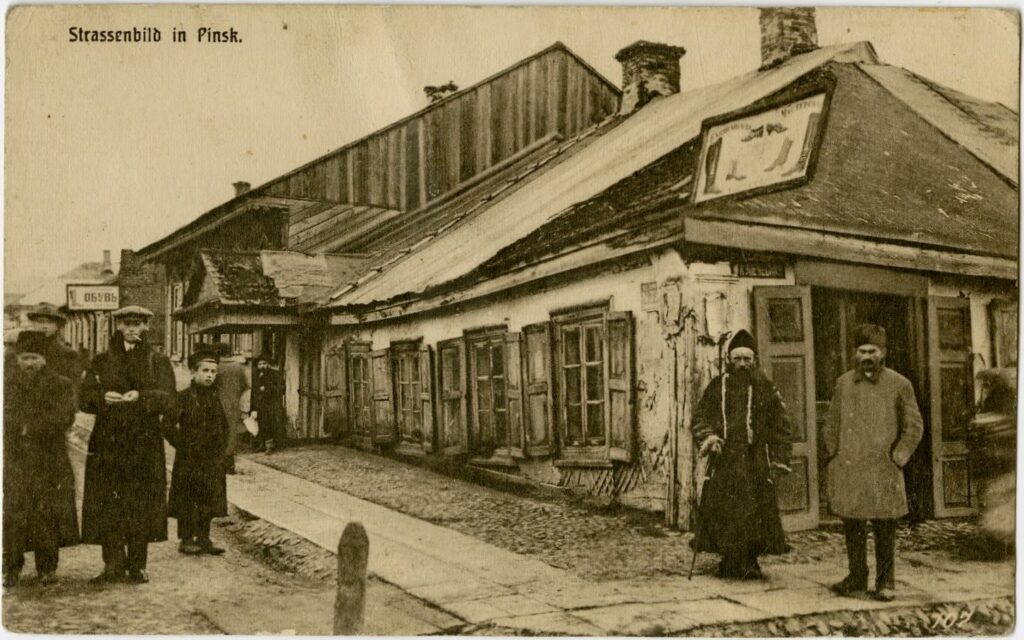
Jews in Pinsk
Another quote from the aforementioned archive:
In March 1941, on the Jewish holiday of Purim, representatives of Jewish communities from the cities of Bremowitz, Rovna, Lachowitz, Sarny, and Stolin arrived in Pinsk to see Rabbi Elimelech Perlow…
Strength and Power for the Nation
So what were the actions of the chassidim who managed to reach the Rebbe despite the ban? What did they want to gain from these daring visits? They wanted to rise, to become stronger, to gain strength and power in the stormy days when no one knew what they were bringing on their wings. Of all those chassidim who would sneak quietly to the Rebbe’s house, almost none remained. Not many days passed before the Nazis broke the agreement, and then, through their savage Ukrainian allies (the ancestors of those we feel so sorry for now, for some reason…), they massacred the remaining Jews and showed no mercy. There is no doubt that for these chassidim, the figure of the Rebbe and his comforting words were a source of faith, joy, and hope.
On that Purim, about which the agents reported and whose words we quoted above, the Rebbe knew that he was being followed and also knew that his life was in danger, but he did not think of surrendering. He knew what his role was at that time and acted according to the dictates of his conscience.
On the evening of that Purim, according to the writings of Holocaust survivor Rabbi Feivel Ginzburg, the Rebbe was approached by his close associate Rabbi Natan Noteh Weiner from the city of Vladormitz (he survived the Holocaust, immigrated to Israel, and lived in Ramat Gan). The Rebbe then said to him:
I can’t trust anyone, they’re following me, I don’t know who the people are dancing around me, the situation is very bad, and it’s impossible for them to come to me…
And yet, as we saw, they came to him that Purim, and how they came. Because no one could stop the fountain of love for his fellow Jews and the love of God that poured out from its pure source.
In the late winter of 5701 (1941) an associate of the Rebbe named Asher Chechik wrote a letter to Rabbi Yehoshua Heshel Hatovsky and Rabbi Chaim Mendel Kostromski, heads of the Karliner chassidism in the Land of Israel, in which he stated:
The secret police invited Motel Bortnik for a “conversation” and showed him a sealed notebook in which the Rebbe’s entire daily schedule and everything he had said and done in recent times were recorded, “almost every movement of his is immortalized in that notebook.” In that conversation it was said that the Rebbe had earned the title of “Cantor Revolutsioner” – an opponent of the regime…
In the letter, Chechik urges the chassidim to prostrate themselves at the graves of their ancestors, and perhaps to observe a fast.
Under the Eyes of the Detectives
In the 1990s, as the archives began to be made accessible to the public, hair-raising documents about the Rebbe’s work during those difficult days were discovered. The opening of the Soviet archives relating to World War II to the general public occurred in the late 1980s and early 1990s. This process was a direct result of the “glasnost” (openness) and “perestroika” (restructuring) reforms led by Mikhail Gorbachev in the Soviet Union, and it accelerated dramatically after the collapse of the Soviet Union in 1991.
In the same chapter, the quotes mentioned above were revealed, as well as this secret segment that sheds light on the period; a document entitled: Report on the anti-Soviet activity of the counter-revolutionary underground in the territories of the Pinsk region, dated May 21, 1941. The document is “top secret”, and is intended for Comrade Minchko, Secretary of the Regional Administration of the Communist Party, Pinsk, Belarus.
The document was published and translated (to Hebrew) by Y. Rosenblatt, Belarus.
The Jewish rabbis opposed Soviet rule in the western region of Ukraine and Belarus with extreme hostility… Representatives of a religious opposition and revolutionary underground, concerned primarily with Jewish affairs, spread a network of very active anti-Soviet activity among the weaker strata of the Jewish population, especially among the young.
They prophesy the imminent destruction of Soviet rule, slander the party and the government, slander the conditions of life under Soviet rule, and even call on the weaker sections of the Jewish population to launch a struggle against Soviet rule. They pretend to be defenders of Jewish tradition and the interests of the Jewish people, but they are extreme racists. These religious figures who wage an uncompromising struggle against the Soviet regime…
We are handling the case of the Rebbe of Pinsk, Rabbi Avraham Srulevich (i.e. the son of Yisrael -Y.R.) Perlow, brother of the Stoliner Rebbe, Rabbi Moshe Srulevich Perlow, who is on a mission of several agents and who are known within the religious Jewish population as a miracle worker. He gathers around him the most religious and extreme part of the surroundings. Perlow carries out anti-Soviet activities, spreads slander and provocative rumours in order to make believing Jews hostile towards the Soviet regime.
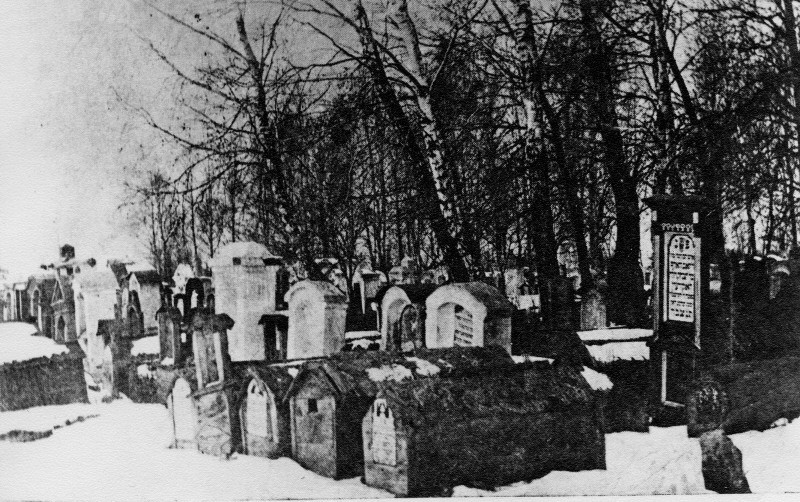
The ancient Jewish cemetery of the Karlin region, located in Pinsk
On May 10, 1941 [Shabbat the week the Torah portion of Emor is read, 13 Iyar 5701], in his speech to a group of religious Jews, Rabbi Avraham Srulevich Perlow said: “It is very difficult to live in the Soviet Union. Worse than in Germany… What kind of life is this?! When people do not believe in their day, do not know what will happen to them tomorrow. A person in the Soviet Union expects arrest every day, and especially we religious Jews, they oppress us here, they deal with everything, they hold on to everything possible and write protocols. And all this because we are religious Jews. Here in the Soviet Union they say there is no antisemitism, and in fact it is worse for us here than in Germany, we are persecuted here more.
In order to arrange organizational matters for Perlow on that holiday, Perlow’s son-in-law, Frankel Shmuel, who lives in the city of Pinsk, went to Vilna, according to the information and data of our agents. In Vilna there is a Jewish national organization “Chevra Kadisha” headed by Dessler and Seshnin. This organization is ostensibly officially engaged in matters related to the Jewish cemetery, but in fact it looks after the interests of various Jewish associations that exist in the city of Vilna. Behind them stand representatives of the revolutionary underground.
A document in which every word speaks for itself. It is astonishing how much dedication the Rebbe showed during that difficult period, when no one knew what the day would bring, to stand firm against the rulers who, as is well known, spared no effort in confronting those who stood in their way.
These are the details we know from that episode. After a year and a half of Russian rule, the Germans conquered the region, and from then on, the lives of the Jews of Pinsk and Karlin became difficult and bitter. The lives of the Rebbe and his family also became unbearable, and the few details we know from the Rebbe’s last days until being murdered in sanctification of the Name of G-d on Cheshvan 14, 5703/Oct. 25, 1942 (this is an approximate date set after the Holocaust) we will present in the next article of the series, G-d willing.
(With thanks to Rabbi Baruch Asher Kula, researcher on chassidism)