Between the Straights – Jews Groan between the Nazi Conquest and their Polish Neighbours
Some significant dates in Holocaust history during Bein HaMetzarim (Between the Straights – the 3 week period between the Shiva Asar B’Tammuz and Tisha B’Av fast days): Tammuz 17, 5701 in Borysław, Poland; Tammuz 15, 5701 in Jedwabne, Poland; Tammuz 5, 5706 in Kielce, Poland.
The educational and documentary activities of Ganzach Kiddush Hashem naturally give “priority” to events that have some connection to the date on which they occur.
We are now in a period that has a charged meaning, and we need to know how to talk about it and how to teach about it, and the reference is to the pogroms and the events of murder and extermination that were carried out by the Polish population, part of it, of course, as history writers are careful to express.
Historians emphasize: “Part of the population” – that is, not all Poles massacred their persecuted and suffering Jewish neighbours in the midst of World War II, and certainly not all of them did so in the first year after the liberation of the camps, as did the Polish residents of Kielce with the few Holocaust survivors who returned home, but there is something very outrageous in this reservation and in the clear attempt to shirk national and personal responsibility for bloody events that in ordinary days would have been supposed to shock the world and its entirety. And did anyone expect the entire population to take an active part in the murder and bloodshed? We wonder about the fertile ground for these events even at the beginning of the war, and especially for those after it. This, even when we ignore the massive Polish “inheritances” – the labour of generations of countless Jews that was stolen by neighbours who did not return the businesses and properties even after the war, even when there were those who did come to claim their property.
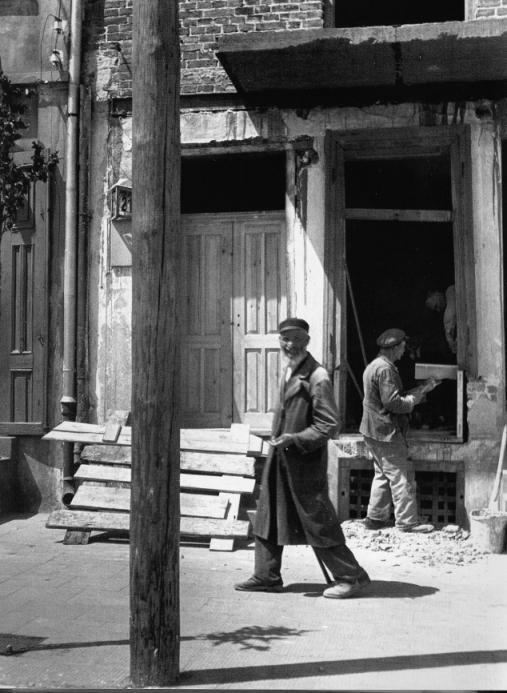
A painful reminder. A Jew, deprived of a livelihood due to the boycott encouraged by the Polish government against Jewish businesses, walks in front of his shop in a village near Lodz, Poland. In the background, his gentile “successor” is busy renovating the shop. Photo by Roman Vishniac, “A Vanished World,” Ganzach Kiddush Hashem Archive.
A Poignant Reminder of Abysmal Hatred
In these days, we mark eighty years since the infamous Kielce pogrom, during which Jewish Holocaust survivors were killed by their Polish neighbours, for no reason. We also mark eighty-five years since the terrible and horrific pogroms that were carried out, in the midst of the war, by Poles (!) against the innocent Jewish population. The events in Borysław and other places nearby were almost never covered or published, while the Poles have only “apologized” and asked for “forgiveness” for the brutal Jedwabne massacre in recent years. For example, in 5761 (2001), at a ceremony marking the 60th anniversary of the massacre, in the presence of the then Israeli ambassador to Poland, Professor Shevah Weiss, Polish President Aleksander Kwasniewski acknowledged the Poles’ responsibility for the massacre, saying:
We know for sure that among the persecutors and murderers there were Poles. Here in Jedwabne, citizens of the Polish Republic died at the hands of other citizens (…) For this crime we beg forgiveness from the shadows of the victims and their families. I apologize here today, as a citizen and as President of the Polish Republic. I apologize in my own name and in the name of all Poles whose consciences are troubled by this crime, who believe that it is impossible to be proud of the greatness of Polish history without feeling, at the same time, pain and shame for the evil deeds committed by Poles against others.
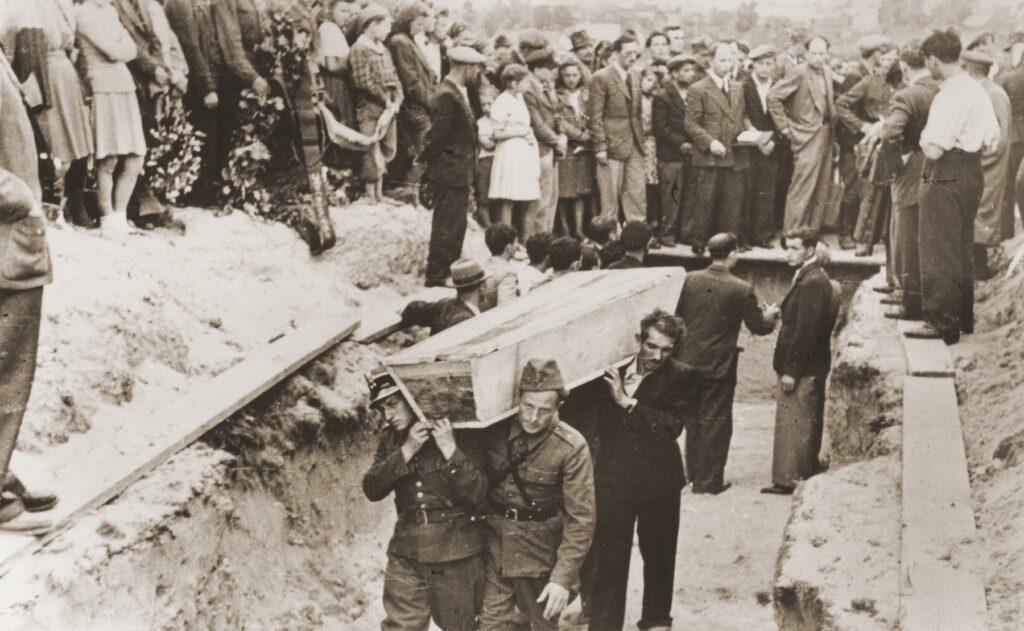
The burial of the Jewish victims murdered in the Kielce pogrom in 1946
On the other hand, under pressure from the residents of Jedwabne, the mayor was forced to resign from his post due to his participation in the ceremony. The Poles did not mourn much for what happened, but they would certainly be much more comfortable without this stain on their past. However, history does not lie, and the truth must be told: in many cases, too many, Poles took part in the murderer of their Jewish neighbours and even did so, sometimes, as described in the press and literature of the time, “in a barbaric medieval manner”…
We mention these events, which occurred in July (of 1941 and 1946), because they are a painful reminder of the abysmal hatred that surrounded the Jewish communities at that time. They reveal not only the atrocities committed by the Nazi regime, but also the severe antisemitism that prevailed among the local population in many places in Poland, even before, during, and after the war.
The truth is that the period between the two wars was full of serious antisemitic incidents, and many times they ended in murder and bloodshed. Economically, the Polish stranglehold also strangled the Jews, and many of them suffered the humiliation of starvation, encouraged by the government. Jews were also excluded in public places, and Jewish students were forced to sit in special places at universities – an act of humiliation. However, we are focusing here on a sample of events that occurred during the war and after it, when Polish Jews and gentiles faced a common enemy, so to speak, and the antisemitic instinct still found fertile ground for destructive actions that left scorched earth and clean blood spilled like water. This issue is broad and deserves attention, because even among the ranks of the partisans and underground groups that fought the Nazis, antisemitism prevailed, which in most cases was severe to unbearable, but there were also too many cases that ended in violence and even murder.
The Slaughter in Borysław (Tammuz 5701, July 1941)
In the first days after Nazi Germany’s invasion of the Soviet Union, waves of severe violence broke out against the Jewish population in the areas occupied by the Germans. In the city of Borysław (then under Polish rule, now in Ukraine), as in many other places in the eastern Galicia region, the first days of chaos were used to carry out pogroms. Many Jews were brutally murdered during those days, and in some cases buildings where Jews were concentrated were set on fire, with the cooperation or incitement of local elements. In many published articles and in studies conducted through in-depth interviews with Holocaust survivors (see: Iuliia KYSLA, “Vyzhyvannia za ekstremal`nykh umov: Holokost v Boryslav (1941-44); her article shows that not only Ukrainians from the surrounding villages were bloodthirsty at the beginning of the German occupation in Av/Summer 5701, but also Poles, neighbours and friends, and even childhood friends from school, took part in the actual murder of Jews).
The Jewish community in Borysław, which numbered about 12,000 people before the Holocaust, was exterminated during the Holocaust, leaving about 400 people, a fairly high number compared to cities and towns with similar geographical characteristics.
The Slaughter in Jedwabne (Tammuz 5701, July 1941)
One of the most shocking events took place in the town of Jedwabne on July 10th, 1941. On that day, Polish residents of the town gathered their Jewish neighbours in the market square, and then led them to a barn. There, the Jews were locked in and burned alive. For many years, this crime was attributed to the German occupiers, but later historical research (especially the work of Jan Tomasz Gross) showed that direct responsibility for the murder lay with the local Polish residents.
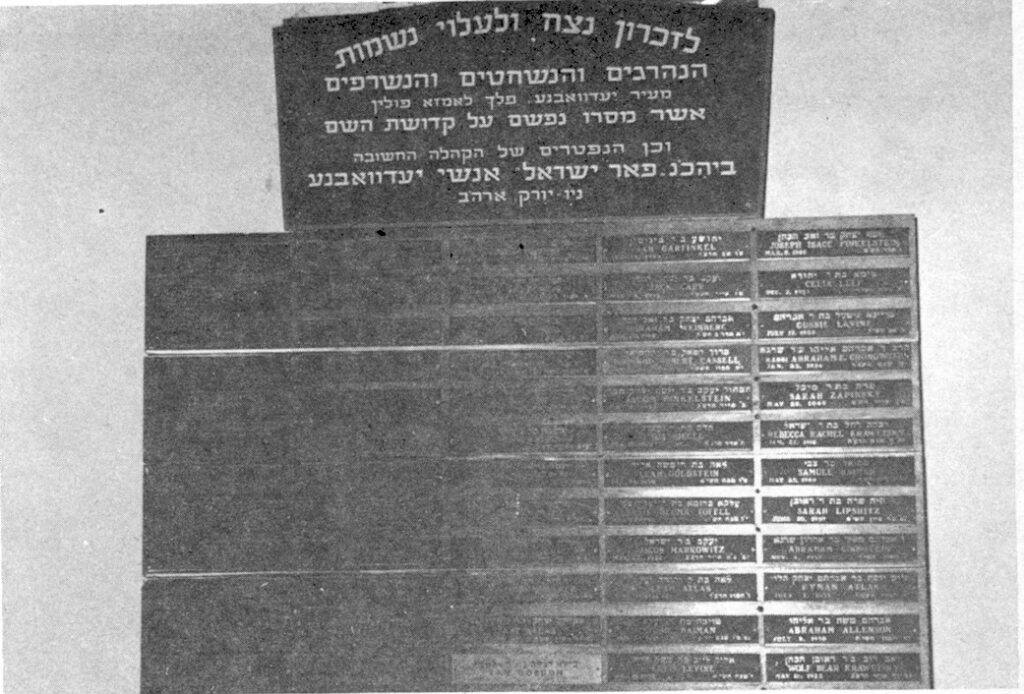
A memorial board for the victims of the Jedwabne Pogrom, displayed in the Pe’er Yisrael synagogue for Jews from Jedwabne in New York
The Event
On July 10, 1941, several weeks after the German army occupied the Białystok region and a week or two after the establishment of local authorities in the area, the Jewish residents of Jedwabne (along with refugees from other places) endured hours of torture, were gathered in a barn, and burned alive by their neighbours and peasants from nearby villages.
People caught hiding, including small children, were thrown onto the hot coals. Only a small number of people managed to escape. The number of victims – according to various estimates, assuming that almost all the Jews present in the city were killed – ranges from 900 to 1,600 people. The latter number corresponds to a rough estimate of the size of the entire Jewish community in Jedwabne before September 1939. It is very likely that it changed in the following two years. In June 2001, the existence of two mass graves of murder victims was revealed, where – according to estimates – 300-400 people (adult men and women, children and the elderly) and 35-40 people, respectively, were buried. It is likely that there are also other graves of Jedwabne Jews who died as a result of personal violence, and perhaps additional mass graves.
The tragic events in Jedwabne were not the only pogrom committed against Jews in this part of the Białystok province. Even earlier, on June 25th, 1941, anti-Jewish violence occurred in Jedwabne, causing fatal losses. Later, in this area, a series of increasingly violent pogroms took place, including pogroms in Wąsosz and Radziłów, where several hundred Jews were killed. Jedwabne was the culmination of this wave.
On May 16 and 17, 1949, after a short investigation by the Ministry of Public Security, a trial was held in a court in Lomza against people accused of participating in the Jedwabne pogrom. 21 people were charged, 11 of whom were sentenced to 8–15 years in prison, and one person was sentenced to death.
The first information about the Jedwabne pogrom was published in 1966 by Szymon Datner in an article published in the “JHI Bulletin”. In 1967, the Regional Commission for the Investigation of Nazi Crimes in Białystok opened a further investigation of the case. However, it was not until 2000 that the events gained widespread public recognition, mainly thanks to Jan Tomasz Gross’s book “Neighbors: The Destruction of the Jewish Community in Jedwabne, Poland” (which was justifiably criticized for not meeting academic standards in many places, although this does not change its moral significance for the Polish side), and in press publications (in 1999, Polish television broadcast Agnieszka Arnold’s documentary film dedicated to the events related to the pogrom). In the summer of 2000, the National Institute of Remembrance opened a third investigation of the pogrom. Preliminary results, published on July 10, 2002, confirmed that the murder was committed by Poles (…) The Germans had a certain role in the first stage of the pogrom – gathering the Jews in the town square and abusing them. In the second stage – gathering the people in the barn and burning them alive – the Germans could only watch the events.
The Slaughter in Kielce (Tammuz 5706, July 1946)
The slaughter in Kielce symbolizes the continuation of Jewish suffering even after the end of World War II. On July 4th, 1946, about a year after the liberation, a false blood libel was spread in the city of Kielce, alleging that Jews had kidnapped a Christian child. In response, an angry mob attacked a building that was home to Holocaust survivors. In the chaos and riots that followed, dozens of Jews were murdered – survivors who had survived the Nazi inferno but found their deaths at the hands of their neighbours in their homeland. This event made it clear to many of the survivors that they had no future in post-war Europe, and is considered one of the main catalysts for the massive immigration (the “Bericha”) of the Holocaust survivors.
Over forty Holocaust survivors were killed in these events, which caused a mass exodus and the end of the dream of living in the bloody land.
The events, later called the “Kielce Pogrom”, took place mainly in a building at 7/9 Planty Street, where about 200 people lived. In addition to the residents, the building also served as a home for various Jewish institutions. However, this was not the only scene of tragic events. Pogroms against Jews also occurred in other places in Kielce and on trains moving through the city that day.
The funeral of the 42 Jews murdered in the Kielce pogrom
The Background of the Pogrom
The causes of the Kielce pogrom can be identified as independent actions of the army, the militia, and some officials of the Polish Ministry of Public Security. The immediate reason for taking these actions against local Jews was a rumour about the kidnapping of 8-year-old Henryk Blaszczyk, who had gone missing on July 1. His father, shoemaker Valenty Blaszczyk, reported him missing that very day at around 11:00 p.m. The boy returned home alone two days later. On the day of his return, around midnight, his father, under the influence of alcohol, arrived at the militia station and claimed that all this time his son had been held in a basement by Jews, from where he had managed to escape.
On the morning of July 4, Valenty Blaszczyk and his son Henryk, along with their neighbour, appeared again at the militia station. According to their testimonies, an unknown person gave the boy a package on the street and asked him to carry it home. He offered him 20 zlotys for it. After arriving there, the man allegedly took the package from little Henryk and locked him in the basement, where several other children were already being held. On the way to the station, Henryk pointed to the building at 7 Planty Street and identified it as the place where he had been locked up. He also identified the man who had kidnapped him. The building was 200 meters from the militia station.
Later, the testimonies of the two Bolsheviks turned out to be completely false. Without informing his parents, the boy went to a village located 20 kilometers from Kielce, where he had lived with his family during the occupation. He told a story about being kidnapped and locked up just to avoid punishment.
After the interrogation of Blaszczyk, the station commander, Sergeant Edmund Zagorski, sent a patrol consisting of six of his men, who, together with Valenty and Henryk Blaszczyk, went to Planty Street. After the militiamen managed to arrest a man named Kalman Singer, whom the boy identified as the culprit, and returned with him to the station, another patrol was sent to Planty Street with an order to search the building. The patrol consisted of several men, all volunteers. On their way to the place, they told passersby about the alleged kidnapping of Christian children by Jews with the intention of using them as victims of ritual murders. After searching the building, it was clear that the story told by Blaszczyk could not be true, since the building at 7/9 Planty Street did not have a basement.
The Course of Events
The outbreak of violence began on the morning of July 4. The first shots were fired by soldiers inside the building. Once inside, soldiers dragged Jewish people from their hiding places and brought them outside, where the crowd, some of whom were also soldiers, beat them and threw stones at them. Several people, men and women, were shot or stabbed with bayonets and other blunt weapons. Two women were thrown from windows and killed by the crowd in the street. Efforts by representatives of various authorities to calm the crowd were unsuccessful and proved futile. Civilians and soldiers robbed their victims and looted their belongings that were left in the building. From the testimony of a Holocaust survivor published by Yad Vashem: I saw a pile of naked corpses. It was only a year and a half after the camp. I was used to seeing bodies there, but nothing made such a strong impression on me as this. First of all, everyone was naked… it was a robbery. They also took their clothes.
According to testimonies, the bodies, at least some of them, were in very serious condition. Two of them were not identified. Among them stood out tattoos that the Nazis had carved a few years earlier. They survived the Nazis, but not the murderous lust of their neighbours.
The “hunt” for Jews also took place at stations along the Kielce-Częstochowa railway line. On trains and stations in the Kielce district, about 30 Jews were murdered that day.
The first phase of the pogrom lasted until noon, and the second began when workers from the Ludwikow factory arrived on Planty Street. Around 4:00 PM the pogrom was finally stopped, but it did not completely calm the anti-Jewish atmosphere. Immediately after the pogrom, an anti-Jewish rally was held. The crowd also demonstrated in front of the hospital where wounded Jews were being treated.
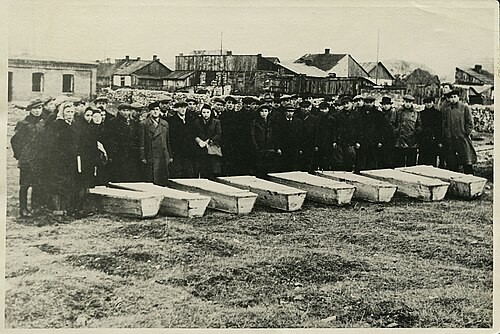
The victims of the pogrom
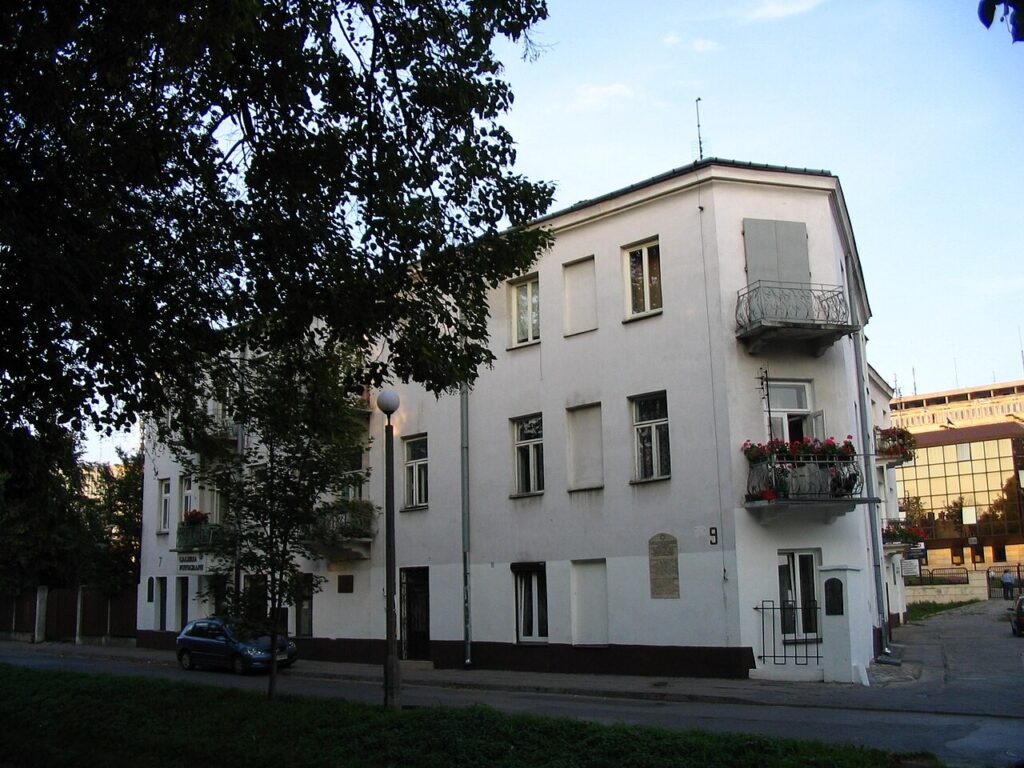
The building in which the pogrom took place
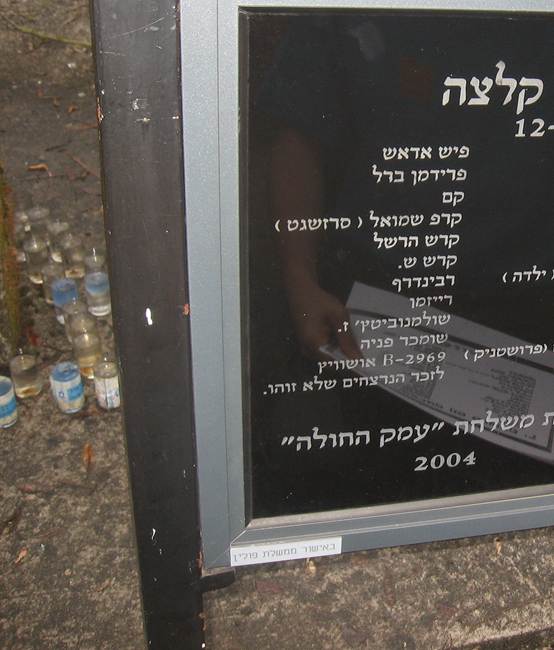
Details of the last murdered person on the memorial plaque: B2969 Auschwitz… This is what was known about the poor murdered person who survived Auschwitz and died at the hands of Poles after the liberation. He was buried without a name… and there were murdered people who were not identified…
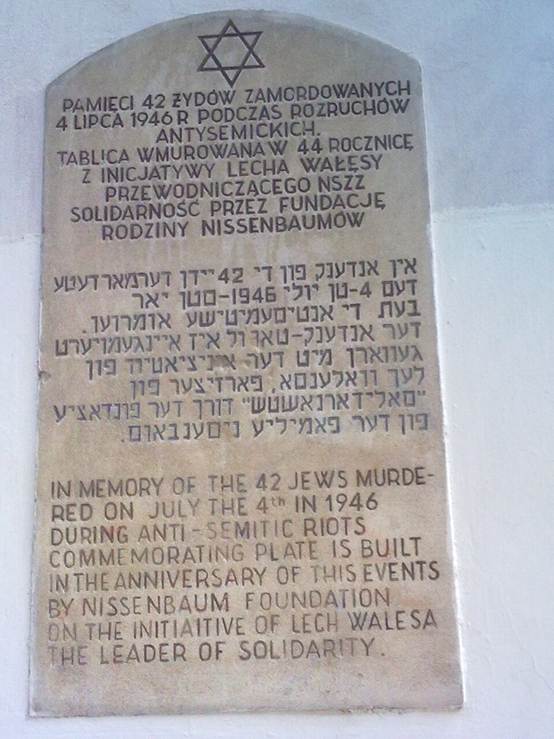
The “Kielce Pogrom” following liberation
To complete the picture, we will quote the testimony of Jonas Turkow, who, in his book “Acharei HaShichrur” (After the Liberation), in the chapter “Krakow through the Eyes of a Jew,” commemorates the pogrom committed by the Poles among the Jewish Holocaust refugees in Krakow. Incidentally, this story is supported by many testimonies published in various places:
On Saturday, August 11th, 1945, anti-Jewish riots broke out in Krakow. While the synagogue at 26 Miodowa Street was full of Jews who had come for Shabbat prayers, gangs of thugs began to gather in front of the synagogue gate, and they spread rumours that the Jews had killed Christian children, thus rekindling the incitement of the ancient blood libel stories.
A Polish mob broke into the synagogue, and began killing and stoning Jews. The rioters tore up the Torah scrolls, took them out into the courtyard and burned them. The synagogue building itself was set on fire from the inside. At the same time, a wild mob of thugs attacked Jewish passersby, beating them to death. They also broke into Jewish apartments and institutions, beating their residents and robbing them of anything they could get their hands on. They even attacked Jews wearing military uniforms and did not spare them.
In one case, the thugs knocked on one of the doors. There was a sudden silence because no one answered the knocks on the door. A moment later, a Jewish woman, the owner of the apartment, went to the door and peeked through the keyhole to see if the murderers had already left. At that moment, a bullet hit her in the eye, and she fell dead on the spot. Also near the city tram station, thugs smashed open the head of an elderly Jewish woman.
The thugs had prepared lists with addresses of Jewish apartments, even those with Christian names. As the Polish army units and the municipal police tried to calm the wild crowd, a series of shots were fired at them from the windows of various houses in the area. A real battle ensued. Many Jewish victims fell, dead and wounded. Wanting to save the Chief Rabbi of Krakow – Rabbi Lebartow – the representatives of the authorities transferred him to a Christian environment and hid him there.
Only on the second day did Russian army units appear on the streets of Krakow and put an end to the riots against the Jews. It must be noted that many Jews also served in the Soviet army units that took to the streets to fight the rioters. They fought with dedication, and in the end they defeated the rioters. A Polish boy, a newspaper seller, Stanisław Nyak, said during interrogation that a Polish officer ordered him to enter the synagogue and leave immediately shouting: “Save me! The Jews want to slaughter me!…” The Polish army man also ordered him to shout that he had seen a Christian child murdered in the synagogue.