Flowing Tears and Glimmers of Hope – Part 1
Eighty years since the World Agudath Israel Convention in 5706 (1946), a few months following liberation
By: Yaakov Rosenfeld
The “Preparatory Conference” of World Agudath Israel, held in London in the winter of 5706, was attended by representatives from Europe, the United States, and the Land of Israel. It was a heartbreaking conference. It was held in the year of liberation, when the refugees of the war began to digest reality as it was and tried to rebuild their lives, personal and public. The words spoken during it were recorded in Yiddish, from which we are now translating, exactly eighty years later.
We stood breathlessly among the shelves of the Ganzach Kiddush Hashem archive and leafed through the yellowing pages of this historical document, here are some excerpts from it.
In a meeting held on the issue of survivors, Rabbi Yitzchak Meir Levin was asked about the certificates to the Land of Israel for war refugees who were being held in the DP camps, and in the midst of the poignant conversation, Rabbi Teitelbaum of Satmar (Rebbe Yoel z”l -Y.R.) was given the floor.
(Earlier, upon the entrance of the Satmar Rebbe, the chairman introduced him as a guest who had come the previous day with a written power of attorney to represent the National Orthodox Chamber of Transylvania at the conference, which brought together 70 rabbis and about seventy thousand Jews. The guest was received with respect and sat down in his honourable place at the delegates’ table.)
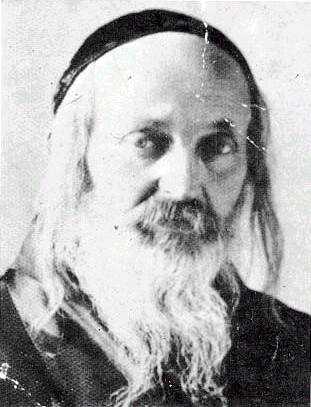
Rabbi Teitelbaum of Satmar, the only representative from Romania, described the situation of Orthodoxy in Transylvania, and told how he and other rabbis moved and were displaced (zich gevalgert) in various camps.
He told of a camp called “Ebenzeh” (Ebensee, a forced labour camp at the foot of the Austrian Alps. In this camp, many Jews served as slaves in cruel conditions and died after illness and torture) in “Tyral” (Tyrol, geographically close to Ebensee), where after the liberation, between Passover and Shavuot, only 10 percent of the survivors remained alive. This was already the situation under the “liberators” (the quotation marks are in the original. Indeed, the records of the Ebensee Museum present this grim fact, about the mass death of survivors of forced labour precisely after the liberation, in May 1945).
He told of how thousands of Jews who were liberated from Transylvania “have something to thank” for Agudath Israel in Switzerland. He told of the exceptional individuals among the 400,000 Jews of “Carpatho-Rus” (this region included, among others, the Jews of Munkács, Ungvár, Khust, Bárgasz, and others), who, when they returned home and found empty walls, found it harder than it had been in the camps. When they first turned to the Joint concerning kosher kitchens, things began to improve. The first yeshiva was founded in Bucharest, sheltering refugees from various countries. Agudath Israel in Transylvania established orphanages; today (i.e. at the time), Transylvania has a central religious leadership and under it communities of 70,000 Jews, with 70 rabbis, kosher kitchens, and Bais Yaakov schools that serve as orphanages. The orphanages house children between the ages of 15 and 22, “elend vi a shtein” (alone as a stone). Children younger than these are not seen there. “For the first time I saw small Jewish children in London. The orphans face two paths, Torah and the Land of Israel, and therefore Agudath Israel must come to their senses…”
Among the names of the speakers, we find our teacher Rabbi Yaakov Rosenheim (who, at his home in the Land of Israel, wrote down his speeches and these were read in public); The chassid, Rabbi Yitzhak Meir Levin; Rabbi Meisels (Rabbi Zvi Hirsch, who survived Auschwitz and was rabbi of Bergen-Belsen); the genius Rabbi Chaim Yaakov Rotenberg, the rabbi of Antwerp; the Schatz Rebbe from London; the genius Rabbi Yechezkel Abrahamsky; the genius Rabbi Moshe Feinstein, the genius Rabbi Aharon Kotler; Rabbi Oshry; and the Bobover Rebbe, Rabbi Shlomo z”l.
The somber and terrible atmosphere that reigned among the participants in the face of the tragedy of the Jewish people can be felt with your hands between the dense lines on the ancient pages. Tears well up between the eyelashes of one’s eyes and one’s heart breaks, and when it seems that we have already read everything, the words of Rabbi Meisels, the rabbi of the Bergen-Belsen camp, come and leave you thunderstruck. On Sunday evening, Rabbi Meisels spoke, and those who spoke after him also noted his words and described how difficult it was for them to hear and digest.
Rabbi Meisels said:
I thank G-d with all my heart that He has granted us life, sustained us, and allowed us to reach this time, because if they had told us, the prisoners of the camps, back then, that we would still be able to stand before the leaders of the nation and give them a report on our activities, I would have told myself that it was a fantasy. Every step of a person, and excuse me, we had never even heard the word “person” back then. We were called “Hunt” (dog), “Zau Hunt” (sow dog), “Schwin” (swine), and so on! We survived the war, and if we lived 120 years to tell the story, we would not be able to do even a little bit of it! Do you know what we were saved for? For the children! He pointed his finger at the children of the hostel (boarding house/orphanage) of an association that were being displayed there, on Rosh Hashanah 5703 (1942)! The children of the 2 blocks in Birkenau near Auschwitz, approximately 12 hundred children, were imprisoned in a block and I managed to go in there, blow the shofar for them. Do you know what I said to them? Do you know what happened after I spoke to them words of encouragement so that they would not lose their confidence even when a sharp sword was placed around their necks? One boy stood up, and he had such a fervour for Judaism, and said to his friends, “Listen! Either way, we will leave this world, let us leave in the name of G-d!” Then they said, before the sound of the shofar “from the straits, I cried out, G-d answer me from His heights” (Psalms 118:5) and it seemed then that Rabbi Akiva and the Ten Martyrs were saying this. The sky was torn apart by the cries (terrible weeping spreading among those present…). An hour later, they were being transported in vehicles to the crematorium.
On another occasion, they took 150 children. I thought then, where are they taking them, there is no other option but to burn them. Suddenly, 50 children returned and said:
The crematorium was not empty. And they ordered the children to get undressed, in the meantime, a “demon” from the SS arrived and conducted a selection. These, the 50 children who returned, were returned to the camp, and the rest were sent to be killed. The children told: Thus, naked, the children, condemned to death, came out dancing. They sang “V’Ta’er Libeinu” (And Purify Our Hearts).
The cruel ones looked on from the sidelines, pondering in their hearts whether there was any nation in the world that would behave (react) like this in such a situation.
We must be proud and strong! (This is what the children who returned said).
Rabbi Meisels said: I must tell you, my teachers and masters, if we, Jewish survivors of the camps, say, “All my bones shall say, ‘Lord, who is like you?'” then these words have a real, actual meaning, for who among us has not been beaten to the point of being forced to lie down for at least a few weeks?
In the name of the holy Rebbe, the Yismach Moshe z”l, they say, regarding the verse, “For there is no memory of You in death; in the grave, who will thank You? (Psalms 6:6)” We do not resent it, but we ask: “In Sheol, who will thank you? Who will thank you from the grave?”
The holy souls of those killed in sanctification of G-d’s Name ask, claim, and demand help from those who are still, to this day, walking around in the clothes of prisoners in the camps.
He described the liberation. He describes how everyone searched for their family. Rabbi Meisels himself was the father of ten children, of whom only a daughter and two sons remained.
We must start anew, try to rebuild, this is not about “strengthening the religion” but about “building the religion,” we must start everything anew!
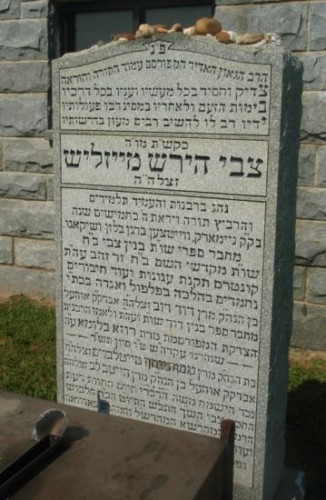
The grave of Rabbi Meisels z”l
Rabbi Meisels tried to build, but Jewish organizations put up obstacles (…) until, with the help of a court ruling, he was crowned Chief Rabbi of the British zone, after the activities of Rabbi Dr. Schoenfeld, who sent Rabbis Baumgarten, Wilensky, and Munk to Bergen-Belsen. Then, after houses were confiscated (by the authorities), the rabbi built synagogues, mikvahs (ritual baths), Talmud Torah schools and a yeshiva, and shechita (kosher slaughter). The yeshiva had 150 boys studying, who literally spent day and night studying Torah and service of G-d; the Bais Yaakov school had 400 female students, and there was more. The rabbi thanked Agudath Israel in America for its help.
The rabbis who spoke after him found it difficult to express their emotion and shock at Rabbi Meisels’ words. Captain Manheit, a chaplain in the French army, expressed his protest at the shocking fact that survivors of the camps were still walking around in the prisoner clothes given to them by the Nazi oppressors – “This is a disgrace and a shame!”
From the words of all the participants, a bleak picture emerged: the Torah-observant survivors faced, in addition to bereavement and loneliness, also a lack of basic religious needs, as a result of the abuses of the secular parties and organizations that ruthlessly controlled the vast amount of money collected for the rescue and rehabilitation of the survivors.
Here is an excerpt from the words of Rabbi Dr. Schoenfeld (“who has just arrived from Poland, from where a delegation is expected to arrive here”):
Everywhere Agudath Israel is the “sun” that lights the light in the hearts of Jews, it goes from candle to candle and ignites it. It describes the great injustices that are being committed against the “pious” in various camps by the free Jews. The only advice is to create strong independent communities, holy communities. Just do not be afraid of the false accusations against us that we are “withdrawing from the public” when in truth they are the ones who deserve this definition, those who are trying to rebuild Jewish life on secular foundations (sekulareh yesodos). These are the ones who are withdrawing from the Jewish public! Our holy communities do not fundamentally state that we want to stay there, no! We want to travel to the Land of Israel and settle there, and live a life of Torah and mitzvahs (commandments) there, we are in these camps like desert dwellers on our way to the Land of Israel. The Land of Israel must be built according to the Torah and mitzvahs, otherwise G-d will not let us build it!
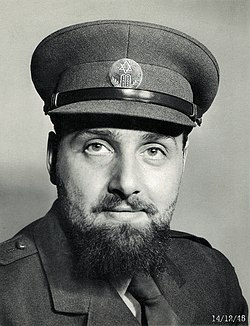
Rabbi Shlomo Schoenfeld, 1912–1984, London. One of the greatest rescuers during the war years, one of the organizers of the Kindertransport. After the war, he was the living spirit among the survivors. Among his activities was organizing aid truck convoys for Holocaust survivors. According to historian Norman Lebrecht (Genius and Anxiety, Hebrew version, pg. 353), Schoenfeld was responsible for saving over 10,000 lives during the Holocaust. Rabbi Schoenfeld sometimes wore a British army uniform (as a military rabbi) to facilitate his movement in liberated Europe and increase his influence with officers in the field in order to aid survivors.
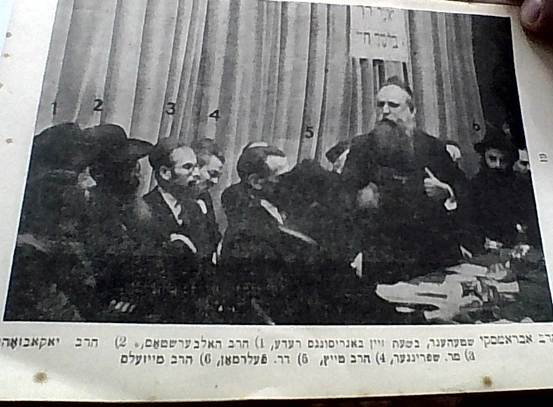
Photo from the conference
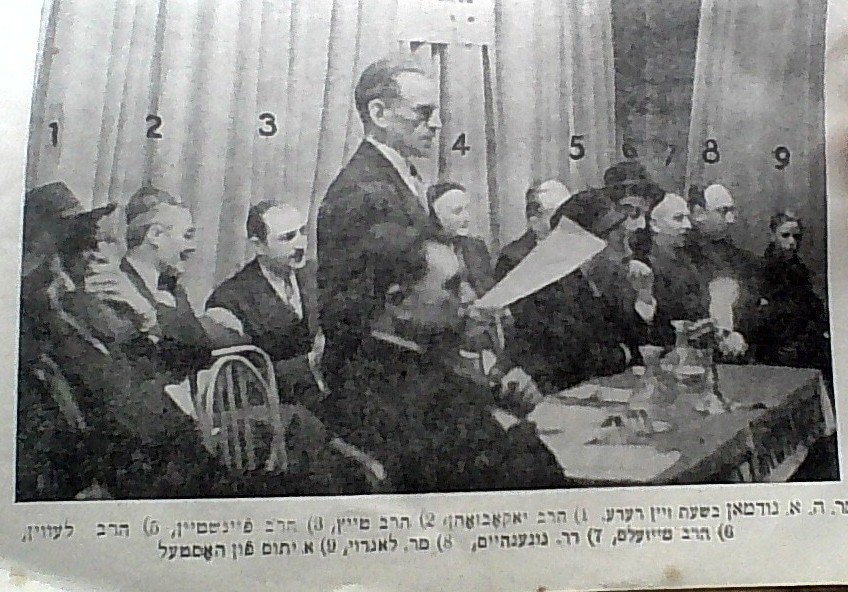
The Writing on the Wall: “And I said to you ‘Through your blood you shall live'”
On the far right, according to the caption is an “orphan from the orphanage”. The child, Yaakov Meltzer, read a declaration on behalf of all his friends:
Important gathering! We enthusiastically intend to remain faithful Jews and sons of holy parents, and we aspire to reach the Land of Israel and live there as G-d commanded us in the Holy Torah.
After the child’s words, which aroused great emotion, those gathered said “Shema Yisrael” (the Hear Oh Israel prayer) and all the children broke into the song “Lecha Hashem HaGedula” (Yours, G-d, are the greatness), sweeping the entire audience with their singing.
We will G-d willing soon present a continuation of this article, centered on a surprising speech by the Bobover Rebbe of Bobov, Rabbi Shlomo z”l.
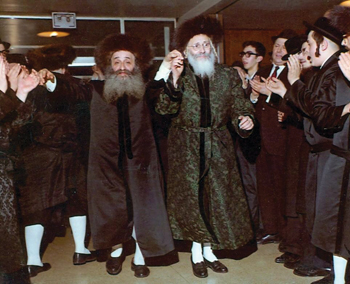
Rabbi Meisels and the Bobover Rebbe
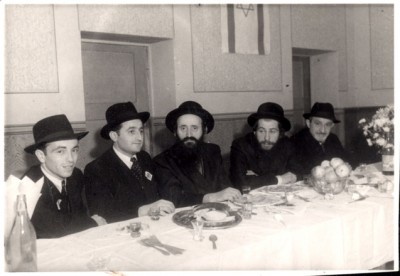
Rabbi Meisels, “the Weitzner Rav,” in Bergen-Belsen following liberation
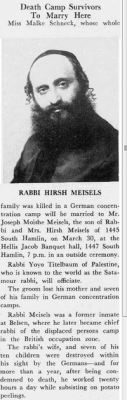
A newspaper article on the remarriage of Rabbi Meisels, when he was a rabbi in Chicago
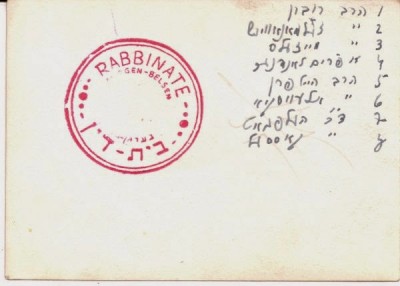
Rabbi Meisels’ signature among the members of the Bergen-Belsen beit din (rabbinical court)