Hakafot in the Rehmsdorf Camp
From our Archives
By: Yaakov Rosenfeld
(Hakafot = dancing in circles with Torah scrolls on the holiday of Simchat Torah)
Few people today know about the Rehmsdorf camp, just as little is heard of the neighbouring town of Zeitz. In truth, even eighty-five years ago, Rehmsdorf was unknown to the vast majority of the people imprisoned there for backbreaking labour at the synthetic gasoline plant. Thousands of Jews, primarily from Hungary, were forced to perform grueling, arduous work; they toiled for twelve consecutive hours without rest, surviving on inadequate rations.
In late winter of 1945, the Nazis forced the camp’s prisoners — numbering nearly five thousand — to march toward Terezín. Tragically, most did not survive the march; they collapsed along the way or were shot by their murderers. Of all those who undertook that harrowing journey, only a few hundred survived. They arrived at Terezín on the very day the camp was liberated — the day the war ended.
This story is sad and heart-rending; yet, at the same time, it embodies the heroism of the Jewish spirit. Set within the Rehmsdorf camp during the Holocaust, the story was published in 5711 (1950-1) by Rabbi Shmuel Zanvel Kahane, son of the Chief Rabbi of Warsaw, the eminent Rabbi Shlomo David Kahane z”l.
Rabbi Kahane’s account was discovered in a yellowing clipping from the HaTzofeh newspaper, preserved in the Ganzach Kiddush Hashem archives. Rabbi Kahane used to spend his time on Mount Zion at the Tomb of King David and the Chamber of the Holocaust, where he gathered and committed to memory many of the stories shared by Holocaust survivors who visited the memorial site.
Visitors and students touring the shelves of Ganzach Kiddush Hashem’s archive in recent days have focused primarily on the vast collection of expertly preserved and cataloged documentation regarding Jewish holidays and the High Holy Days during the Holocaust. Staff members accompanying the visitors, especially the students, stand by and observe, noting what particularly catches the eye amidst the wealth of testimonies and documents. I noticed that the following story, which I am recounting here with minor editorial adjustments, deeply moved many of the visitors.
Partnership in the Camp
A bond was forged in the Rehmsdorf camp between the Torah genius Reb Meshulam and Leizer, a plasterer by trade. Both toiled in back-breaking labour at the factory for the Nazis. Day after day, they set off for work in the pre-dawn hours; together they stumbled along, working until they were utterly spent amidst the screaming of the Nazis. They would return from work each night like shadows, at which point Reb Meshulam would speak to Leizer’s heart, comforting him with faith and trust. Leizer would help Reb Meshulam walk on his frail legs, while Reb Meshulam sustained Leizer with words of encouragement and solace. Such was the partnership between them, a partnership of mutual strengthening, in body and soul. Each contributed his share.
This partnership lasted for six months, and Reb Meshulam was particularly scrupulous about it on Shabbat. What was the issue regarding the Shabbat? The Nazis would not waive the requirement for labour on Shabbat and holidays; however, Reb Meshulam managed to avoid committing grave transgressions. According to the sages, when two people perform a task together, they are exempt [from individual liability]; thus, he would always ask Leizer the plasterer to carry loads with him and share the burden of the grueling work. In this way, they avoided the serious sin of Shabbat desecration week after week.
Reb Meshulam was aware of the danger involved in this arrangement, as the Nazis disapproved of workers helping one another, and Reb Leizer was reluctant to take the risk; consequently, Reb Meshulam promised him a “share in the Garden of Eden.”
Every Shabbat, Leizer would assist Reb Meshulam with his work, helping him carry loads; often, this meant he could not finish his own tasks and put himself at risk, yet he remained steadfastly committed to his agreement with Reb Meshulam. Aside from Reb Meshulam and Leizer, no one else knew of this arrangement. Others viewed Leizer’s assistance as a humanitarian act, for Reb Meshulam was a frail man who was constantly on the verge of total exhaustion.
Then came the holiday of Shemini Atzeret, which that year fell on the holy Shabbat…
Reb Meshulam was assigned the task of carrying beams, and Leizer the plasterer assisted him, as usual. Suddenly, in the midst of the work, Reb Meshulam lost track of his surroundings. He remembered the holiday; then, all at once, he grabbed a beam, clasped it to his chest like a Torah scroll, and began to dance with it, filled with wondrous fervour, just as one dances during the Hakafot on Simchat Torah…
At first, the two chanted softly: “King of the Universe, bring salvation now,” but gradually their voices rose, swelling into a mighty song. They poured their pure souls into the cry—”King of the Universe, bring salvation now”—and then Reb Leizer and Reb Meshulam broke into a fervent dance. Singing loudly, “Blessed be our God who created us for His glory,” they danced while embracing the wooden beams, as if clutching Torah scrolls in a brightly lit synagogue, surrounded by hundreds of delightful children holding flags…
Onlookers were astounded and tried to warn them of the terrible danger, but Reb Meshulam was no longer of this world; he danced with ever-increasing fervour alongside Leizer. Their very appearance seemed transformed, their stature seemingly elevated, so it truly appeared, according to the account. The two continued to dance together until an SS man appeared, shot them, and killed them. Thus, the two holy partners died together, their souls ascending in purity amidst immense joy, in the midst of singing “Blessed be our God who created us for His glory”…
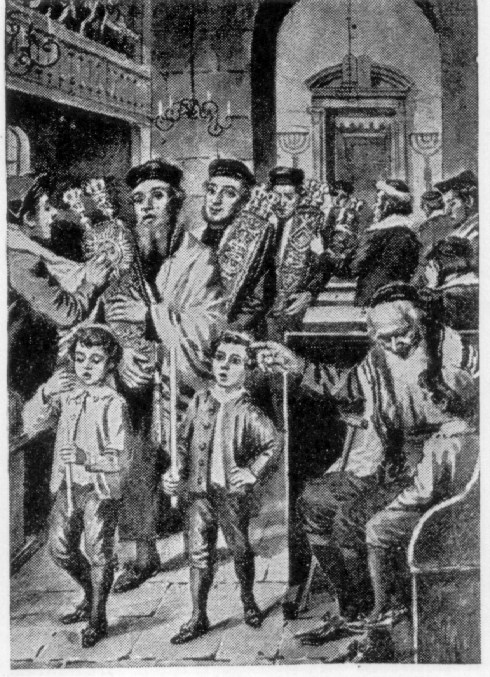
Dancing on Simchat Torah in the Warsaw Ghetto
We at Ganzach Kiddush Hashem chose to present this story, drawn from the database of hundreds of testimonies housed in our archive, for the reason mentioned above.
A sample of the accounts and testimonies we have presented to students and visitors over the past week (before the holiday):
An account of Simchat Torah in the Warsaw Ghetto in 5702 (1941); 15 prisoners in Romania celebrating Hakafot in the Valley of Tears 1941; Simchat Torah in Nazi Germany – in Berlin (!); Simchat Torah in the Kovno Ghetto 5704 (1943); Simchat Torah in Radvil 5701 (1940); a description of Sukkot in Siberia — “to avoid working on the holiday, we offered bribes of boots, shoes, bread, and cigarettes”; a remarkable account of building a sukkah in the Warta Ghetto; of Sukkot in the forests of Pinsk; of a Lulav (palm frond) without an Etrog (citron) in Auschwitz; of halachically (Jewish law) kosher sukkahs in the Vilna Ghetto; testimony regarding the long line in Kalisz to enter a sukkah; despite the risk of Nazi roundups; a rare account of the “chasidim’s shack” sukkah in the Częstochowa labour camp; of Reuven Yisrael Kut, who – with supreme self-sacrifice – removed the roof of a guard hut and laid straw over it to fulfill the commandment of sukkah in Schwaningen; and of Pinchas Steier in the Zagłębie camp, who failed to appear for lunch and was found, after a search, in a sukkah he had built for himself, humming the Ushpizin (7 biblical characters who “visit” the sukkah) prayers… He was sentenced to seven days of detention in a cold, dark cellar, and throughout his punishment, he was heard reciting Psalms; an account from the Tarnów Ghetto of a long line of Jews who, at great personal risk, stood waiting for the Four Species despite the immediate danger; a rare description of Warsaw in 1943, specifically the Sukkot of that year, when sukkahs were erected and the Council of Rabbis issued a directive requiring anyone who had stockpiled food to share it equally with the hungry, especially the refugees; a record of the miraculous rescue of fifty young men who “danced on the night of Simchat Torah to the song ‘purify our hearts’ on the threshold of the gas chamber”; an interesting account of “matzah baking” on the eve of Sukkot, ordered by the rabbi of the town of Czyżew so that there would be lechem mishneh (2 loaves) for the Sukkot meal; Simchat Torah night in the Wołomin Ghetto, moments before the extermination; a sukkah in the heart of the Buchenwald camp; the bitter weeping of thousands of Jews in Nitra as they recited the blessing over a single set of the Four Species weeks before the final deportation; and the story of Rabbi Menachem Ziemba’s sukkah and the etrog he cherished as if it were a great treasure; of the final year in the Warsaw Ghetto; of the last Sukkot holiday spent with Reb Shalom Eliezer of Ratzfert (Újfehértó, Hungary); of the hakafot in the Skarżysko camp, revolving around a single copy of the Chumash (Pentateuch) led by the Rebbe of Radoshitz; of the hakafot in the Kovno Ghetto in 5704 (1943), which “strengthened faith and instilled hope and courage in frozen hearts”; of the sukkahs erected inside air-raid shelters; of the alleyways between Szeroka and Piotrowska streets, where sukkahs were camouflaged with straw and where “a Jew from Brisk tasted an olive-sized piece of bread”; of the “frenzied dancing of yeshiva students in the Kovno Ghetto workshop on the night of Simchat Torah”; of the Rabbi who wept bitterly in the Gurs camp in France on Simchat Torah night, prior to the deportation to Poland, and the elderly Jew who approached to comfort him, saying, “Please do not weep, honoured rabbi – the Holy One, Blessed be He, is found in Poland, too…”; of Simchat Torah in Warsaw in 5701 (1940), a vivid description of a large group of veteran chassidim dancing with immense fervor on Mila Street, right out in the open…; of Wolf, the Breslov chassid, who risked his life to bring a single etrog to the bombed-out city of Warsaw in 5700 (1939)…
All of these represent but a tiny fraction of the wealth of testimonies and documentation from across Poland, Hungary, Russia, Germany, Romania, Estonia, Libya, and beyond.
The educational and archival team at Ganzach Kiddush Hashem extends its deep gratitude to the veteran staff members whose efforts have enabled the younger generation to encounter this remarkable material, which recounts the heroism of the Jewish spirit during the Holocaust.