Here Lived A Jew
In memory of the tzaddik (righteous man), Rabbi Moshe Leib of Sassov, upon the anniversary of his passing on the 4th of Shvat
By: Yaakov Rosenfeld
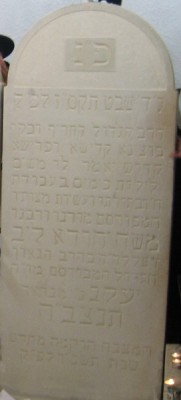
Translation of gravestone: Here lies, 4th of Shevat 5567 (1807), the great Rabbi, the sharp and knowledgeable, the holy light, holiness is said about him, who spent nights as days in the service of G-d and His Torah and the fulfillment of His commandments, the famous, our teacher Rabbi Moshe Yehuda Leib z”l. The son of the great Rabbi, our teacher Rabbi Yaakov of Brody. May his soul be bound in the bonds of life.
In the photo is the the grave of the righteous Rabbi Moshe Leib of Sassov z”l. In years past, the place was bustling on his yahrzeit (anniversary of passing). Men, women, and children would pour out their hearts in prayer and supplication in honour of the man of G-d, who loved his fellow Jews, was like a father to orphans, widows, and the brokenhearted, and who did everything he could for the welfare of the Jewish People. He was best known for his wonderful activity for the “pidyon shevuyim” (redemption of captives).
A Magical Chassidic Nigun (Tune)
On the day of the death of the Tzaddik of Sassov (Rabbi Moshe Leib), a group of musicians arrived at the funeral and began playing a magical Jewish tune in the cemetery of Sassov. And they said: “Once, after the Tzaddik of Sassov had a poor couple buried at his own expense, when he heard our orchestra, he said: ‘May these musicians accompany me to my grave on the day of my death.’ Years passed, and our orchestra was invited to a wedding of some kind. On the way, the horses began to gallop in another direction without being able to stop them, until they reached the funeral, which turned out to be the funeral of the Rebbe of Sassov. We remembered the Rebbe’s words at that wedding years ago, and we performed the same tune.”
Only 25 Jews survived from the Sassov community, while 1201 were murdered by the Nazis and their Ukrainian collaborators, nearly eighty-five years ago, at the end of 5701 (1941)…
The city of Rabbi Moshe Leib of Sassov was destroyed to the ground, and with it the magical atmosphere, the fond memories, and the glorious, holy heritage disappeared.
Rabbi Moshe Leib of Sassov, whose yahrzeit falls today, left a strong mark on the world of chassidism. His teachings, his thoughts, and his music still enliven the hearts of Jews who thirst and yearn for redemption.
In preparation for Parshat (the weekly Torah portion) Bo, we will tell two wonderful stories about the tzaddik, Rabbi Moshe Leib, both of which are related to this Parsha. The first story is famous throughout the Jewish diaspora, and songs have already been composed and countless descriptions written about it. The Rebbe, Rabbi Moshe Leib of Sassov breaks out in an enthusiastic dance in response to the words of his beloved Rabbi Elimelech about the joy of God when He passed over the houses of Israel, saying, “Here lives a Jew”…
Here Lives a Jew
In times of peace and war, in times of sorrow and serenity, Jews always revived themselves when they passed by a Jewish house in their wanderings. Then, when they saw the mezuzah, they would knock gently, and the owner of the house would open his house and his heart to them. “Vos hertzich, Reb Yid?” (How you you, dear Jew?) he would ask warmly, and very quickly the water would heat up and the meal would be prepared. Here lives a Jew!
In times of trouble and distress, when the cursed Nazis were exterminating the remaining Jews throughout Europe, they also marked the homes of Jews and their shops. “A Jew lives here,” the wicked ones wrote with their evil hearts, words that allowed the ignorant masses to break in, destroy, rob, and even murder.
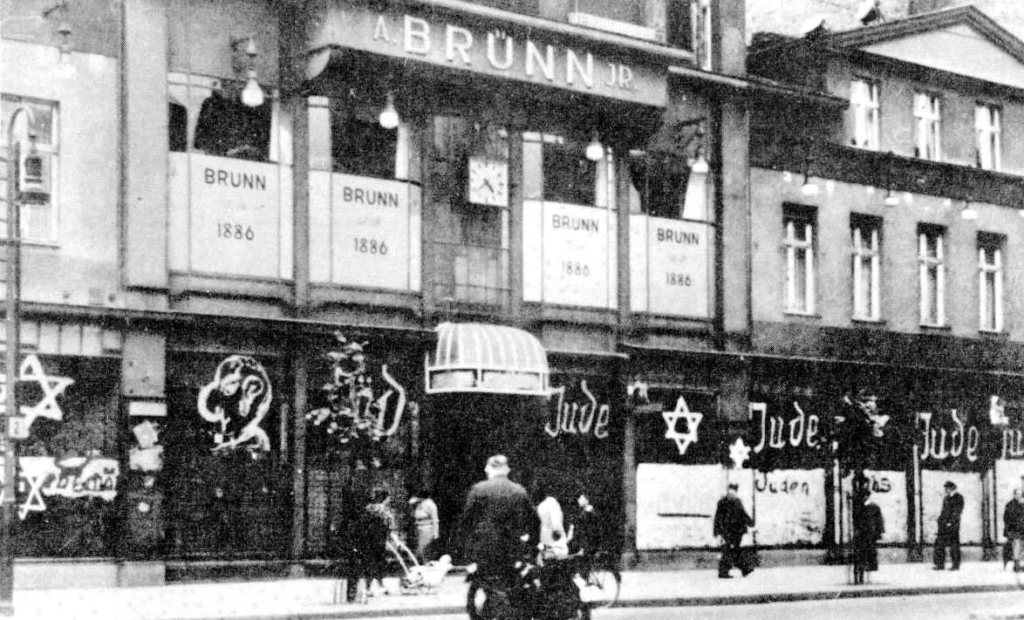
Jewish stores in Berlin sprayed with hateful graffiti
May G-d avenge the blood of the victims.
Here is the story as it was written and told.
The holy Rabbi Yechiel Yehoshua of Biale told:
“The Rebbe of Sassov, may his merits protect us, once traveled in a wagon in the winter with a Jewish coachman, to visit Rebbe Elimelech of Lezhansk, may his merits protect us. On one of the cold nights, heavy rains began to fall and strong winds blew, which caused danger, so the Rebbe of Sassov ordered the coachman to stop and look for a Jewish house where they could enter and warm their bodies a little. The coachman got out and went to several houses and returned the way he came, saying that he had checked and did not find a house with a mezuzah, and therefore they should continue their journey and look for a Jewish house further along the way. The Rebbe of Sassov felt that his weak and thin body was in danger in the freezing cold, so he asked the coachman to knock on one of the houses, and perhaps find some decent gentile who would be willing to let them in to warm up. The coachman approached again and knocked on one of the doors, and when the owner of the house opened the door, he saw that there was indeed a mezuzah on the doorframe, and the owner of the house was Jewish, and with great joy, he began to run to the cart, and while dancing, he sang, “Here lives a Jew, here lives a Jew.”
The next day, when the storm subsided, they continued on their way to Lezhansk, arriving on Shabbat Parshat Bo. While preparing the Shabbat table, Rebbe Elimelech, may his merits protect us, said about the verse, “you shall say, ‘It is a Passover sacrifice to the L-rd, for He passed over the houses of the children of Israel in Egypt’” (Exodus 12:27). Why is it said, “Passed על (on) the houses of the children of Israel,” when it should have been written, “Passed מעל (over) the houses of the children of Israel,” since the meaning of the verse is that the L-rd, in striking down all the firstborn in the land of Egypt, passed over the houses of Egypt and struck them down, and passed over the houses of Israel? And the explanation: that G-d descended at night, and passed through the whole land of Egypt, and saw the nakedness of the land, a land full of abominations and the filth of the gates of impurity, and therefore “G-d passed through to strike the land of Egypt.” But on the other hand, when He “saw the blood on the doorframes” in the houses of Israel, the blood of the Passover offering, then “G-d passed על (on) the door,” meaning He skipped over them from striking them, but He did not skip over them completely, but as it were, G-d danced over the houses of Israel and sang, “Here lives a Jew, here lives a Jew.” When the Rebbe of Sassov heard this, he rose from his seat, and with great enthusiasm and joy of holiness, he climbed onto the table of Rebbe Elimelech, may his merits protect us, and began to sing and dance with all his might: “Here lives a Jew, here lives a Jew.”
“Not One Dog Will Whet Its Tongue” (Exodus 12:7)
The second story connects to our parsha, on the verse “And against all the children of Israel shall no dog whet its tongue,” in which the Jews of Sassov and its surroundings mournfully contemplated when the oppressor came upon them eighty-five years ago and in a fit of rage murdered most of them, setting wild dogs, whose taste was the taste of sin, on men, women, and children. May G-d avenge their blood.
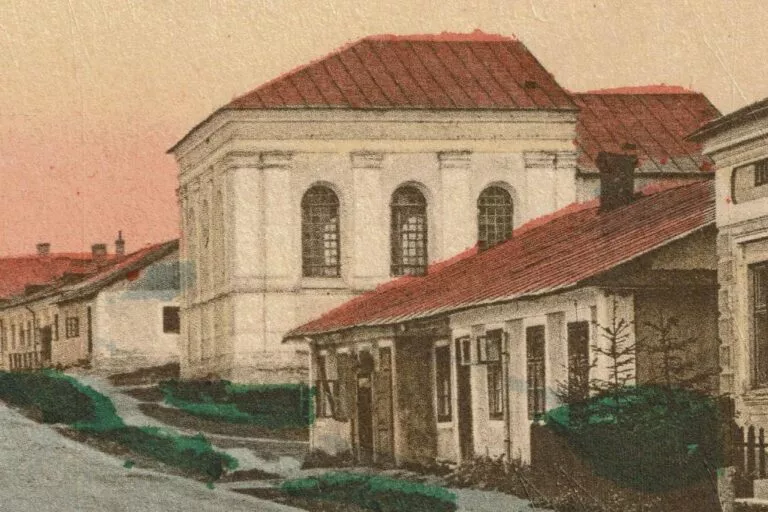
The synagogue in Sassov
Here is the story from the authoritative historical book “Dor De’ah” (Yekutiel Arieh Kamler, New York, 5712):
“And indeed, his love for his fellow Jews was a fierce love without boundaries and without limits. In those days, when the Jews who owned the orandis (estates) in the villages, if they could not pay the rent for the orandis to the master, they had one option: to kill them in captivity, they and their wives and children. The righteous Rabbi Moshe Leib redeemed them from death and saved them from destruction, whether by redeeming captives for whom he gave the required money, or by giving his life for them at the risk of his own life, when he went to the tyrannical and cruel masters like coyotes, to ask them to release the unfortunates from a prison cell, even though he knew that he was in danger. And once, when he came to ask for mercy and pardon from a master of such captives, when the master saw the holy Rabbi Moshe Leib from afar, coming to him again, after having already warned him not come again, the master ordered his servant to release the dogs from their captivity and to set them on him. Then the holy Rabbi Moshe Leib z”l, was not frightened by them and went towards them and extended his arm to them and said: ‘Tear my flesh – if you have been sent from Heaven for this purpose!’ The dogs remained in their position and not one dog whet its tongue. When the master saw this, he was greatly frightened and raised his face to the holy rabbi and ordered the captives to be released from their captivity and set free…”
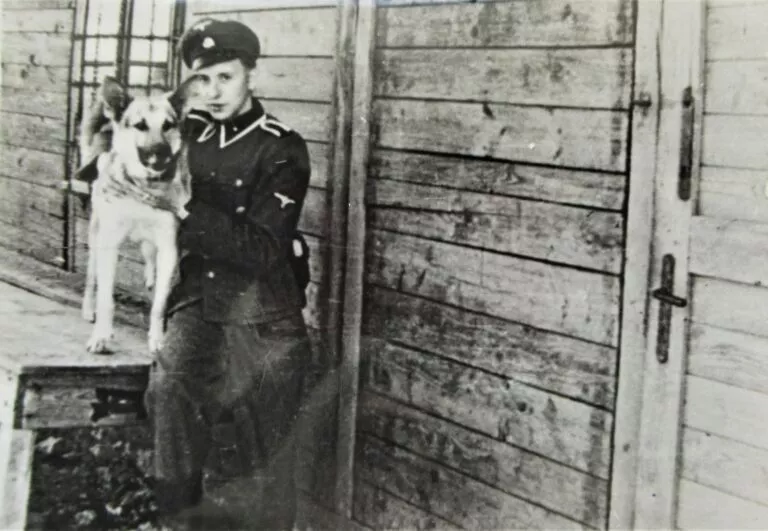
A Nazi camp guard with his German shepherd dog, in Plaszow, a concentration camp near the city of Krakow
Sassov’s end, courtesy of Wikipedia:
“On July 2, 1941, during Operation Barbarossa, the town was occupied by the Germans, and even before they entered it, the local Ukrainians forced the town’s Jews to build a triumphal arch in their honour, murdering some of them. After entering the town, the Germans murdered 22 prominent members of the Jewish community there, after they had been handed over to them by the local priest. Various decrees were subsequently imposed on the town’s Jews, including the obligation to wear an armband and the obligation to pay large ransoms. About a month later, the local Poles and Ukrainians rioted among the town’s Jews, robbing them of their property, beating them in the streets, and burning down the local synagogue.”
“Over time, Jewish refugees from surrounding villages arrived in the town, after the local Ukrainians carried out severe pogroms against them. The town’s Jews and Jewish refugees were employed in forced labour in quarries near the town, where some were tortured and murdered, and some were sent to labour camps where they perished within a short time. Despite the efforts of the local Judenrat to ensure that the Jews continued to work, German and Ukrainian policemen periodically murdered dozens of Jews in the town. On the eve of Rosh Hashanah 5703 (1942), about 100 Jews from the town were sent to the Belzec extermination camp, and the sick and unfit for work were murdered on the spot. About three weeks later, another Aktion (roundup) was held in the town, in which the town’s rabbi was also killed.”
“At the end of November 1942, the last 400 Jews remaining in the town were deported to the Zolochiv Ghetto. After the deportation, a small, fenced-off labour camp continued to operate in the town’s suburb, Chomitz, where about 700 Jews from the area were concentrated. These Jews were employed in the quarries near the town, and were forced to break up the tombstones in the Jewish cemetery in the town and pave the town’s streets with them. Later, another labour camp was established in the town, where about 70 workers were concentrated. In the summer of 1943, both of these camps were liquidated, and all of their inhabitants were shot.”
From the Sassov community, about 25 Jews survived the Holocaust, in the forests or in Soviet territory.