How Was the Chachmei Lublin Yeshiva Built?
Interesting testimony from Rabbi Meir Shapira z”l’s secretary
A fascinating document from Ganzach Kiddush Hashem’s archive – Presented by Yaakov Rosenfeld
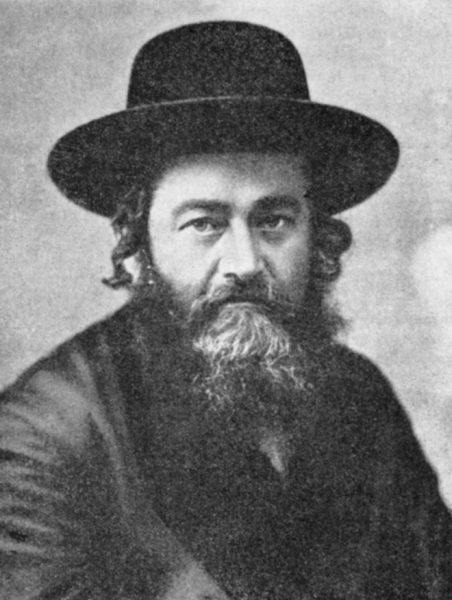
Rabbi Alter Meir z”l, a native of the city of Sanok in Poland, and an ardent Czortkow chassid, served as secretary to the genius Rabbi Meir Shapira of Lublin z”l, during his years as rabbi of the city of Sanok.
Due to the draft decree in Poland, Rabbi Alter Meir immigrated to the Land of Israel in 5692 (1931-2) and brought with him the aromas of Jewish-chassidic Poland to Tel Aviv, where he lived and wrote memoirs and original Torah thoughts. Sixty years ago, in the month of Kislev 5726 (1965), he passed away with a good reputation, leaving behind manuscripts and books that became the property of the public.
In this article, which he published in the newspaper “HaTzofeh” a few months after the Holocaust, exactly eighty years ago (Cheshvan 5706/1945), Rabbi Alter Meir brings a wonderful story from his memories of his teacher and rabbi, Rabbi Meir Shapira of Lublin z”l, during his stay in the United States on behalf of the Chachmei Lublin yeshiva, the great and famous yeshiva that Rabbi Meir Shapira founded with his own hands and with great devotion.
We bring these words faithful to their source, and may they be for the upliftment of the soul of Rabbi Yehuda Meir son of Rabbi Yaakov Shimshon Shapira z”l, and his faithful disciple Rabbi Ze’ev Dov Alter son of Rabbi Yisrael Meir z”l.
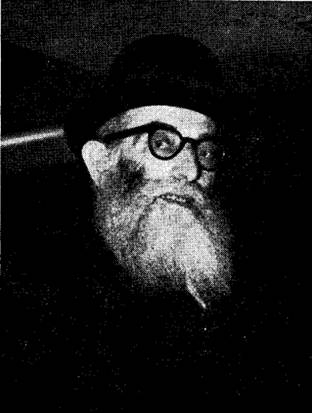
Rabbi Alter Meir z”l
This was during the stay of Rabbi Meir Shapira, of blessed memory, in America in 5688 (1927-8). He suffered a lot until he adjusted to the conditions of the new land. In the first months he suffered from real hunger and was penniless to the point of not even buying a stamp. His friends were worried about his well-being and telegraphed him, but he did not answer, until they contacted their acquaintances and learned that nothing had happened to the rabbi and they calmed down. This situation lasted for three months or more until the situation became unbearable for him, and from then on he was successful in raising funds for the Chachmei Lublin yeshiva and his image rose due to marketing carried out by himself and by others.
Here is the fact as it was told to a small circle of his associates:
As you know – the rabbi z”l began to tell – when I came to America for matters of the Chachmei Lublin yeshiva, I was confused, and apart from the honours that were bestowed upon me by institutions close to me, no line of work was outlined that would be worthy of its name, there was no proper marketing, and all my plans were dashed. I was paralyzed with grief and worry for the future of the yeshiva. The disappointment was great, and only at the urging of my companion, Moshe Eisenberg, did I stay and suffer. For the entire day I did not leave my room and was very irritated. I did not write to anyone, not even to my closest friends, nor did I immerse myself in studies, because I lacked clarity of mind, and apart from the daf yomi (studying a page of Gemara a day) that I took upon myself as a duty and studying Chumash (the Pentateuch) with Rashi’s commentary, I did not learn anything.
And so, one hot summer day, Mr. Eisenberg urged me to go down to the street for a little walk.
I agreed and we went down to the street, which was bustling with people, some of whom had happy faces that I greatly envied, and while I was doing it, I envied them and begged: Master of the Universe! When will I also be able to show a satisfied face?
On our way we entered a side street, it was already evening. Suddenly a Jew with a beard and peyos (sidecurls) emerged from the side, and with a begging voice, invited us to enter the nearby synagogue for the evening prayers.
“In the name of all of you,” he said, “do not refuse me. My livelihood depends on this, because today the first gabbai (assistant) of the synagogue is commemorating a yahrzeit (anniversary of death), who, by the way, is also very rich, and if I do not arrange a minyan for him, he may dismiss me from the position of shamash (synagogue custodian).”
Hearing these words, I could not refuse and we entered.
The “President” Mr. Sam Dzanas, who had once been a yeshiva student, passed in front of the ark himself, and at the end of the prayer he approached me and asked me to study a chapter for the ascension of the soul.
He did not know my name but saw me as dressing in rabbinic gard. I remembered at that moment that I had not yet studied the daf yomi and agreed to study that day’s daf in front of the small congregation.
The president, Mr. Dzanas, did not understand why I chose to study the Gemara page of Tractate Sota 21 A, which fell on that day. Here, Mr. Eisenberg came to his aid, explaining to him the entire section of the daf yomi and highlighting that I was the initiator of the daf yomi. We sat and I read the page as if G-d had been good to me. When we reached the paragraph, “If a man gives all his household wealth for love, he will be utterly condemned,” and the Gemara passage, “Ulla says: The verse is not speaking of individuals like Shimon, brother of Azarya, whose brother Azarya supported him and enabled him to study Torah. And it is not speaking of individuals like Rabbi Yochanan of the house of the Nasi (prince/president), whom the Nasi supported so that he could study Torah,” they are not condemned because they supported Rabbi Shimon and Rabbi Yochanan from the beginning and provided for their every need so that they could devote themselves to studying Torah, but rather who is condemned, those like Shevna; “Hillel and Shevna were brothers, Hillel engaged in Torah out of necessity and Shevna engaged in pragmatism, finally Shevna came to Hillel and asked that they divide it between them, and he would give him half of his wealth and Hillel would give half of his wealth in Torah, about such a person it is said that if a man gives all the wealth of his house, he will be condemned.”
Here I got excited and said, how is it that the wealthy do not pay attention to the gift that was given to them in maintaining Torah students, and in particular to the yeshiva that is only now being built. They have the ability to gain the Torah of many from the beginning and it will be considered as if they themselves are engaged in it, because if the things are said in the Gemara in the Torah in the name of an individual, like Shimon and Rabbi Yochanan, how much more so is he who maintains yeshivahs in which hundreds of students study, some of which are very large.
When I finished the page, and before Mr. Dzanas prepared to say Kaddish, he took out his checkbook and signed for a thousand dollars (the dollar at that time was very valuable – Y.R.) immediately and said that he had another hand in doing something for the yeshiva. He kept his promise with dedication and loyalty. The shamash of that synagogue also brought me his donation of one hundred dollars. Mr. Dzanas’ greatest help was that he invited a large number of synagogue gabbais and influenced them not only to invite me to speak but also to act and make each one of them his acquaintance, in such a way that the circle of donors expanded and enabled me to erect the huge building of the Chachmei Lublin yeshiva.