In Memory of the Tens of Thousands of Victims from Riga, Latvia
85 Years Since the Rumbula Massacre
By: Yaakov Rosenfeld
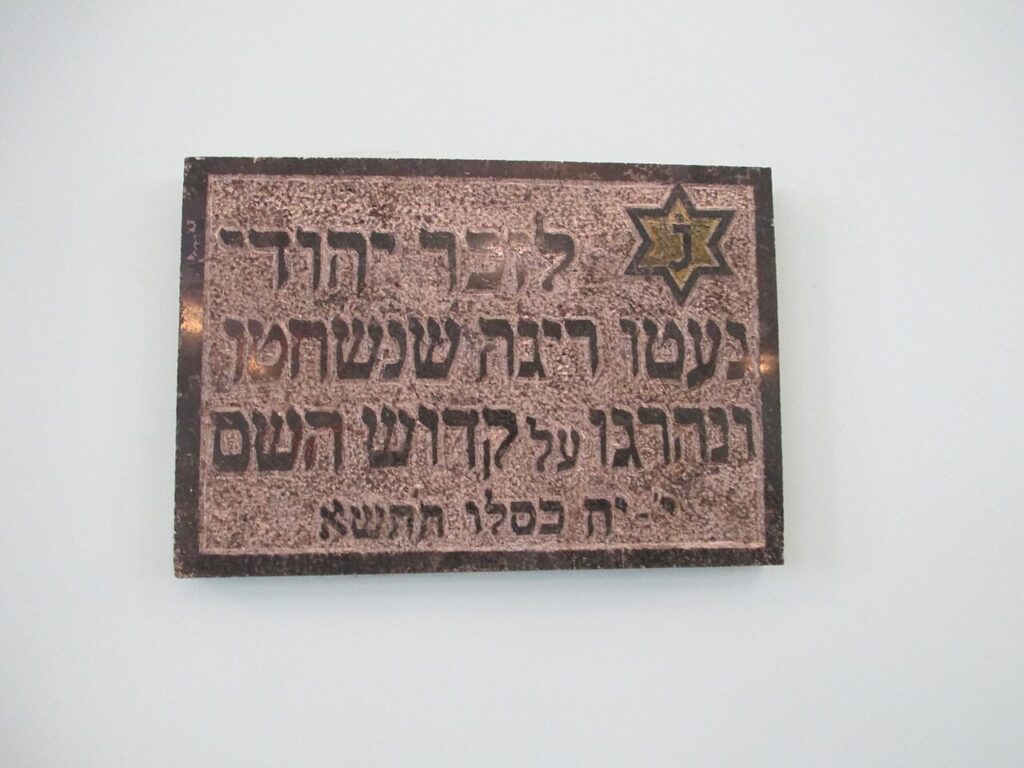
A memorial plaque in a surviving synagogue in Riga
Riga was a large, vibrant city. Tens of thousands of Jews lived in this beautiful, major city, the capital of Latvia, situated on the Baltic coast.
Thirty thousand of the city’s Jews were murdered during the Holocaust, primarily by machine-gun fire. This was carried out with the active, enthusiastic participation of bloodthirsty Latvian civilians, who showed great zeal in this task. In November 1941, between 25,000 and 28,000 Jews were murdered in the Rumbula Forest.
The massacre in the Rumbula Forest took place after the Nazi regime decided in the month of Cheshvan 5702 (1941), eighty-five years ago, to deport German Jews who were then in the Soviet Union to Riga. In order to “make room” for this population, the Nazis resolved to liquidate the Jewish community of Riga and house the German Jews in their place. There are various theories as to why the Germans chose this course of action. A prevailing view is that the Jews of the “East” were considered even more loathsome by the Nazis; furthermore, some researchers, citing discovered Nazi documents, suggest that the Nazis sought the total annihilation of Eastern European Jewry to ensure that their Talmudic and spiritual influence would cease to exist.
The Ganzach Kiddush Hashem archives contain and document invaluable material regarding Latvian Jewry in general, and the Jewish community of Riga in particular, with a special focus on the interwar period and, most certainly, the years of the Holocaust. The archive staff is currently working to prepare this precious historical material for publication.
To mark the eighty-fifth anniversary of the Rumbula massacre, the Education Department of Ganzach Kiddush Hashem has focused on commemorating the victims of Riga: Torah scholars and yeshiva students, chassidim and men of pious deeds, rabbis and religious functionaries, fathers, mothers, and young schoolchildren – thousands upon thousands – who were martyrs in sanctification of the Name of G-d during those years of wrath, and over whose graves not even a single headstone was ever erected. May these words serve as a monument to their memory and an eternal flame for their souls.
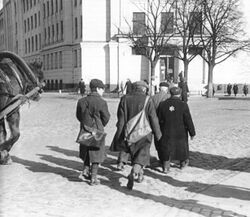
Jews in the Riga Ghetto
We possess a vast and diverse collection of materials. In anticipation of the upcoming yahrzeit (anniversary of passing), we wish to commemorate two young men, profound Torah scholars and spiritual giants, who perished in Riga, leaving no trace behind.
By way of background: during the interwar period, there was a surge of activity in Riga dedicated to the observance of Shabbat throughout the Jewish world. An organization named “Shomrei Shabbos” (Guardians of the Sabbath) was established, and its members spearheaded remarkable initiatives across Europe. As part of this effort, a periodical titled Der Shabbos was published, featuring contributions from public figures, rabbis, and community activists from all backgrounds and circles, all united in their commitment to the holy Shabbat. This publication also featured a famous letter by the Chafetz Chaim – a call to strengthen Sabbath observance – which was likely written at the request of the “Shomrei Shabbos” activists.
As part of the effort to commemorate the Jewish community of Riga, the Ganzach Kiddush Hashem Archive has collected valuable material regarding the “Shomrei Shabbos” organization. The archive also holds copies of the unique newspaper Der Shabbos, which sheds light on this distant and intriguing era. During the interwar period, an Agudath Israel newspaper titled Heint was published in Riga; it, too, contains historically significant material.
G-d willing, the exhibition “Latvian Jewry” will feature these fascinating documents, accompanied by a clear, polished Hebrew translation. Also on display will be Torah discourses authored by brilliant young scholars, the pride of the Lithuanian yeshivas, who resided in Latvia. Among them was the righteous Torah luminary, Rabbi Yosef Shor – may God avenge his blood, son of the renowned Rabbi Yitzchak Isaac z”l. Rabbi Yosef studied at the Hebron Yeshiva in Jerusalem before returning to Lithuania. He edited the monthly journal Knesset Yisrael, which preserved Torah teachings — both oral and written — from world-renowned Torah giants, the great sages of Lithuania and Latvia. Rabbi Yosef was a man of profound righteousness; his conduct in the Riga Ghetto was a source of wonder to all who witnessed it, until he was murdered by the Nazis. The archive also contains Torah discourses by the righteous Torah luminary, Rabbi Bentzion Don Yechiya. For many decades, he served as a highly esteemed rabbi; he was a prolific author and an authority on Halacha (Jewish law) whose every word was eagerly awaited. He occupied the rabbinical seat of his father, the great Rabbi Eliezer, in the city of Lutsin (Yiddish for Ludza), known as the “Jerusalem of Latvia,” until he was brutally murdered by the Nazis, who fell upon him like wild beasts and subjected him to horrific torture. He was killed on the 25th of Av, 5705 (1945). His Torah discourse concerns a halachic analysis regarding the hagalah (making utensils kosher with boiling water) process for aluminum vessels coated with an earthen mixture.
In this piece, as mentioned, I present words of inspiration regarding the sanctity of Shabbat, authored by two young Torah scholars from Riga, Latvia.
The genius and tzaddik (righteous), Rabbi Hoshea Shor, whose full name was Rabbi Yehoshua Heschel Hoshea, was a student at the Riga Yeshiva, where he was regarded as one of the most outstanding pupils. He served as a rabbi and shochet (ritual slaughterer) in several communities; the following are his wonderful words intended to inspire Shabbat observance.
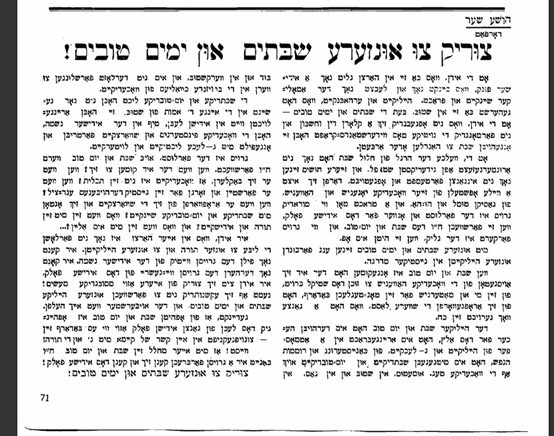
Back to Our Shabbat and Holidays!
There are Jews in whose hearts a Jewish fire still burns, a longing and yearning for the wholeness and spiritual elevation they once experienced in their homes during Shabbat and holidays. Yet, these same individuals, perhaps lacking a clear reckoning with themselves or the necessary strength of resolve, have begun to relax their observance or even work on Shabbat.
For those among them, those whom the habit of desecrating the Sabbath has not yet dragged down to the lowest depths, and whose spiritual sensibilities have not yet become entirely dulled, the time has come, with G-d’s help, to pause. They must step back from the daily race and the relentless commotion, from the noise and the clamor of the streets, and reflect upon the immense and terrible loss suffered by the Jewish People when, G-d forbid, Shabbat and holidays are desecrated. Conversely, they should consider what a vast and sweet treasure is preserved when these days are kept.
Our holiness and spiritual standing are bound up with our Shabbat and holidays.
When Shabbat or a holiday arrived, the Jew would cast off the daily clamor of the struggle to earn a living, the toil and exertion required for his everyday needs, and would shed the heavy burdens that had occupied his energies throughout the entire week.
The holy Shabbat and holidays would elevate him far above all this, immersing him in an atmosphere of sanctity and purity, of spiritual transcendence and upliftment. They imbued even his weekdays, wherever he might be, whether at home or in the street, in the city or in the countryside, with the distinct spirit of Shabbat and holidays, preventing him from being swallowed up and reduced to a mere speck yearning toward the surging tides of materialism.
The confines of the home shone with a radiant light. This light penetrated deep into Jewish life, deep into the Jewish soul, dispelling the darkness and gloom of the everyday, and filling everything with purity and refinement.
Great is the loss if, G-d forbid, Shabbat or the holidays are weakened or desecrated. When will the Jew come to his senses? When will he reflect and realize that material pursuits are not his true purpose? And when will he grasp, and take to heart, this lofty call: to cast off the heavy burden weighing him down, and instead clothe himself in the beauty of Shabbat and holidays? What will become of his Torah and his Judaism? And what will become of him, himself?…
You, Oh Jews, in whose hearts the love for our Torah and our sanctity has not yet been extinguished – you who can still feel the profound pain and the inner cry of the Jewish soul, you who can still hear the anguished plea of the Jewish People, our brethren – refrain from such dangerous actions! Resolve firmly never to desecrate our Shabbat and holidays. May the Almighty assist you. Know that by properly observing Shabbat and the holidays, the lives of the entire Jewish People are bound together in an enduring connection with G-d and His Torah! Know, too, that by desecrating Shabbat and the holidays — G-d forbid — you commit a grave transgression against yourselves and against the Jewish People!
Return to Our Shabbat and holidays!
Another article from “Shomrei Shabbos” has been preserved in the archives. It is authored by the young Torah prodigy, Reb Chaim son of Reb Shneur Zalman Kluft, may G-d avenge his blood. He was a native of the town of Nevel (in the Vitebsk Governorate) and a distinguished student of the “Yagdil Torah” institution in Riga, as well as the Riga Yeshiva.
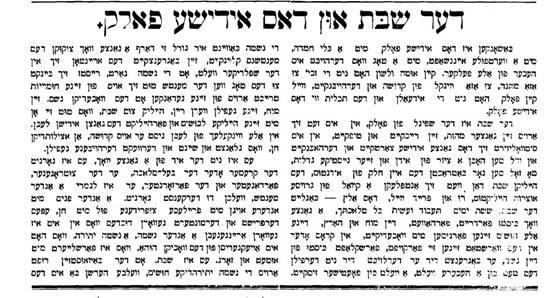
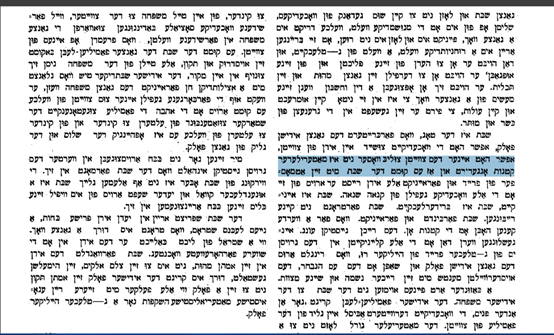
Shabbat and the Jewish People
Shabbat infuses every Jew with new strength, joy, and a fresh vitality for life, a spirit of hope that sustains him throughout the entire week. Like a ray of light, it illuminates the challenges of the mundane weekdays. The holy Shabbat reminds a person of his true essence; it restores him to his Divine image, to his heavenly standing.
The holy Rabbi Chaim Kluft, may G-d avenge his blood – Shabbat and the Jewish People, 5699 (1939).