In the Month of Nisan we were Redeemed and in the Month of Nisan we will be Redeemed – The Voice of a Survivor of the Bochnia Ghetto
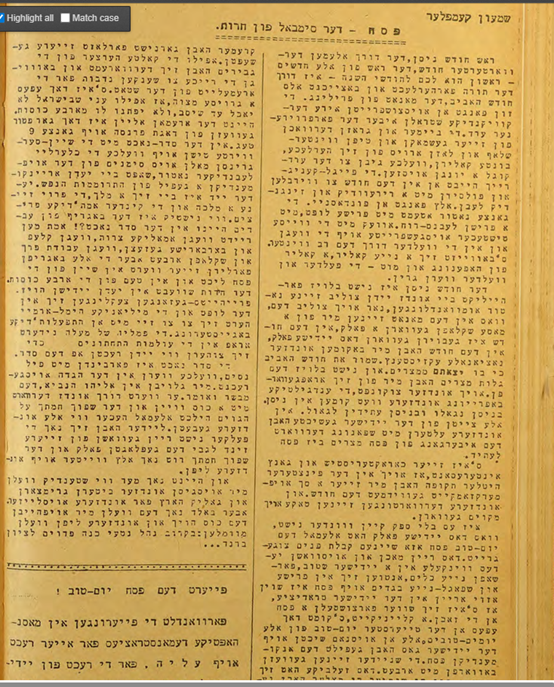
In preparation for Passover 5706 (1946), Rabbi Shimon Kempler, a survivor of the Bochnia Ghetto, published an emotional and moving article on the essence of the holiday of freedom. The bold lines were originally published in Yiddish in the newspaper “Undzer Shtimeh” (Our Voice) – a Holocaust Survivor publication published in Bergen-Belsen, and a copy of which is preserved in the Ganzach Kiddush Hashem archive.
We present these words in a faithful translation, on the eightieth anniversary of their publication, in memory of the tens of thousands of survivors who revived vibrant Jewish life in the heart of the Bergen-Belsen camp under British occupation.
Upon the liberation of the camp on Iyar 2, 5705 (April 15th, 1945), the liberating forces found some 60,000 Jews heartbroken but full of hope. Sadly, many returned their souls to the Creator precisely in the first days of freedom due to exhaustion and epidemics. But those who remained chose life: in the first year, about a thousand new Jewish homes were built (i.e. marriages), and hundreds of babies were born. Yeshivas, Bais Yaakov institutions, and Talmud Torah schools were established within the camp, and once there was a huge heart of kindness and mutual aid. From that steadfast spirit, the following was written:
The Renewal of Creativity and Spirituality
The month of Nisan, to which everyone looks with anticipation, is the “head of the months.” The Torah calls it the “month of spring,” when the sun sends golden rays to caress the frozen earth. The trees and plants wake up from their winter slumber, wearing fresh hues that give the universe a young and renewed look. The birds burst into cheerful song, a song of life and joy – everything begins from the beginning.
All of creation breathes fresh air, and a new spirit of life blows across the world. The white and swarthy carpet that covered the roads and forests gives way to another whiteness – a green and festive garment that spreads across the horizon.
The Birth of a Nation
However, for us Jews, the month of Nisan is not only sacred because of the renewal of nature, but mainly because of the birth of our people. In this month we emerged from the iron furnace, from the suffering and torture of slavery, and became a nation with a wonderful uniqueness. “Keep the month of spring, for in it you came out of Egypt” – and not only did we lift the Egyptian exile from under us; for in Nisan they were redeemed and in Nisan we will be redeemed.
Throughout Jewish history, our ancestors waited with longing for Nisan, out of the desire to see the connection between the redemption of Egypt and the redemption to come. How thrilling it is to discover that even in the last period of darkness, under the yoke of the oppressor, the Jews raised their eyes to Nisan – and their expectation was not disappointed.
Preparation and Elevation of the Soul
It is no wonder that the people of Israel welcome the holiday with such great beauty. The meticulous cleaning of every corner, the thorough washing, the new dishes, the festive clothes sewn in honour of the holiday – all of these are deeply engraved in the Jewish consciousness. It is difficult to describe Passover without this holy commotion, which heralds the arrival of the most precious of holidays. Passover is indeed the most precious “Yom Tov” (“holiday,” but literally “good day”) of all yom tovs… The entire Jewish street was buzzing with activity: the tailor’s hands did not rest from their activity, the shoemaker, the miller and the bartender did not rest from their work, and even the most hardened hearts were opened with the generosity of “Kimcha de Pesach” (charity for Passover), to ensure that even a the poor Jews would sit at the table as a free man and would not lack four cups of wine.
On the night of the Seder, around magnificently laid tables, everyone’s hearts overflow with excitement. Every Jew in his home is a king, his wife a queen, and his children princes. How does the proclamation “we were slaves” fit in with the majesty of the evening? True, we recall the hardships of the past, the decrees and the hardship, but all of these pale in comparison to the beauty of the night and the taste of freedom felt throughout the house. The song of freedom is carried in the air, and a Heavenly entourage descends to listen in awe and admiration to the Seder ran by G-d’s children.
The Prayer for the Future
The Seder night is intertwined with many miracles, as we read in the Hagada. We believe and look forward to the coming of Elijah the prophet, and prepare a large cup of wine for him, and when Elijah comes, we cry out in pain, “Pour out your wrath on the nations.” This prayer always stands at the top of our requests. Unfortunately, the world has not yet been cleansed and is not yet cleansed of the terrible sin committed against our tortured people, and this prayer still hovers between our lips.
This year, more than ever, we will pour out our bitter hearts over the deep sorrow that was our portion in the difficult exile we have just gone through. But immediately afterward, we will raise our glass with confidence, and our lips will sing the hope of complete redemption: “Lead the shoots if Israel’s stock, redeemed, into Zion with great joy.”
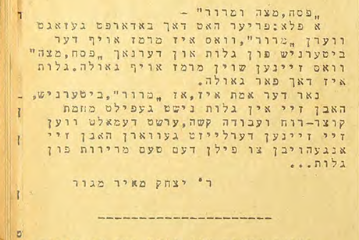
Passover, Matzah, and Bitter Herbs
Torah thoughts by the Gerrer Rebbe, which was so fitting for that period and the heartfelt emotions that accompanied it. From the pen of a camp survivor
The Gerrer Rebbe, the “Chiddushei HaRim” asks: Why is the order “Passover, matzah and maror (bitter herbs)”? After all, maror symbolizes the bitterness of exile, and it had to appear before Passover and matzah, which symbolize redemption? And he explained: During the time of slavery, due to impatience and hard work, the Israelites could not taste the taste of bitterness. Only after they were redeemed did they begin to feel the bitterness of exile…