Jewish Morals in the Nazi Jungle
Written and edited by Faigy Schiff, based on testimonies held by Ganzach Kiddush Hashem
In the jungle, animals prey on each other to survive. But Jews were blessed to live in the image of the Creator. Despite the terrible conditions and impossible situations.
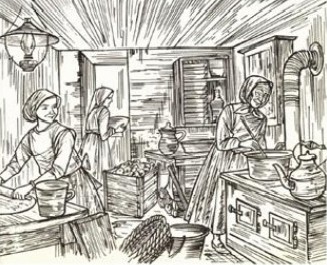
Women in the kitchen in a ghetto, drawing
…Most Jews were refined to high levels of morality, virtue, mercy, and sacrifice for the sake of others. The “human animals” of the occupation regime stood amazed and surprised at the devotion, love, and compassion that not only fathers and mothers showed to their family members, but also to every Jew. They, who wanted to humiliate and oppress and turn independent people into “reptiles” who crawl for a loaf of bread, were puzzled by the awareness and self-respect that the Jews maintained in the most difficult and tragic situations. Of course, there were also isolated cases everywhere of deviations from the pure framework, when people, out of constant anguish and fear, were tempted in moments of weakness and wanted to save themselves at the expense of others, but these cases were only “exceptions” that reinforced the rule, that the vast majority of the Jews of the ghettos lived and perished in holiness and purity.
Fathers and mothers refused to part with their children and together they went to the furnaces, Jews shared their meager ration of food with a sick neighbour who could not go to work so that he could lie in a barrack and recover and not be immediately taken as a sick person to the furnacess… Even on the last night on the verge of death in the furnaces, they gave maximum help to their brothers who were about to escape…
Even when they were put into the furnaces, they did not lose the character of man created in G-d’s image and sang with great emotion “Ani Maamin” (I Believe). Is there greater spiritual heroism than this?
(Alexander Kahane, HaTzofeh)
The common fate and the terrible hardships bound all the Jews in the ghetto into one cohesive brigade, and the spirit of solidarity pulsed in it properly… There were almost no informers in the ghetto, even though there were “favourable conditions” for the spread of this scourge.
(L. Garfunkel, Kovno HaYehudit BeChurbana, Yad Vashem)
People did not allow their loved ones go alone into the unknown:
When the children were taken, the mothers followed them. A husband who could save himself accompanied his wife. Sons and daughters who had the right to stay in the ghetto did not leave their parents and went with them to Treblinka.
(Mordechai Eliav, Ani Maamin)
Eight-year-old Yankeleh was loved by the camp commander, an SS man. When his father was sent to be exterminated, he could have been saved and remained alive thanks to the commander’s friendship, but in his fierce love for his father, he joined him at the last minute on the final journey.
(S. Niger, Kiddush Hashem)
Jews did not surrender their brothers to the oppressor even at the cost of their lives, thus sanctifying the Name of Heaven with their death:
The picture would not be complete if I did not add the last path of Mrs. Chava Hutner, president of the “WIZO” in Bedzin. The “House of the Dead” (orphanage) had a kitchen whose employees were not harmed during the deportations. Many women would escape there and thus save their lives.
The Gestapo men present at the scene watched several women who had entered the kitchen, seeking shelter and refuge from the threat of deportation, and ordered those who were not working there to leave. None complied. Then the Gestapo men ordered Mrs. Hutner to hand over to them the women who were not regular kitchen workers, but she firmly refused. The Gestapo men gave her five minutes to comply with their order, and if she did not comply – she would be deported to extermination in their place. The five minutes passed – she remained silent and steadfast in her refusal. Then the Gestapo men pounced on her like animals of prey, forcibly removed her from the kitchen and included her in the shipment destined for extermination.
(David Liwer, Ir HaMeitim)
When my husband Yisrael and I were still trying to find help to save our little girl, we turned to a Jewish policeman we knew named Perlstein… Perlstein’s family loved the little girl Tamarli very much, and when they heard that she had been kidnapped for deportation, they raised their hands in anger. Perlstein, who was in the room at the time, took off his police hat and handed it over with his documents to Yisrael. “Run quickly to the umschlagplatz (deportation square)” – he cried – “and inform the officer on duty that your child is among the kidnapped Jews…” With trembling hands, Yisrael snatched the hat…
“Yisrael, I forgot to tell you that on the way you must kidnap someone, an adult or a child, to take Tamarli’s place, since the number of people in the shipment must match…” – Yisrael remained as if petrified, took off his hat and muttered: “My only child, only her I am allowed to sacrifice, only mine, only mine.”
(Chaya Elbaum-Derembus, Masa Nedudim BeChipus Achar Elokim, Yalkut Moreshet, Avraham Korman)
When the Germans captured a Jew in Warsaw after the uprising, they would promise to release him if he revealed at least one bunker where Jews were hiding. Then they let some Jews be executed and did not turn over their brothers.
(Hillel Seidman, Warsaw Ghetto Diary)
Purim 1945. On Purim night, one of the Jews, Aryeh Sheftel, spoke about the defeat of the Germans in the ears of the sorrowful Jews. But when the Jews reached the commander, they felt that something bad was about to happen. The commander spoke: “We know about your meeting and the speech that was given. One thing can save you: if you immediately announce who the speaker was. We will punish only him.” Deathly silence. Orders were given: “Run, run!” They ran and ran, sticks and whips do not cease to fall on bent backs, their strength has already run out, and everyone is running. The sticks are constantly being lowered. Aryeh Sheftel has already decided: he will confess. But from all sides whisper against him: “We will not give you up, go on, we will not give you up…”
(K. Shabbtai, Davar)
436 young Jews from Salonika were chosen by SS officers to help convince the Jews who were brought in by transports to go to the gas chambers, under the pretext that they were going to bathe…
When their new role was explained to them, the young men, who were shocked by the very idea… began to mingle among themselves, and then they all decided as one that they would prefer to die than in sanctification of G-d’s Name in the gas chambers, provided that they would not engage in persuading Jews to go to their deaths without their knowledge.
When they refused, they were taken to the gas chambers the next day.
(Aryeh Meir, HaModia)
At one of the workplaces outside the ghetto, one of the workers was expected to have a dangerous unpleasant experience this week because things were once again not in order there as far as the tools were concerned. It was necessary that the person be found, otherwise they would not pass in silence… It was a matter of a few moments, and when the real culprit did not answer, the young carpenter turned himself in of his own free will… He declared that although he had nothing to do with the matter, he was willing to take the blame upon himself in order to help his unfortunate friend. This courage of the young Jewish worker made a deep impression on the non-Jewish side as well and resulted in the whole matter being resolved amicably.
(Yediot HaGhetto)
People even gave themselves up for death to save the life of someone else:
In the first year of Nazi rule, on Purim, the evil one announced to the Jewish elders that on that day, on Purim, he would take revenge on the Jews of this town for the ten sons of Haman who were hanged in Shushan the capital, and his plan was ready: the ten Jews would be hanged on that day in the market square in front of all the residents.
The ten Jews were caught without choice, without delay, among them were old and young, poor and rich, simple and respectable, and one of them was found – a groom who had just been at his chupa (marriage canopy). He was taken from the bride’s room, and with the general panic over the captured Jews, a particular sorrow was felt for this groom who had been caught in the trap. He was one of the crops of this town, and the pride of the entire town was in him. And now, believe it or not, this is what happened. One of the many neighbours of the captured groom, of his own accord, went and announced that he was ready and willing to trade places with the groom. Quite simply. Let them release the groom and take him, the old man, in his place to complete the number of Jews chosen for hanging…
This is not the end, this is just the beginning of a very long journey. Hundreds of thousands of stories of exalted Jewish morality have been told, are being told, and will be told. The Ganzach Kiddush Hashem archive is packed with such testimonies, and this is the opportunity to tour the site, listen and read, and discover the holy heroism of our people.