Kol Nidrei: Who Composed the Stirring and Poignant Melody?
Kol Nidrei (The Prayer at the Start of Yom Kippur) – A Heartrending Tune
By Yaakov Rosenfeld, Ganzach Kiddush Hashem
While browsing the Ganzach Kiddush Hashem archives, a very old newspaper clipping caught my eye. It had been published on the eve of Yom Kippur in the year 5702 (1941), exactly eighty-five years ago, in a newspaper titled Havaner Lebn (“Havana Life”). Havana is the capital of Cuba, a country where the official language is Spanish. Who were the Yiddish-speaking Jews living in the Cuban capital, and for what purpose did they publish a newspaper that appears to have been of high quality and widely popular?
Cuba is located in the Caribbean, and a Jewish community has existed there since approximately 5510 (1750); it included many Anusim (crypto-Jews) who had fled the terror of the Inquisition. For many years, a well-established Sephardic Jewish community thrived there. Ashkenazi Jews arrived in the years preceding the Holocaust, at a time when the gates of the United States were closed to them. Thousands of Jews of Polish origin lived in Cuba during that period; the locals referred to them as “Polakos.”
Antisemitism, which was present in Cuba as well, led to the Caribbean nation closing its doors to Polish refugees in the pre-Holocaust era; consequently, the St. Louis ship was forced to turn back with nearly a thousand Jews on board who had fled Nazi Germany.
The Ashkenazi community of Polish origin in Cuba lived alongside its long-established counterpart, the Sephardic community; consequently, the Yiddish story presented here, translated for the first time and originally published in Cuba at the height of the Holocaust, carries significant weight in terms of authenticity, as the legend was reportedly recounted to the author by a Cuban Jew of Anusim descent.
In any case, the story itself is compelling and moving, and it is presented here eighty-five years after its initial publication.
(Translated from Yiddish to Hebrew by Yaakov Rosenfeld, and from Hebrew to English by Ricki Prince)
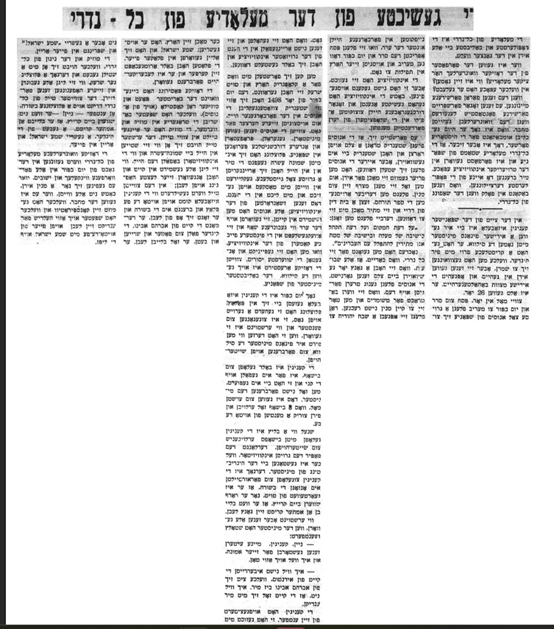
“The Story of the Melody – Kol Nidrei”
The melody of Kol Nidrei is the most popular and beloved among Jews worldwide.
Who composed this melody, which so remarkably touches the heart? What was his name? In which era did he live?
There are various theories regarding this matter. There are even fantastic legends about this mysterious and wondrous composer, who remains unknown to historians to this day. Yet, it is certain that the melody of Kol Nidrei originated in Spain and was composed during the tragic era of the Inquisition.
We present here one of the earliest versions of the story circulating among the people concerning the creation of Kol Nidrei.
During the reign of the Spanish Queen Isabella, a Jewish finance minister named Da Silva served in her court. He was a married man and a father of four children who had been forced to live as Christians; yet, they were secret Jews who observed the commandments in private. He was twenty-six years old.
Twice a year, for the Passover Seder and for Yom Kippur Aravit (evening service), groups of Anusim from Spain would gather in hidden underground caves. There, they would conduct the Seder, and on Yom Kippur, they would pray Aravit and pour out their hearts in prayer to G-d.
The Inquisition pursued them but failed to capture them, despite deploying agents specifically tasked with searching the hidden, deep caves to apprehend these righteous individuals.
Naturally, the Anusim lived in constant fear; they wore crosses on their chests and were compelled to swear oaths to the cross and outwardly observe its rites. Yet, on the eve of Yom Kippur, before proceeding to pray, they needed to have their oaths annulled so they could be counted toward the minyan (prayer quorum). To this end, they would bring out a Torah scroll, convene a beit din (rabbinical court) of three, and obtain authorization to pray. In doing so, they would recite the following:
“Al daat HaMakom v’al daat hakahal, b’yeshiva shel maaleh u’b’yeshiva shel mata, anu matirim lehitpalel im ha’avaryanim” (With G-d’s approval and with the approval of the congregation; in the convocation of the Court above and in the convocation of the Court below, we sanction prayer with the transgressors – Artscroll Machzor translation)
Afterwards, they would recite the Kol Nidrei prayer, signifying that all the oaths they had sworn throughout the year, including those sworn upon the cross, were null and void.
Tears would stream from the eyes of the Anusim as they reflected on the fact that they were regarded as apostates and barred from joining a minyan. Then, they would offer praise and thanksgiving to the Almighty for having spared them from falling into the hands of the cruel Inquisition, and immediately proceed to pray.
One can only imagine the pounding hearts and the mortal terror with which they prayed.
On Yom Kippur in the year 1498, as the Anusim gathered, as was their custom, in the hidden cave to pour out their hearts before G-d, the congregation included Spanish nobles, generals, professors, and ordinary citizens. Suddenly, in the midst of the Amidah prayer, the door flew open, and a multitude of figures clad in white, wearing masks and holding candles, burst into the cave.
These were the officers of the Inquisition; they shackled the Anusim, threw them to the ground like bound sheep, and dragged them to the Inquisition’s dark dungeons, where they tortured them and inflicted the most terrible agonies upon them. Among the captives was Da Silva, the most beloved minister in Spain.
…The queen sat in her palace. Suddenly, she heard a commotion in the street; she went to the window and was horrified to see the finance minister, Da Silva, being led to his execution.
She hastened to the highest authorities, fell to her knees, and pleaded that the sentence not be carried out. It was the first time anyone had been permitted to bring a person back from the brink of death.
With lightning speed, the queen ran with the authorization to the execution site and handed the document to the official standing beside the minister. She then approached the condemned man to tell him he had been spared, provided he swore before the Inquisition and the bishop that, from that day forward, he would return to the Christian faith and never again observe any Jewish commandment.
Everyone was stunned when the minister stood tall and proudly declared:
– No! My forefathers died for the sake of their faith, and I shall do the same.
– I do not wish to break the lineage that began with Abraham our patriarch; I do not want the chain to be severed with me.
The queen, desperate to save the popular finance minister from death, decided to try a creative yet heart-wrenching approach: she ordered his four young children to be brought in, and they wept and pleaded with their father to relent and stay with them.
The father’s heart was torn by the weeping of his children, yet he remained steadfast in his resolve, driven by utter self-sacrifice. With a harrowing cry, he shouted, “Shema Yisrael!” (Hear Oh Israel) and leapt into the fire himself. The flames instantly engulfed his body, and he burned to death.
This event captivated the composer Max Bruch, who later composed a musical tragedy based on the story. It became famous with Don Carlos Castillo (himself of Anusim descent) playing the main cello piece. Bruch structured the music in two parts. The first begins calmly, depicting the group standing in the cave reciting the Amidah prayer, until the moment the Inquisitors storm in, shackle everyone, and all hope for survival is lost. The second part portrays Queen Isabella arriving at the execution site to bring him news of a reprieve; yet, he chooses to sacrifice his life for the sake of the unbroken chain of generations extending back to the patriarch Abraham. His children weep and beg him to stay alive, but…
He screamed “Shema Yisrael!” and jumped into the fire…
The music and melody of Kol Nidrei begin quietly and gently, only to be suddenly interrupted by a terrifying cry. This sequence evokes the hushed, noble, and pure silence of prayer, followed by the panic and dread of death that engulfed the cellar when the murderers burst in, and finally the drama of the trial, the children’s pleas and the father’s supreme act of self-sacrifice.
This wondrous Kol Nidrei melody resonates on the eve of Yom Kippur in every congregation and community where a Jewish minyan gathers, even though few know the identity of its composer.
The man who poured his very soul and spirit into the melody would himself later end his heroic life at the stake, with the words “Shema Yisrael” upon his lips.
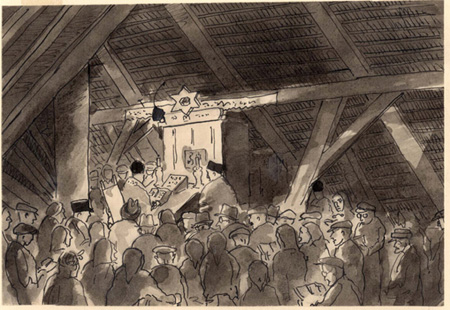
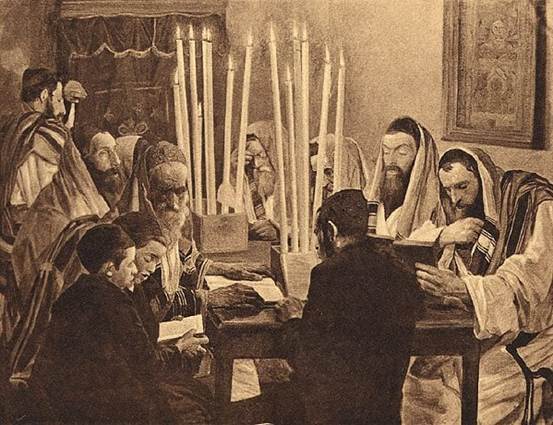
Felix Bloch (1898-1944), Kol Nidrei, the attic synagogue in the Theresienstadt Ghetto