Kotzk – A Burning Flame and a Destroyed Town
By: Yaakov Rosenfeld
On the memorial day for the Kotzker Rebbe, the miraculous figure whose inspiration has built thousands of worlds and whose light has been followed by hundreds of thousands of chassidim and men of action whose essence is truth and faith, I returned to the ancient Jewish town – one of the first towns in Poland, and observed its past and present. I saw old photos courtesy of the municipality and the Polish History Institute, I researched its existence throughout history and to the present day, and in the dead of night I sat down to write the reflections of my heart.
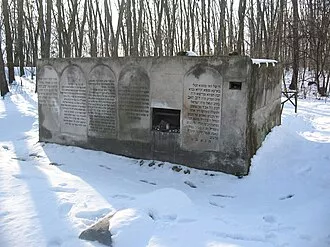
The holy ohel (small structure around a grave) in Kotzk
Kotzk as a town is not one of those places where there is anything to look for today, except for the holy ohel to which the eyes of faithful Jews are directed, and therefore, the invested museum that is bustling in Kotzk has nothing and nothing to look for. This town until the destruction had a clear Jewish majority, and today there are no Jews there, but Kotzk is not a matter for museums or for “commemoration” of any kind, certainly not Polish commemoration by the grandchildren of the murderers and their accomplices. Kotzk exists and is burning, and thousands worship their Creator in its light in truth and faith.
Kotzk was a small town in Poland, but its spiritual breadth far exceeded its geographical dimensions. Kotzk, in my mind, is synonymous with the word “a demand.” The Kotzker Rebbe, the exceptional figure even in the exceptional chassidic landscape of the nineteenth century, did not seek many chassidim, nor did he seek to build a large and magnificent court. Kotzk was not a place of sweet melody and exemplary stories. Kotzk demanded truth. And this truth is found today in countless chassidic shtieblach (small synagogues), Torah studies, yeshivas, and kollels (yeshiva for married men); a wonderful world of Torah and chassidism above which stands a Tzaddik Yesod Olam, a man of truth, whose seal is truth and who is the river that flows from Eden from which springs of Torah and holiness flow throughout the entire world. I imagine that at the third meal last Shabbat, among hundreds or thousands of chassidic gatherings in Israel and around the world, the Kotzk Rebbe was present at the long tables covered with white tablecloths no less than a century ago, or perhaps more.
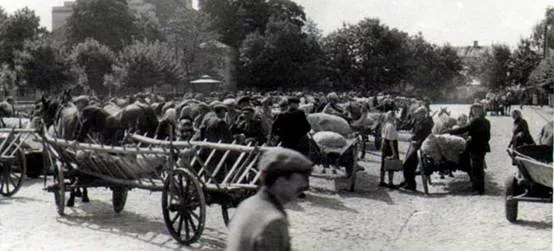
The market in Kotzk prewar
The Kotzk municipality website tells as follows (translated from Polish to Hebrew by Yaakov Rosenfeld, and from Hebrew to English by Ricki Prince):
Jews settled in Kotzk at the beginning of the 17th century and for many years constituted the vast majority of the city’s population. In 1927, over 2,500 Jews lived there, constituting 68% of the city’s total population.
The Holocaust cut short this Jewish community. On September 9th, 1939, during an air raid on the city, “the tzaddik (righteous man) Morgenstern” was killed. A ghetto was established in Kotzk, to which Jews from Lubartow, Sowałk, Srók, Nowy Dwor and Radzyn Podlaskie were deported. The ghetto’s inhabitants were murdered in 1942 in Perczew and Treblinka.
During World War II, the Nazis destroyed the cemetery. On their orders, some of the gravestones were broken and used to pave the streets. Executions were carried out in the cemetery, and the bodies of the victims were buried at the execution site. The location of the graves of the Holocaust victims remains unknown to this day. The destruction of the cemetery continued after the war. Local residents used the gravestones, among other things, as grinding wheels. In 1958, the authorities decided to plow and reforest the cemetery area.
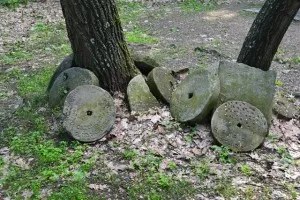
Gravestones in Kotzk
The municipality of Kotzk does not know about the Poles’ role in the extermination of the Jewish people, certainly not about the looting of property and the atmosphere of antisemitism that prevailed in Kotzk, as throughout Poland, after the Holocaust. The remnant of the Jewish community that returned home after the war fled Kotzk by the skin of their teeth after “nationalists” murdered a Holocaust refugee whose only sin was trying to return to the landscape of his homeland. He entertained fantasies that he might meet someone from the old world, until his former neighbours, from the Polish minority living in Kotzk, murdered him in cold blood and sent him to meet his loved ones in the Olam HaEmet (the World of Truth, i.e. the afterlife)…
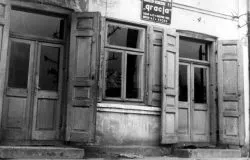
A Jewish home in Kotzk
The Polish history website states that “to this day, a large part of the pre-war city structure remains – mainly houses that were Jewish property before the war. The home of the tzaddik, with its characteristic tower, has survived at the intersection of Wiszka Polskiego Street and Polna Street.” I don’t know which house they are referring to, and what the “characteristic tower of the home of the tzaddik” is.
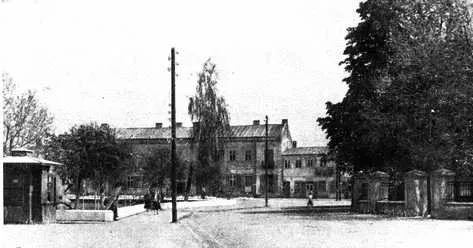
Kotzk market square
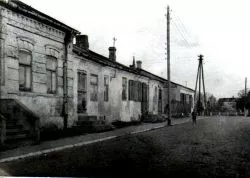
A street in Kotzk
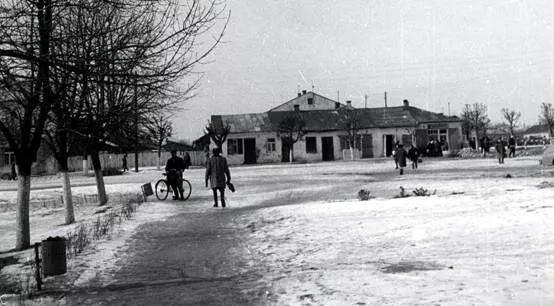
A typical house in Kotzk
By the way, the entry on Kotzk Judaism on the Polish history website opens with a typical chassidic story, and to be honest, it’s a nice conversation between those editors, who I don’t know if they are Jewish or not, apparently not, but they understood that the entry on Kotzk as a town and as a “concept” should open with this story:
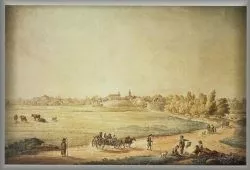
Kotzk in 1796 (5556)
The Kotzker Rebbe asked a chassid: – Have you ever seen a wolf?
– I have.
– Were you afraid of him?
– I was.
– And were you thinking that you were afraid?
– No, I wasn’t. I only was afraid.
– This is what – answered the Rebbe – the fear of G-d should be.
The Point of Truth
In a fit of rage, the Nazi oppressors murdered the Jews of Kotzk, but they could not overcome the point of truth and faith. Here we see them walking in pairs, their eyes down and their hearts up, learning among themselves the Oral Torah. Here we see them and the beit midrash (study hall) goes with them wherever they turn. This point burns in their hearts, and will never be erased.
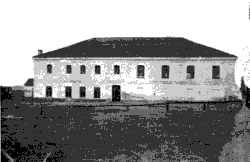
Synagogue. Destroyed in 5701 (1941), 85 years ago
Gur is Kotzk (i.e. Gur chassidism is a direct continuation of Kotzk chassidism, all the customs and the way of life). And Kotzk is the interpretation of the words of heavy silence and of few, but piercing words. And this is the essence of truth. It does not need many words and does not seek to please. It exists, burns, and with its power, worlds are built.
Kotzk’s method demanded that man peel away layers of falsification, of comfort, of imagined religiosity. For Kotzk, it was not enough to observe the commandments, nor to follow a meticulous tradition. The question that always stood before the eyes of the chassidic people who crowded the towns of Poland was simple and “cruel”: Are you genuine? In front of yourself, in front of others, in front of your G-d. This is a question that the young chassidic scribe grapples with to this day, and forever, in every site and place where Jews live.
Indeed, Kotzk was not just an idea. It was also a living community: Simple chassidim, students, craftsmen, women, and children, mostly poor, whose lives were conducted in the shadow of an incessant spiritual demand. Shabbat, beit midrashes, difficult weekdays – everything was woven together into a Jewish life in which holiness did not hover above reality, but demanded fully entering into it. Not an idyll but a daily struggle, a constant, unceasing striving for the true service of G-d. We will mourn the physical destruction of Kotzk and its Jews, like that of all the towns of Eastern Europe and its millions of martyrs, until the end of all generations, because the loss is unbearable and the grief pierces to the depths of the soul.
After the war, Kotzk did not rise again. Not in the mythical sense, nor in the communal sense. No story of revival was created in physical Kotzk. It is simply in the place where it was even before the destruction. Kotzk did not become a mass pilgrimage site, nor a national symbol. Since the Holocaust, it will forever be marginal and sleepy. Kotzk as a collective does not need a museum nor commemoration.
The memory of Kotzk is not a memory of nostalgia, nor of sweet emotion. Even in her great days, she was not like that. Kotzk lives and exists and will forever sanctify the the Name of Heaven with her ways, which will forever build shining and clean corners of beit midrashes within the tens of thousands of Jewish homes, and will forever dwell in the hearts of the Jews who walk in the light of true righteous people with modesty and humility on the one hand, but with strength and power on the other.
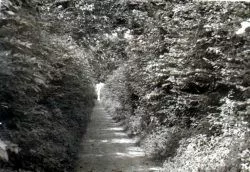
A section of the Kotzk park
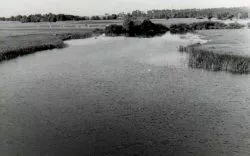
Kotzk, eve of the Holocaust

Kotzk cranes

The sun setting in Kotzk
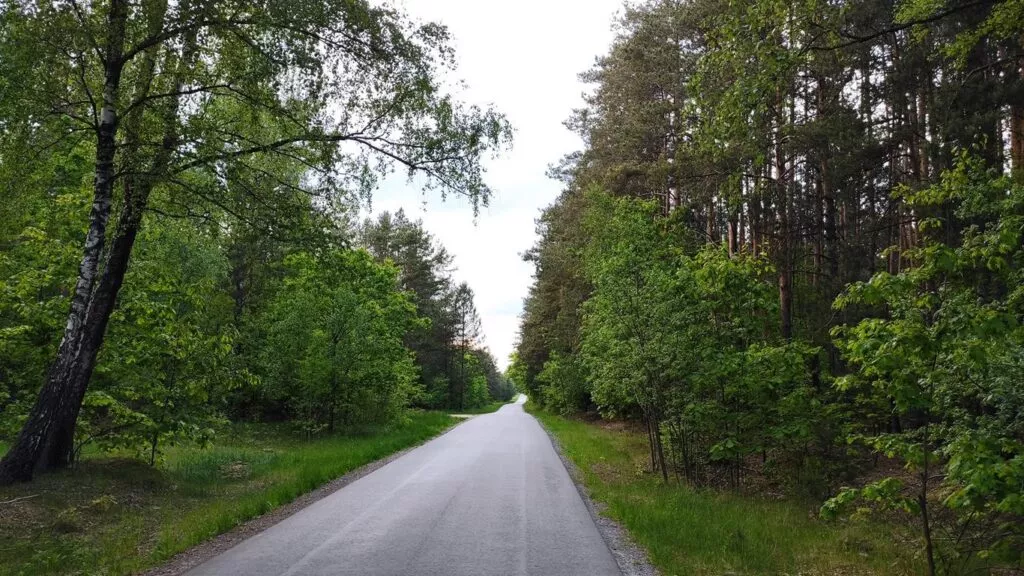
The way to Kotzk
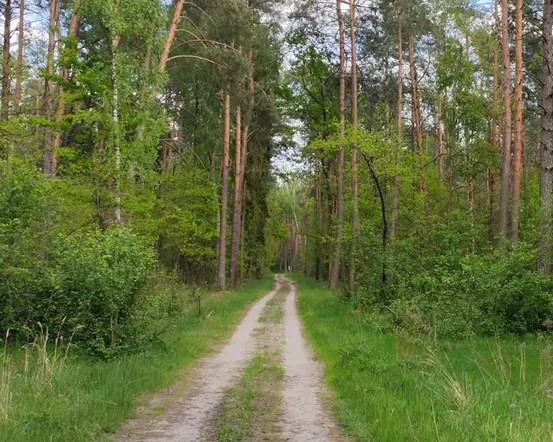
Chassidim walked here. Path in the forests of Kotzk
Photos in the article courtesy of the Kotzk municipality