Mists of Purity
A Rosh Hashana story by Yaakov Rosenfeld, Ganzach Kiddush Hashem
Rosh Hashana 5770 (2009)
The prayer leader stands in the Great Beit Midrash (study hall) in Jerusalem. Next to him stands the Rebbe, and behind him tens of thousands – men, women, and children – all waiting for his mouth to open. The leader of the prayers is an old chassidic man from Bnei Brak, and this is his first year in which he descends in front of the ark. And now, an old, old memory comes to his mind, a memory from the distant youth at the Sfat Emet yeshiva in Jerusalem.
The prayer leader stands with his eyes closed, and the congregation waits. This memory fills his mind and heart. It is an ancient melody that rises and falls — a melody possessing the sweetness of the Garden of Eden. The prayer leader knows full well where he learned this tune and where he first heard it, for he has never forgotten it.
Suddenly, the prayer leader is transported back decades — perhaps forty years — to the yeshiva, sitting on an old wooden bench, as the image of Henich, the elderly Jew from Poland, rises before his eyes.
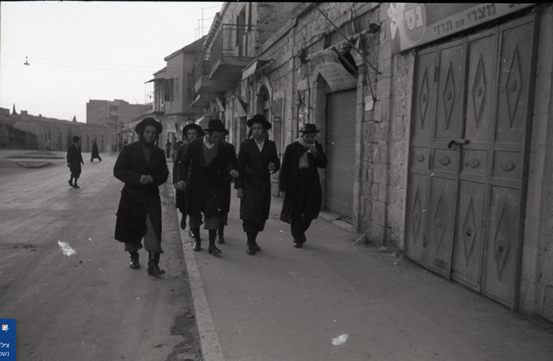
In Jerusalem — amidst old stone houses and the quiet, historic neighborhood known as “Mekor Baruch” — the Gerrer Rebbe often walks late at night, during the final watch before the break of dawn.
Standing among the neighbourhood’s homes is a building — modest yet large and sturdy — clad entirely in dressed Jerusalem stone. Within, it is filled with the love of Jerusalem’s pure-hearted residents — many of whom came from the Diaspora, having risen from the ashes. This building houses the Sfat Emet yeshiva, established back in 5686 (1924-5). It is one of the world’s renowned yeshivas, and the Rebbe keeps a watchful eye upon it from the beginning of the year to its end.
A young yeshiva student sat in the beit midrash on a quiet, dark night. From a secluded corner at the back of the hall, a sweet melody drifted forth — a tune of yearning and longing that stirred the very depths of the soul, piercing to the heart and innermost being…
It was a melody he had never heard before. The young man looked around until he spotted the musician. He gazed at him, noting the furrows on his brow and his misty, distant eyes. It was Reb Henich — a deeply devout chassid from Poland. He was a man who might well have harboured a broken heart, for he was childless and alone; yet, he was a joyful chassid, filled with faith and trust, who would often sit immersed in the Sfat Emet, delighting in the words of Torah.
Reb Henich sat hunched over a large volume of the Talmud, and from the depths of his yearning heart, the melody emerged and spread throughout the study hall. The young man could not restrain himself; he had to know the source of the tune. When silence fell over the study hall and the enchanting melody ceased, the young man approached Reb Henich and asked about the tune’s origin.
“This is Reb Yossel Chanchiner’s nusach (version) of ‘Atah Nigleita,'” he replied.
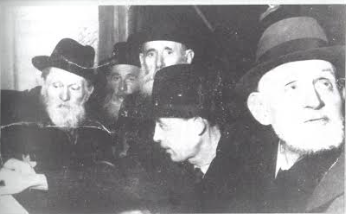
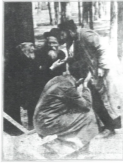
Reb Yossel Chanchiner in the Lodz Ghetto
Yossel Chanchiner! The man and the legend! In the post-Holocaust world of Gur — and indeed to this day — there is no one steeped in the wisdom of the elders for whom the name Yossel Chanchiner does not stir a thrill of emotion and deep yearning.
Rabbi Yossel was a chassid, a Torah genius, and a righteous man. His surname was not “Chanchiner” but rather “Chalminer”; however, having lived in Chęciny during his early years, he was — in keeping with Hasidic custom—known by the name of that town. After marrying into the family of the Sfat Emet of Ger z”l, he settled in Kielce; he was one of the select few privileged to lead the prayers at the Ger synagogue during the final years of the Sfat Emet’s life.
Rabbi Yossel was a towering figure in Torah scholarship and chassidism, and the youth drank in his words with thirst. He was a devoted servant of the Almighty and a man of many virtues, yet it was his prayer that became legendary throughout the Jewish and chassidic world of Poland. Survivors of that bygone era — the “Poland Shel Maalah” (Heavenly Poland) — would yearn for his melodious voice and his unique style of prayer, which played upon the heartstrings like a violin. Reb Yossel’s voice was resonant yet gentle; he imbued the words of the liturgy with his own profound interpretation, and hearts would melt at the sight of his impassioned, outpouring prayer.
To convey to the younger generation just how deeply the Rebbe — the Imrei Emet — cherished Reb Yossel’s prayer, the elders of the community would recount with reverent emotion the story of that Rosh Hashana in the year 5696 (1935), when the Imrei Emet was staying in Jerusalem.
A few days before Rosh Hashanah, the chassidim inquired as to who would lead the prayers, and the answer was: Reb Yossel! Yet, at the time, he was in Poland… In those days, traveling from Poland to the Land of Israel was no small feat. However, when the Rebbe has a need, chassidim know how to move heaven and earth to fulfill his holy wish. Indeed, on the eve of Rosh Hashana, after an arduous journey, Reb Yossel Chanchiner arrived in the Land of Israel, and the Rebbe derived great spiritual satisfaction from the sweet, heartfelt prayers of the righteous chassid. While Reb Yossel did not arrive in time to lead the Selichot service, his Rosh Hashana prayers pierced the azure skies of Jerusalem.
That year was the first — and the last — in which Reb Yossel’s prayer and his unique melody were heard; a melody for which the surviving chassidim had yearned and longed throughout the intervening years. While the survivors could quote gems of wisdom from Reb Yossel’s vast storehouse, they could by no means reproduce his specific musical rendering of the prayers. For decades, that melody had faded from memory. In the Great Beit Midrash, amidst throngs of chassidim and men of piety, prayer leaders would raise their voices during the Malchuyot, Zichronot, and Shofarot sections of the service, pouring out their souls in pure, heartfelt prayer, yet the melody of Yossel Chanchiner remained forgotten, as if it had ascended alongside the ashes of the holy martyrs who had given up their lives in sanctification of G-d’s name…
Reb Yossel stood in the holy Beit Midrash in the town of Gur, surrounded by saintly figures — the Rebbe himself and his family — and beside him, the most exalted chassidim, Torah giants, and tzaddikim (righteous men), the pride of Polish Jewry. They all stood together in the Beit Midrash, which was packed to overflowing — inside and out — with throngs of chassidim, all united in heart and mind toward their Father in Heaven.
Reb Yossel stood—his eyes turned heavenward yet his heart heavy—seeking to find favor in the eyes of his Father in Heaven with a heart torn and seething with emotion. These were the difficult years between the two World Wars; the state of Polish Jewry was no longer what it had once been, and hearts foreboded the tragedy that—God forbid—was destined to unfold. During those days of awe in Ger, Reb Yossel would uplift the people to sublime heights, enveloping them in mists of purity and clouds of holiness, while this melody would pierce the walls of the heart and melt them away:
“You revealed Yourself to Your holy people in a cloud of glory, speaking to them… You made Your voice heard from the Heavens, and You revealed Yourself from within mists of purity…”
A few years before the war, Yossel’s son was murdered by a Polish rioter. The incident shook the entire Jewish community of Poland, and Reb Yossel’s pure heart was torn apart. That Rosh Hashana, so the chassidim recounted, Reb Yossel wept inconsolably as he stood before the prayer stand, and the entire congregation wept along with him. This was not the first tragedy to befall him, yet Reb Yossel remained steadfast in his faith and his closeness to God. That heart-wrenching weeping on Rosh Hashana continued throughout the entire prayer service, and the memory of it never faded from the hearts of the war’s survivors; even after all they had endured and despite being left utterly alone, they never forgot that weeping.
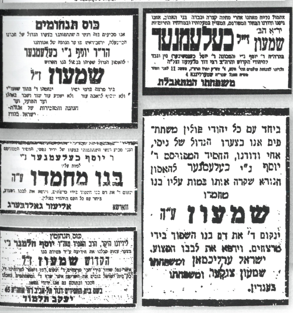
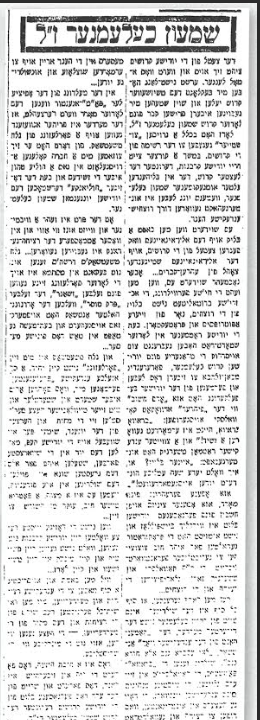
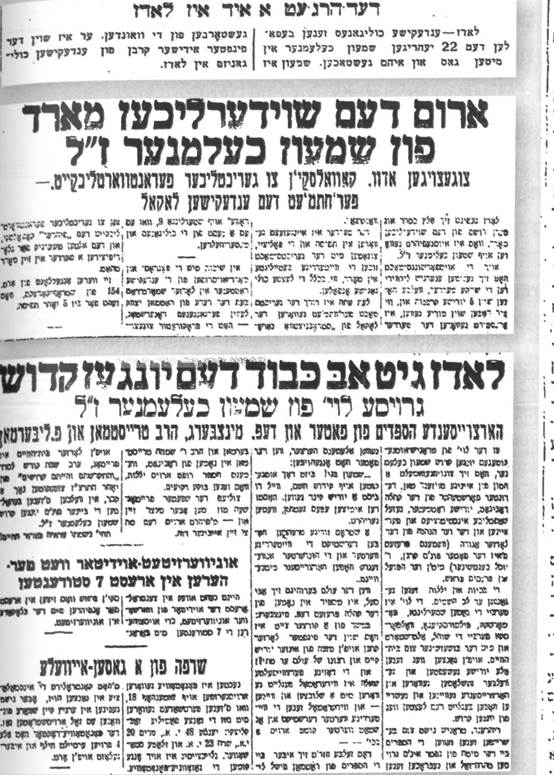
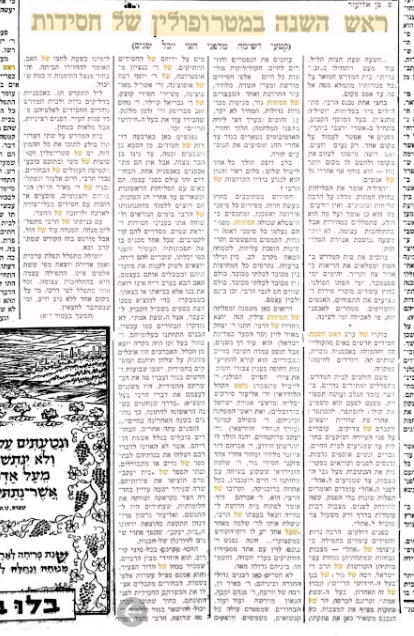
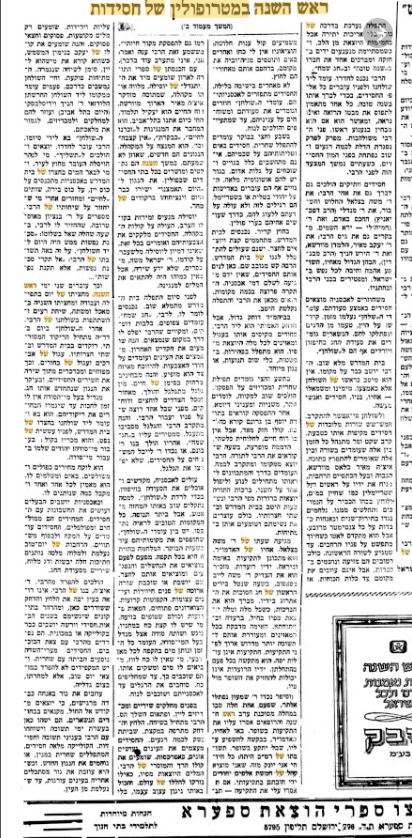
The Jewish press in Lodz on the Shimon Chalminer murder case, winter 5696 (1935-6)
During the war, Reb Yossel suffered terribly. He lost his children, bearing his anguish in silence and faith, until the moment came to sanctify G-d’s Name, in the month of Elul 5702 (1942), when he surrendered his soul to its Creator, pure and refined.
According to an account shared by a Holocaust survivor, a veteran Hasid, the wicked murderers singled out Reb Yossel to stage a Rosh Hashana prayer service for them, complete with a choir and tallises (prayershawls); Reb Yossel was compelled to comply. The day after this “prayer service,” which was indeed harrowing and heart-rending, the wicked men led the prayer leader and the entire choir away to be executed.
It was a harrowing scene; among those forced to witness this act of sanctifying G-d’s Name were some who recalled a funeral from two years earlier, the time a Polish hooligan had smashed a bottle over the head of Shimon, the son of Yossel Chanchiner.
At that terrible moment, the cantor, Reb Yossel, cried out from the depths of his heart: “Shimon! Did you ever wrong anyone? Did you harm that gentile in any way to provoke him to kill you? Certainly not! You were killed for one reason alone: because you are a Jew!” The entire congregation broke into heart-rending sobs. (A description of the eulogy and the crowd’s weeping appears in the newspaper clipping attached to this article, from the Ganzach Kiddush Hashem archives.)
The Holocaust had ended, and in Jerusalem, the Ger chassidic movement began to rebuild. Once again, throngs of chassidim appeared at the Beit Midrash in Jerusalem, enveloped in a sense of holiness and filled with pure faith in the Tzaddik (i.e. the Rebbe). Holocaust survivors cast off their mourning and drew spiritual vitality from the holy Rebbe in Jerusalem. While they sought to forget the days of darkness, they had no desire to forget — nor did they — the days of light experienced in the “Ger of old.” Illustrious figures like Reb Yossel came to life again in Jerusalem; young chassidim absorbed their stories and cherished their legacy with love and longing. Reb Yossel, too, remained close to their hearts, yet miraculously no one could reproduce his niggun (tune). It was as if a barrier of fire stood in the way, blocking from memory that sweet melody which had so powerfully embodied the sanctity of those bygone days.
Fifty years had passed. That young man, now a distinguished figure, a revered chassid, and a teacher of Torah, was chosen to lead the prayers at the Great Beit Midrash in Jerusalem… How and why did the lot fall specifically on him, out of tens of thousands? There is no knowing; such was the way Divine Providence unfolded.
Rosh Hashanah 5770, the Great Beit Midrash in Jerusalem…
The prayer leader stands, raising his voice in prayer, and reaches the “Atah Nigleita” passage. Suddenly, that old melody rises in his mind, and the image of R’ Henich of Bnei Brak, who long ago departed this world without children, appears before his eyes. Memories of the holy Rabbi Yossel Chanchiner, who was murdered during the dark days of persecution; of his son, killed just a few years earlier; and of his other descendants who perished in sanctification of G-d’s Name — all of this rises before him. Suddenly, like there is no forgetfulness before the Throne of Glory, everything becomes clear, lucid, and razor-sharp.
He falls silent for a brief moment. His natural instinct urges him to continue with the standard liturgy, just as always. The force of habit tells him: “Make no changes; do not act strangely. You are standing beside the Rebbe, with the congregation behind you; this is neither the time nor the place for such sudden departures from custom.”
But the memory of Reb Yossel rose before him, Reb Yossel and all the holy ones with him, as did the memory of Reb Henich, who had passed away without leaving enduring offspring; Reb Henich, who, on that dark Jerusalem night at the Sfat Emes yeshiva, had brought Reb Yossel’s melody to Jerusalem with wondrous sweetness.
At this point, the prayer leader could no longer restrain himself. Suddenly, that melody rose from his lips, swelling and spreading throughout the great study hall. It was beautiful and sweet, and seemed like the song of the Garden of Eden.
Nearly two decades have passed since that Rosh Hashana, and a new prayer leader now officiates at the Great Beit Midrash in Jerusalem, yet the liturgical style of Reb Yossel Chanchiner continues to touch hearts. That melody pierces the very soul, stirring and deeply moving multitudes of the Jewish People, drawing them closer to their Father in Heaven during these days when the world stands in judgment.
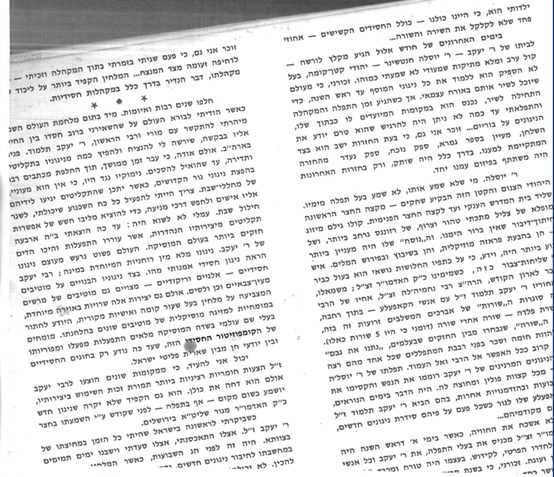
David Werdiger’s memories of Yossel Chanchiner. Album in member of Reb Yaakov Talmud, Ganzach Kiddush Hashem
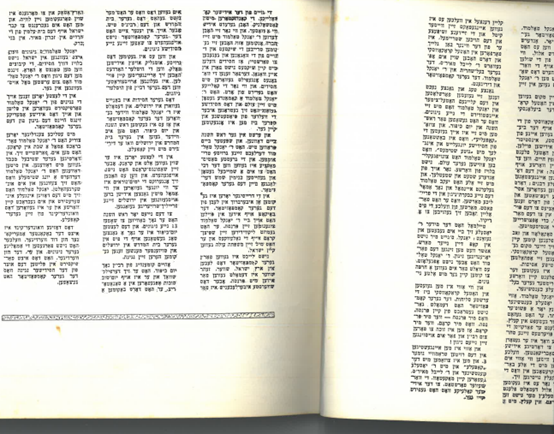
A depiction of Rosh Hashana in Ger, featuring Reb Yossel Chanchiner, “the merchant from Kielce who would travel to Warsaw at the beginning of the month of Elul to prepare for Rosh Hashana,” at the center
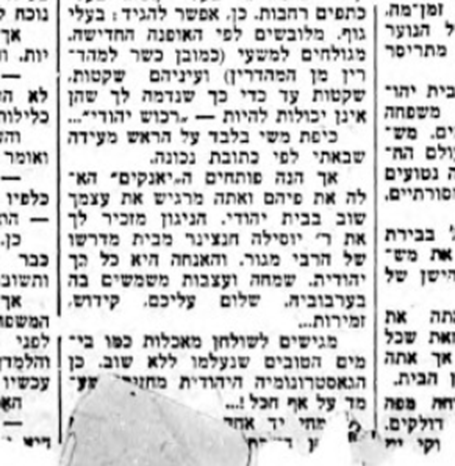
From a newspaper clipping of David Flinker