Mr. David Ettinger’s Memories of Uman
As the great gathering in Uman approaches (on Rosh Hashana) — an event that will see tens of thousands of chassidim from Israel and around the world descend upon the “City of Longing” — we at Ganzach Kiddush Hashem recall the Uman of the past. We present a commemorative article written from the heart by a native of the city, Mr. David Ettinger. Originally published in the quarterly HaAvar (Elul 5715), the text is presented here – with minor editorial adjustments — drawn from the archives of the Ganzach Kiddush Hashem library.
This year marks the 300th anniversary of the fortification of this city in 1654, undertaken in anticipation of an attack by the Haydamaks — the forces of Chmielnicki and Gonta. Thousands of Jews played a significant role in this conflict; having fled from surrounding villages and even distant settlements, they gathered in Uman to seek refuge from the enemy’s sword. Thousands of Jews assembled to defend their lives within this besieged city and to support the Poles, who were favorably disposed toward them.
The names of valiant Jewish heroes — such as Shafransky, Shragorodsky, Menker, and others—are remembered for the courage and bravery they displayed during the battles of Uman. Much has been written about this city in history books and encyclopedias; prayers and elegies have been composed in memory of the victims; and fast days—along with the reading of a Megillat Ta’anit (Scroll of Fasting)—were instituted to commemorate the city’s destruction and the day of mass slaughter on the 5th of Tammuz. Anti-Jewish pogroms recurred throughout various eras—culminating in the Civil War of thirty years ago — until the final, most devastating blow: Hitler, who brought about total annihilation.
I wish to record memories of the city during times of peace — to describe its character and the lives of our brethren there during the few generations preceding the Bolshevik Revolution, spanning the 1880s through the turn of the century.
My Town
This is the city of my birth, where I spent the best years of my youth. The lives of our brethren there unfolded in those days with vivid, rich colour. Uman had long been renowned among Ukrainian cities for the abundance of its harvests and the excellence of its fruit, as well as for the staples it supplied to the far-flung regions of Russia.
Fertile estates and rich farmlands stretched for thousands of kilometers around Uman; their owners — counts and magnates of Polish and Russian nobility — chose to reside in palaces within the provincial capitals. They constantly required intermediaries to handle their financial affairs and merchants to sell their produce — and this was the livelihood of the Jews.
Major agreements between estate or factory owners and wealthy merchants were typically concluded in Kyiv — the provincial capital — during February and March, a period known as the “Contract Season,” when most merchants would travel there to meet with the landed gentry. This season set the tone for the market. Matchmakers also took advantage of these visits by men of means to broker marriages between the parents of grooms and the parents of young women of marriageable age.
Until the early 1990s, there was no railway connection to Uman; travelers would journey by wagon — or by sleigh in winter — to Bila Tserkva (a ten-hour trip) and continue by train to Kyiv, with every such journey considered a major undertaking. With the establishment of rail links, travel naturally became more routine and comfortable; nevertheless, for years afterward, setting out on a long journey — even within the country — remained a significant event in family life.
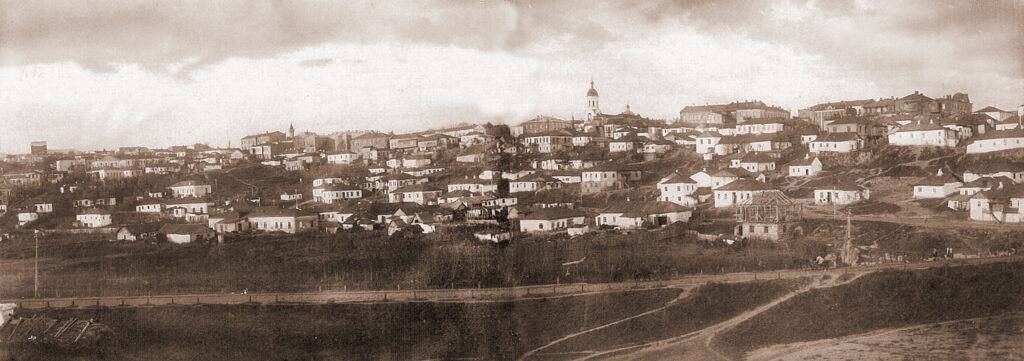
The city of Uman
Between the New City and the Old City
The city spreads out, sloping downwards from west to east and north. Its higher section was known as the “New City”; by the 1880s, it already boasted paved streets with sidewalks and houses arranged in an orderly, urban layout. Families of non-Jews lived there alongside Jews — municipal officials, doctors, and judges. The area housed a military church and a gymnasium (secondary school), as well as a newly opened post office — replacing the earlier system where a single Jewish man handled mail distribution and managed the transport and rental of horses for postal travel. Later, as the city grew and developed, this section also saw the opening of modern shops, banks, and new synagogues.
The situation was different in the second, eastern section, located in the lower part of the town. It began at the center—where the police station and courthouse stood, alongside the old church — which served as the town’s hub. In the middle of the spacious square lay a deep well; if one tossed a stone into it, moments would pass before the echo of its descent was heard. According to the town elders, this well had claimed the lives of many Jewish children and infants during the reign of Chmielnicki, as they were thrown into it alive. The well struck terror into the heart of every Jewish child. Years later, a municipal park was planted there, and the well vanished.
Further east lay the Old Town, inhabited entirely by Jews and filled with dilapidated, antiquated houses. The streets branched off into filthy alleys and shortcuts that wound through open courtyards and garbage heaps. There, too, stood the Rathaus — a fortress-like structure built of heavy stone; the shops, touching one another, formed a complex that enclosed a vast area, serving in times past as a fortified wall against attacking forces.
Synagogues and the Great Synagogue which were Burned
Nearby stood most of the chassidic study halls and the cheders — the traditional schools for young children. There rose the ancient and magnificent Great Synagogue, built with thick walls reminiscent of the structures in Old Jerusalem; its entrance was set “from the depths,” and it housed a four-tiered Holy Ark, a masterpiece of intricate woodcarving. Large brass chandeliers hung from the ceiling by chains, and in the center of the building stood the bimah (prayer platform), encircled by artistic brass pillars adorned with interwoven tendrils and floral designs. In its day, this synagogue was renowned for the famous cantors who led the prayers there.
Then, on one night of horror, the synagogue caught fire and was completely destroyed. I was about fourteen years old at the time and vividly recall the sight of that terrible, raging blaze; the Torah scrolls, the other scrolls, the communal record books, and the priceless Torah crowns—everything was consumed by the flames. Grief and mourning gripped the entire city. The fire had been caused by a candle left burning after a Chevra Kadisha (burial society) gathering, where the participants had drunk to excess before departing.
Sofia Garden
The homes of the city’s nobility and prominent figures were located in the northern part of the city. Each house was surrounded by a garden and a flowerbed; the houses were magnificent, and their owners would set out from their courtyards in carriages. At the end of the street leading to the city’s north — on the lower ground — began an ancient grove known as “Sofia Garden,” planted centuries ago by Prince Potocki for his beloved, Sofia.
The grove is shaded by the majesty of towering, dense trees whose crowns rise beyond the reach of the eye; it features a magnificent landscape of slopes and hollows, covering an expansive area of over five square kilometers. Massive rock formations are scattered throughout, creating tunnels, passages, crevices, and hidden recesses. At the far edge of the grove stands an agricultural school—the alma mater of agronomists Elimelech Zagorodsky and Akiva Ettinger. Near the entrance, excellent fresh water gushes and flows from a natural rock spring.
Chassidism, Its People and Characters in Uman
In those distant years, chassidism from the Baal Shem Tov (the founder of chassidism) struck deep roots within the Jewish community of Uman and its environs. This was fostered by the proximity of the town of Talne — home to Rebbe Dovid’l — or perhaps Rebbe Dovid’l attained his greatness and renown thanks to the nearness of Uman and the wealthy supporters there who generously provided the funds to sustain his court. Uman was also home to chassidim of the Rebbes of Sadigura, Makarov, Bershad, Rachmistrivka, and Breslov; each group had its own kloiz (study hall and small synagogue).
It is worth mentioning one of those quintessential chassidim — a man the likes of whom I have never seen or heard of in all my days. His name was Reb Yaakov Frankel, and he was the grandson of Rabbi Levi Yitzchak of Berditchev; a wealthy man with extensive business interests and property, he would immerse himself in the mikveh (ritual bath) every single day. Countless times — whether before prayer, upon encountering a priest on the street or at a funeral, or even upon the intrusion of an foreign thought or impure reflection — he would immediately rush to the mikveh to immerse. Whenever he passed by a church, he would close his eyes and recite the verse, “You shall utterly detest it.” He was also careful to perform a specific skipping motion with his feet when stepping over a doorway threshold—both upon entering and leaving — so as to avoid forming the shape of a cross. To this degree, or perhaps to a lesser extent, the majority of the Jewish community in those days was devout and deeply rooted in chassidism and traditional life, even though most were not necessarily Torah scholars or paragons of religious perfection.
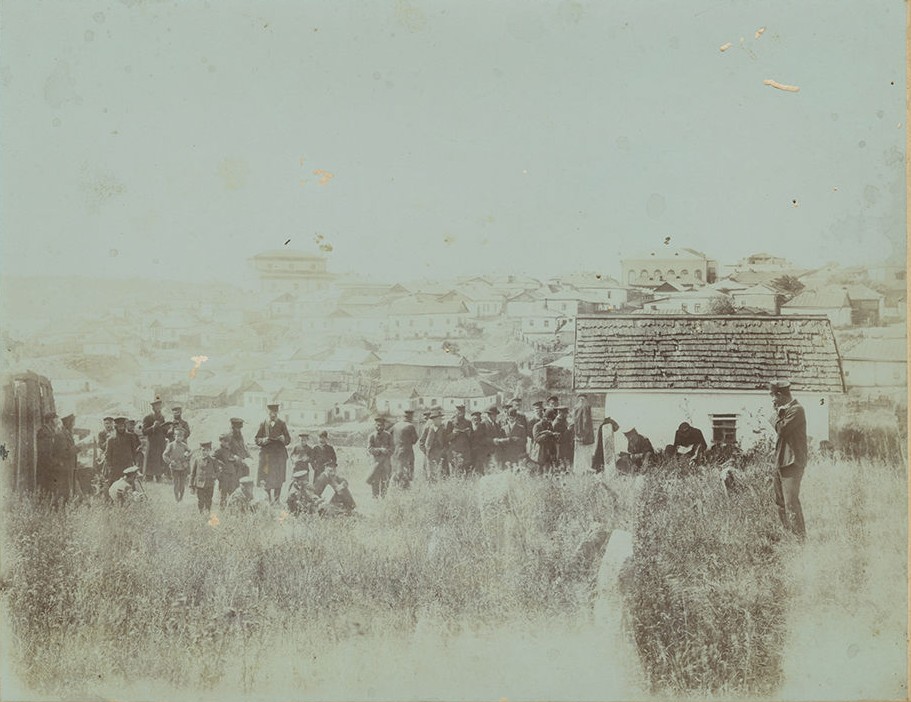
Chassidim praying at the grave of Rebbe Nachman, with the city of Uman in the background
Although the city was considered an important commercial hub, it was — despite its isolation from the railway — essentially nothing more than a large, stagnant town. Not everyone knew how to read or write the language of the land, Russian; the few who received a newspaper would pass it from person to person. Family ties were generally close and loyal, and young people treated their parents with respect; a daughter understood her destiny was to marry and become a mother. Manual trades were regarded as a lowly form of occupation and life’s purpose; artisans held no place in respectable social circles — with the exception of those practicing refined crafts, such as goldsmiths and watchmakers.
The memory of my mother z”l rises before me, along with her wonderful, noble figure; she knew much of the Tanach (Torah, Prophets, and Writings) by heart, as well as Wiesel’s Shirei Tiferet and Schiller’s poems in German; yet, at the same time, she prayed daily and observed even the most minor commandment.
Intellectuals and Famous Figures
Among the famous figures and luminaries associated with the city of Uman, foremost mention must be made of Rebbe Nachman of Breslov, who was laid to rest there; year after year, thousands of his chassidim and admirers would travel there for the High Holidays to pray in his synagogue and prostrate themselves at his gravesite. As is well known, there was significant opposition to the Breslov movement — particularly among the chassidim of the Bershad Rebbe — and it was common for stones to be thrown at Breslov chassidim during the High Holidays; yet, the Breslov chassidim would willingly accept being struck by such a stone, regarding it as a good omen for the coming year.
The writer Micha Yosef Berdyczewski — who also hailed from a small town near Uman — visited the area in early 1900 and went with a friend to see Nachman of Breslov’s gravesite; upon approaching the building standing over the grave, he left his companion behind and drew near the site alone, seeking a moment of solitary communion with the memory of the holy figure.
The writers Mordechai Spektor and Ish-Naomi (Wechsler) also originated in Uman and wrote extensively about it in their works. Zvi Kashdai, the writer Dov Avraham Koralnik (1883–1937), our first envoy to London — the late Dr. Mordechai Eliash — and the renowned violinist Mischa Elman all hailed from Uman; the writer David Bergelson and our Finance Minister Levi Eshkol (Shkolnik) were also products of Uman or the nearby towns.
The Families of the Notables and “Gevir” (Noble) Reb Kalman
Among the prominent families of that era in Uman, it is worth mentioning the Tolchinsky, Bernstein, Ettinger, Frankel, Lifshitz, Horowitz, and Vilshansky families, who stood at the helm of the community. The first four families were descended from — or had married into the family of — the wealthy noble Reb Kalman of Uman; upon his death in 1870, he bequeathed a fortune of seven million rubles to his three sons and four daughters—a staggering sum in those days!
In addition, he left behind charitable institutions he had founded with his own funds — a hospital, a home for the elderly, a pharmacy for the poor, a soup kitchen, and synagogues — and he arranged marriages for his daughters into distinguished families of great learning and high social standing. It was these families that introduced new social graces and a modern outlook on life — practices and attitudes previously unknown in chassidic circles. They also brought in tutors from Lithuania for their children and engaged instructors for Tanach and Hebrew studies. Some families even sent their sons to the gymnasium; in many instances, the schools agreed to waive the requirement for Jewish students to write on Shabbat.
One of the gvir’s sons-in-law, Reb Pinchas Niminsky — who was childless — emigrated to the Land of Israel in his old age. In the will he drafted in Jerusalem, he bequeathed a quarter of a million rubles for the poor of Uman, without explicitly specifying that the funds were for the Jewish community; consequently, an apostate lawyer informed the authorities in Uman, and a portion of the money was seized by the state.
One of the gvir’s sons — the eldest, Elazar, who had studied Torah under the learned scholar Reb Moshe Chaim — relocated to Odessa; he was the brother-in-law of the Kiev millionaire Yisrael Brodsky. The second son, Yoel-Natan, moved to Kyiv and owned the sugar factory in Zhashkov. The family members — who, over the course of three generations, grew to number more than a hundred individuals — held a prominent position in the city.
Changes Resulting from the Rail Connection and the New Traffic Movements
As previously noted, the town’s population was predominantly Jewish, and all commerce — whether in grain or through shops serving various sectors — was in their hands. There were few artisans among the Jews; their livelihood relied primarily on trade and brokerage. The connection of the town to the railway network in the 1890s brought about a transformation in the economic order, which also triggered a fundamental restructuring of education and youth activities.
As long as the city remained cut off from the outside world — lacking a railway connection — the local community remained remote from the events affecting our brethren following the harsh decrees and expulsions from Moscow and other Russian cities; Uman and its environs were spared the waves of pogroms that swept through in the 1880s, and we knew little of the mass emigration to America and Argentina that was then spreading across Poland and Lithuania.
However, with the establishment of the railway connection, the city’s population — and the Jewish population in particular — began to grow, swelled by the influx of thousands who flocked here to settle. New currents of thought began to stir among the youth. The national movement awakened, alongside societies dedicated to the Hebrew language and the Chibbat Zion (Lovers of Zion) movement, as well as socialist groups like the Bund. Later, the HaPoel HaTzair movement emerged — led by Mr. Kulik — as well as the Socialist Zionist movement and others.
One of the gymnasium students, Grisha Bonfeld, gained renown for his impassioned nationalist speeches (he later immigrated to the Land of Israel and passed away there). Modern schools were established, including a Talmud Torah with a comprehensive curriculum.
The growth of the Jewish community also brought about a revolution in the realm of commerce. Agents and merchants arrived from afar to purchase grain from the Uman area for shipment to distant Russian provinces. Banking houses and warehouses were established to handle a wide range of goods — including tools, agricultural machinery, and supplies for the numerous sugar refineries in the vicinity. Trade, which had already been in Jewish hands, became even more firmly entrenched and expanded throughout the population.
The grain trade — which had effectively been monopolized by wealthy magnates through their connections with the poritzim (land owners) — shifted into the hands of small-scale traders; a market of petty merchants and brokers emerged, operating both in Uman and near the local railway stations to ship grain daily to its destinations or to sell it in Königsberg and Danzig.
An end was put to all this bustling activity. What Petliura left behind, Hitler destroyed. Who knows how many Jews returned to settle in the city? I heard that the entire cemetery was plowed over, and only the ohel (little building over a grave) of Rebbe Nachman of Breslov remains.