Reb Yaakov’s Last Passover Seder
A
Year after year, as Passover and other holidays approach, memories of bygone days and intense longing for the pure life that is no longer, and for those upright Jews – Jews who with all their might followed Judaism – who did not let leave anyone behind. When some of the survivors of the town gathered to discuss organizational matters for the people of the town and the surrounding area, an old-new story was woven about one of the immigrants, or a simple but upright person, as the wise man says: “Whatever is simple is not crooked.”
And so the story began: Just as all of the Jewish People have a share in the World to Come, so all of the Jewish People have a share in this world. But what? Some enjoy tangible things that are real, and some things that are seemingly insignificant. Not to mention that sometimes the poor person who enjoys insignificant things has a greater share than wealth and riches in his house, and his righteousness does not last forever. There is a person who seizes this world and in reality has nothing, and there is a person who seemingly has nothing, and in reality has everything. And these matters are known and ancient.
About whom and what are these things meant to be about? About… About… It is better not to use the real name so as not to offend someone who could be offended. Therefore, we will call the hero of our story Reb (honorific for Jewish males) Yaakov the Simple. “Simple” – the meaning is not entirely what people are used to understanding from this title, that is, a not very clever person who behaves simply, but in the true sense: an simple person. Simple in his actions and qualities, who can also be a wise man.
And the Chozeh of Lublin rabbi already asked the famous wise Rebbe, Rabbi Naftali of Ropshitz z”l: Doesn’t it say in the Torah, “Be simple with the L-rd your G-d” and not “Be wise”? Rabbi Naftali answered: One has to be a great wise man to be simple.
B
Our simple man was considered by people to be just a good Jew, not very wise, but those who knew him closely knew that behind his simplicity lay a profound wisdom and an extraordinarily good sense. Perhaps his wisdom came from his extensive experience in life, from always walking among chassidim and wise men and following them, and perhaps his simplicity came from his wisdom. Either way, this Jew was a wonderful Jew who was also a novelty in the generations before ours.
One saw a short, thin Jew, who with great difficulty carried his large head on his narrow neck. The hair on his head had turned white before its time, while his long, shaggy beard, which reached almost to his stomach, was dark brown. His alert eyes lept with life and spread rays of love and compassion for all things created in the Image of G-d.
Reb Yaakov won hearts with his warm, heartfelt gaze and the light laughter that always hovered on his lips. If a stranger came to see Reb Yaakov and his happy face, he would be sure that this man was certainly wealthy and that his home lacked nothing. And not for himself; he was poor and oppressed and his home was in chaos. His only son was wild, and his daughters also did not follow in their father’s footsteps. Only the woman whom G-d had appointed for him was also kind-hearted and gentle-hearted. The couple lived as they are accustomed to saying: “like two doves.” They admired each other. He saw in her the face of everything, and especially “a woman who fears the L-rd will be praised,” and in her eyes – there was noboby like her Reb Yaakov. And after all, things were easy and even more so: if they loved others with all their heart and soul, how much more so themselves and their children. And since there was a strong love between them, they eased each other’s suffering.
And the suffering was too much. Even from the girls, but they suffered most from the son. Not only did he not fear Heaven, but he was also a great spendthrift. A penny that fell to his hand was as if it had fallen into the great sea, and he was an incomparable glutton. When his mother prepared lunch for the entire family of five, she had to hide it in a container so that he would not destroy everything without leaving a single remnant. In addition to this “good” quality, he was also very angry person and aggressive, and the slightest reason in the form of a toddler was enough for him to turn the entire house upside down. Once, when he demanded money from his mother and she did not give it to him, simply because she did not have any, he was seized with great anger and broke several fingers in his right hand, and his veins were cut to the point of being in real danger. And if it was not enough that his parents suffered from him all week, on Shabbat he poured his wrath even on strangers, who fled from him as if from a fire. Already on Friday afternoon, quarrels and arguments began to erupt, and would say, partly jokingly and partly seriously: “Leave me alone because the Sabbath murder has already attacked me.”
And Reb Yaakov the Simple? Was he publicly upset about this? No, no! And so he would say: If I had no sons and they would not have blackened my face, would it have been better? Now that I have been blessed with a son, will I be upset? And is it possible to be ungrateful to G-d? And besides, he would say this in the melody of the Gemara: Do you think that he is already a stone? I tell you that my Shmuel (that is his son’s name) is a really good stone, but what? He is a little nervous, but over time everything will work out and everything will fall into place peacefully.
Reb Yaakov the Simple accepted everything with joy, and when asked, he always answered with joy: “Thank G-d!” One should ask: Does every Jew say yes? Not every Jew is like our Jew. Every Jew says yes, but the Simple One believes this. He is convinced that all is well. And how could it be otherwise? And how could it be said that the blessing of the Boyaner Rebbe z”l (May his merits protect us and all of the Jewish People, amen) was not fulfilled? This is how the Rebbe blessed: “May G-d grant abundance, blessing, success, and happiness from children,” etc., etc. Then the Rebbe pondered a bit and added: “Yes, in the end He will grant… He will grant…” And don’t you see here with a sense that the Rebbe saw what he does not yet see, but will see? Well, thank G-d, everything is good and right.
He knew how to trick the speaker, and he would say: He came to make me think of myself as deprived by the Master of the World because I am not rich? Well, the question arises: Who is rich? The gentleman who drinks a cup of tea and puts three teaspoons of sugar in it? And what do I do? Where does it say that the entire cup should be sweetened? For example, I only have half a teaspoon of sugar… “a little.” Here he would tug at his long beard and a slight laugh would float on his lips: So what do I do? I drink four-fifths of the cup without sugar, and the rest – I put the sugar, and the tea is very sweet! After all, that’s what people say: If the end is good, all is well! And in general, what is the purpose of eating and drinking? To be a healthy person so that he can worship G-d, and I wish I could worship G-d as much as I am healthy…
At first glance, these things seem like a nice joke, but our Reb Yaakov the Simple was not the joking type; he was completely serious, and so he thought and truly lived what he said. Sometimes, when the opinion of him was smug – and this was usually when the Sadigura-Boyan chassidim and the entire Ruzhin dynasty sat and drank “L’chaim” on the day of remembrance of one of the Rebbes of the dynasty – he would say: So-and-so is rich, he has a hundred thousand gold coins, and he lacks another hundred thousand for the poor man, as stated: “He has a portion that wants two hundred.” However, I – I have nothing, and I lack nothing. Or: So-and-so has a lot and needs everything for himself, while I have little and I divide this little between me and the poor man who needs support. And he would not say this out of pride, but because he found it his duty to thank G-d for having granted him a kind-hearted wife like he had, who delighted in giving to the poor. And indeed, wonderful things were told about the extent of the charity and hospitality of the Simple One and his wife. A decent poor man who came to him was not only fed and given water, but he was given his bed while he himself lay on a plank.
C
He was not an exceptional scholar, but he was completely imbued with the fragrance of Torah and chassidism. While in his youth “sitting” in the homes of the Rebbes of the Ruzhin family, he absorbed the fear of G-d and good qualities, as well as words of wisdom and cleverness, and above all: he learned the quality of love of his fellow Jew. And, behold, a wonder, he would always say: The common man should be respected above all, even if he seemed, G-d forbid, to be extremely rude. Thus he related: Once, an extremely rude man who did not even know how to speak Yiddish came to the old Rebbe, Rabbi David Moshe of Czortkow z”l. When the man left the Rebbe’s home, the Rebbe’s assistant said to the Rebbe, whose custom was to teach virtue to every person from Israel: And why should virtue be taught to a person like the one who has just left? The Rebbe raised his holy eyes to Heaven and said calmly: “Nu, er is a ba’haltener Yid” (Well, he is a hidden Jew)…
The joy of the Simple One was beyond anything imaginable. First of all, a man who, in his opinion, lacked nothing – why wouldn’t he be happy? In addition, he used to say: Just as I say the blessing every day, “He has not made me a gentile,” so I say – to distinguish between sacred and sacred – “Blessed is he who has not made me a misnaged (opponent of chassidism).” And he added: “I thank You, Oh L-rd my G-d, that You have placed my portion among the followers of Ruzhin and have not placed my portion among the followers…” Here he did not say the end, but rather cast a meaningful glance, as if to say: Well, what is there to say here, you know… In moments of joy, when he was a little overwhelmed, he would add: And for everything, I thank G-d for the woman He gave me, who is always a “helper” and not an “opponent” (a pun on the biblical phrase “ezer kenegdo” – “a help against him”).
D
Those in the know know that Rebbe Rabbi Naftali of Ropshitz z”l never spent a day in the year without doing something, or at least talking, about matters regarding sukkah (hut sat in during the holiday of Sukkot). The righteous of his generation said of him that his soul was carved from the mitzvot (commandments) of the sukkah in the Torah. As for Reb Yaakov the Simple – we do not know the hidden things and we will not be enlightened to the ways of Heaven – it turns out that his soul was carved from the mitzvot of Passover. He prepared all year for the holiday of freedom. It is a pity that we did not come to Rebbe Naftali, whom even his great disciple Rabbi Chaim of Sanz z”l said did not achieve absoluteness, but it is permissible to say: as it were, he resembled the chassidim of Ropshitz in this.
How much did the Simple One prepare all year for Passover? He simply added penny to penny and coin to coin and gave them to one of his well-wishers to keep for him for the needs of the holiday. And so he would say: If all year long a person should be content with what he has and rejoice in his lot, that is not the case on Passover. On Passover one should be rich in the literal sense and not just according to “what rich man rejoices in his lot.” The joy should also be complete because it is declared, “Every poor man shall eat,” and how can one call every poor man to eat when the feast is not even sufficient for its owner? And how can one truly experience the holiday of freedom if it is impossible to fulfill the mitzvah out of prosperity and blessing? He reasoned these thoughts to himself in order to calm his conscience, why his heart suddenly filled with such a desire to spend a lot of money on the holiday.
Well, he had accumulated quite a sufficient amount to prepare the holiday necessities to a satisfactory extent. And this is to know, because a fairly large amount was needed to satisfy the demands of his beloved son Shmuel. He was also preparing for Passover. He was proud of the “goods” he had to sell on Seder night: if he did not ask the questions, all the preparations were worthless. And the payment he demanded was “just this,” and it was a shame to try to convince him to lower the price a bit. If he demanded an object, even if it was extremely expensive, they had to buy it before the holiday, and if it was money – everything had to be handed over to him right before he gave his “goods.” There was a case where he did not receive “what he deserved” before the holiday and the parents asked him to believe them and give them the questions on credit – but they were sorely mistaken. When Passover night arrived and after Maariv, when Yaakov and his son the “jewel” went home together, and between them – the boy was gone… the town “walked on wheels” that night. After much searching, they found him hiding in the old cemetery, which was right next to the synagogue. With great difficulty, they persuaded him to come home, and after they pulled his mother’s wedding ring from him, he asked the questions…
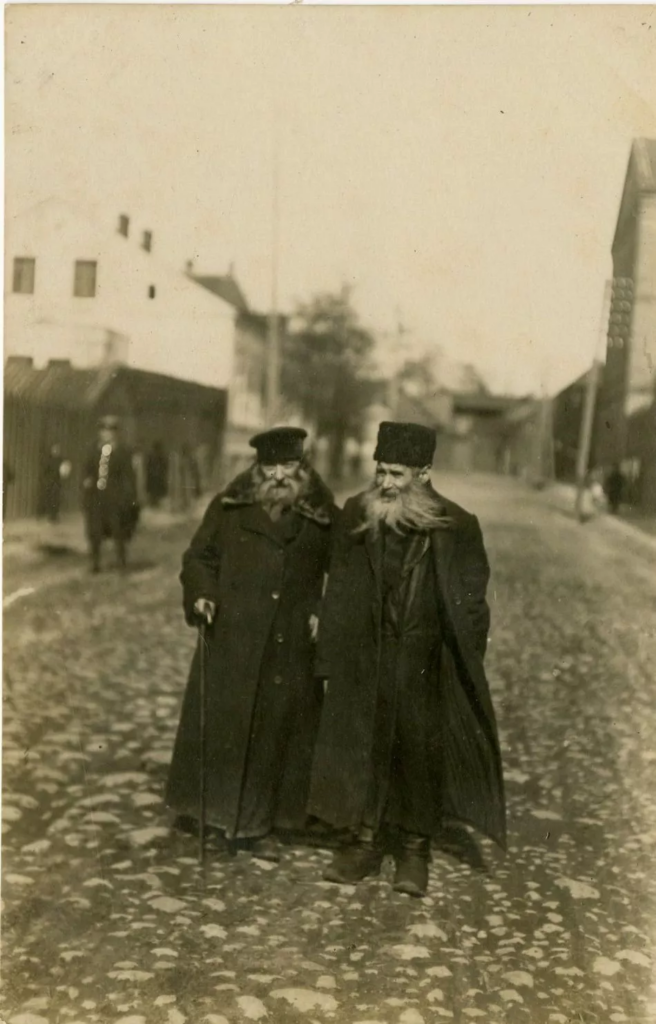
Jews in a town
How did the Simple One conduct the Seder? Let us hear what he himself said in a moment of joy, when asked how he conducted the Seder. And he said: How do I conduct the Seder? And what do I know? But what? I will tell you a parable: He who wants to buy shoes, to whom does he go? To a shoemaker. He who wants to buy furniture – to whom does he go? To a furniture dealer. Do you buy furniture from a shoemaker or a hat from a painter? So it is with this subject. How does G-d, demand from Yaakov (here he added his nickname, which for obvious reasons should not be revealed) that he conduct the Seder according to the intentions of the Arizal and Rabbi Vital? It is not from me that one can buy these goods… What does he want from me? What I can give. And what do I know? I know how to rejoice. Well, I am happy on Passover night that I am a Jew; that I am one of those whom G-d redeemed from slavery to freedom – everything is as it is written in the Hagada. And so that my wife will be happy too, I thoroughly explain what is said in the Hagada to my wife and children, and they are happy too. And then… this is what the Rebbe said: When the Jewish People is happy, G-d is happy, and when G-d is happy – for this reason I am happy, says the Simple One with endless enthusiasm and supreme joy. So I am even happier, and so we are happy all that night and all the holiday, and if you want to say it – all year long!
And so we have come to the essence of the Simple One’s character: the quality of joy. In this character he was a true genius. There are those who are happy for some reason, while the Simple One – he was happy for himself for no reason at all. He and joy were one and the same. And wasn’t that what the old Rebbe, Rabbi David Moshe of Czortkow z”l said: “And what is joy?” – whatever the joy may be, it makes an impression in the Upper Worlds and brings salvation and mercy and all good things.
However, if it were not for the Simple Ones’s simple and complete faith in G-d and in Moshe, his servant, how could a person with such “wealth” and such “naches” (pride from his children) be happy? Rather, it was his great faith that taught him that there is no evil, G-d forbid, in the world, for thus said the holy Rabbi Yisrael of Ruzhin z”l: “We imagined what G-d is like” – we thought that the quality of judgment had come when some evil came upon us, but the truth is that “Your grace, Oh L-rd, is in the midst of Your temple” – everything is grace…
Here the narrator will tell of the final Seder of the Simple One. It was during the terrible Holocaust years. The narrators have already told and described the “life” in these days of horror, and it is not the narrator’s business to repeat what is known. We only want to tell that the Simple One slowly changed and became a different person. The joy passed, it faded, and in its place came sadness. Not that G-d forbid he stopped believing in G-d and in Moses his servant, and not that G-d forbid the degree of sadness fell upon him because of his situation and the bad state of his home – the Simple One did not reach that point. On the contrary, he believed that the steps of the Messiah were approaching, but his soft and loving heart could not accept with love the suffering of others. His own suffering – he accepted it with love, after all, first of all, what and who was he that he would come in complaint before G-d? And secondly – everything was worth it for the coming redemption. But his heart was overflowing with the suffering of the Jewish People, the holy nation. No longer did heartwarming laughter accompany him, no longer did his face shine with joy… A heavy cloud rested over him. Instead of tears of age that used to flow from his eyes – were tears of sorrow and grief, great anguish for the Jewish People’s sorrow. Great anguish that he, who was always happy, was pained.
It is clear that while the Nazis were in the town, in addition to all the other troubles, there was a shortage of food and all human needs, and when even the higher ups lacked, all the more so for the poor, like the Simple One, who had spent every penny in their pockets. This time, Reb Yaakov did not prepare Passover with a surplus, and even the expression “in a smaller scale” seems to be an extreme exaggeration regarding the real and sad situation that prevailed in his home at that time. This Seder night, during the time of the Nazis, was marred by great poverty, both physical and spiritual; the soul was missing. No longer was that joy, no longer that miraculous light. Immediately upon reciting the Kiddush, hot tears flowed from the Simple One’s eyes, and so did his good wife – her compassion for themselves, for the children, and for all of the Jewish People was aroused. Is this what the holiday of freedom would be like? Thus they continued reciting the Hagada with broken hearts, and so was their food mixed with their tears. There is no doubt that even in Heaven they were astonished and amazed: Did even the Simple One, who always pleased G-d and people, suffer from sadness? And did the One Who Sits in Heaven, G-d forbid, remove His care, as it were, from His children?
Heaven took pity on Reb Yaakov. G-d remembered Yaakov’s love for G-d all his days and the purity of his heart. It was not agreed upon on High that Reb Yaakov’s Seder would pass like this, and so G-d gave him great joy this time too from a place that he had not neglected. When the Simple One had already reached the “Chasal sidur Pesach kehilchato” (It is the end of the Passover Seder according to its laws” – the last part of the Seder) his son, the “wild man,” who seemed to have fallen asleep on his bed, suddenly woke up, and called to his father in a courageous and confident voice, yet soft and gentle, unlike his usual voice: “And what happened to you, father? Where is your faith and where is your piety? How often did you believe and rejoice in years as was customary? All those teachings and conversations of the Rebbe that you used to repeat every hour, where have they gone? I tell you,” he continued with his characteristic fervour and wildness, “I tell you, father, that everything will pass! G-d is stronger than all the Jew haters!”
Reb Yaakov seemed to wake up from a strong shock. Is this our son? Is that really how he speaks?
(…)
He did not have enough time and patience to think much and philosophize. He felt his eyes light up. A wave of joy overcame him, and as if by chance he took his son’s hand, pressed him to his chest and kissed him on the head, and began to dance with him in a fierce and energetic dance: “Chasal sidur Pesach kehilchato… Ka’asher zachinu lesader oto ken nizkeh l’asoto” (It is the end of the Passover Seder according to its laws…As we were privileged to arrange it, so we will be privileged to do it). Thus they danced and sang, and the mother joined them, and again they gathered their strength, danced and sang and shed tears – tears of joy as in all the years.
Reb Yaakov was blessed and the son survived, and he was doubly blessed with that his only daughter remained alive with her husband and sons. And that daughter and her husband took off their secular clothes after the Holocaust and changed them into holy clothes.
This story is the work of the author and Holocaust survivor Shlomo Yahalomi (Diament).
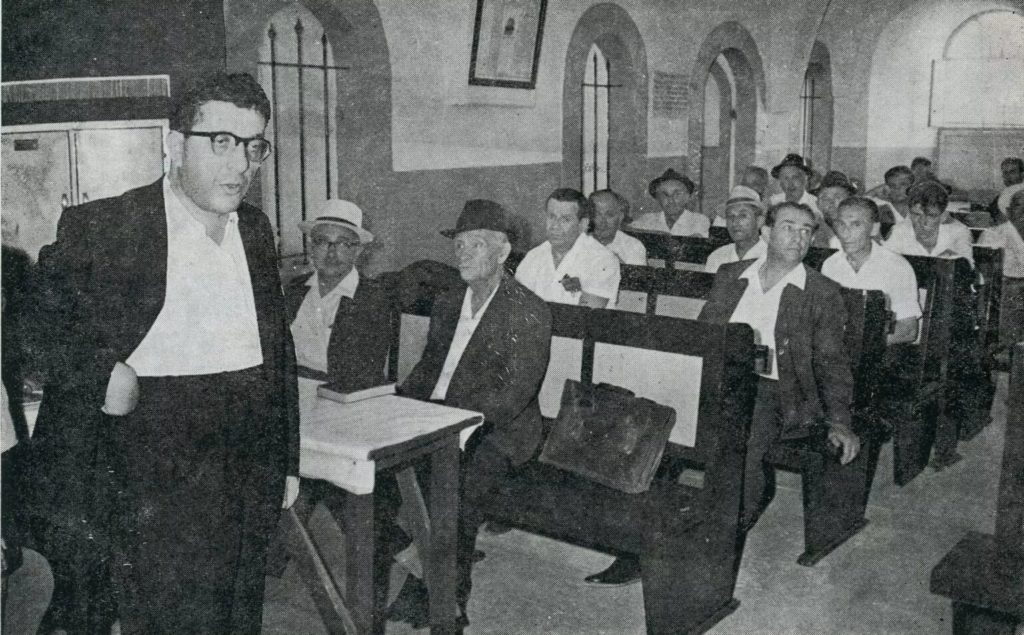
Shlomo Yahalomi Diament of Strzyzow giving a eulogy in a synogue on Mount Zion
Published in 5721 (1960-1) in the Hatzofeh newspaper, it has been edited and presented to you by Ganzach Kiddush Hashem.
Shlomo Diament was born in Strzyzow to his father Yosef Chaim and his mother Devorah, daughter of Rabbi Halevi Kanner, both of whom died before the Holocaust.
In 5690 (1930), he founded the “Eitz Chaim” Yeshiva in his city and headed it.
His wife Leah, daughter of Eliezer Licht, and his two children perished in the Holocaust, and he was exiled to Siberia.
At the end of the war, he married Devorah, daughter of Rabbi Menachem Eisen, arrived in Munich, and from there immigrated to Israel and settled in Tel Aviv.
May these wonderful words be in memory of the soul of the Holocaust survivor who remained steadfast in spirit and soul, Shlomo ben (son of) Yosef Chaim z”l.