The 3rd Siyum HaShas in the Daf Yomi Framework, the 1st Following Liberation
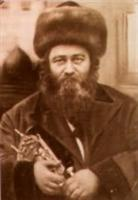
Rabbi Meir Shapira z”l
Eighty years ago, in the early winter of 5706 (the end of 1945), the Siyum HaShas (celebration marking the end of studying all of Gemara) in the daf yomi (learning a page a day) framework was held for the first time since the outbreak of the Holocaust. The celebrations were held with mixed emotions, as most of those who began the Shas as part of this cycle did not get to finish it. They were murdered in sanctification of the Name of G-d during the years of the destruction of European Jewry. The difficult feelings were well expressed by Rabbi Yitzchak Yedidya Frankel z”l, the rabbi of Tel Aviv, about whom we can mention the words of the lamenting prophet: “I am the man who has seen affliction by the rod of His wrath” (Lamentations 3:1). As for him, Rabbi Frankel z”l, he saw Polish Jewry in its days of praise and glory, and therefore, his pure heart was torn in the face of the horrible news of its destruction and ending.
Rabbi Frankel, father-in-law of our president, Rabbi Yisrael Meir Lau, was born in Łęczyca, Poland, and at a young age studied Torah from the genius Rabbi Akiva Asher Gottfried, a student of the Sochaczew Rebbe, the Avnei Nezer. At the age of 13, he was sent to study in Warsaw, at the yeshiva of the wonderful genius Rabbi Menachem Ziemba, who studied with him in the rabbinate and was ordained by him at the age of 18, as well as by Rabbi Shlomo David Kahane, by Rabbi Chanoch Tzvi Levin of Bedzin, by the Ostrowiec Rebbe (Rabbi Yechezkel Holstock), and by Rabbi Shalom Shachna Czerniak, the rabbi of Maciejów, who examined him for many days. In Warsaw, Rabbi Frankel also met the Chafetz Chaim, who blessed him with the priestly blessing.
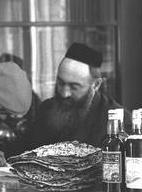
The genius Rabbi Yitzchak Yedidya Frankel z”l
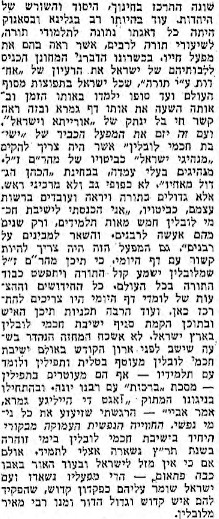
The article before you was published by Rabbi Frankel eighty years ago and is held in the Ganzach Kiddush Hashem archive:
“And I saw Rabbi Meir sitting in his beit midrash (study hall), a very sharp Torah scholar, and I made the blessing ‘Blessed is the Creator of light.'”
With these words, the genius Rabbi Shalom Mordechai Schwadron of Brezin (Brzeżany) z”l opened his letter of approbation for the young Rabbi Meir Shapira. Indeed, this sage saw the future, for a new light was rising in the Jewish sky.
In my lecture in Jerusalem five years ago, on the anniversary of the passing of this righteous man, I mentioned in passing that it could be said that from the day of Rabbi Meir Shapira’s passing, the sunset of Polish Jewry began, leading up to its complete destruction in these days.
Since the passing of Rabbi Meir Shapira, we have not yet had the opportunity to celebrate the Siyum HaShas properly, and every time we prepare to celebrate the Oral Torah holiday, a drop of sorrow drips into the cup of calamity for all of Israel. On the eve of Tammuz 5698 (1938), when charedi (ultra-Orthodox) Judaism was preparing to celebrate the Siyum HaShas in great splendor in Zichron Meir, the colony named after Rabbi Meir Shapira, news arrived at the last minute that the sentence on Shlomo ben Yosef z”l, had been carried out, and the mourning caused all celebrations to be canceled. And so this year, 5706 (1945), although we certainly did not dream of celebrations on a large scale, for how could we be happy if the main celebrants were not there, those thousands of daf yomi students in the Diaspora who were uprooted and slaughtered – we thought that at least here in our country we could celebrate the Torah celebration, which is meant to encourage and strengthen Torah study, and then the events of the last few days came and spoiled the joy.
With the death of Rabbi Meir, the joy of Torah has been nullified, and this can be said without any exaggeration. Anyone who has not seen Rabbi Meir Shapira at the joy of completing a tractate, and even more so at the end of Shas, has not seen a holy joy in his life. Rabbi Meir understood the role of a rabbi to start everything from the root and not be satisfied with routine matters, and first and foremost he concentrated on education, the foundation and root of Judaism. Even when he was a rabbi in Galina and Sanok, all his concern was given to Torah studies, to Torah lessons for the masses, which he saw as his life’s work. With his oratory gift, he introduced the idea of ”unity through Torah” into the hearts of the Jewish People, that all Jews in the Diaspora from one end of the world to the other would study the same page of Gemara at the same time and at the same hour, and in this he saw a living, unbreakable connection between “Torah and the Jewish People,” and with this he initiated the great undertaking of the Chachmei Lublin yeshiva, which the Jewish leaders needed to establish, as Rabbi Meir Shapira z”l put it. Leaders with a position, like the High Priest among his brothers, not bent over nor bowed down, but great in Torah and fear of G-d and working on their own authority, as he put it: “I brought five hundred students into the Chachmei Lublin yeshiva, and only two of them I will make rabbis, and the rest will become scholars of rabbis.”
This enterprise also had to be connected with the daf yomi, because Rabbi Meir Shapira z”l intended that in Lublin the voice of the Torah would be heard and the honour of the Torah would spread throughout the world. All the Torah thoughts of the Daf Yomi students had to be concentrated there, and many other plans were planned by the man, including the establishment of a branch of the Chachmei Lublin yeshiva in the Land of Israel.
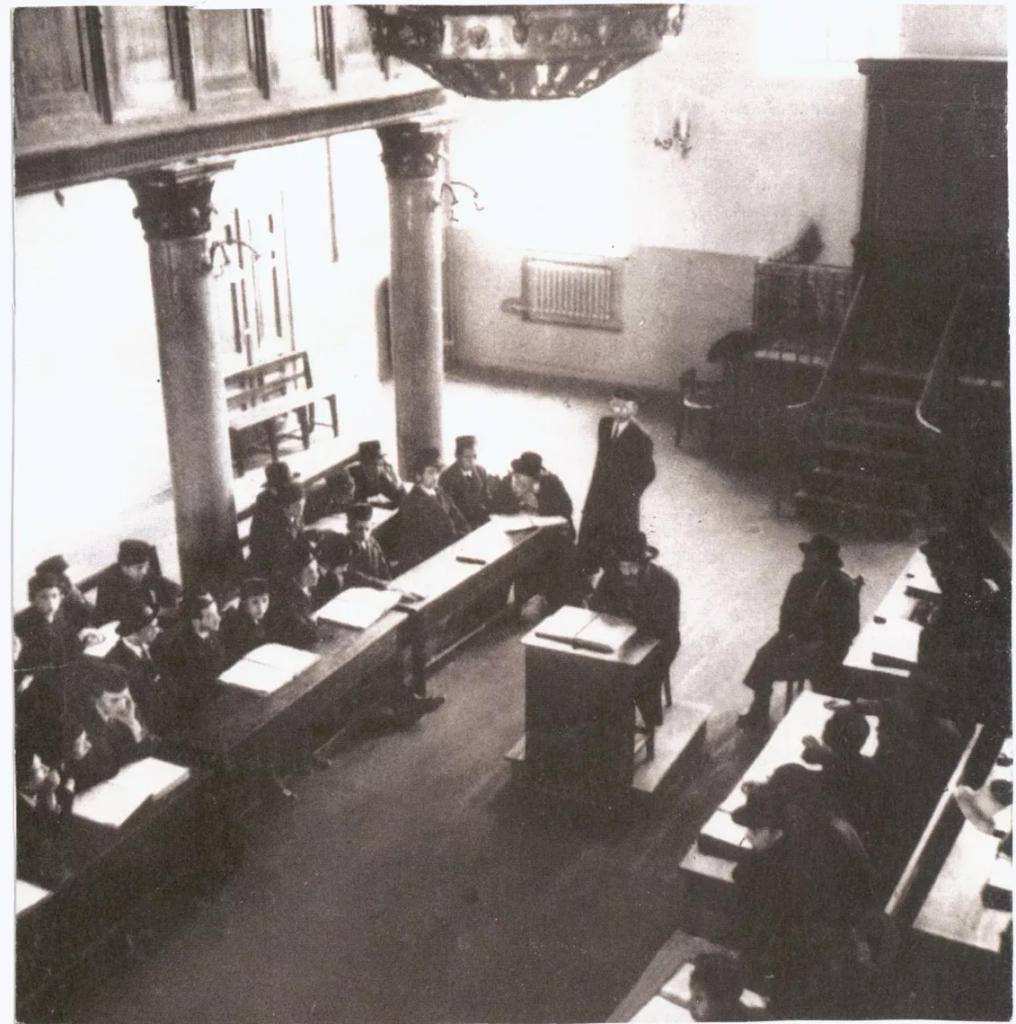
“I will not forget the sight”
I will never forget the wonderful sight of him sitting before the Torah ark in the hall of the Chachmei Lublin yeshiva, wrapped in a tallis (prayershawl) and tefillin (phylacteries) studying with his students – also adorned with tefillin – studying the Tractate Brachot with the commentary of Rabbeinu Yonah. When he began his sweet melody, “zogt di heilige Gemara, amar Abayeh” (the holy Gemara says, said Abayeh), I felt that it shook every fiber of my soul. The profound emotional experience from my sole visit to the Chachmei Lublin yeshiva at its height in 5690 (1930) has remained with me forever. However, although the Jewish People is unlucky and while the light in its darkness suddenly went out, his works remain and the Jewish People guard them as a sacred trust, entrusted to them by a holy man and great man of the generation, Rabbi Meir of Lublin.
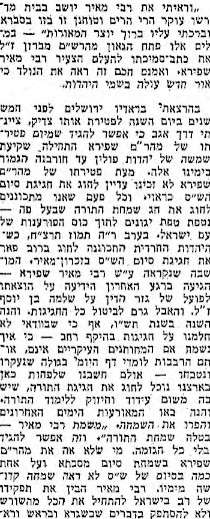
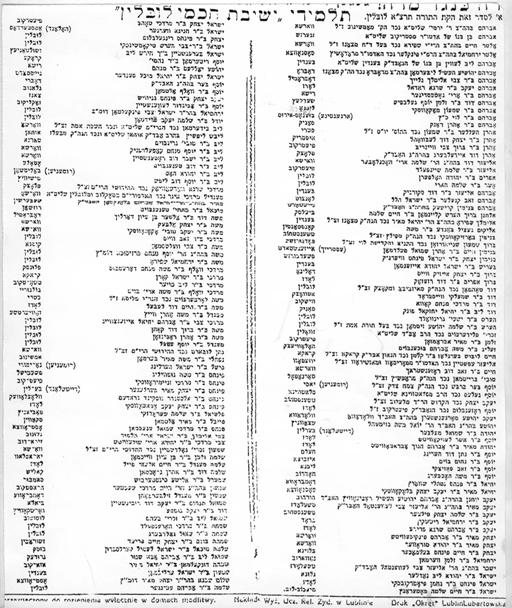
List of students of the Chachmei Lublin yeshiva, approximately in the year that Rabbi Yitzchak Yedidya Frankel visited the yeshiva