The Destruction of the City of Uman
85 Years Since the Destruction of the “City of Longing”
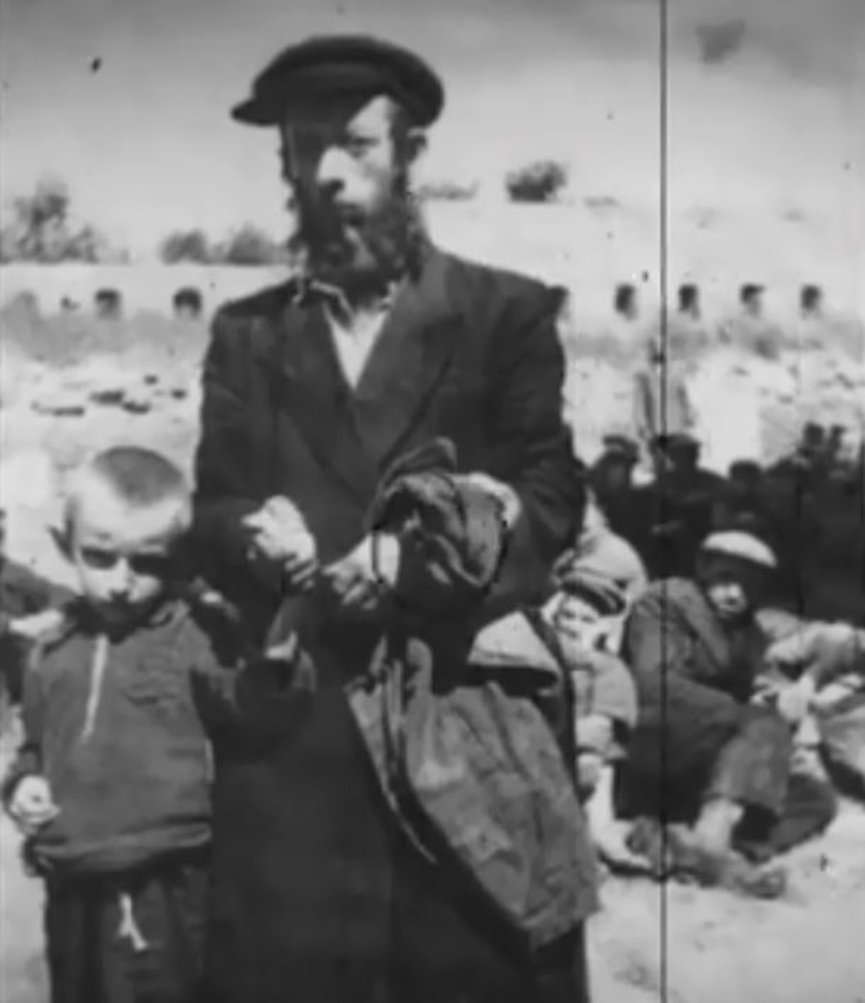
A scene from the deprotation from Uman
This article examines the harrowing history of the city of Uman during World War II, focusing particularly on the bitter devastation that befell the local Jewish community—from the invasion of Ukraine by Nazi forces in the late summer of 1941 to the bloody battles at the war’s end, when the Red Army liberated the city and the surrounding areas.
The site where the city of Uman is located has a long history as a key military outpost. As early as the era of the Polish-Lithuanian Commonwealth, Uman served as one of the most important fortresses in the Podolia region.
Over the years, the city was the site of numerous battles and wars between Polish rulers and Turkish and Tatar forces. Tragically, the local Jewish community suffered frequent persecution, including the bloody Haydamak uprisings. These persecutions reached their peak in 5528 (1768), when murderous bands led by Gonta and Zalizniak captured the city and perpetrated a horrific massacre of its Jewish and Polish inhabitants.
The city of Uman was divided into two main areas: the new, modern city and the old, rural district. Most of the Jewish population was concentrated in the old part of the city—specifically along the hilly streets facing the old cemetery. This area housed the central institutions for Torah study and prayer, including the historic Breslov Hasidic Kloiz (small synagogye) and the city’s Great Synagogue. The Tolna Hasidic Kloiz was also located on that same street.
Before the outbreak of the war, the population of Uman numbered approximately 45,000, of whom about 20,000 were Jews. Jewish life flourished, with dozens of study halls and synagogues. However, under Communist rule, most of the synagogues were nationalized and closed one by one. By the late 1930s, even the last synagogue had been shut down, and many Torah scrolls were confiscated by the Soviet authorities.
At the center of the old Jewish cemetery in Uman stands the ohel (building around a grave) of Rebbe Nachman of Breslov — a site to which Jews have flocked to pray for generations.
The Outbreak of War – “Operation Barbarossa”
On June 22, 1941, Nazi Germany violated the non-aggression pact with Stalin and launched a massive invasion of the Soviet Union — Operation Barbarossa. The Red Army, unprepared for this surprise attack, began a panicked retreat, leaving behind entire brigades that fell into captivity.
Despite the rapid breakthrough, fierce battles raged in central Ukraine as Russian troops attempted to put up resistance. Two major battles shook the front: the renowned battle for Kyiv and the historic campaign known as the “Uman Pocket.” In this area, a massive concentration of tens of thousands of Soviet troops was encircled by the Nazis, leaving them with no way out.
The city of Uman, which served as a strategic transit point between Kyiv and Odesa, was finally captured by the German army on August 1, 1941 (though some sources indicate that entry into the city occurred as early as July 31).
Uman Under the Nazi Boot
Immediately following the occupation, Uman became a regional center for the Nazi occupation administration. The city served as a base for the forces of evil that controlled the surrounding towns and villages.
Small groups of partisans began to organize in the forests surrounding Uman. Despite suffering from a severe shortage of weapons and equipment, they carried out daring resistance operations against the enemy, attacking German trains and disrupting the supply lines of the Nazi forces. These resistance fighters strove to strike back, even as the situation within the city itself grew increasingly grim and dire with each passing day.
The Nazi regime in Uman did not content itself with persecuting the Jews; it also severely oppressed the local Ukrainian population. It is estimated that some ten thousand young people from Uman and the surrounding area were forced to leave their homes and were deported to Germany for forced labour.
Only a handful of young people managed to escape this fate. Some chose to collaborate with the Nazis and joined the local police, while others fled to the forests to wage a partisan struggle.
The dark period of Nazi rule in Uman lasted nearly three years: from the 7th of Av 5701 (July 31, 1941) to the 17th of Adar 5704 (March 12, 1944). On that day, the city was finally liberated by Soviet forces following a series of bloody battles that broke the German lines.
The path to liberation was fraught with severe difficulties. Following the famous Battle of Korsun-Cherkassy, the Germans attempted to hold a defensive line north of Uman. That year, spring arrived earlier than usual, bringing with it the notorious Ukrainian rasputitsa—the season when the snow melts and the ground turns into a vast sea of deep, sticky mud.
The roads became completely impassable. Military vehicles and trucks sank into the deep mud, and only heavy tanks—such as the Soviet T-34—were able to maneuver in these harsh conditions.
The Second Ukrainian Front, under the command of Ivan Konev, capitalized on the momentum and launched a massive offensive. The Red Army drove the Nazis back dozens of kilometers to the Bug River, and on March 12th, 1944, Uman was finally liberated.
The Nazis left a devastated city in their wake. Uman was shattered — both physically and spiritually. As in many other towns and cities in the region, the most harrowing aspect of the destruction was the loss of Uman’s rich and thriving Jewish community, which had been all but wiped off the map of life by the Nazi murderers.
The Holocaust and the Destruction of the Jewish Community
Before the outbreak of the terrible war, the Jewish community of Uman numbered approximately 13,000 people. With the arrival of the Nazis in the summer of 1941, many attempted to flee eastward alongside the retreating Soviet forces; however, some 5,000 Jews remained trapped in the city when the German army entered it in the month of Av 5701.
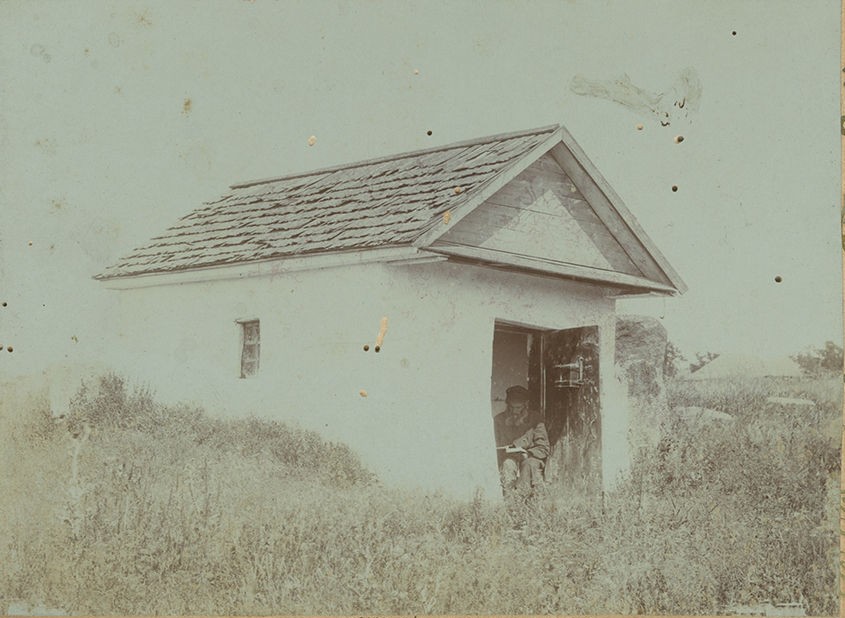
A Jew praying at the grave of Rebbe Nachman of Breslov
Along with the German army came bloodthirsty SS units and the “Sonderkommando 4” murder squad, whose sole objective was the implementation of the “Final Solution.”
The Nazis deceived the population with a false announcement stating that all members of the Jewish intelligentsia and community leaders were required to report to City Hall for questioning. Approximately 80 Jewish men — the community’s elite — reported as instructed, naively believing the Nazi lie that they had been summoned merely for interrogation. Tragically, however, instead of being questioned, they were immediately arrested and, shortly thereafter, executed — killed in sanctification of the Name of G-d.
Subsequently, a Judenrat (Jewish Council) was established and harsh decrees were imposed; every Jew was required to register and wear a white, humiliating armband bearing the Star of David. The registration process was accompanied by acts of brutal beatings and humiliation, while Jewish homes were left vulnerable to looting by German soldiers and Ukrainian collaborators.
The Great Slaughter on the Eve of Rosh Hashana 5702 (1941)
The shocking Aktion (roundup) that devastated the city took place on the eve of Rosh Hashana 5702 (September 21st, 1941). German murderers, together with local Ukrainian police, rounded up over a thousand women and children and confined them in the basement of a palace on Lenin Street.
With inhuman cruelty, the Nazis sealed off all the basement’s openings. Amidst the absolute darkness and suffocating air, many perished from hunger and asphyxiation. The few survivors were dragged out the following day, while the men were sent to the killing pits by the brutal forces.
The British journalist Alexander Werth, who entered Uman following its liberation in 1944, describes heart-rending scenes in his book. He notes with anguish that although Jews had constituted a quarter of the city’s population before the war, not a single one remained on the streets of Uman after the liberation. He writes: “As in many other Ukrainian cities, Jews had made up a quarter of the population before the war, yet now, not a single person of Jewish appearance was to be seen on the street. Half the Jewish population had fled eastward back in 1941, but the 5,000 Jews who remained in the city—men, women, and children—were rounded up one night and herded into a large warehouse. All the windows and doors were tightly sealed, and after two days, they all died of suffocation…”
The Uman Ghetto
Following these initial, horrific events, the Nazis ordered the complete evacuation of Jewish residents from their homes. By the end of September 1941, all Jews were forced to crowd into a designated area near the market square, which was declared the “Uman Ghetto.” The ghetto was situated along Rakovka, Vostochnaya, and Nekrasov Streets.
The time allotted for the transfer was less than a week, causing indescribable panic. Jews from neighboring towns were also brought to the ghetto, exacerbating the overcrowding and poor sanitary conditions. Although the ghetto was not entirely enclosed by high walls, Jews leaving or Ukrainians entering any exit was strictly forbidden, punishable by death.
The Nazis appointed a local leadership (Judenrat) headed by Samburski and his deputy, Tabachnik; they were responsible for overseeing the implementation of the enemy’s orders, including the collection of heavy fines and gold through terror and beatings.
The Great Slaughter in Sukhyi Yar
About a week after being forced into the ghetto — during the intermediate days of Sukkot, on the 17th of Tishrei 5702—the bloodiest Aktion in the history of Uman began. German Police Battalion 304, assisted by the Ukrainian police, surrounded the ghetto and began driving the Jews toward the market square.
From there, thousands of victims were marched to the municipal prison, where they were forced to undress and leave all their belongings behind. The scenes were heart-rending: the sick, the elderly, and young children were loaded onto trucks and driven out of the city to a site known as “Sukhyi Yar.”
There, beside three huge open pits, 5,800 holy and pure souls — may G-d venge their blood — were shot to death. Among the martyrs were some 400 Jewish prisoners of war who were murdered alongside the civilian population. Today, a monument stands at the site, recounting the harrowing story of that bitter day; it remains as a silent, eternal witness to the terrible devastation that turned the area into a sea of blood.
The end of the ghetto came on the fateful day of the 5th of Iyar, 5702 (April 22, 1942). German police units, accompanied by Lithuanian and Ukrainian collaborators, surrounded the ghetto and began a systematic search. They combed through every house, attic, and cellar hiding place until they had flushed out the last remaining Jews.
Those still physically fit for work were deported to the labour camp in Haisyn. The rest — the elderly, women, and helpless children — were taken to the forests surrounding Uman, where they were killed by the collaborators under German supervision.
Sources indicate that the “official” reason for the liquidation of the ghetto was an order from the Nazi officer Jürgen Stroop; at the time, he was overseeing the construction of a strategic road and argued that Jews must not be allowed to remain alive, lest they aid the partisans. This same murderer later gained notoriety for liquidating the Warsaw Ghetto.
The End of a Glorious Community
Following the liquidation of the ghetto, only about sixty Jewish artisans remained in Uman — individuals whose services the Nazis required. Yet their fate, too, was sealed; during 1943, these last remaining Jews were also put to death.
Thus came the end of a community that had flourished for centuries — a place that had been a center of Torah, chassidism, and a rich Jewish life. Uman was left without Jews, yet its history remains forever etched in the heart of the Jewish People.
With that bitter destruction, a vibrant Jewish community vanished, leaving behind a city empty and bereft of its original inhabitants. It marked the tragic end of a magnificent community. Torah scholars, chassidim, and men of pious deeds once dwelt in these narrow alleys; study halls bustled daily with the sounds of Torah and prayer, while in the kloizim, Hasidim sang hymns with fervor and strengthened one another in the service of the Almighty.
In a brief and horrific period of less than three years, the Nazi devastation cut down the community — with all its beauty and spiritual richness. Thousands of Jews — men, women, and children — were murdered in sanctification of G-d’s name in the forests and the pits of blood surrounding the city. Their voices were silenced in those dark days, yet their memory continues to cry out to this very day.
(Translated from Yiddish to Hebrew, and then to English, and based on Di Shtile Eydus fun di Sukhyi Yar: Zikaron Kedoshei Uman Hy”d B’Shnot HaZe’em)
Heartfelt thanks to the Yiddish forum “Yiddishe Velt Forums.”