The Incident that Shook the Town 100 Years Ago
By: Yaakov Rosenfeld
A hundred years ago, in the month of Kislev 5685 (Dec. 1924), an interesting news item was published in the popular Yiddish newspaper “Dos Yiddisheh Vort”, published in Poland in the interwar period.
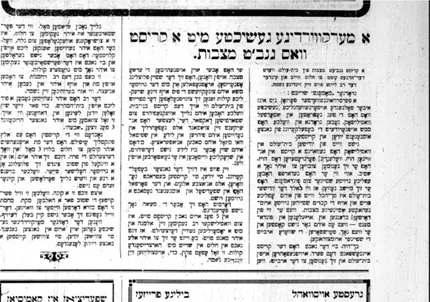
Here is the article (translated from Yiddish to Hebrew by Yaakov Rosenfeld, and then from Hebrew to English by Ricki Prince)
Subtitle: Christian steals tombstones from cemetery, then gets killed, and comes in a dream to his wife and children to mourn his sinful soul…
The “Moment” newspaper of Grodno writes:
“An Extraordinary Case”
A faithful man tells us of the following extraordinary incident that occurred recently in the town of Vaslishok (Vasilishki) near Grodno, an incident that truly stirred up the population of the entire area, both Jewish and Christian.
Not far from the town cemetery, a Christian lived in a private house. Since he wanted to expand his house, he began to build an additional room, and since he needed large stones for the construction, he “made up his mind”: since the Jewish cemetery was close to his house, only a few steps away, and since the graves were set with large, hewn stones, he would take stones from there and fix them in the foundations of the house.
He intended to make a profit on both the cost of the stones and on the costs of labour and transportation.
And so it was. In the dead of night, the Christian harnessed the donkey and rode with it to the cemetery, and began to work.
He managed to put the first tombstone on the cart, when the tombstone broke loose and the heavy stone suddenly landed on his foot, crushing it completely, to the sound of his cries and wails.
His cries of anguish echoed around, and the Christian’s family felt compelled to help him and took him to the city doctor, but the latter described the situation as “terrible” and ordered the patient to be evacuated to the hospital in the city of Lida, so that he could undergo surgery. However, they did not bring him to the hospital in Lida, because unfortunately he died on the way.
The death of the man, who was received by all segments of the population, both Jewish and Christian, as the “finger of God,” left a strong impression on the entire population, but the story certainly did not end there.
Five days had passed since the death of the Christian, and his widow came to the Rabbi of Vaslishok. She entered his room and burst into terrible, uncontrollable tears. Between her sobs, she said that since her husband’s death he had been coming to her every night in a dream, screaming in heartbreaking voices “that she would do something to redeem his sinful soul.”
According to her, after the first time he came to her in a dream, she ran in fright to the priest and he ordered her to bring candles to the monastery, but this did not help, and at night the dead man came with an even more terrible voice.
She asked the rabbi for mercy on the dead man and on her, and she asked for advice on how to calm the dead man’s soul.
The rabbi ordered her to donate a bundle of candles to the synagogue, and by their light Jews would study and pray. He also ordered that all members of the household sit shiva (week long mourning period following a Jewish funeral) together for three days.
After the Christians accurately fulfilled the rabbi’s instructions, the dead man stopped coming to the woman in dreams, but, according to the woman, 3 times a week it seems to her that in some corner of the house a large fire suddenly lit up (“esh Gehenom” in the original. Literally “hellfire,” but the translator is not sure what it is referring to). This fire ignites for a moment and then goes out, and no one sees it.
She is now looking for a buyer for the house. She is willing to sell even for half the price because she is afraid to live in this house, the buyer has not yet been found.
This story has many echoes, and a series of legends have developed in its wake among both the Jewish and Christian populations.
A Window into a World that Was
The news, whose source is the writer from the “Moment” newspaper in in Kovno, Lithuania, opens a window into a fascinating world that was and is no longer. This news has a refreshing scent of Jewish life in the towns of Poland and Lithuania, and in general, reminds us of forgotten names of towns that were once full of Jews and vibrant with a life full of Torah and the fear of G-d, and since the Holocaust they have stood forgotten. This is the fate of thousands of cities and towns throughout Europe, especially Eastern Europe, that never recovered from the destruction, because unlike the large and central cities like Warsaw, Budapest and the like, whose rhythm of life dictates some kind of active routine, the countless towns scattered across this cursed continent will never be restored, and the cheers of children, the singing of chassidim, and the sweet melody of the page of Gemara will never be heard again. The Jews brought life into their places of residence and brought a touch of charm to them. The shops were bustling, the markets were bustling, and the atmosphere was full of life and youthful joy. All of this will never return. Never. And whoever comes there, and observes the song of life, will agree wholeheartedly with this statement. Europe is dead – dead, and will live no more.
The savage Arabs have not yet reached Poland, they are still busy destroying the cities and provinces of Central Europe; when the turn of Poland, Hungary, Ukraine, and Romania will come – no one knows; but what is clear is that the beautiful life that was once enjoyed there will never return there.
Vaslishok is the name of the town in which the story presented in the newspaper took place, or rather within its borders, adjacent to its cemetery which stood, as usual, on the outskirts of the town. In the next article in the series I will tell you a little about the town and its Jewish residents who constituted a clear majority; about its rabbis and its historic synagogue, of which we managed to obtain a rare photo from a few years ago, before the authorities in Belarus sold it for a pittance, and we will also tell you about that in the next article.
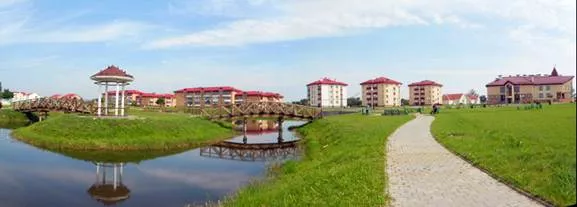
And before we tell the interesting, wondrous story, let’s tell a little about the peaceful and joyful Lithuanian town, most of whose residents (approximately 1,800) were Jews.
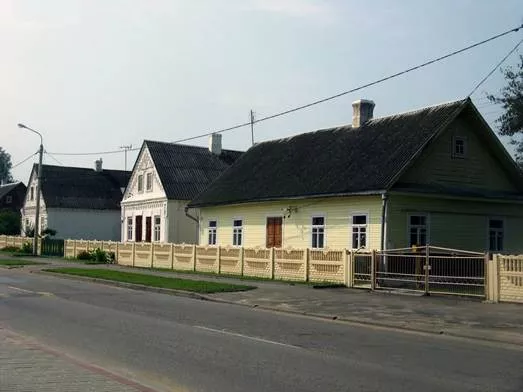
Homes in the town