The Jews Cope with the Decree Against Shechita (Kosher Slaughter)
This article is published during the time that the Daf Yomi (a page a day) Talmud study program is learning Tractate Chulin on matters of shechita, and to mark the 90th anniversary of the outlawing of shechita in Germany.
By: Yaakov Rosenfeld
I call upon you, individuals, to stand the test and show that you are among the descendants of their sons who were stoned and crucified for the death of the Torah, as in the Rosh’s response, chapter 32, verse 8, concerning the women who did not have the strength to stand in the king’s palace, and at the time of the decree they exchanged for fear of death, and when they found a miracle and escaped they returned to their religion. The truth is that they did very badly, and they need to repentance and accept the torment, and even more so than the exchanges that are not at the time of the decree, because it is public, and at the time of the decree the sages said, “Even to change the strap of a sandal, it is forbidden to change it.”
A letter by the genius Rabbi Chaim Yitzchak Yerucham, the head of the Altstadt beit din (rabbinical court), 5694 (1933-4), on the matter of outlawing shechita. Seridei Esh, pg. 175.
“Animal Cruelty”
The slaughter decree in Nazi Germany in the 1900s did not fall on the Jewish people like a bolt from the blue. It was preceded by slaughter decrees in Switzerland, Norway, Sweden, and other countries. The common thread in these decrees is that they were never devoid of antisemitic motives, even though they were publicly fueled by animal welfare organizations that only had the welfare of animals in mind, ironically of course.
It is interesting to note that in 1912, when animal rights activists attempted to ban the slaughter of animals, in order to eliminate the possibility of such a regulation, the German Reichstag passed an amendment to the Criminal Code by a large majority, according to which:
Regulations of states for interference in the form of the slaughter of animals according to the religion of any group are prohibited. (—Amendment to Section 360 of the Criminal Code)

Press coverage on the outlawing of shechita, Ganzach Kiddush Hashem archive
The slaughter decree in Nazi Germany was fundamentally of the same nature. The leaders of the enlightened nation could not stand idly by in the face of the suffering of the animals and birds and issued sweeping legislation against Jewish slaughter, first in 1933, when they could still import meat from neighbouring countries, but over time the decree became more and more severe until in 1936, ninety years ago, the prohibition on consuming kosher meat was enacted. This law, in effect, put an end to the kosher meat market, and although underground slaughters always existed, and continued even under the noses of the Nazis, this solution was effective only for individuals, not for the masses and certainly not for public institutions.
Now, to mark the ninetieth anniversary of that difficult period of struggle, which preceded the terrible Holocaust that wiped out a third of the Jewish people, men, women, and children, it is interesting to look at the essence of the shechita decree and the attempt of the great Torah scholars of that generation to deal with the decree and its consequences.
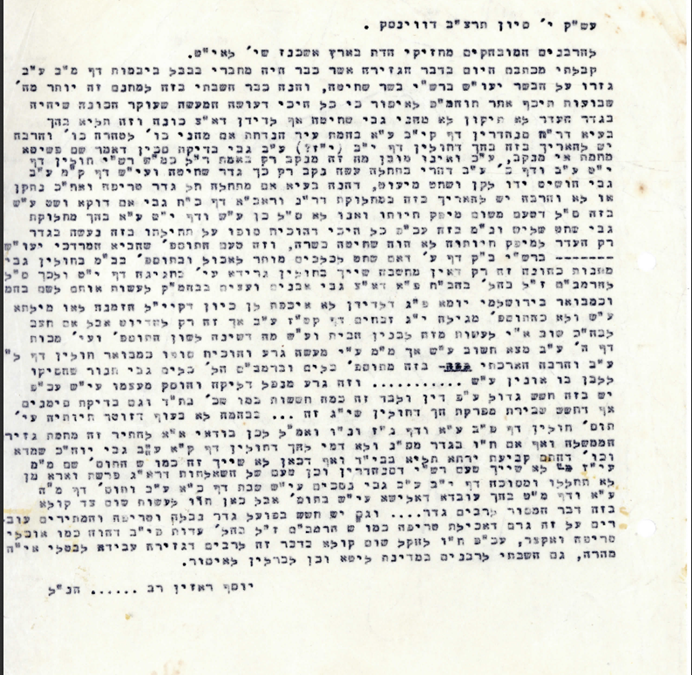
Letter from the Gaon (genius) of Rogachev regarding the outlaw of shechita, “to the distinguished rabbis who hold the religion in the land of Ashkenaz.” A copy is held in the Ganzach Kiddush Hashem archive.
The laws of shechita – which Daf Yomi scholars are currently busy with, and are struggling to understand – have already been proven by medical researchers and renowned experts to be free of animal cruelty. Many articles and books have already been written in various languages to prove this assertion. The preliminary “stunning” by means of an electric shock, which European legislators have tried to impose on slaughterers since the last century, makes the animal treif (unkosher), and although there were rabbis who tried to find a solution to this, according to the halachic authorities from generation to generation, there is no permission to kill the animal or stun it before shechita. The author of the book Seridei Esh (the Gaon Rabbi Yechiel Yaakov Weinberg, head of the Rabbinical Seminary in Berlin) recounts at length the painful episode and its consequences, and gives it a brief introduction:
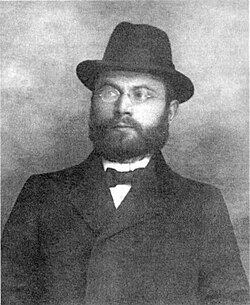
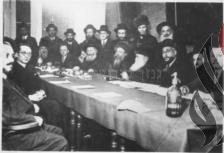
Rabbinical gathering
“The wicked kingdom decreed a ban on shechita without stunning the animal before slaughtering it. After that, the wicked, through cruel legal tricks, denied the possibility of bringing meat from abroad, and did not allow slaughter without a permit, even for the elderly and dangerously ill.”
In the first part, he discusses the issue of stunning animals, whether in retrospect, due to lack of choice, it is considered a solution or not, and later in the book (Section 6) he discusses the issue of “piece of the joint” – an issue that is currently being discussed (Sivan 5786/2026) among the pews of the study halls everywhere, as this is the issue currently being studied in the Daf Yomi.
In the Gemara (Chulin 27) we learn that the verse “And slaughtered the calf” is intended to teach that there is no need to separate the head from the body by cutting off the joint, and Rashi interpreted it to mean that one should not separate the head from the body by cutting off the joint, but rather stop after the ruling on the signs and that’s it. However, the Tosfot method is that the Gemara’s intention is that one should not begin slaughtering from the joint until one reaches the signs, and by this it is found that one has to cut off the entire head.
The Rama ruled (Yoreh Dead 24, 5): “And the custom of severing, even most of the joint is cut, and it should not be changed, because there are many who are more powerful than that.”
However, in the book Yishmach Moshe (Responsa “Heshiv Moshe,” paragraph 23) he stated that even the strictest have no place to be strict except with animals, but with birds there is no prohibition at all, and even where “there is a custom to prohibit, the custom is in error.” The Maharsham also believed in his book “Da’at Torah” that at least lenient treatment should be given to birds, even without much loss.
According to their words, Rabbi Yechiel Yaakov Weinberg wrote that “Since this matter now concerns all of our fellow Jews, who live in countries where shechita is prohibited without the joint piece, and it must be felt that if, G-d forbid, they do not find any permission to eat poultry meat, many will stumble into the sin of eating neveila (an animal that died without shechita) and treifa (animal that has been disqualified for shechita, first forcefully and then willingly, G-d forbid, and will be entangled, G-d forbid, in this grave sin. And there is no hour of greater urgency than this, one must certainly rely on the above-mentioned mitigating factors even from the outset, and permit the slaughter of poultry with the entire joint piece, in certain ways.”
Stages of the Decree’s Progression
The negotiations were sent to the Gaon Rabbi Chaim Ozer Grodzinsky, who, although he strongly opposed the discussions surrounding stunning animals, agreed to permit the elderly and the sick in certain ways in this matter, and in his words, “whatever we were able to do according to the law, we must do to prevent our brothers from eating nevelah and treifa, which if they get used to it, will start out of force and will end with pleasure, even if the decree is revoked.” [On this matter, there have been many branches of discussion and responses from the great Torah scholars of the generation, some of which were printed in the Responsa Seridei Esh. We will only note the words of the Gaon Rabbi David Sperber, author of “Afraksta D’Aniya” (Part 2, Orach Chaim, 38), who believes that it should never be permitted to do so in the first place, and that even the permission of the “Heshiv Moshe” and the Maharsham is only if the entire head is cut off retrospectively, but if the entire head is cut off in the first place, there is no doubt that they will cause a knocking out and make the bird treif drive by doing so.]
As mentioned, in 1936 the Germans had already completely banned the import of kosher meat from outside Germany, except for meat imported free of charge. As a result, a fund was established in London to finance kosher meat for German Jews, and thousands of Jews participated in the fund, which helped approximately 83,000 families and several institutions to receive meat. However, in 1938, the import of free meat was also banned, and in a last-ditch effort, the members of the “Jewish Center for Meat Gift Affairs” (a body established by Rabbi Azriel Munk for this purpose under the name “Institute for the Protection of Shechita,” whose name was changed by government decree) convinced the German government to allow the distribution of the meat that was already stuck in the port of Hamburg, and indeed this was the last effort that succeeded, until the outbreak of World War II.
With the occupation of Eastern European countries by the Nazi tyrants, the law prohibiting slaughter was applied to all occupied countries, but this law generally had no practical significance, since the Jews were in camps or ghettos and had no practical possibility of slaughtering animals even if it were permitted. The Nazis wrapped the law, which was introduced for clear antisemitic and Nazi motives, in the guise of “animal cruelty” and “animal protection”.
The Nazis, who murdered and tortured innocent people for five whole years, were the ones who cared about the “cruelty” of animals…
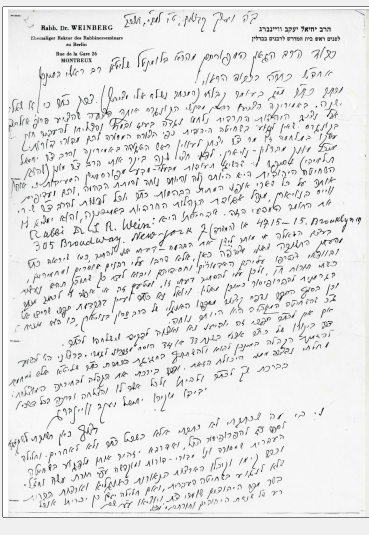
Here is a photograph of a letter from the Gaon, the author of Seridei Esh (from 5723/1962-3) in which Rabbi Weinberg cites the testimony of Dr. Munk, who obtained certificates from famous scientists indicating that Jewish slaughter is the “easier and more convenient way to kill animals,” and that “they prefer it to all other methods of killing animals.” The letter is preserved in Ganzach Kiddush Hashem’s archive
Coping

A meat-free menu proposal. Photograph from the Frankfurter Israelitsch Gemeindeblatt newspaper (courtesy of Yad Vashem)
From Ida Wolf:
With the introduction of the prohibition of slaughter, the housewife who maintains a traditional household is faced with a new task: she must feed her family for the first time, using meat-free food that is both nutritious and inexpensive. This matter is not at all as difficult or impossible as it may seem at first glance. It requires a re-learning that can be made easy through systematic guidance and consideration.
First and foremost, substitutes must be found for two important components of meat: protein richness and flavor texture, which are invaluable because they spice up the food and improve its taste. It is recommended to cook as much as possible with dairy ingredients. It is recommended to purchase, if possible, dairy cookware, because only through the abundant use of milk, butter, and cheese can a person obtain the protein he needs – protein cannot be provided solely from eggs, vegetables, and fish. This requires, of course, paying greater attention than before to ensuring that the natural protein in the food is not reduced due to improper preparation. Thus, one must avoid boiling fish; it is better to cook it in a sauce that has already been used or to bake, steam, or grill it. With this preparation, not only will all the nutritional components be preserved, but their taste will also be better. In addition, cheese, cream, and milk are also beneficial, along with mushrooms and herbs, which provide flavor to the food. The attached weekly kitchen note, containing several recipes, is a practical interpretation of this brief explanation.
Sunday Lunch: Semolina soup of roasted green wheat grains, baked cauliflower, potatoes
Sunday Dinner: Salted fish, peeled potatoes
Monday Lunch: Potato soup, stuffed cabbage, rhubarb compote
Monday Dinner: Russian eggs, green sauce, potatoes
Tuesday Lunch: Herb soup in breadcrumbs, steamed fish, potatoes
Tuesday Dinner: Poached egg, lettuce salad, bread in cheese
Wednesday Lunch: Roasted semolina soup, Steamed white cabbage, fish pieces (using leftovers)
Wednesday Dinner: Rice in milk, sugar and cinnamon, applesauce
Thursday Lunch: Mushroom soup, spinach, roasted potatoes, cocoa pudding
Thursday Dinner: Macaroni in tomato sauce, grated cheese
Friday Lunch: Tomato soup, potato dumplings, horseradish
Friday evening: Rich vegetable soup with semolina dumplings, fried cod fillet with potato salad
Saturday lunch: Bean soup, mixed celery salad, biscuit roll
(Russian eggs courtesy of chef Omer Miller: Take hard-boiled eggs, cut them in half, and make a rich filling from the yolks like an egg salad that is put back in. The filling usually includes mayonnaise, mustard, salt, pepper, and a little paprika that gives color and flavor.)
“New Kashrut”
A problem that the Torah-observant public faced was the kosherness of restaurants and public eating places. In this context, the Orthodox Jewish journal “Der-Oralit” published a warning against “new kashrut” in the summer of 1934:
“New Kashrut” – A new concept was born out of the current Jewish situation, which is tragic but also somewhat comical: “New Kashrut.” And what is it? There is of course no mention of this in the Torah and Talmud, nor in the halachic literature and responsum. When the word “new” is used in the sources in the context of halachic law, it is only in the sense that studying the Torah and keeping the commandments will remain as new to us as on the first day – “Every day they will be as new in your eyes.” We first encountered the existence of such a concept of “new Kashrut” in an advertisement for a Jewish restaurant at a well-known bathing spot in the “Black Forest” [= a resort area in western Germany]. There it was stated in this context: “The meat kitchen is managed according to the new Kashrut.” We report daily on such adaptations in the style of “new Kashrut” in public establishments as well as in Jewish institutions and private homes in the country.
For our readers who are not at all familiar with the meaning of “new Kashrut,” and who also cannot find it out in any Jewish lexicon, the concept is defined here in a clear and concise manner: It refers to meat from animals that have been slaughtered after stunning, with or without shechita – and in this case, it is of no importance. It is therefore meat that is not kosher in a new way, but rather, according to the old and new concepts, it is complete treifa, and there is no rabbinical power in the world that can make neveila and treifa kosher. It is almost cynical that Jewish restaurants believe that they can use a concept that simply does not exist – “New Kashrut” – to entice kosher-observing guests.
(“Der Israelit,” Av 14 5694 (July 26th, 1934), pgs. 5-6.)
As mentioned, during these years a controversy arose between the circles of faithful Judaism and the liberals. The lenient ones demanded that, due to the needs of the hour, even shechita preceded by stunning should be allowed. This issue was placed before the Torah giants in Europe, and it even reached the Land of Israel. The negotiations were genuine and pointed, and one of the clauses of the aggravation, even in matters that were halachically lighter than stunning, was that when decrees were passed against the religion, it was forbidden to surrender and show the lenient ones that their decrees were successful and that as a result the prevailing halachic law amongst the Jewish People would change from generation to generation.
In 5698 (1938), Dr. Herzberg published a scathing article in the Zionist newspaper against the rabbinical position that denied compromise, and in response, Der Israelit published a response article:
No one denies the difficulty that arises here and no one wanted to simply silence the problem. Quite the opposite is true. We must be convinced that our rabbis are always looking for any way to allow the eating of meat. But such a way must be within the framework of tradition […] Sometimes people who think differently from us get the impression that these Orthodox are of a gloomy nature without a heart of flesh, without joy in life, distant from feelings of joy and sadness. Wouldn’t we also want to eat happily from the pot of meat? […] It is precisely him [the observant Jew] who must endure the internal struggles, which are sometimes the most intense. But again and again the observant Jew will rejoice when he knows that he himself is now conquering his instincts after all. The feeling that he knows that he is placing his whole being at the service of G-d, Who in any case is working for a higher purpose, elevates him and gives him confidence and strength, despite all the mental anguish, to hold on. Along with Dr. Herzberg, others will certainly say that these are pale, empty phrases that are of no value today. To them I must reply that at this moment, when so many feel exactly this way and no other, they can no longer be just idle chatter […] At least we should not forget the large number of scared people (religiously speaking) […but] how many people have already believed in the past that they must desecrate Shabbat at work in order to save their basic livelihood. It is true that it cannot be claimed that Orthodoxy passed judgment on these people and did not explain its approach to anyone who found the way back. However, what would happen to Judaism if the Orthodox world had approved the behavior of these people in desecrating Shabbat? […] Of course, it would be more convenient if we had meat, but nevertheless this is not such a pressing fundamental problem as it seems to Dr. Herzberg.
“Der Israelit,” Tamuz 29, 5698 (July 28th, 1938), pg. 8 – Courtesy of Yad Vashem