The Life and Work of Regina Mundlak, May G-d Avenge Her Blood
Not much is known about the life and death of Regina Mundlak – may G-d avenge her blood – who does not even have an entry in the Hebrew Wikipedia site. Interestingly, the German and Polish versions of Wikipedia provide detailed accounts of her life, though they are not exhaustive; meanwhile, fragments of her biography can be found in various encyclopedias across different languages online. Notably, every single one of these sources cites a remark by Regina that is worth reflecting upon: “I do not understand modern art; it is completely foreign to me!” While many people might identify with this sentiment, it carries particular weight coming from an artist whose works were sold at the most prestigious and high-priced exhibitions in Europe.
An encyclopedia of artworks from the last century explains why the works of Regina, a persecuted Jewish woman murdered in Treblinka eighty-five years ago, did not receive the documentation and recognition that such a world-renowned artist deserved; it claims that because Regina focused on Jewish art, she painted primarily Jewish figures. This is a rather puzzling explanation, given that Regina was murdered after being subjected to grueling forced labour in the Warsaw Ghetto, and over two thousand of her works were destroyed, lost, or stolen…
As mentioned, Regina herself commented on the matter; the following is the original quote, as found in the Polish and German versions of Wikipedia:
“I do not understand modern art; it is completely foreign to me. I have not tried to paint differently, just as I cannot try to live differently.”
However, the Wikipedia editors in those languages add, in an objective tone:
“Nevertheless, her work is significant, both as a record of the world of Eastern European Jews and for the artistic values it embodies.”
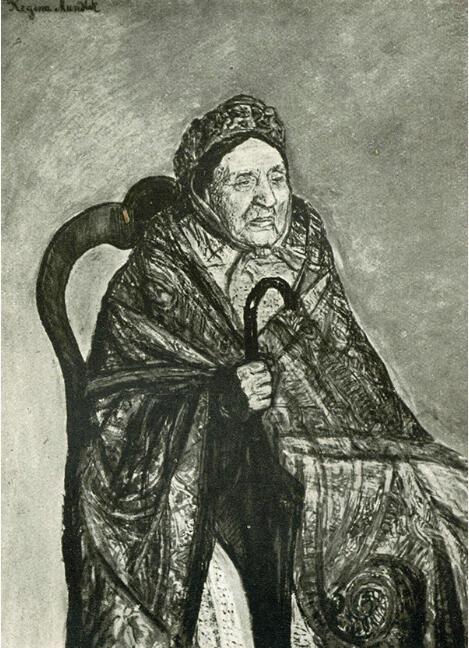
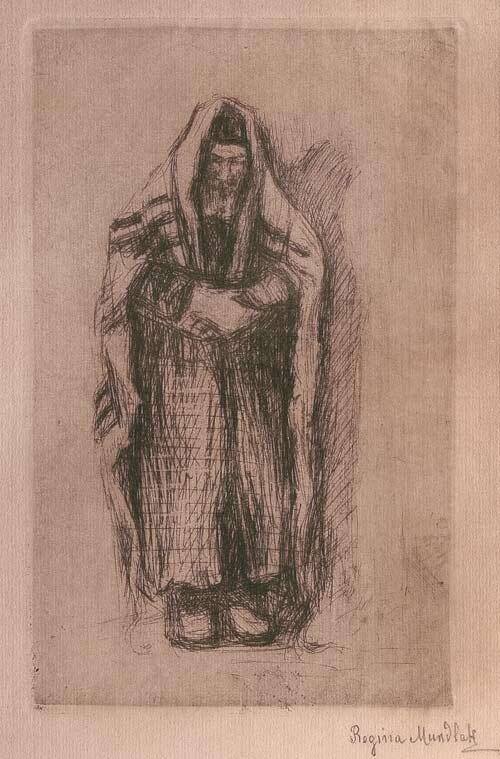
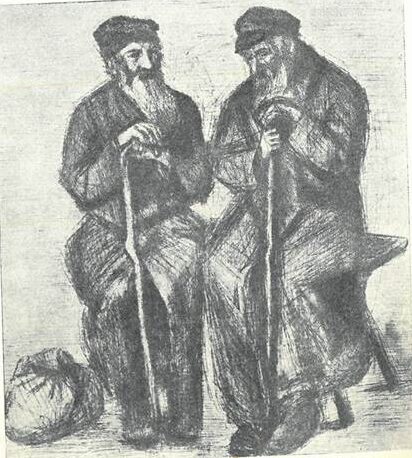
The Ganzach Kiddush Hashem archive houses invaluable works created by Regina Mundlak. Additionally, the library holds a significant essay by Joseph Sandel, featured in his book Yiddisheh Motiven in der Poylisher Kunst (“Jewish Motifs in Polish Art,” Warsaw, 1945). In rich, evocative Yiddish, Sandel describes Regina’s paintings and her sensitive, distinctly Jewish heart. She lived during the twilight years of the shtetl, a time when traditional Jewish livelihoods could no longer withstand the poverty spreading across Eastern Europe. While others embraced the new, modern, and “enlightened” world, Regina chose to capture the simple, wholesome essence of Jewish life with her delicate brush. Remarkably, these depictions of a bygone era captivated the hearts of leading artists and connoisseurs in Berlin, Paris, Warsaw, and Vilna. Her exhibitions became renowned, and prominent European newspapers featured her paintings and artworks. Furthermore, postcards issued by prestigious organizations often showcased her paintings.
When writing with sorrow about the life and death of Regina, it is worth noting an important detail from her biography, which Sandel mentions in the aforementioned piece. At the age of 14, Regina was brought to Berlin by the renowned German-Jewish painter Max Liebermann, who had been captivated by her talent for “painting and observation”, and she indeed flourished there, achieving great renown. Yet, she returned to her small town in Poland (Kulskawa, near Łomża) with her mother, as her mother could find no peace in the city and failed to settle in. Such was her devotion to her mother! Years later, when the Russo-Japanese War broke out and Regina was 18, she returned to Berlin with her mother once more. As her star began to rise again in the world of art and painting, she remained deeply attached to her mother and sisters, doing everything in her power to support them. Great wealth never came her way, even though her paintings astonished everyone who saw them; the celebrated painter Hermann Struck wrote about her work, offering it exceptional praise.
More from the Polish Wikipedia page:
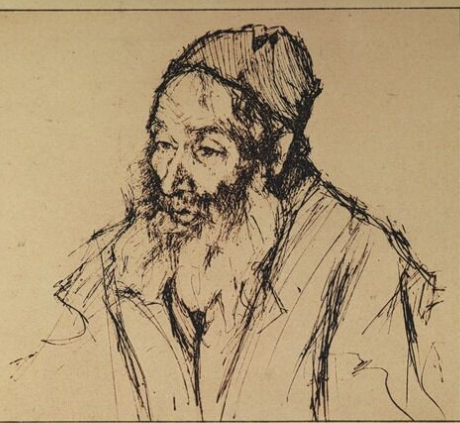
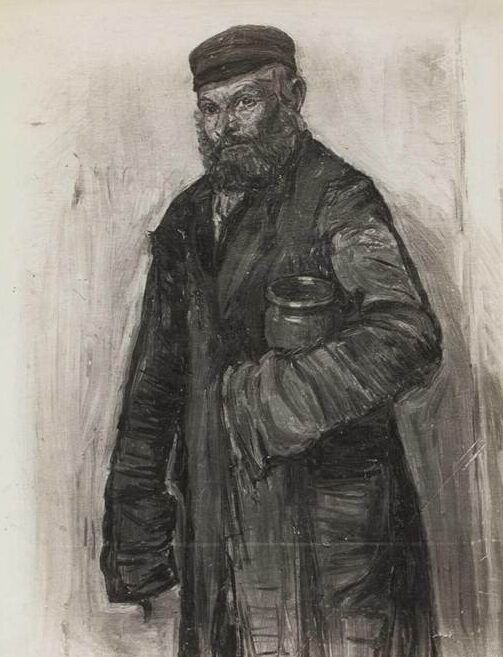
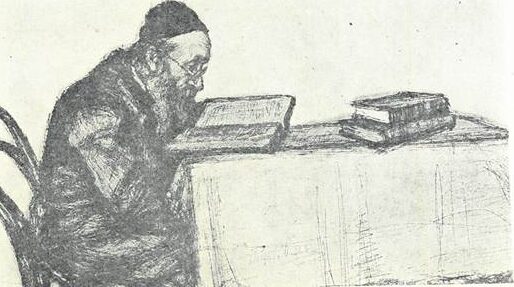
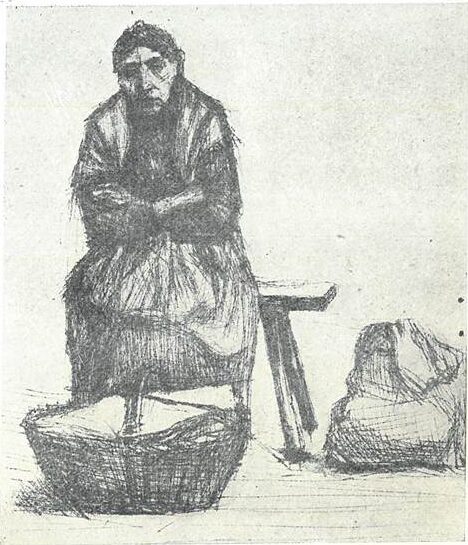
The drawings published in 1901 were primarily realistic portrait sketches; compared to later works, they reveal a skilled, yet still slightly hesitant, hand. The works published in 1902, however, already demonstrate a rare capacity for observation. Her body of work consists mainly of pen-and-ink drawings, impressions and sketches from her native land, depicting Jewish life in Poland and scenes of Jewish family life at home, such as the lighting of the Shabbat candles.
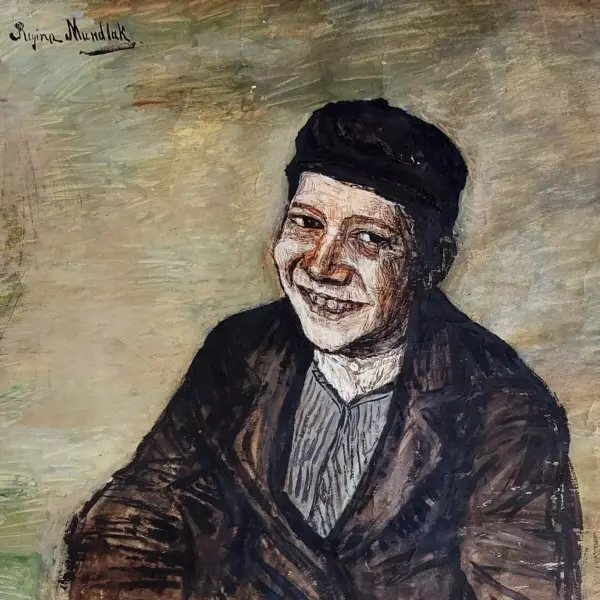
Like very few other Jewish artists, she remained faithful to her social surroundings, placing, almost exclusively, impoverished Jewish figures at the center of her work. In the early stages of her career, she emphasized the serious, harsh, and realistic aspects of the Jewish experience, imbuing her figures with the weight of their destiny and the burdens they bore. Later, she shifted the focus of her portrayals away from bitterness and harshness, highlighting instead cheerfulness, kindness, and an inner refinement, though, at times, this came at the cost of some of the figures’ distinct individual character.
In the 1920s, many of her motifs were copied by the Berlin artist “Phönix” in the form of postcards. A work by the artist is also in the Lost Generation Art collection.
Although she was a highly talented artist, well-known within Jewish artistic circles in Berlin during the early 20th century, she has been almost entirely forgotten. This can be attributed, in part, to a certain conservatism and a lack of interest in the currents of modern art…
As mentioned, Regina’s fate was a tragic one. She endured the suffering of the Jewish People in the Warsaw Ghetto, where she was subjected to forced labour. Ultimately, when she was seized during an Aktion (roundup) in 1942 and placed on a train bound for Treblinka, there was nothing more that could be done.
When she was already at the Umschlagplatz (deportation square), Emanuel Ringelblum, who managed the underground archive in the Warsaw Ghetto, attempted to save her, but in return for his intervention, he received a crushing blow to the head:
“There, the commander of the deportation square, the corrupt Jewish policeman Mieczysław Szmerling, decided who would live and who would die. Szmerling cared about only one thing: money. If someone paid him a ransom, he let them go. The Jewish intelligentsia had no money, and were therefore forced to go to Treblinka. I will never forget how he lunged at me, whip in hand, because I had interceded on behalf of the pianist Chana Dickstein, the painter Regina Mundlak, and the economist Dr. Yitzchak Lipowski…” (Account by Emanuel Ringelblum, Oneg Shabbat Archive).
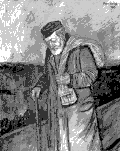
Presented below are surviving drawings from among the more than two thousand(!) works created by Regina, may God avenge her blood. Contemplate this pure Jewish art, and weep over the terrible loss.