The Month of Elul 5701 (1941), The Destruction of Janowa
The month of Elul of 5701 (1941) was a disaster for tens of thousands of Jews, for whom the German attack on the territories of the Soviet Union was a sudden and complete death sentence.
“Operation Barbarossa” – this is the name chosen by the Nazi leaders for this brutal attack, which no one in the world except these diabolical minds could have imagined the power of destruction and killing that it entailed.
The late summer of 5701 brought with it the news of murder and annihilation to the Jewish communities throughout the Nazi occupation zone. Eighty-five years have passed since that terrible summer, and we are trying to trace the footsteps of those sentenced to death, to learn about the extent of heroism and holy strength, and to perpetuate their memory for generations to come.
Among the towns of Lithuania and Belarus that were destroyed during the years of fury is the city of Janowa, on the banks of the Neris River (Vilia). Janowa had a significant Jewish community, and between the two wars its Jewish population comprised nearly seventy percent of the city.
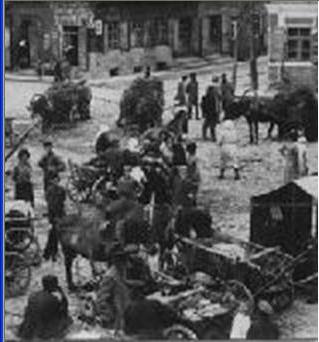
The Janowa Market, Ganzach Kiddush Hashem Archive
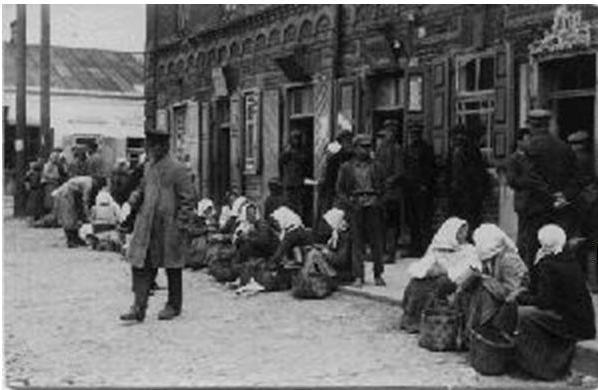
A street in Janowa, Ganzach Kiddush Hashem Archive
The decline of Janowa began during the years of World War I, during which many young people left the city; until World War I, Jews constituted about 92% of the city’s population. Until then, Janowa was a city with a strong economic status and most of its Jews worked and made a living. Many of them also established trade relations with Lithuanians, Poles, Russians and Germans, and thus became well acquainted with the non-Jewish environment. Janowa had magnificent and vibrant synagogues, as well as cheders and yeshivas.
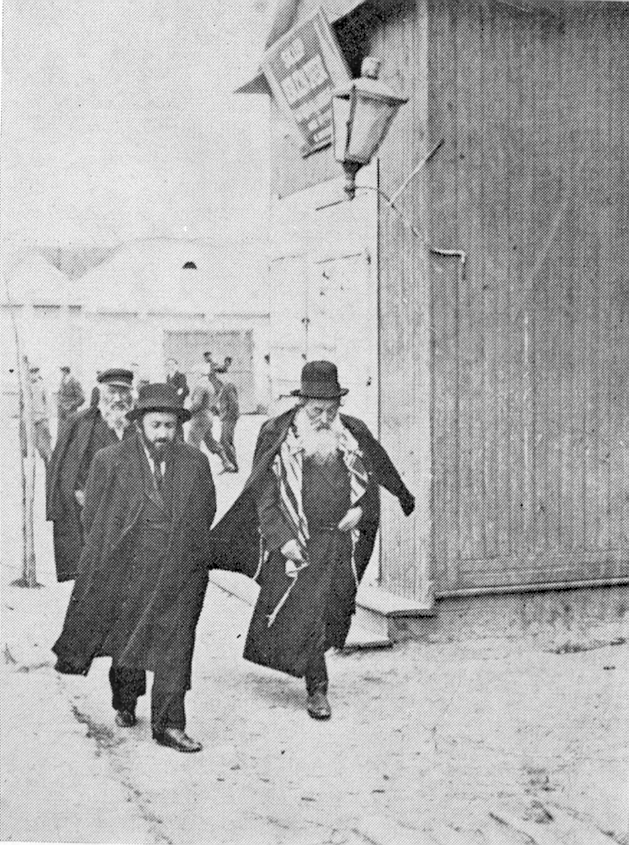
Rabbi Yosef Kosovski, wrapped in a tallis (prayershawl), walks on a street in Janowa with his son-in-law, Rabbi Zalman Bussel
In the “Encyclopedia of the Ghettos,” the bitter end of Janowa is told, which place from the beginning of the month of Elul 5701:
At the end of 1939, after the German occupation of Poland, an entire yeshiva from Kleczk settled in Janowa. In 1940, with the annexation of Lithuania to the Soviet Union and its transformation into a Soviet republic, the local industrial plants (most of which were owned by Jews) were nationalized, as were most of the shops. All parties and youth movements were disbanded, and Jewish educational institutions were closed. In mid-June 1941, several dozen local Jews were deported to Siberia.
On June 23rd, 1941, the day after the German invasion of the Soviet Union began, Janowa became one of the centers of heavy fighting, was bombed, and almost completely burned. 70 Jews hiding in one of the basements were killed in the bombing. At the same time, the Jews began to flee deep into the Soviet Union, but due to the blocked roads and German aerial bombings, only a few succeeded.
On June 26th, 1941, the Germans entered Janowa. The local Lithuanian auxiliary police, which had been organized even earlier, began acts of looting and terror and began to kidnapp Jewish men for forced labour. During July 1941, the Germans ordered the Jews to wear a yellow badge and imposed a ransom of 150,000 rubles on them.
In early August 1941 (according to another version – on August 14), armed Lithuanian nationalists took about 500 Jewish men to the Girele grove, where they were shot in pits prepared in advance. The Jews who remained in the town, mainly women, children and the elderly, were concentrated in barracks, which became a kind of ghetto. On August 23rd, they were also taken to the same grove and murdered.
In a village near the town, about 150 Jews from Janowa remained and were employed there in agricultural work. In September 1941, they were returned to the town, and together with other Jewish families who had been found in hiding places, they were concentrated in the town’s barracks yard under close guard by armed Lithuanians.
Glorious Figures from the Town of Janowa
In memory of the Jewish community of Yanowa, and on the occasion of the opening of the academic year of the cheders and yeshivas, we read about two fascinating figures who graced the town of Yanowa exactly one hundred years ago. The words are presented as testimony in a memorial book for this community, and were compiled by Ganzach Kiddush Hashem from the original found in the institute’s archives.
One hundred years ago, in 5686 (1926), two dear and beloved brothers passed away in the town of Yanowa, whose entire lives were devoted to others. Generations of children grew up in the town of Yanowa, pure and innocent children, in the shadow of these two holy and pure brothers, sons of Reb Yosef Goldstein, z”l, who were great Torah scholars, servants of G-d, men of kindness with all their souls and hearts.
Reb Yaakov (“Yankel Der Esig Macher”) was a vinegar maker. Not he, but his wife, who was no less righteous than he. They did not have children of their own, but many children were blessed to grow and flourish under their protection and thanks to them.
Reb Yankel sat in fasting for most of his days, or most of his days, and did not need anything for himself. He would distribute all his wealth to the needy, and when he ran out of money, he would beg for alms and give to the poor.
On certain days of the week, he would walk among the houses of the town, collecting penny by penny, and immediately rushed to the houses of the poor and shined a light on them.
Who would receive support from Reb Yaakov? Anyone whose time was pressing. These were formerly wealthy people who had broken bread and were ashamed to collect alms for themselves after they had lost their assets; these were poor Torah scholars whose homes were empty; and these were those who were making a simcha (celebration, such as a wedding) or in need of medical care. Reb Yankel would give them alms as a gift in a respectful and secret way, or he would lend them money without interest. Often he would give alms to the poor in secret.
Such were Yankel’s daily ways. He would put in efforts and stamp his feet for everyone who had nothing, but above all he would strive and devote himself for poor children, of whom there was no shortage at the time in the town of Janowa. He would create an inn for destitute and homeless children for any reason, and pay for their food and living. There was not a day that went by without children eating at his table. He made sure to pay for their schooling and provide them with full funds for foster homes. Many times, he financed the secular education of abandoned children with his own money so that they could support themselves when the time came.
All the people of Janowa remembered Hersheleh, whom Reb Yankel had taken from his mother, who had lost her mind. It was very difficult to get him out of his mother’s home, but he finally succeeded and raised him as a tender orphan for many years. He educated him and invested a great deal of effort and money in him, until he grew to be a great student and became one of the best students in the yeshiva.
Many of the students of the yeshiva katana (yeshiva for elementary school aged children) in Janowa earned a living under his patronage and were able to sit and study in peace. Reb Yankel established “Tiferet Bachurim” in Janowa – a holy institution intended for young people and teenagers up to the elderly who, after their day’s work, came to study and hear lessons in Torah, Halacha (Jewish law), Agada (stories), Musar (ethics)and Guidance. The young people enjoyed the Torah lessons of Reb Yankel himself and from the rabbis he placed at his side.
Sometimes, when he noticed their sensitivity to such a need, he would modestly and respectfully give them pocket money.
An entire generation of young people grew up in Torah and the ways of the land thanks to Reb Yankel, who never tired or became lazy and worked with all his strength and energy until his last days.
The second brother, Reb Shimon, was his name, and his pure soul has also been tied up in the bundle of life for exactly a hundred years. He was a teacher in essence, a teacher who made all the good boys of Janowa his protégés. His cheder was a “springboard” for the yeshiva. In this cheder, the boys learned to study Gemara, the Tosfot (series of commentaries), and the regular commentaries until they became Torah scholars ready for the yeshiva. Reb Shimon managed his cheder with amazing skill, and also taught his students the necessary secular subjects. His parents liked and appreciated him greatly, because he was an uplifting personality and would devote himself to his students and give them warmth and encouragement. Sometimes his work bordered on self-sacrifice because he would work from morning until late at night, until his strength was exhausted. All the people of Janowa knew how to appreciate Reb Shimon’s influence on his students in Torah, fear of G-d, the way of the land, and good character traits.
Moreover, the doors of Reb Shimon’s house were wide open to any poor, sick, or bitter-hearted person. Whoever wanted to could sleep in his house, eat in his house, and receive whatever they needed.
The deaf Fraidel was one of the regular guests. At the end of her days, she was confused and would wander around the town from house to house and from place to place, and when fatigue overtook her, she would go to Rabbi Shimon’s house to rest and eat. Rabbi Shimon dedicated a special mat for her, and sometimes she would lie on it for days on end.
Such figures frequently visited his home, and Reb Shimon would receive them all with open arms, even though he was poor and his many children crowded into a small, cramped house. When his wife milked the goat in the morning, Reb Shimon would make sure that the first cup of milk was served to the guests.
At the end of a day of holy work, he would come to the synagogue next to his home and give Torah lessons to the men, who greatly enjoyed his discussions on Halacha and Agada. After the lesson, he would stay with children who were idly wandering around the synagogue and trying to overcome their boredom by acting like reckless youth. He would call them to a corner and give them candy or coins and talk to them about sublime things, instilling in them a fear of G-d and proper behaviour.
Only late at night would he return home and study Torah for long hours. In later years, when his eyes became ill and his vision became difficult, he would sit with students. They would read to him from the books and he would explain things to them pleasantly and knowledgeably. He did this until his last days.
He also passed away in 5686, exactly a hundred years ago.
In memory of the “holy brothers” Reb Yaakov and Reb Shimon, sons of R’ Yosef Goldstein, who were the object of longing and admiration of the people of Janowa, a beautiful and magnificent Jewish town, until the wrath came upon it and left almost no survivor nor refugee.
May their souls be bound in the bonds of life.
Eighty-five years have passed since that bitter month of Elul 5701, in which the Jews of Janowa, the ancient Jewish town, a significant Jewish community, the birthplace of the great Rabbi Aharon of Karlin, were massacred.
We will never forget the towns of Israel that were brutally annihilated; may G-d avenge the blood of His servants that was shed in our days, Amen.