The Rabbi Who Went Up to the Heavens Singing “Ata Haraita La’Daat”
By: Yaakov Rosenfeld
During the summer of 5701 (1941), following Germany’s invasion of the Soviet Union as part of Operation Barbarossa, the Nazis — aided by Lithuanians — perpetrated pogroms and massacres against the Jews of Lithuania. The testimonies of survivors from Lithuania’s towns are harrowing; in many places, Jews were forced to dig their own graves and were then brutally shot into them.
The town of Meretch (a district town in the Alytus region of Lithuania) also drank from the cup of wrath; scarcely a trace or survivor remained. In the interwar period, 1,400 Jews lived in the town.

During the months of Tammuz, Av, and Elul, the Nazis and their Lithuanian collaborators perpetrated a horrific bloodbath; on the 16th of Elul, a massacre took place there that brought an end to this long-standing, holy Jewish community. The Jews were forced to assemble at the pits they had been made to dig for themselves, and — with bestial cruelty — men, women, and children were shot into the pits.
We at Ganzach Kiddush Hashem commemorate the towns of Jewish Lithuania; through our educational activities, we tell the stories of their pure-hearted inhabitants and the unique way of life that once existed but is now no more.
To mark the eighty-fifth anniversary of this terrible inferno, we share the story of the rabbi of Meretch—one of the first to be killed in sanctification of G-d’s name back then, eighty-five years ago, when the Nazis stormed the town and, aided by the Lithuanians, wreaked havoc and destruction.

Rabbi Michel David Tropel z”l’s book
The genius, Rabbi Michel David Tropel z”l was the rabbi of Meretch. He was a wonderous genius and a venerable, revered rabbi, whose book Mayim Chaim illuminates complex issues within the tractates of the Talmud.
Rabbi Michel David was born in 5625 (1864-5) to Reb Yochanan of the town of Niemenczyn (Nemenčinė), near Vilna. In his youth, he was considered a prodigy and immersed himself in Torah study at the yeshivas of Volozhin and Mir, eventually receiving rabbinic ordination from the renowned Rabbi Yitzchak Elchanan Spektor of Kovno.
He began his rabbinic career as a young man in the town of Vissel, Russia (in the Yekaterinoslav Governorate) — a small town with a sparse Jewish population. From there, he moved to Bila Tserkva (known as “Sdeh Lavan” – White Field), where he served as a beloved rabbi, wholeheartedly devoted to the community. After years of fruitful service there, he was appointed rabbi of the town of Meretch, where he accomplished great and remarkable things.
Alongside his greatness in Torah scholarship and religious instruction, he was deeply involved in communal affairs and was regarded as a man of loving-kindness in the truest sense of the word. His home was constantly open to numerous guests, who were received with affection and a warm, welcoming demeanor.
Rabbi Troppel was a traditionalist rabbi. He firmly opposed changes to ancient customs; for instance, Rabbi Ephraim Oshry z”l recounted an incident at a rabbinical gathering in Lithuania where a member of the audience proposed standing in brief silence to honour rabbis who had passed away. Despite his gentle and tender-hearted nature, Rabbi Troppel adamantly refused to participate in this silent tribute, arguing that such a practice was unknown in Judaism and amounted to adopting the “ways of the nations.”
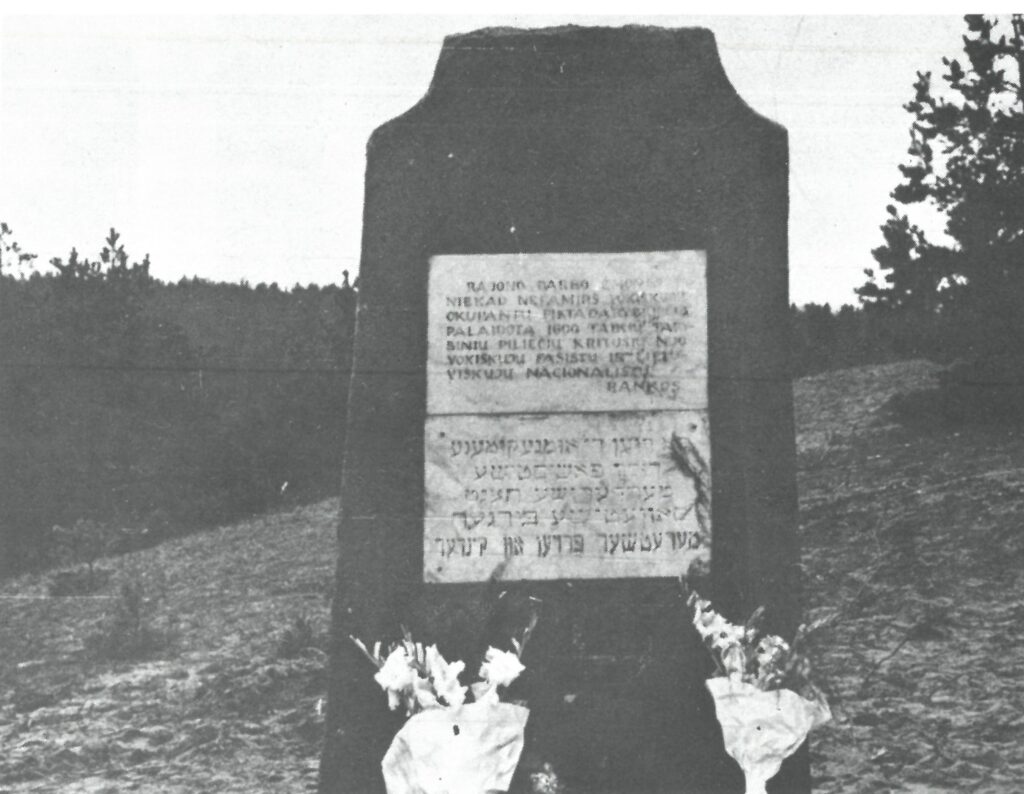
The mass grave of the Meretch victims – women and children
By the outbreak of the war, he was already advanced in years — seventy-six years old. During the month of Sivan 5701 (spring 1941), when prominent Jews attempted to hide in the homes of “good” neighbors, they quickly realized they had made a grave mistake in trusting the non-Jews. The Jews were handed over to the Nazis; in many instances, they were robbed and left without even the clothes on their backs. Rabbi Troppel, however, hid in the home of a non-Jew in a nearby village — a man who, for a change, protected him and did not reveal his whereabouts.
Two weeks after the Nazis entered Meretch, they began searching for the rabbi, stopping at nothing to pressure the community leaders into handing him over. Yet, nothing availed. The community members cherished the rabbi deeply and would not even entertain such an idea. Fifty of the community’s finest members were arrested and ordered to reveal the rabbi’s hiding place — or face dire consequences. But all fifty replied in unison: “Do with us as you please; we will do nothing to endanger the rabbi’s life.” The Nazis flew into a rage and threatened — as attested by Rabbi Ephraim Oshry — “to utterly destroy the entire Jewish community.”
Community leaders appealed to anyone with influence — even reaching the highest ranks of the clergy — but to no avail. Eventually, they were issued an ultimatum: if the rabbi was not handed over within twelve hours, all the Jews would be thrown into the river.
The Jews of Meretch prayed fervently and wept bitterly; finally, they resolved to inform the rabbi of the Nazis’ demand. Yet, no one dared to undertake this task, until the Christian in whose home the rabbi was hiding summoned the courage to tell him what was happening.
Upon hearing the news, the rabbi immediately donned his Shabbat attire; he wrapped himself in his tallis (prayershawl) and kittel (religious robe), placed a white kipa (skullcap) on his head, and — clutching a Torah scroll to his chest — walked with the non-Jew toward the town and the Nazi headquarters.
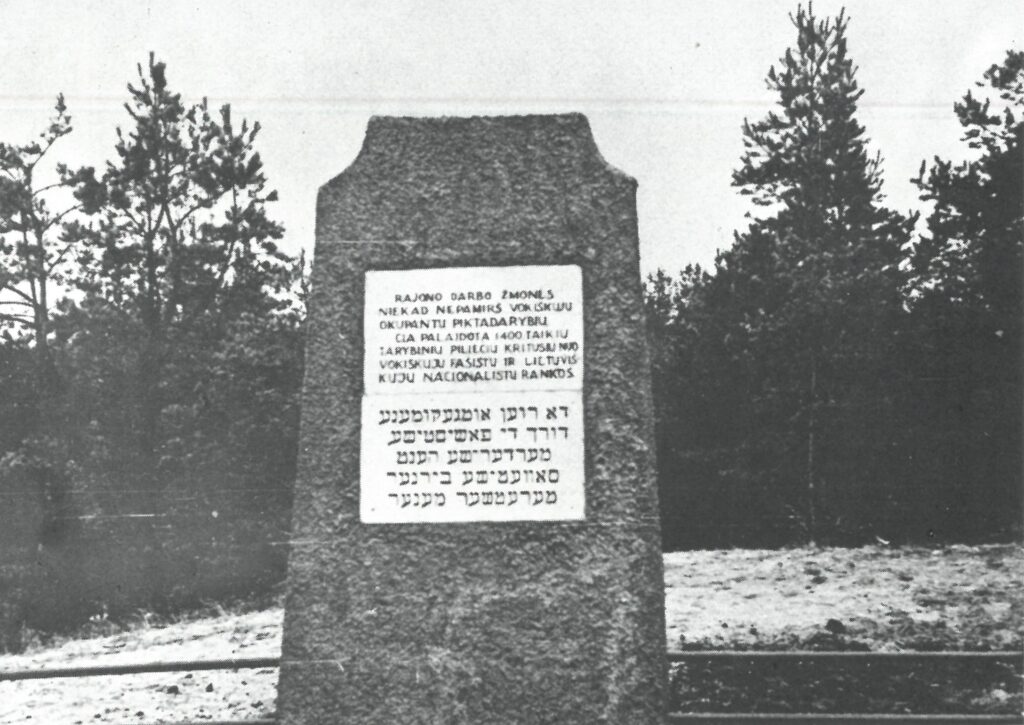
Mass grave of the Meretch victims – men
Before leaving, he bade farewell to his wife — the rebbetzin — his son-in-law, Rabbi Weiner of Kelm, and his daughter, telling them: “It is my wish that, should I be killed, you do not weep. I am going to fulfill the greatest commandment of my entire seventy-eight years of life —the commandment of Kiddush Hashem (sanctifying G-d’s Name)…”
When the rabbi appeared before the Nazis, he was ordered to dance and sing; instead, he clasped the Torah scroll tightly and began to sing in a voice not his own:
“Ata haraita la’daat ki Hashem Hu HaElokim, ein od Milvado” (“You have been shown, in order to know that Hashem is G-d, there is nothing but Him)
He danced and exulted with joy and faith — a sight the Nazis (may their names be blotted out) could not tolerate. The rabbi’s dancing drove them into a frenzy.
They began to beat and torment him with cruel, agonizing suffering, until he collapsed and his soul ascended to heaven.
Parts of his holy body were later recovered and laid to rest in the city cemetery.
Subsequently, the murderers gathered hundreds of Jews in the synagogue, killed them in gruesome ways, and cast their holy bodies into the Nemunas River.
May G-d avenge their blood.
(Source: Pinkas HaKehillot Lita, Eleh Ezkera)