The Rebbe Who Gave His Life to Save a Jewish Woman
By: Yaakov Rosenfeld
The American Yiddish daily press, which was very widely distributed about eighty years ago, constitutes an important historical document, and therefore, the treasures contained in the period’s press and preserved in the Ganzach Kiddush Hashem archive serve as an inexhaustible source of invaluable information about the period and its events. Many of the articles were written by Holocaust survivors, eyewitnesses, or reliable writers/reporters who heard firsthand accounts and published them after hearing them. The articles in the newspaper “Der Tag Morgen Journal” (a merger between two large Yiddish newspapers, which at their peak sold over a hundred thousand copies a day) are considered faithful and have a strong Jewish historical flavour. I have drawn much information from this newspaper, and there is still something special about a heart-wrenching testimony that I found in an issue published exactly eighty years ago, on January 20, 1946, 20 Shevat 5706.
“I Remained Alive” – this is the name of the series published in serial form (Ich Bin Gebliben Leben) by Leib Feingold, and today, exactly 80 years ago, it provides a rare glimpse into the horrors of the Warsaw Ghetto, into the lives of the Jews tortured there, and into the difficult disagreements within the public leadership regarding the options for defense and salvation from the waves of deportations and murder.
First, he brings heartbreaking memories of the Rebbe of Grodzisk and his work during the terrible days of the ghetto, and then moves on to tell about the Rebbe of Stolin, Rabbi Aharon z”l.
We will begin. The holy Stoliner Rebbe, Rabbi Yisrael Perlow, known as the “Frankfurter” after the place where he was buried, left behind six sons and four daughters. All of his sons were holy and pure, great Torah scholars, shepherds of illustrious congregations, and excellent violin players. Every Saturday night, the Rebbe, Rabbi Yisrael, escorted out the “Shabbat Queen” with his six sons accompanying him on their violins.
The fourth son, Rabbi Aharon, was the Rebbe of the Karliner-Stoliner chassidim in the city of Warsaw. He was the son-in-law of the late Rebbe, Rabbi Natan David of Pertzova, and therefore lived in Warsaw, far from his father and his holy brothers. He led his congregation with warmth, love, and patience, and many became attached to him. He was a man of kindness and mercy, and at the outbreak of the war he did everything in his power to assist the members of the Warsaw community who were in trouble and captivity.
Here is an excerpt from Leib Feingold’s testimony (translated from Yiddish to Hebrew by Yaakov Rosenfeld, and then from Hebrew to English by Ricki Prince):
…The Stoliner Rebbe, Rabbi Aharon Perlow, also came to all the meetings. He had strong complaints about the (leadership of) the public in Warsaw for not doing enough for the poor, hungry refugees who were being thrown into the ghetto. With enthusiasm like a burning fire, he spoke about the world’s indifference to the terrible disaster of the Jews, and he severely accused the nations of their complicity with the Nazis in hating Jews. He literally cursed the Jews who believe that money will save them from all troubles, and claimed that it is precisely money that will cause them very serious troubles because both the Nazis and the Polish (and Ukrainian) citizens believe that the Jews have hidden treasures. They are staring at the treasures, and anyway it will cost us our lives. He always sat (at meetings) nervous and hummed a mournful song (Kaladna, a kadira oif di neshama…).
(Here the author describes the Stolin Rebbe’s anger at those leaders who fled Warsaw to safety, etc.).At meetings with the head of the beit din (rabbinical court), Rabbi Chaim Yehoshua Gotschachter, and with the Sochaczewer Rebbe, when they discussed helping the refugees and ways of coping and uprising, the Stoliner Rebbe always arrived first. Regarding armed resistance, he did not express an opinion, since most of the rebbes and rabbis were against it (…) but the Stoliner Rebbe quietly agreed with the idea that weapons should be obtained. He was tirelessly busy obtaining food for those involved in planning the uprising and rebellion. In this matter, he was an “apikores” (a heretic), meaning he did not believe that the Poles would be ready to help on a day of command. He also refused a Pole’s offer to hide in his house, both because he did not trust him and did not want to go over to the Aryan side, and because he did not want to save only himself.
When the deportation orders arrived and the public still believed that people were being sent only to work and resettle in Russia, the Rebbe announced in every way at his disposal that the Nazis had one intention: to destroy, kill, and annihilate everyone.
He ordered resistance, or at least to hide.
He himself, in the attic of his house, built a hiding place. For the first time in his life, he used a hammer. He built himself a place that no one could enter. He then expressed regret to those around him why he had not insisted in the meetings that every Jew must carry a weapon.
When he saw thousands of Jews going to their deaths, he sat on the ground and recited Kinnot (Elegies) and Eicha (Lamentations). He also studied Iyov (the Book of Job). He tore his clothes and sat on sackcloth. He always kept with him his tallis (prayershawl), tefillin (phylacteries), and his violin, which he refused to part with.At night, when there was no danger, he would play the violin. Quietly, in the darkness of the night, the faint sound of a weeping violin would come from his house. Those who were nearby would hear him occasionally growling and saying, “My soul will die, the death of the righteous”…
One day, SS men went up to the Rebbe’s house, accompanied by Ukrainians and Jewish policemen. They demanded that all the Jews come out of their hiding places.
But no one came out; on the contrary, the crowd fled one by one to their hiding places, to bunkers, basements, and attics.The Ukrainians shot after the escapees, and from his hiding place the Rebbe saw a Ukrainian chasing a helpless and weak woman (…) Then, in the blink of an eye, the Rebbe ran with the tefillin and the violin and pounced on the Ukrainian, who threatened the woman who was beaten and terrified with his gun. The Rebbe fought him with all his might to get the weapon out of his hands.
Then, a shot rang out, and the Rebbe fell, wallowing in his own blood. The Ukrainian wanted to shoot more bullets at him, but the SS man prevented him from doing so by screaming: ‘Let him lie down, it is better for him to lose his blood, and die like that.’
As things calmed down and they left, all the people came out of their holes and tried to save the Rebbe, but there was nothing more to be done, the Rebbe had lost too much blood. He lay dying without a drop of strength, with the broken violin and the bag of his tallis and tefillin by his side.It is difficult to read this testimony. May the soul of the Rebbe, Rabbi Aharon ben Rabbi Yisrael, be bound in the bundle of life. May G-d avenge his blood.
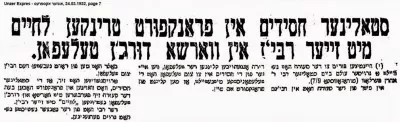
Appendix: The Stoliner Rebbe and Warsaw in better days
“Stoliner chassidim in Frankfurt drink l’chaim with their Rebbe in Warsaw, via telephone.” This is what the Unzer Express newspaper (above) announced at the end of Adar 5692 (1932).
And here is the body of the news (translated from Yiddish to Hebrew by Yaakov Rosenfeld, and then from Hebrew to English by Ricki Prince):
On Purim this year, during the meal, a large crowd gathered at the Stoliner Rebbe (Rabbi Aharon Perlow Moravska 7/9).
During the meal, the telephone in the Rebbe’s house began to ring. When one of the chassidim approached the phone, the operator announced that they were calling from Frankfurt am Main…
The Rebbe was immediately asked to answer the phone. It turned out that the Stoliner chassidim living in Frankfurt, in the middle of their Purim meal, had telephoned Warsaw and thus drank l’chaim to their Rebbe.
The Rebbe greatly enjoyed this whole event.
From this information we learned that the Stoliner-Karliner chassidim lived in Frankfurt, and that this was before the rise of Hitler and the Nazi Party. Who were the chassidim, and what became of them?