The Rebbe’s First Gemara
Tamuz 9 – The yahrzeit (anniversary of passing) of the holy Sanz-Klausenberger Rebbe, Rabbi Yekutiel Yehuda Halberstam z”l
By: Yaakov Rosenfeld
To read part 1 in the series about the Klausenberger Rebbe, please click here.
One hundred years ago, in 5686 (1926), a chassidic rabbi was first crowned in the great city of Klausenburg, better known to the world as Cluj-Napoca, located in the heart of the Transylvania region of Romania.
The rabbi who was crowned was a young yeshiva student, whose name was Rabbi Yekutiel Yehuda Halberstam, who was known in the world as “Ilui (prodigy) from Rudnik.” “Rabbi Zalman Leib,” as he was affectionately called by his relatives and admirers, had already managed to reach heights in many Torah places in his short life, and therefore had amassed a circle of fans and admirers in many places. He spent a long time at the Warsaw Yeshiva “Mesivta,” where the greats of the generation studied Torah and produced world-class students – “Ariyot” (lions). Many years later, for a long period, he attended the classes of the Gaon (genius) of Brisk, who lived in Warsaw, and with other righteous and world-renowned scholars.
He learned most of his Torah in his childhood from his father, the eminent Rabbi Zvi Hirsch of Rudnik, and under his tutelage he even managed to pass the entire Shas (6 orders of the Mishna) exam as a bar mitzvah aged boy, but the seeds of greatness were already evident in him while he was still a small child. Who is it that is told today that on the day of the Fast of Esther, he managed to learn the entire tractate of Taanit in the Babylonian Talmud, at the age of ten, and still had time to make a huge rattle to blot out the name of Haman…
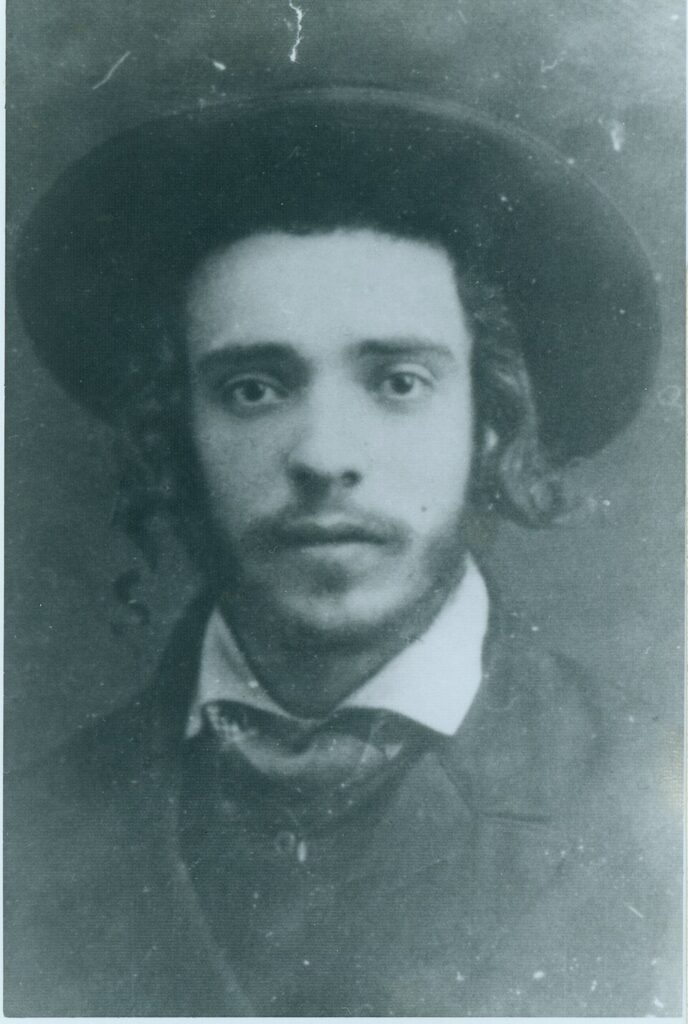
In his youth
“Zalman Leib” was a poor orphan, but his eyes shone and his heart sang with a joy that was out of this world as he spent long nights in study halls and drank in the words of Gemara and the Poskim (rabbinical decisiors).
When he became engaged to his first wife, the mother of eleven of his holy children, who also was also an innocent sacrifice on the altar of the Holocaust, he received a precious gift from his father-in-law: a gold watch.
The gift delighted his heart as a gold watch can delight any heart, but the young groom, the poor orphan, loved Torah more than thousands of gold and silver, and one desire burned in his heart. He wanted to have a Shas. A full Shas set, Gemara, and the commentaries of Rashi, Tosfot, Rosh, Rif, Ran, Nemukei Yosef, Maharsha, Rashash…a full Shas set.
The gold watch gleamed in the orphan boy’s jacket pocket, but there was no doubt in his heart about his plan, and like every dream and imagination that had come to his mind throughout his life, ideas and fantasies that the Jewish People today cannot imagine themselves without, he realized this dream very quickly.
Want an example of a dream he managed to fulfill while still a young rabbi in Klausenburg? Here it is:
The story begins when the Rebbe was a small boy, a pure little Jewish boy who loved to study Torah and loved his rabbis, but he was pained by the harsh conditions that were the lot of the children in the cheders of that time. They would sit in narrow, crowded rooms, and he knew that these were not conditions that were good for young children, nor for their academic progress.
“I promised myself then,” he once said in his old age, “when I grow up, I will build a large and spacious, wide and magnificent building for the Jewish children”… And he kept his promise, and when the remnants of Klausenburg tell of the beautiful building that the Rebbe erected with his own hands, with his ten fingers, when he was a young avrech in the 1920s, a new rabbi to the newly founded community, they were still amazed at how he had the strength to undertake such an undertaking, but he had Divine help. Sometimes he would close the great Gemara, the one we are now dealing with, and go out to raise funds for the “Chedder.” He had a broad and far-reaching view. He could not agree to the children of the chassidic community studying together with those who were not as familiar with the words of the Sages, and when the building stood in splendor, he was not happy with it, nor were the parents of the chassidic community happy, who by 5687 (1927) had already numbered over 300 families and whose number was increasing year by year.
A hundred years have passed since the beginning of the first rabbinate of the Sanz-Klausenburger Rebbe, and the descriptions of his greatness that have survived of his devotion to the shepherd of his flock, to the students of his yeshiva in Klausenburg, and to everything holy, seem to be taken from completely different realms, the devotion of holy men in the era of destruction.
Let us return to those days.
The watch went wherever it went, and in return, he received the great and magnificent Shas, which was filled with all the goodness that until now he could only imagine for himself, filled with all the goodness and sweetness that until now he had been forced to enjoy in synagogues by the light of dim candles, and now he had this treasure in his own home. A complete Shas, a paradise on earth. And when he traveled to the city of Klausenburg, as a young man, when he was accepted as the rabbi of a large and holy Jewish community, the great and precious Shas went with him, and this Shas was a dear friend to his heart, a soulmate, and he would bask in its love throughout all the years of his rabbinate in this great city.
The Shas gave life, pleasure, and joy to the rabbi who carried the burden of the holy community on his shoulders and had already led a holy Jewish community, as a revered Rebbe, continuing the path of his holy ancestors from generation to generation.
In 5704 (1944), the song of life of the beautiful and pure community of Klausenburg came to an end. The Nazis entered Klausenburg, the Rebbe was taken to Auschwitz while his wife and children remained in the Klausenburg Ghetto. All of his acts of strength, heroism, and holiness, which sanctified the Heavens there during that bitter period, when he received the horrific news of the death of his wife and eleven children, leaving him alone in his world, are written and famous, and even here at Ganzach Kiddush Hashem, we have published in a variety of languages, forms, and modes the wonders of this supreme sage, who, as he testified about himself:
“I lost my wife, I lost my eleven sons and daughters, but I did not lose my G-d…”
History knows how many Jews did not lose their G-d thanks to that righteous man who, even during the Holocaust, even on the death marches, showered faith and trust (in G-d) on the hearts of broken-hearted Jews, and after the liberation, he would gather them and protect them and teach them Torah, and raise thousands of students, and built marriage canopies and homes and communities; history knows how much that righteous man worked until his last day to increase Torah, to raise great Torah scholars, and how many acts of charity and kindness were performed by his pure spirit, by his holy hands, and still the desire of his soul and the delight of his heart were the letters of the holy Gemara.
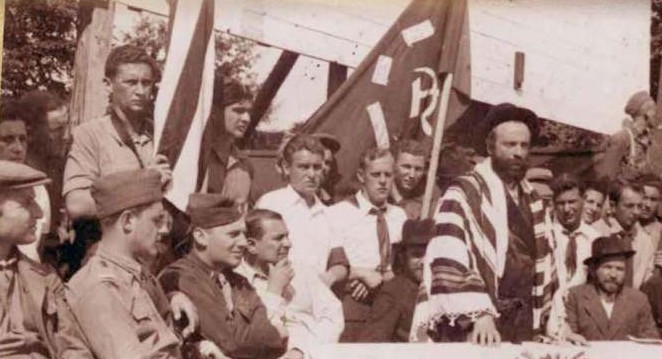
General Eisenhower, later President of the United States, visits a displaced persons camp, Yom Kippur 5706 (1945). The Sanz-Klausenberger Rebbe, in the midst of prayers, went out to greet the guest (Courtesy of Sanz Magazine)
In the Gemara and its commentaries he found what his soul loved, and students who sought Torah and served G-d were also loved and cherished by him more than anything else.
How dear were the words of Torah to him? Once he asked to go to one of the streets of Kiryat Sanz, when the Gerrer Rebbe, the “Lev Simcha,” was staying there. He knew where the room of the Lev Simcha was and listened to the voice of the Torah that emanated from it, an enjoyable voice, the voice of the singing of the Garden of Eden, the voice of the ministering angels. The Sanz-Klausenberger Rebbe was moved to tears, and could not take his ear away from there. There is no more enjoyable voice than the voice of a holy person of the highest order who toils in Torah and clings to its essence. The Rebbe of Sanz could not help himself. He knocked on the door of the room, and asked to enter, along with his companion.
But the Lev Simcha, humble as he was, did not want to be seen meditating on the Torah. And the moment the Sanz-Klausenberger Rebbe entered to visit him, it was as if all the books had disappeared from the table and a large page of the Hamodia newspaper was spread out on it…
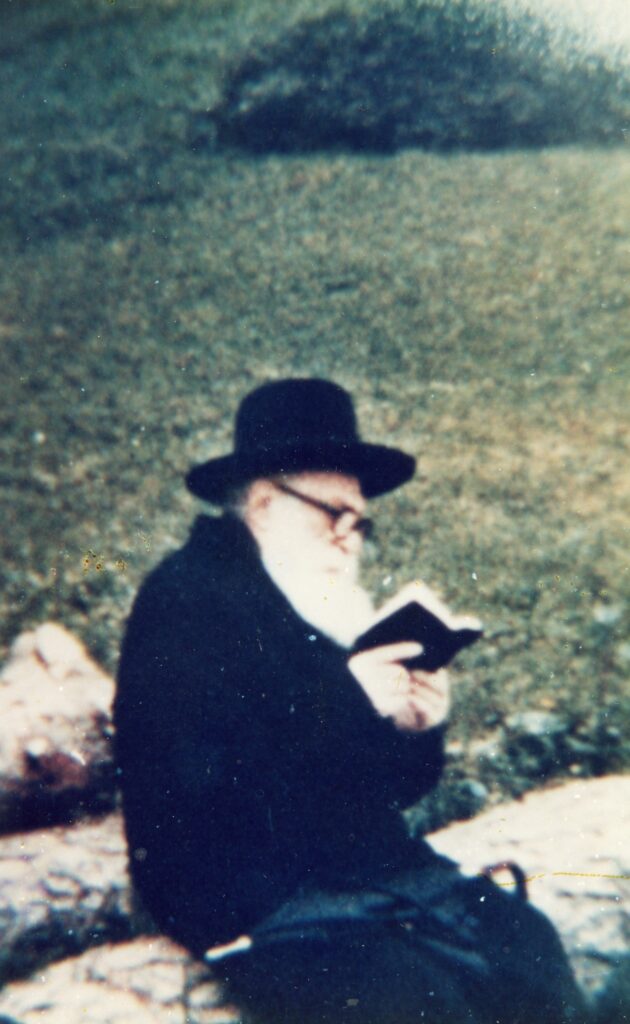
The Rebbe, the Lev Simcha, studies in the mountains of Switzerland
The Sanz-Klausenberger Rebbe recounted this testimony with endless admiration.
He loved the Torah with an unwavering love, and dedicated his life to it, and gave all his strength and wealth for the “work of the Shas, the essence of which is the propagation of Torah and the establishment of great Torah scholars in all circles and denominations.”
And forever and ever he remembered that first Gemara, that was his replacement for the beautiful and dazzling gold watch, and when one day a veteran student, a Holocaust survivor, came to visit him and revealed to him that he had visited Klausenburg immediately after the liberation and found that Gemara there, the Rebbe’s first Gemara, the righteous man of the generation gasped, and immense excitement spread through him.
“With great effort, I managed to bring it here, and return it to its owner”… said the student, moved to tears at the sight of the holy Rebbe’s tearful eyes.
The Rebbe sat with the old bindings and ran his holy hands over each of the pages. He stroked them with love and his excitement knew no bounds. For a long time he sat with the pages and stroked them, and loved them, and it seemed that his soul was overflowing with love and longing, and then he answered and said to the student who had brought the wonderful priceless treasure:
“How much I love this Gemara, but it is not mine. It is yours. You found it after I had already given up on it, and according to the halacha it is not mine. If it is good in your eyes to bring it to me, so be it, but you were not obligated to…”