The Seridei Esh Rabbi
Commemorating his yahrzeit (anniversary of passing) on the 4th of Shvat – which falls this year on Jan. 22nd, 2026
In recent years, Ganzach Kiddush Hashem archive staff have taken it upon themselves to sort and catalog two very large collections that include tens of thousands of documents and photos about Rabbi Weinberg z”l and his activities. On the website, you can find many of these documents that teach about the rabbi’s great, multifaceted personality and his activities for the community.
The Life and Deeds of the Rabbi
Rabbi Yechiel Yaakov Weinberg was born in 5645/1885 in the town of Bogud, Poland. He moved with his family to Ciechanowiec. The rabbi of the city at that time, Rabbi Eliyahu Baruch Kamai, took him with him to the Mir Yeshiva. From there he moved to the Knesset Israel – Slobodka Yeshiva. In both yeshivas, he was one of the top students.
In 5666/1906 he began serving as the rabbi of Pilvishki, where he established a kibbutz for young people. During World War I, he moved to Germany, where he completed general studies and received a doctorate following his work on the Syriac translation of the Bible. He belonged to the “Torah im Derech Eretz” (Torah with the Way of the Land) school of Rabbi Shimshon Raphael Hirsch.
In Germany, he headed the Berlin Rabbinical Seminary named after Rabbi Azriel Hildesheimer, and held this position until the institution was closed on Kristallnacht.
Rabbi Weinberg was one of the greatest and most influential rabbis of his generation and corresponded with a wide range of rabbis around the world. Among other things, he worked to allow stunning of animals before slaughter following a law that banned slaughter in Germany. After extensive correspondence, he shelved his rulings on the matter, in accordance with the request of the rabbinic decisors.
After the Nazis came to power, he worked to save his students, but was deported to Poland because of his Russian citizenship, and due to medical treatment he underwent, he was forced to remain there. At the outbreak of the war, he was in the Kovno Ghetto, and then deported to Warsaw, where he served as president of the “General Rabbinical Association” and later as president of the “Polish Rabbinical Association.” He worked extensively, using his connections with the Joint, to improve the situation of the Jews in the ghetto. Because of his Russian citizenship, he was transferred to the Würzburg labour camp in Germany and remained there until the end of the war.
After the Holocaust, the rabbi recuperated in a hospital in Nuremberg for many months. Then, with the help of the activities of his students, Rabbi Shaul Weingort and Rabbi Mordechai Marcus Cohen, he received a residence permit for Switzerland. There he stayed at the Eitz Chaim Yeshiva in Montreux. As a survivor, he worked extensively for the spiritual rehabilitation of the She’erit HaPleita (survivors) and worked to free agunot (women who do not know the whereabouts of their husbands and therefore can’t remarry) and assisted survivors in all matters.
Rabbi Weinberg passed away in Switzerland in 5626/1966 and was brought to Israel to be buried in the Har HaMenuchot cemetery in Jerusalem.
His works include: “Seridei Esh,” “Yad Shaul,” and “LeFrakim.”
A Taste
A small portion of documents about him from our collections:
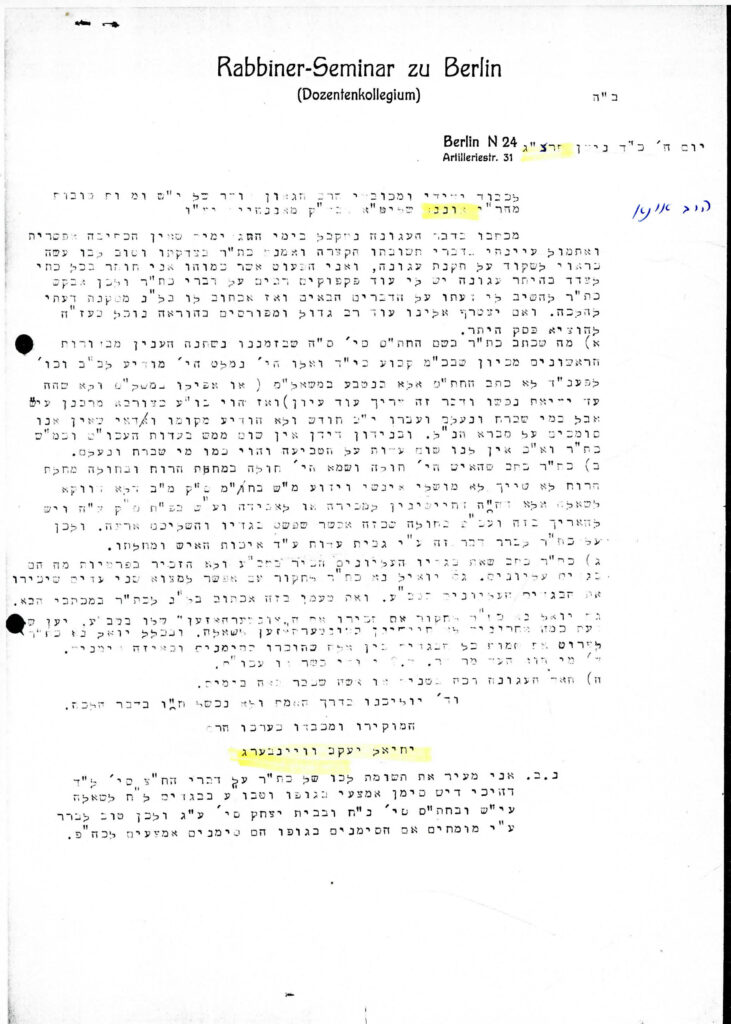
Rabbi Weinberg dealt extensively with the resolution of agunot and maintained extensive rabbinical correspondence on the subject.
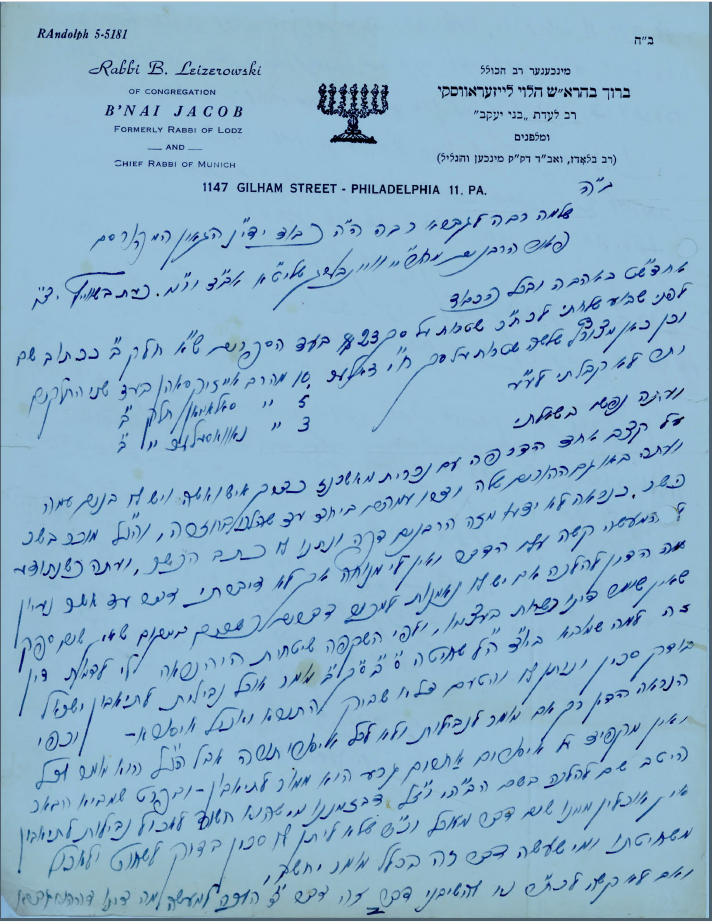
Rabbi Weinberg was asked to give his opinion on various issues. For example, whether it is permissible to give kosher certification to a butcher married to a gentile.
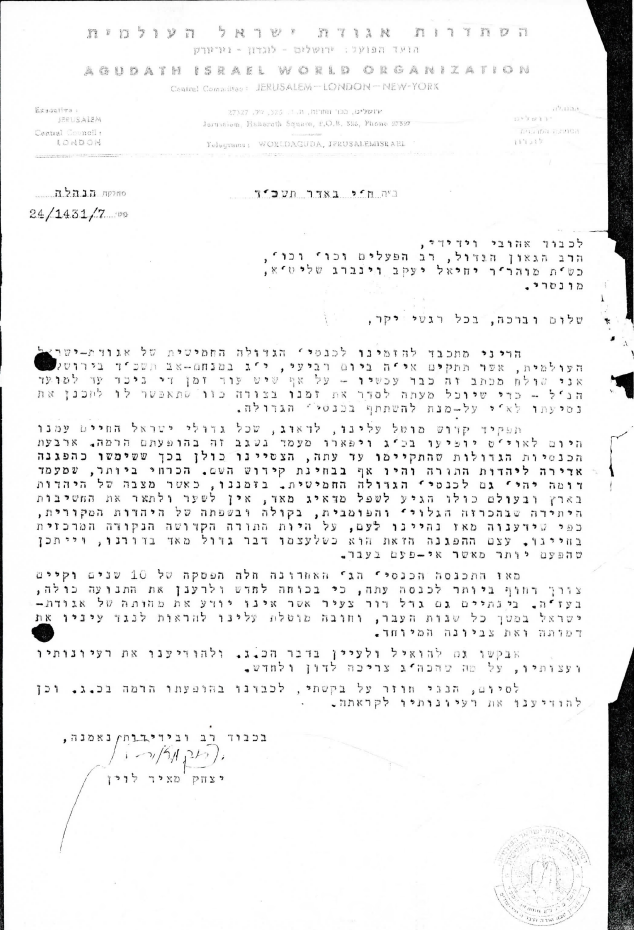
As part of the European rabbinic community, Rabbi Weinberg was invited to the fifth major congress of the World Agudath Israel that was held in Jerusalem.
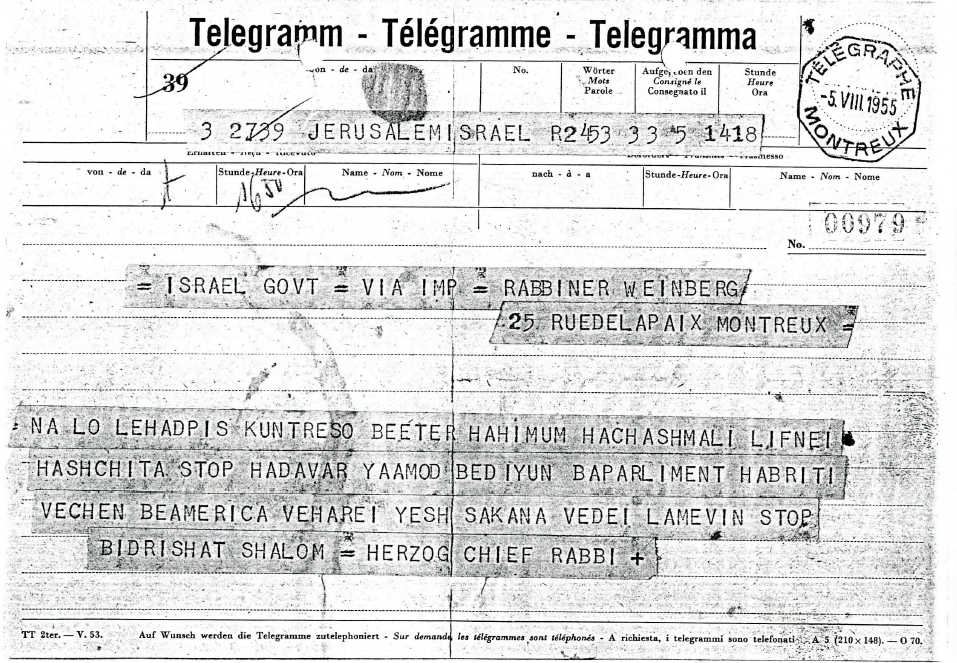
Rabbi Weinberg was looking for a way to allow stunning an animal before slaughter in order to solve the problem the ban of shechita (ritual slaughter) in Germany.
Rabbi Herzog wrote him a telegram saying the following (Hebrew message written in English letters):
Please do not print a pamphlet permitting electric stunning before slaughter Stop
This will be debated in the British Parliament as well as in America and there is danger and not enough understanding Stop
Regards, Herzog Chief Rabbi