Torah and Study in the Valley of the Shadow of Death
Tammuz 13, 5701 (July 8th, 1941) was the day that the end of the glorious Jewry of Kovno commenced, and we at Ganzach Kiddush Hashem, will mark this date in our educational and documentary activities, eighty-five years exactly to that bitter day when the innocent and upright Jews of Kovno were forced to enter the ghetto and suffer there until their terrible ends.
Students of yeshivahs throughout Bnei Brak, in coordination with the Education Department of Ganzach Kiddush Hashem, will unite with the Jews of Kovno in a unique way: studying and delving into the words of the book Shu”t MiMaamakim (Responsa from the Depths).
Rabbi Ephraim Oshry, who died at the age of ninety in 5764 (2003), served as rabbi in the Kovno Ghetto, and he printed his answers to the questions of heartbroken Jews during the Holocaust 15 years after the Holocaust, when he was already sitting on the rabbinical chair at the Great Synagogue of New York.
In the introduction to Shu”t MiMaamakim, Rabbi Oshry tells about the circumstances of writing the answers. At the time, he was the closest person to the rabbi of the city of Kovno, the genius Rabbi Avraham Kahane Shapira, about whom we have written here at length in the past.
Rabbi Kahane was “gravely ill and on his deathbed, and many would turn to him to ask for Torah from him to advise them on what to do, because in the wake of the terrible ravages of time, questions arose that the time had caused, and that in normal times would have been unthinkable…”
“And all these questions often entailed a risk to life, and since I was always a visitor to his house, literally as a member of the family, he would ask me to examine these questions and express my opinion on them…”
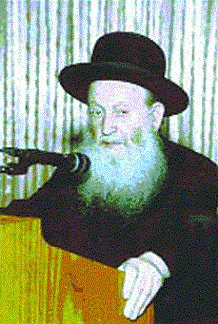
Testimony about the self-sacrifice of Rabbi Oshry can be found in the memoir of Rabbi Yitzchak Elchanan Gibraltar, a Holocaust survivor from Kovno, in his book Yesor Yisrani (Part 1, pg. 28).
“We also heard lessons from the genius Rabbi Ephraim Oshry z”l, who gave us a special sweetness in studying the Torah carefully, and even gave us talks in mussar (moral) and upliftment. He especially devoted himself to us on Shabbat and would pray with us young men and give talks for chizuk (strengthening). On Shabbat, he would come with a burning desire, since in the ghetto he was responsible for disinfecting the clothes of workers returning to the ghetto from working outside. On Shabbat, he would leave his shift. If he had been captured by the Nazis, they would have immediately sent him to the Ninth Forth, to be killed, and he would have told us that he was ready to give up his life as long as he did not desecrate the Shabbat.”
The rabbi himself wrote about this in the introduction to his book:
“At that time, while I was in the Valley of Killings, in the Kovno Ghetto, besides being a brother to my brethren in the forced labour I worked with, I was also privileged to be one who brought many to righteousness. In the midst of the darkness and the gloom of hardship, I continued to teach Torah in my beit midrash (study hall), which was famously known as Abba Yechezkel’s Kloiz, and even later, when the accursed scoundrels set a line on this beit midrash, destroying it and turning it into a prison. Even then, I blessed G-d publicly. I studied Torah in the company of a group at the ‘Halvayat HaMet Kloiz’ in the Gaffanowitz house on Witena Street, in the synagogue of Chaim Shapir on Warena Street, and especially devoted myself daily to studying in the company of ‘Tiferet Bachurim’ and strengthening the failing knees and the faint-hearted spirits of the young Jews and the masses of the people, teaching them wisdom to know that just as they bless for good, they bless for evil, because G-d is good to those who hope for His grace, and therefore we too must hope for salvation, to arm ourselves with faith and trust, to bear the burden with joy because there is hope…”
In the introduction to Shu”t MiMaamakim, Rabbi Oshry states:
“I wrote down (the answers) then for my keeping, as a reminder of suffering and anguish, poverty and hardship, to be a sign and example for the world to the sharp sword that was placed on the neck of an eternal people, and yet he lived his life in holiness and purity and fulfilled his Torah that was handed down to him, with all his soul – even by giving up their lives…”
Years passed until the rabbi wished to deal with the old papers “that time had laid its teeth on and had begun to do harm to them,” but when he saw that “I would preserve in them valuable and exceptional historical material; material that gives us a comprehensive picture of the spiritual life of the ghetto’s inhabitants against the backdrop of a daily struggle for existence,” he decided to compile these painful answers into a book that became a significant historical document – “Shu”t MiMaamakim”…
The answers in this book are wonderful and terrible at the same time, and often, when visitors come to Ganzach Kiddush Hashem, even those who are still very far from a life of Torah and faith, and even those who are not Jewish, when the books “Shu”t Mimaamakim” are presented to them with the addition of explanatory and background words from the staff of Ganzach Kiddush Hashem, there is hardly anyone whose breath is not caught by the reading of the holy teachings dipped in the blood of self-sacrifice. Many of them even break down and cry. And although the author’s goal was “to establish a memorial for the upright and innocent who sanctified the name of G-d with their lives and deaths and to be a memorial and remnant for the Jewry of the State of Lithuania, a Jewry that was rooted in its magnificent yeshivas…”, there is no doubt that “unintentionally” his book caused great Kiddush Hashem (sanctification of G-d’s Name) among those near and far.
After the liberation, Rabbi Oshry remained in Kovno and was the only rabbi there. He later emigrated to Austria and established a yeshiva near Salzburg, and from there he moved to Rome, where he opened a yeshiva called “Meor HaGola” and educated many students.
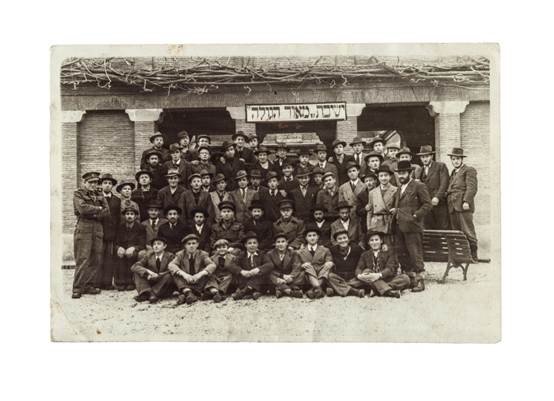
The Meor HaGola yeshiva
In the United States, as mentioned, he headed the community of the “Beit Midrash HaGadol” in the Lower East Side, Manhattan, New York.
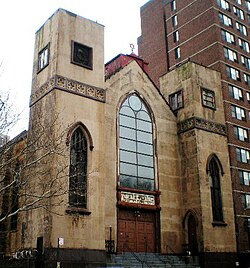
Beit Midrash HaGadol
Rabbi Oshry was a righteous and holy man who not many people know about today. And now, on the eighty-fiveth anniversary of the Kovno Ghetto’s establishment, yeshiva students in Bnei Brak and Jerusalem, in Ashdod and Beitar Illit, in Beit Shemesh and Elad, will exclaim, in the words of his Torah that were poured out of the horrors of those days, “The Torah that I learned in times of distress stood firm for me…”
Link to the book Shu”t MiMaamakim on the Hebrew Books website here.
On the events in the Kovno Ghetto, see our study kit titled “Out of the Depths, I Cry Out: The Jews of the Kovno Ghetto Seek Guidance.”
The experiences of Jews in the ghettos of Eastern Europe have already been reflected in studies and various study kits, but only a few have dealt with this ghetto so far, where Jewish life was rich and unique, and whose stories should be a central part of the study program on the ghettos. The unique historical sources that have survived from it, questions and answers in halacha (Jewish law), photographs, and numerous Jewish writings, make it possible to examine life in the ghetto from a Jewish perspective, and this is the goal of this program.
The study kit presents life in the Kovno Ghetto to the learner: the process of its establishment and the stages of its existence, the suffering and struggles of Jews, and the Jewish position in the ghetto, with the starting point and focus of discussion being the camera lens and, alongside it, the halachic questions that were asked in the Kovno Ghetto throughout its years of existence.