Vaslishok, A Town That Was
By: Yaakov Rosenfeld
To see part 1 in the series, please click here.
In the previous article, we brought an interesting news item from the newspapers of the time about a Christian tombstone thief who received his punishment, and about the great impression this incident left on the town of Vaslishok and its surroundings.
The body of the newspaper article mentions the town rabbi to whom the thief’s widow came to ask for a solution, but it does not say who the rabbi was in that episode, and in general, many were interested in the town and its history, a town that is almost unknown today.
To this end, we devoted time to research, search, and peruse the Ganzach Kiddush Hashem archive and its rich library. In the end, thanks to the professional help of Rabbi Zvi Meir and Rabbi Israel Alter, both veteran archive and library staff at Ganzach Kiddush Hashem, we were able to formulate a profile of the town, its people and rabbis, its lifestyle, and its rich history that was severed during the Holocaust by the Nazi tyrants.
Vaslishok is the Yiddish name of the town Vasilishki in the Grodno region of western Belarus.
In the past, Vaslishok belonged to Poland, and around 5560 (1799-1800) it was part of the Russian Empire, and during World War I it was included in the Second Polish Republic.
The Grodno region includes cities and towns where Torah was not mentioned for many years, and yet their names still evoke a feeling of admiration and longing in the yeshiva halls and in every Jewish heart.
Among the cities and towns of the region: Novardok, Osmena (Oszmiana), Karlitz, Slonim Lida, Grodno and more.
Grodno, the city of the foundation and the root of work (i.e. a major place for service of G-d in the past), is the capital of the region.
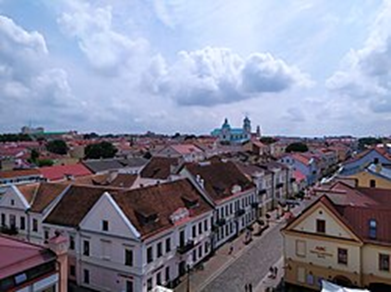
Grodno
In the Days of the Holocaust and Distress
Between the two world wars, approximately 1,800 Jews lived in Vaslishok, constituting the absolute majority of the population. In Elul 5699 (1939), the town passed into the hands of the Soviet government.
30 Sivan 5701 (June 25, 1941) was the bitter day when the Nazis entered Vaslishok and the very next day they executed eight Jews. The Nazis very quickly began to impose a regime of terror and torture in the town; Jews were put to forced labour, forced to wear the yellow badge, and life became increasingly unbearable.
However, all of these, including the confiscation orders, deportation and movement restrictions, did not compare to the decree establishing the ghetto in Tishrei 5702 (1941). In addition to the Jews of Vaslishok, many Jews from the surrounding area also crowded into the small ghetto, and from time to time SS men would break into its borders and commit acts of robbery and murder.
Iyar 23, 5702 (May 10, 1942) was a bitter day in the Vaslishok Ghetto. On that day, about 2,150 Jews from the ghetto in the town were gathered to the local Jewish cemetery, where they were murdered.
The same cemetery that had been in the headline of the newspaper a few years earlier, from which the Christian had stolen the tombstones and was punished on the spot…
The remaining Jews of the ghetto, several hundred, some of whom were tempted by the Nazis’ promises that if they turned themselves in, no harm would come to them, left and were immediately murdered, and about 300 remained to serve the Nazis in the evacuation and sorting of Jewish property, and a few weeks later they were deported to the Szczuczyn Ghetto and there their fate was like the fate of their brothers and sisters, the six million, may G-d avenge their blood.
The Prodigy from the Volozhin Yeshiva who Never got Angry
So, who was the rabbi of the town in 5685 (1924), during the time when the story we discussed in the previous article took place?
The righteous genius Rabbi Eli Eisenbud z”l was his name, and may God avenge his blood that was shed during the Holocaust along with all the members of his community.
Rabbi Eli was the son-in-law of the wonderful righteous genius Rabbi Yosef David Rubenstein z”l, who was known for his holiness and righteousness. Rabbi Yosef David served for many years in the rabbinate of the town and his place was taken by his son-in-law, Rabbi Eli.
Rabbi Eli, who is supposedly the rabbi mentioned in the newspaper, was a righteous man, a genius in Torah, and a man of immense kindness. A survivor of the Holocaust testifies about him in a memorial book for the communities of Szczuczyn, Vasilishki, Ostrin, Novy Dwor, and Rozhanka:
O pious one! O humble one! One of the disciples of Abraham our father! The extent of his generosity and extravagance in charity was beyond our comprehension.
The poor beggars who came from out of town immediately, upon getting off the bus, went straight to the rabbi’s house, where they placed their packages, received the first alms, and sat down at the table to eat.
And I remember that it happened many times that many poor guests came on one day and they all sat down at the table to eat and there was no room for the Rabbi z”l (..) and he stood to the side by the oven, to observe “and he stood over them”…
And in the summer, during the heat, when the Rabbi z”l would go out to get some air and rest a bit in the village in the forest near the city, the poor would come straight to him in his small room in the village and he would receive them with joy and give them a decent alms and accompany them on their way with a blessing…
A wonderful testimony about the goodness and kindness of the revered rabbi (ibid.):
He would set aside decent sums for charity, and when the community did not pay him a salary for a few months and he was owed “thousands of zlotys” and the need at home was great, the rabbi did not cease his charity and donated to the poor “a tenth” of what had not yet been paid to him, from loans he had obtained. He explained to his family: “I, thank G-d, still know how to borrow money, but who will lend to these poor people?”…
The rabbi was considered “highly respected” in his youth, in the Volozhin Yeshiva. It was said that even then he was an expert in 3 orders of the Shas (the 6 orders of the Mishna)…
“He was never angry with anyone, and he did not hate anyone, G-d forbid! Even those who caused him many troubles, as is well known… His pure heart was full of tenderness and compassion and he forgave all who had wronged him.”
“And it is said about him: Those who are offended and do not offend, hear their reproach and do not turn back… About them the Scripture says, and those who love him are like the rising of the sun in its might (Judges 5:31)”
Exactly eighty years ago, at the beginning of the winter of 5701 (1940-1), the Rabbi said goodbye in tears to his two daughters who were then in Kovno, and blessed them that they would be saved and immigrate to the Land of Israel, and his blessing came true.
The Rabbi himself, as mentioned, perished in sanctification of the Name of G-d, and with him all the members of the beautiful and magnificent community, a holy community that was full of scholars and men of action and kindness. In this community there was a society known as the “Chevras Shas” and its members were outstanding scholars, Torah scholars and geniuses. They all also perished and ascended as pure ones to the height of Heaven during the evil years that befell our people.
Many outstanding geniuses lived in this town over the years. The wonderful genius Rabbi Menachem Eliezer z”l, author of the book Yair Kino on Tractate Kinnim of the Mishna, a book that the Vilna Gaon praised, as well as praised its author; the book was written while the holy tzaddik (righteous man) lived in Vaslishok.
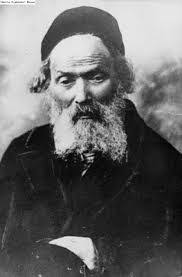
The Chafetz Chaim in Vaslishok
A holy, humble and pious town, full of Torah and grace, which for centuries was a haven for Torah and the worship of G-d, now stands in its gloom and doom, like thousands of other cities and towns in Eastern Europe that were and are no more.
As I write these lines, on Wednesday, the week of Parshat (the weekly Torah portion) Vayeshev 5786 (Dec. 10th, 2025), I am reading lines from the book “Michtavei Chafetz Chaim” written by the Chafetz Chaim’s son, the genius Rabbi Aryeh Leib HaKohen z”l, which contains the biography of his father, and here I discover something wonderful:
One hundred and fifty-five years ago, on the night of Shabbat Parshat Vayeshev (!) 5631 (1870), the Chafetz Chaim delivered his first sermon in the synagogue in the town of Vaslishok.
And he quoted excerpts from the old book that is housed in the archives of Ganzach Kiddush Hashem, and which is one of the most reliable and original historical books about the Chafetz Chaim z”l.
“I remember that in the winter of 5630 (1869-70) he traveled from his home to the city of Vaslishok, which is four parsas (religious unit of measurement) away from our city, and settled there for the winter, to compose his writings. For in our city they bothered him, as mentioned above, although he was a rabbi in the same way as others, but all the troubles of the community were upon him.”.
“I was about nine years old at the time, and he took me with him, so that I could study there in the Talmud Torah.”
“And I remember that my father wrote his books in the Beit Midrash (study hall), in the shtiebel (small synagogue) in the synagogue hall, and that’s where he ate.”
“And he also slept there.”
“His food was brought to him from the house of his father-in-law, the provider, Rabbi Yitzchak (my mother’s brother’s father-in-law…), and he was the principal of the Talmud Torah and the provider.”
“My father, who did not want to eat the bread of charity, suggested to his father-in-law that he choose from the city’s young men, students, who had already completed their class in the upper class of the great Rabbi Leib, who had studied all the Tosafot and the Maharsha commentaties and the interpretations, and he would recite a lesson for them for a certain number of hours, and so it was, that ten young men were gathered, and he recited a lesson for them on Tractate Sanhedrin, and I remember that he spent close to three hours with them every day.”
“I do remember that he also discussed mussar (morals) and the fear of sin with them in every lesson and at the end of the winter he returned to his home.”
“However, in the winter after that (5631) he traveled once again with me to Vaslishok and worked on his writings again, and this winter too, he gathered about twelve young men, most of them others, and studied with them for about two and a half hours.”
“This winter he did not send me to the Talmud Torah, but he himself studied with me.”
“I remember that this winter, on Shabbat night on the week of Parshat Vayeshev, he gave a speech from the bima (prayer platform) on matters of the parsha, and with a great deal of impairment in the speech (as I believe this sermon was the first in his life at that time, apart from one sermon he preached in his youth in Radin on measures and weights).”
This synagogue, whose photo we obtained after much effort, was put up for sale by the Belarusian authorities for a small sum in 5761, according to the tender documents published at the time.
More about the town and the synagogue:
“In Shul Arein…” (Into Synagogue…)
A little bit about the town, from a survivor:
“The locals set their watches according to the synagogue clock, which was kept by Rabbi Yaakov z”l, the shamash (sexton). It was a custom in our town that Rabbi Yaakov z”l would walk through all the streets of the town every Shabbat eve before the time for lighting the candles and announce in a special tone, ‘In Shul Arein’… Immediately after this, the sound of the locks of the shops was heard, and the shopkeepers hurried home to make the final preparations for Shabbat, and when Shabbat arrived, the entire town was clothed in holiness. Lit candles flickered from every house, and from every corner of the town, people from old to young, dressed in Shabbat clothes, flocked to the illuminated synagogues.”
The Recluse who Recounted the Wonders of the Baal Shem Tov in the Lithuanian (i.e. non-chassidic) Town
“After the passing of Rabbi Yaakov, the humble and hidden man, the ‘recluse’ Rabbi Baruch Moshe (…) took on the role of proclaiming Shabbat. He would walk quietly and with measured steps through the streets on the eve of Shabbat. Then everyone knew that Shabbat was approaching and closed the shops.”
“Rabbi Baruch Moshe the recluse was a unique character. He was not a native of the area, and we did not know where he came from. He was a solitary man, living a hermit’s life. He slept in the synagogue, in a wall cupboard on planks, covered with worn-out rags. His clothing was scanty, an old and tattered kapoteh (chassidic coat), but spotlessly clean. He wore shoes with wooden soles.”
“They offered him new boots with leather soles, but he refused to accept them. He would sit in the synagogue and look through books. He would eat his meals every day at a different house, and on Shabbat at the rabbi’s.”
“Even in conversation with his friend, he spoke quietly and calmly, never raising his voice. He knew how to captivate us with stories about the righteous of the world, he read to us the stories from the book Maaseh Alfes, the stories of the Baal Shem Tov who wanted to reach the Land of Israel and was prevented from doing so by Heaven. In our eyes, he was always one of the 36 righteous without whom the world cannot exist…”
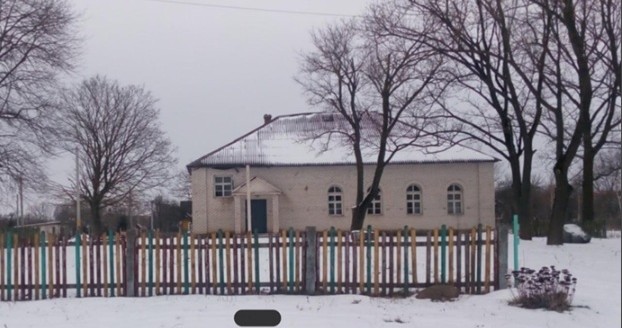
The synagogue in the town
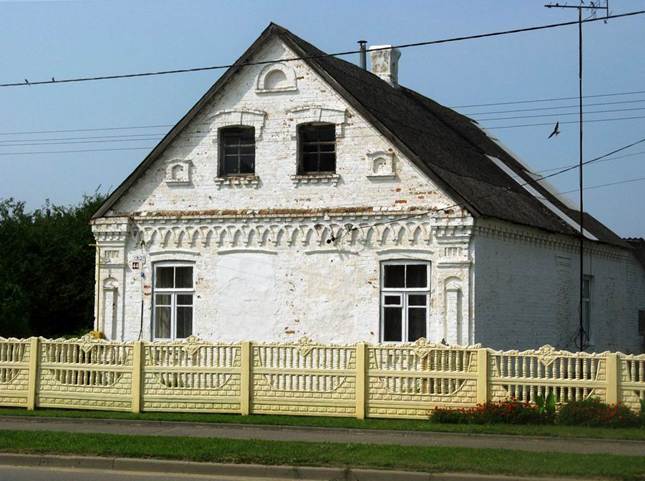
The synagogue in the town. This is where the Chafetz Chaim wrote his book. The synagogue was put up for sale in 5761 (2000-1) for a small sum.
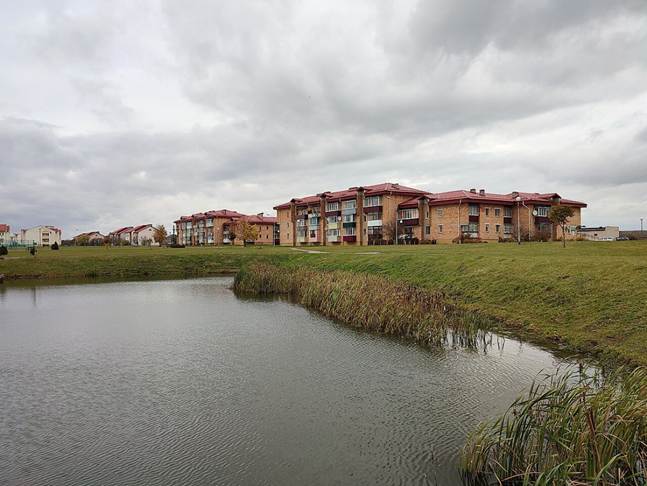
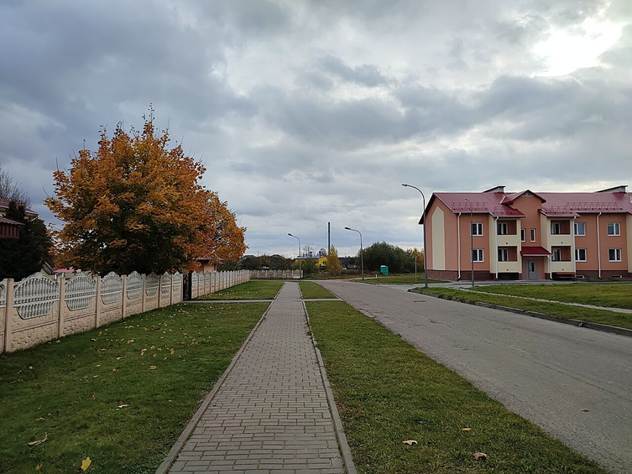
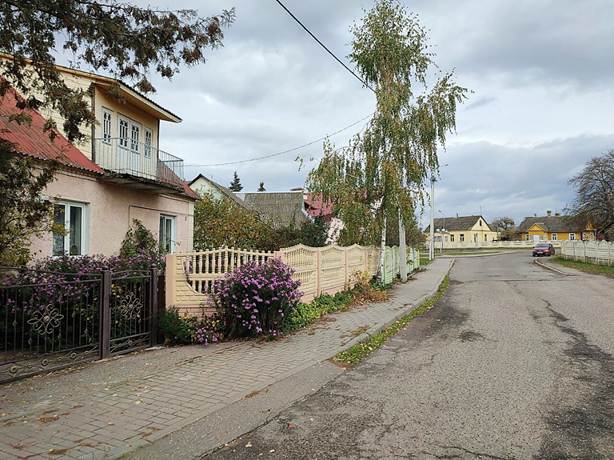
They murdered and also inherited…whose house was this?
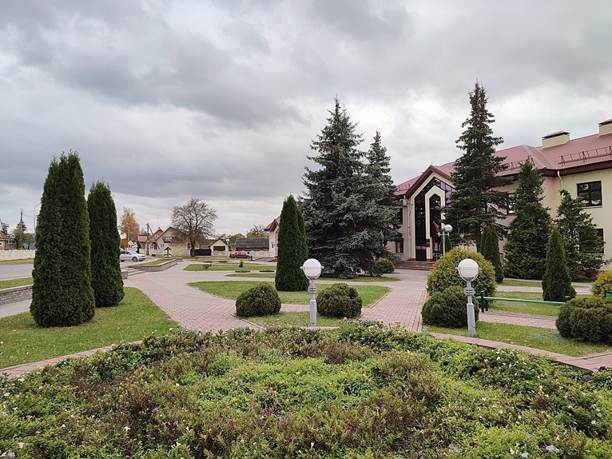
Pastoral beauty drenched in blood
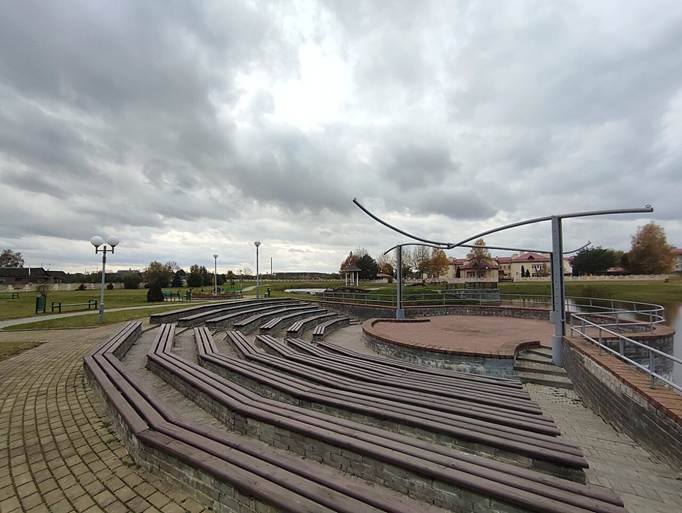
“Soviet-era park planks commemorating the tragedy of the Jewish ghetto”