Volozhin – A Major Jewish Centre
Iyar 23, 5702 (May 10th, 1942), 80 years since the destruction of Volozhin Jewry
(Originally published in Hebrew in May 2022)
On the main road between Vilna and Minsk sits Volozhin, an ancient Lithuanian city that left a strong mark on time and generations. The large and beautiful building of the renowned Volozhin Yeshiva, affectionately known as the “Mother of Yeshivas,” still stands today and stands proudly, a testament to the days gone by.
Volozhin was a lively and vibrant Jewish city. World-renowned gaonim (Torah geniuses) lived there, and the great Lithuanian rabbis radiated their light from it to all corners of Lithuania and Europe in general. The most famous of them is of course Rabbi Chaim of Volozhin, author of “Nefesh Chaim,” whose enormous influence on the world of Torah and yeshivas is evident at every step. World-renowned rabbis, the renowned gaonim of the Brisk family, also lived and worked in Volozhin. Rabbi Chaim Soloveitchik of Brisk was born in Volozhin to his father, the gaon Rabbi Yoshua Ber, who served as the Rosh Yeshiva in Volozhin (head of the yeshiva) for a time, and much earlier, the “Shaagat Aryeh” rabbi lived in Volozhin and served as its rabbi and Av Beit Din (head of the rabbinical court).
However, not only “mitnagdim” (religious Jews who opposed chassidism) lived in this magnificent city. Close-knit communities of chassidim from several denominations and circles were a living spirit in Volozhin and took an active and central part in the spiritual life of the city. Many Lubavitch chassidim lived there, as well as Lechovitch and Slonim chassidim and others.
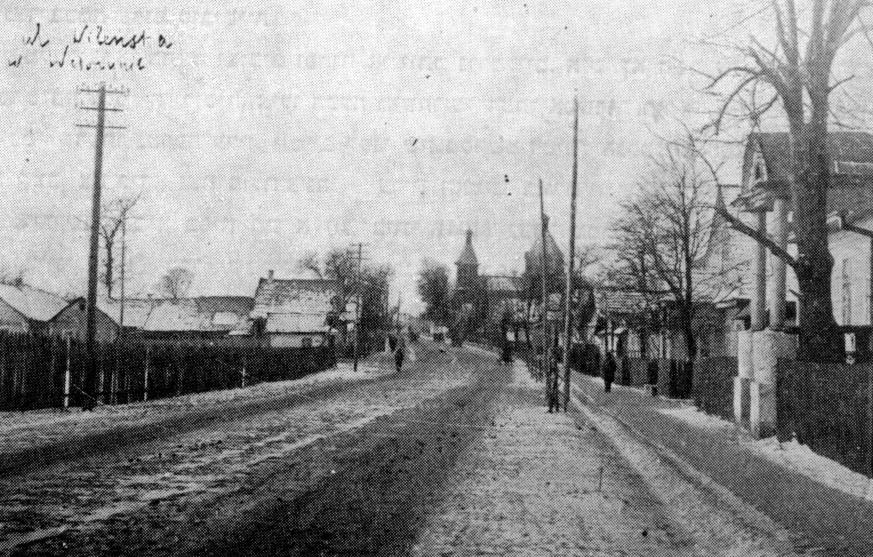
Vilna Street in the town of Volozhin
(The father-in-law of the gaon Rabbi Yoshua Ber of Brisk, Rabbi Yitzchak Efron, who was an outstanding scholar, an important and influential Jew in the city of Volozhin, was a warm Lechovitch chassid.)
Volozhin, the cradle of the yeshivas, was a preeminent Jewish community. Thousands of Jews lived in it and influenced its entire existence until it was destroyed during the Holocaust, and of all its glory and splendour, nothing remained except the words of the Torah of its yeshiva leaders and its teachers, whose “lips are buried in the grave” whenever students mention what they heard from them.
As mentioned, the yeshiva’s magnificent building still stands. It was preeminent institution until its closure exactly one hundred and thirty years ago, due to the intervention of the authorities and their forcing them to introduce general studies into its daily routine.
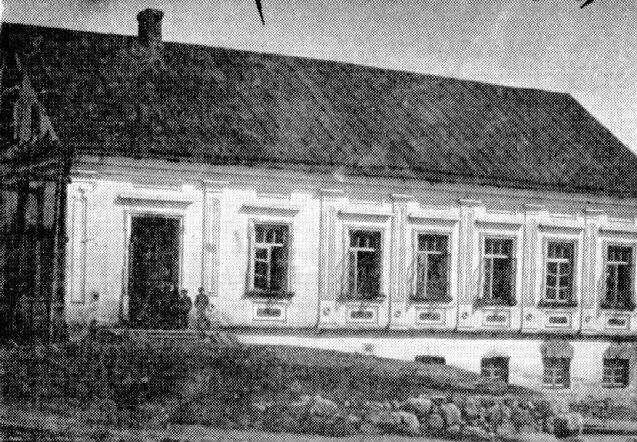
The yeshiva building in Volozhin
We find the essence of the yeshiva and its atmosphere in the memoirs of one of its students (courtesy of the website “Daat”):
…A young man coming to Volozhin for the first time and after finding a hostel, sharing a room with another young man, or with two young men, all depending on the size of the room, would make his way to the yeshiva. And while he was still far from it, he would hear a noise. And the closer he got to it, the noise would get louder and louder, like someone approaching a waterfall. And when he reached the “White House,” the magnificent building of the yeshiva, built of white stones, he would ascend a few steps and enter the large hall of the yeshiva and would remain standing, amazed and astonished at what he saw and heard: About two hundred and fifty single and married students sit and stand – and some even walk with the Gemara in their hands throughout the entire hall – and study loudly and in tune, each one in a different tune, unique to him or her, and all this with enthusiasm and sweetness, with the shaking of the entire body and the movement of the hands, and he does not understand how the student understands and knows what he is learning to the deafening sound of such a large choir. And doesn’t he also have to study here eight, ten hours a day!
And when the first impression was over, he would go to see the mashgiach (supervisor), who sat in the east of the yeshiva and studied there all day as one of the students. And the mashgiach, after greeting him, would begin to wonder about the young man: who and what he was, how old he was, whether he was still a young man or already a rabbi, what he had learned and where he had learned it, and other such questions. He would test his knowledge of Talmud and find him a place in the yeshiva, and if there was no free place in the yeshiva, he would have to study in the beit midrash (study hall), which was located next to the yeshiva. After that, he would go and stand before the head of the yeshiva, whose house was also next to the yeshiva. And he would be accepted as a student.
The principal, who was in charge of the yeshiva’s books, would give him the Gemara he wanted to study, and his simple life would begin in Volozhin. When he got up in the morning, he would go to the Shacharit prayer in the yeshiva. After the prayer, he would return to his lodging and the landlady would serve him breakfast: a cup of tea, bread, butter, or an egg; and sometimes, cheese, or salted fish. And when he finished eating breakfast, he would return to the yeshiva and stay there until one o’clock in the afternoon. If he heard the Rosh Yeshiva’s lecture, he would stay to listen, and if not, he would return to his lodging to eat lunch. And this meal was also simple; a soup of grits or beans, with a small piece of meat and an apple or pear for dessert. For the most part – that was all…
On Rosh Chodesh Av 5701 (July 1941), the Nazis captured Volozhin and immediately began a horrific campaign of murder. Immediately upon entering, they shot Jewish passersby, and on the same day they arrested the Jewish doctor along with his children and, after torture, shot them to death.
In the month of Elul 5701 (August 1941), 3,500 Jews of Volozhin were forced to enter the ghetto established in the “Aropzu” neighborhood, along with many other Jews from nearby towns (including the well-known “Oshmiany”).
On the 7th of Cheshvan 5702 (Oct. 28th, 1941), the Jews of the ghetto were ordered to attend a lecture by the head of the Gestapo, an evil man named “Moka”, on the subject of “work ethics”. At the end of the lecture, he ordered two hundred Jews, among them important and well-known ones, to gather in a room, and from there they were led in groups of ten to the nearby forest, where they were shot into pits.
The exterminations and tortures became more frequent. The most shocking incident that left a terrible impression on all the inhabitants of the ghetto and tore their hearts was when the Nazis spread out a Torah scroll, made Jews lie on it, and then shot them to death at close range. It is a spectacle whose terrible effect on the Jewish psyche is difficult to describe.
The ghetto’s bitter end came on Iyar 23, 5702 (May 10th, 1942). Belarusian partisans in the nearby forests managed to kill three Nazis, which was the pretext for a horrific punishment imposed on all thousands of Jews in the Volozhin ghetto, the so-called “Second Aktion (roundup),” which brought an end to the glorious Volozhin Jewry.
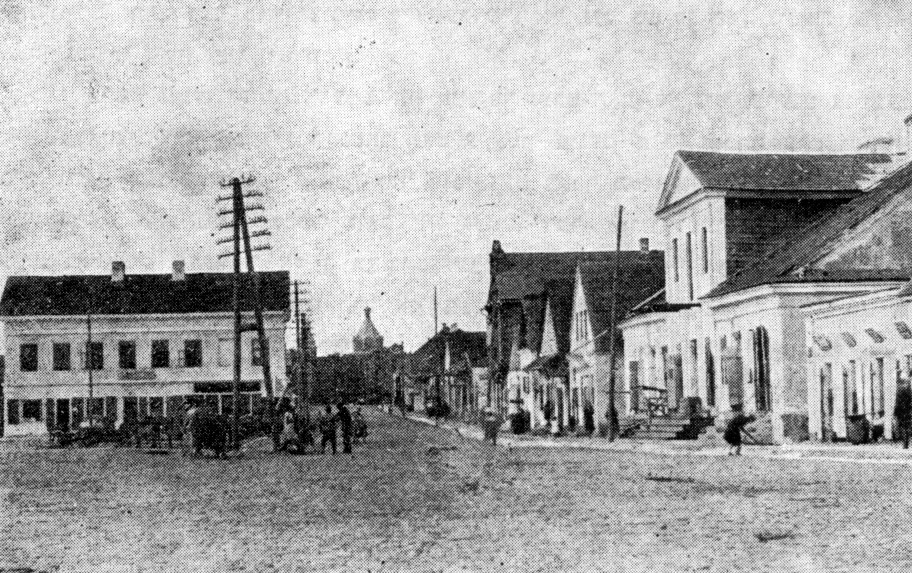
Market square in the town of Volozhin
Like beasts of prey, they screamed for the poor ones to gather inside a large, deserted blacksmith shop, and outside the Nazis set up tables with “refreshments,” strong drinks… and machine guns. They drank themselves to drunkenness, and occasionally fired machine guns into the extremely crowded building; this, they said, to “silence the sounds of crying from within.”
Inside, the Jews argued. Some wanted to die in battle and resistance, but the rabbi requested, and even ordered, not to lose hope and to wait for G-d’s salvation.
The chief of police entered and ordered one of the most important Jews in the community to shine his shoes, and as he bent down at his feet, he shot him at close range, and he fell down in a pool of blood. Hundreds of Jews decided to escape and tried to jump from the roof, but most of them were shot and killed. Only 12 managed to escape and survived.
The remaining Jews of Volozhin were held there until the afternoon, when they were forced to leave towards the forest through the Christian residential areas. When the terrible “procession” passed by the Christian houses, the residents, men, women and children, came out, bursting into songs and dances and rejoicing loudly.
The “procession” was divided into groups by age and gender: children, girls, adults, and elderly women, and in the center were the men who were dressed in their tallises (prayershawls) and preparing for self-sacrifice out of closeness to God and an elevated spiritual preparation (evidence of many men wearing tallises on their final journey appears in several places).
Some of the Jews were put in a building near the cemetery, where they were burned alive, some were taken to the cemetery itself and shot into their graves, but most of the Jews of Volozhin were forced to march that bitter, hasty day into the forest, where they were shot into pits, and tractors and other heavy vehicles drove back and forth over them, and their souls ascended to heaven in indescribable agony.
May G-d avenge their blood.
That day, the 25th of Iyar, has been set as the memorial day for Volozhin Jewry. On this day, we remember the martyrs, unite with their memory, light a candle, and pray for the upliftment of their souls.
May the souls of the martyrs of Volozhin be bound in the bonds of life.