Zamość – A Major Jewish Community
Bein HaMetzarim (The 3 Weeks between the Shiva Asar B’Tammuz and Tisha B’Av Fast Days) 5786/2026, Bnei Brak, Impressions of a Visit
The group of visitors requested information about the town of Zamość, the town of their ancestors for generations.
The information they had so far amounted to the fact that Rabbi Yoel Baal Shem, one of the “baal shems” (a sort of religious folk healer) in the generations before the life of the Baal Shem Tov, the founder of chassidism, lived in Zamość, and since this is the case, the origin and birth of chassidism was influenced by Zamość, since according to chassidic tradition, one of the rabbis of the Baal Shem Tov was Rabbi Yoel Baal Shem of Zamość.
The people wanted to see pictures, testimonies, want to hear about the “town” and read about it, and in the Ganzach Kiddush Hashem archive there is a lot of material about Zamość, just as there is about thousands and thousands of Jewish cities and towns all over the world. The archive is organized and full of valuable archival material, and there are good and talented people who will direct visitors to what they are looking for. We observe the surprise on the visitors’ faces and realize for the umpteenth time that the establishment of the museum is a necessity for hundreds of thousands of Jews of all backgrounds and circles from around the country and the world.
For example, the descendants of Rabbi Yoel of Zamość were thrilled to discover that their ancestor, the “Baal Shem of Zamość,” had earned him a worldwide reputation as the head of the yeshiva in Zamość, which had a sad beginning, because initially only a few Sephardic Jews were allowed to live there, the commercial agents of the famous governor, Don Yosef Nasi[1]. However, it quickly developed into a large and central city where tens of thousands of pious and peaceful Jews lived and raised generations of righteous people for hundreds of years until the ravages of the years of wrath came upon it and destroyed it.
The ancient synagogue of Zamość was a magnificent architectural creation, and its elegant form is described in the literature of scholars of ancient Polish architecture. The surviving photographs of the great and magnificent synagogue indeed reflect a magnificent and large hall, furnished with luxury and splendour and decorated with unique elements.
“Zamość is not a ‘town’. It is a large city that before the Holocaust had more than 12,000 Jews. Zamość was a city of Torah and chassidism, and what it went through during the Holocaust is difficult to talk about, because the testimonies we have of the bitter end are unbearable.
We spare the descriptions of the city’s end from the visitors, some of whom are elderly and sensitive. The Ukrainians were astonishing in their wickedness and cruelty towards the Jews of Zamość, but when we draw testimony about the terrible and piercing cry of the “Shir HaMaalot” (Song of Ascents) that erupted from the mouths of hundreds of Jews who packed the hall to which the Jews of Zamość were deported before being killed in sanctification of the Name of G-d, no one’s eyes remained dry. Even the veterans of the Ganzach Kiddush Hashem archive, who had already told, documented and lectured about everything, shed tears in the face of the terrible testimony, like the Book of Job, which tells of the destruction of a major Jewish community, where Torah and chassidism had been a part of life from generation to generation.
While the deported Jews of Zamość were being imprisoned in the city of Izbica, the murderers entered the crowded gathering place. A Polish-born German (Volksdeutsche) burst into the crowded “hall” in a rage, followed by a huge black dog. The German, named Mats, had a heavy automatic rifle in his hands, and fire was blazing from his eyes. The dog attacked everyone who stood in his way, sinking his teeth into the pure bodies of men, women, and children. The German stood and cursed, stood and cursed, and in every corner of the hall, including the stands, frightened Jews huddled together, filled with tears. Many of the Jews were already lying lifeless, and even more lay wounded to various degrees, some of them lost their minds, they came out in songs and dances… Then, suddenly, from some corner a terrible roar erupted:
Ssh, Zol zein shtil! – There should be quiet here, please be quiet!
And there was quiet.
Jews! A mighty voice thundered. Let us prepare ourselves for the sanctification of the Name of G-d! Perhaps we must atone for the sins of all generations, perhaps… Let us not despair, let us go to the slaughter with joy and enthusiasm like the Asara Harugei Malchut (10 Martyrs – killed by the Romans), so that the gates of the Garden of Eden will be opened for us, and we will be saved from a state of hell! Come, let us shout, “Shema Yisrael” (Hear, Oh Israel!)
And suddenly, a terrible and terrifying roar shook the temple, young and old, women and children, stretched out their hands and sobbed in one terrible wail that shook hearts:
Shema Yisrael Hashem Elokeinu Hashem Echad! (Hear Oh Israel, the L-rd our G-d, the L-rd is One!)
This testimony was given by Holocaust survivor Yaakov Schwartz of Los Angeles, and he concluded:
“That day the greed of the fist-wielding men subsided a little. Apparently the ‘Shema Yisrael’ of hundreds of children and women, the sick and the elderly, softened their hearts…”.
Another excerpt from his testimony, about “The Last Night of the Jews of Zamość in the Cinema in Izbica”:
“That evening, that night, there was a great silence in the hall as if after a storm, only from a corner was a Jew heard saying ‘Song of the Ascents from the depths I have called You’ in a halting, quiet melody.”
“That night, no one slept. Everyone prepared for their end and came to terms with their bitter fate. (…)”
“When dawn broke, an elderly Jew, who was sitting in the gallery, began reciting the Psalms. Those present immediately joined him in reciting the Psalms, which continued until about 12 noon…”
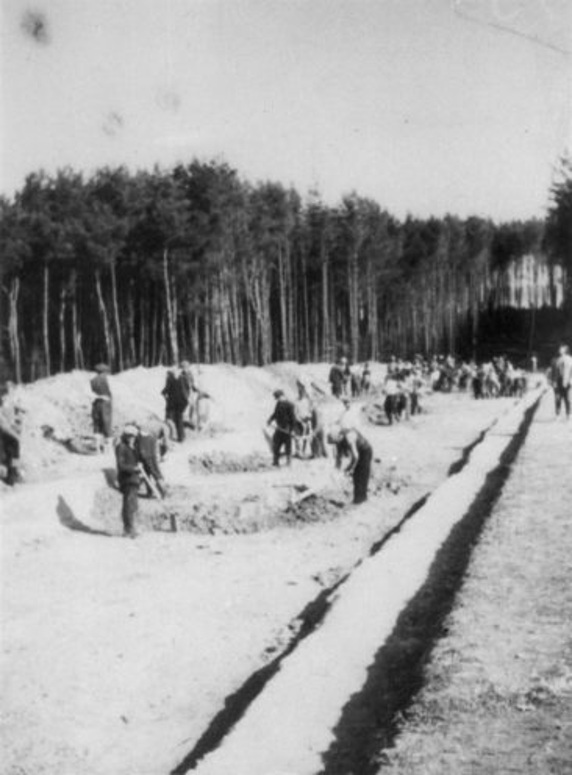
The Jews of Zamość work on the “Auto Line” – forced labour in 1941, exactly 85 years ago
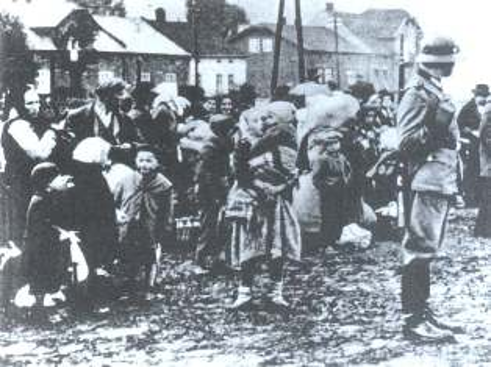
The arrest of Jews in Zamość , 1941
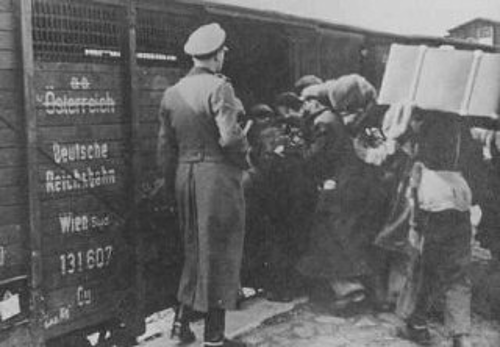
Deportation from Zamość, 1942
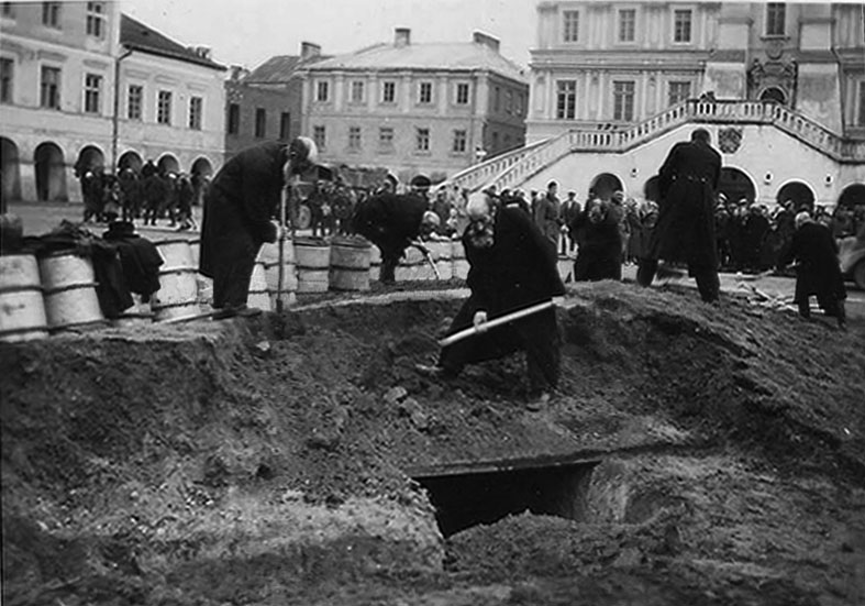
Forced labour. Respectable Jews doing hard labour in Zamość. Zamość Square, 1942
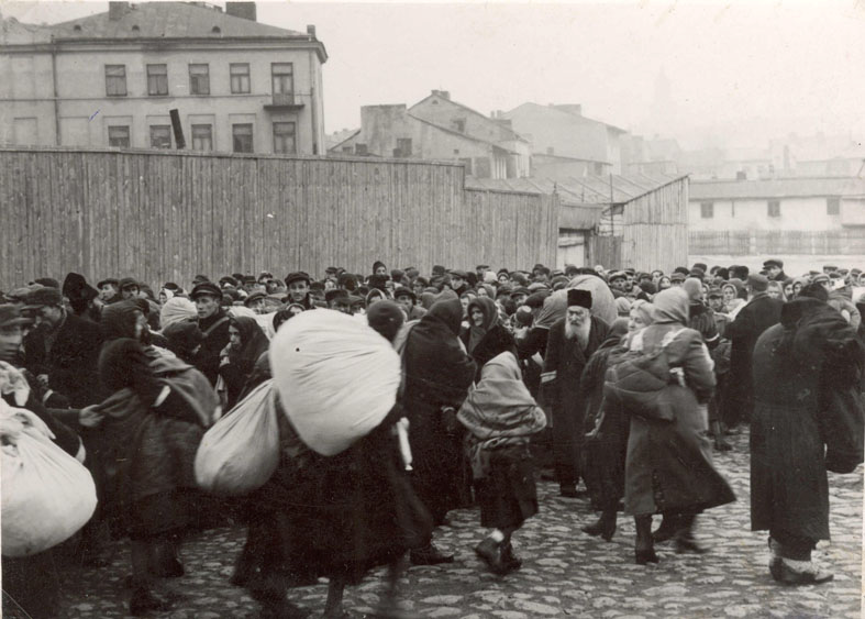
Deportation from Zamość, 1942
Heartbreaking testimony about the fate of the deported Jews of Zamość:
It was cold. The ground was covered with snow and mud. In such conditions and in the middle of a blizzard, a large shipment arrived from Zamość.
The entire Judenrat was on the train. After everyone had undressed and stood naked, as usual, the men were pushed towards the gas chambers and the women to the… hut to have their heads shaved.
But the leader of the Judenrat was ordered to remain in the courtyard. The Ukrainian guards took the shipment and the entire SS unit of Belzec surrounded the Jewish leader. I do not know his name. I saw a middle-aged man, pale as death, but completely calm.
The SS ordered the orchestra in the courtyard to await further orders. The orchestra – six musicians – was usually stationed in the area between the gas chambers and the mass graves. They played all the time – day after day – using instruments taken from the dead.
I was working nearby on construction work, and I saw everything that was happening. The SS ordered the orchestra to play “Everything passes, everything passes” – “Es geht alles vorüber, es geht alles vorbei”, and the song “Three Lilies” – “Drei Lilien,” the lyrics of which describe longing and separation from life, using images from the natural world. On flutes, violins and harmonicas. This went on for some time. Then they put the leader of the Judenrat against the wall and began to beat him on the head and face with whips. The ones who tortured him were Erman – a fat Gestapo man – Schwatrz, Schmidt and some of the Ukrainian guards.
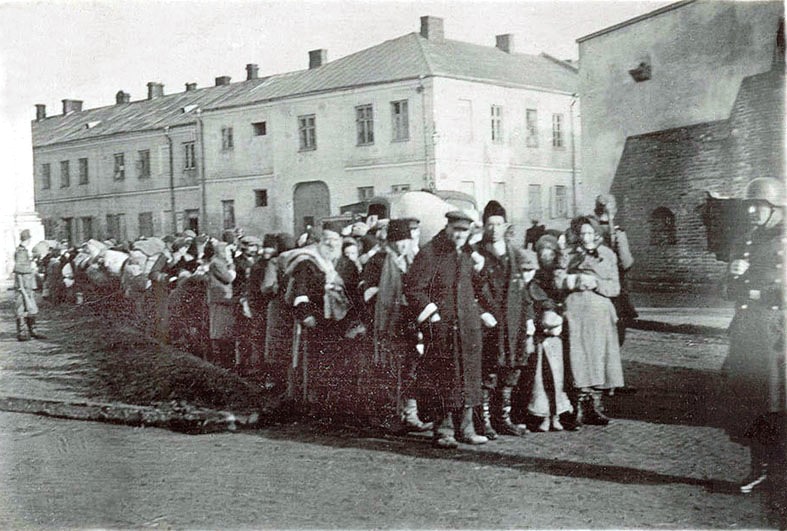
Concentrating Jewish families, Zamość
Their victim was ordered to dance and jump to the music while being beaten. After a few hours, he was given a quarter of a loaf of bread and forced to eat it – while still being beaten. He stood there, covered in blood, indifferent, very calm. I did not hear him moan once. His torment lasted seven hours.
It was six in the evening when Gestapo man Schmidt pushed him towards a grave, shot him in the head and kicked his body onto the pile of gassed victims.
Zamość, the great city, was completely destroyed. Indeed, when the war broke out, thousands of Jews fled from it and crossed the border into Russia, but of those who remained, not many survived, may G-d avenge their blood.
We will tell about this town and its history, with G-d’s help, in the next section. We will also try to tell about the towns that surrounded Zamość, which were also full of honest-hearted and innocent Jews, may God avenge their blood.
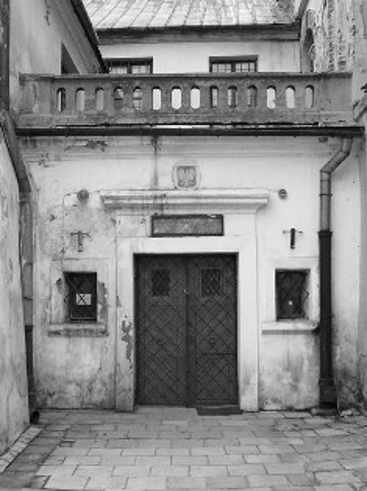
“The Silent One” – one of the city’s characters
(Story courtesy of the Zamość Yizkor book)
The Silent One died in 1929 in the city of Czortkow, Poland, at the age of 83. The man was silent for about 40 years.
I was his doctor until the end of his life.
From time to time (about 24 hours) after his death, they broke into his room in the basement and found him lying on the floor – and the mice did not touch his body, even though during his life they ran around in his ‘residence’.
Not only in the city of Czortkow and its surroundings, but even at a distance, he gained a reputation as a silent man. He did not stop studying the Torah and praying day and night. When he needed something, he would use hints, hand gestures, and mumbling “Nu, eh, ee” and when they finally failed to understand his hints, he would write his requests on a piece of paper. It was known that the Silent One was fluent in four languages: Yiddish, Hebrew, Polish, and Russian. The Czortkow chassidim greatly admired him, and the people of Czortkow (even the Christians) treated him with great reverence and admiration when they saw his behavior and devotion to the work of the Creator.
Before the first war, the Silent One became completely reclusive and locked himself in his special room, “4 amot by 4 amot” (a tiny measurement) in the ruins of the Rebbe’s palace, and did not allow anyone to approach him. Only a few special people had a foothold. He practiced various ascetic practices and did not even go to the mikvah (ritual bath). One man used to come to him every Shabbat evening and pour seven buckets of water over his body, and this served as his “mikvah.”
During the first war, a Christian named “Nistorko” served him. At four in the afternoon he feasted his heart out and until twelve at night he was busy with the work of the Creator. He did not lie in bed, he sat at his desk with his head supported by his hand and slept like that. At three in the morning he woke up every day and performed “chatzot” (a prayer of mourning) and shed tears over the destruction of the Temple and the exile of the Divine Presence.
On his table stood a large bottle of water with small fish swimming in it, and every year this water was used to prepare “Tashlich” (sin casting-away ritual). He ate meat once a week, a quarter of a chicken for Shabbat that he cooked himself. Throughout the days of the first war he was sustained by Moshe Leib Orbach z”l and several women who brought the food through Nistorko, his assistant.
If the Silent One had opened his door wide, chassidim from all corners of the country would have flocked to him and brought him ‘pidyonot’ (money). During the war, after the destruction of the Rebbe’s entire palace, Christians and Russian soldiers brought firewood and food to his basement in abundance, even though the situation of the rest of the Jews in the city was at times very difficult.
Reb Shmuel ben (son of) Reb Meir Frumkin or Frummer was born in 1846 in the village of Slavtzin, he lived in Konska Wolia (Zdansk in Yiddish) in the Zamość district. His mother gave birth to him at the age of 50. His parents were simple people, “Yashovniks,” and did not give their sons any Hebrew education, but when the Silent One grew up and excelled in his superior mind, his father gave him to the Genshev Rebbe and he engaged in Shas (the 6 orders of the Mishna), in poskim (halachic decisors), and studied with him until his marriage and from him he received rabbinical ordination. However, Rabbi Shmuel did not want to use the title of rabbi but rather engaged in the trade of metal, copper, lead and gunpowder.
He kept this material in his basement in secret, and even his family, his wife, and his three sons had no idea about this business of his. And here begins his tragedy, which is intertwined with various legends. However, the main legend that was prevalent in those days is as follows:
Once, a dispute flared up between him and his wife, and Rabbi Shmuel cursed her with a strong curse – that she would burn. And so it was. His wife went down to the basement to look for something, and she had a lit candle in her hand, and it fell from her hand and the gunpowder ball exploded, and as a result of the explosion, his wife and two daughters were killed. His third daughter miraculously survived.
Reb Shmuel was very pained, for he believed that this terrible accident had been caused by his curse. Reb Shmuel packed his belongings, took with him 90 rubles, the dowry he had prepared for his third daughter, and traveled to the Rebbe of Czortkow – Rabbi David Moshe Friedman, the son of the “Riznai” – in order to extract a ‘teshuvah’ (ruling) from him. ‘A zo tzung darf shweigen’ (such a tongue must be silent), said the Rebbe. From that day on, Reb Shmuel accepted the words of the righteous man and remained silent until the day of his death.
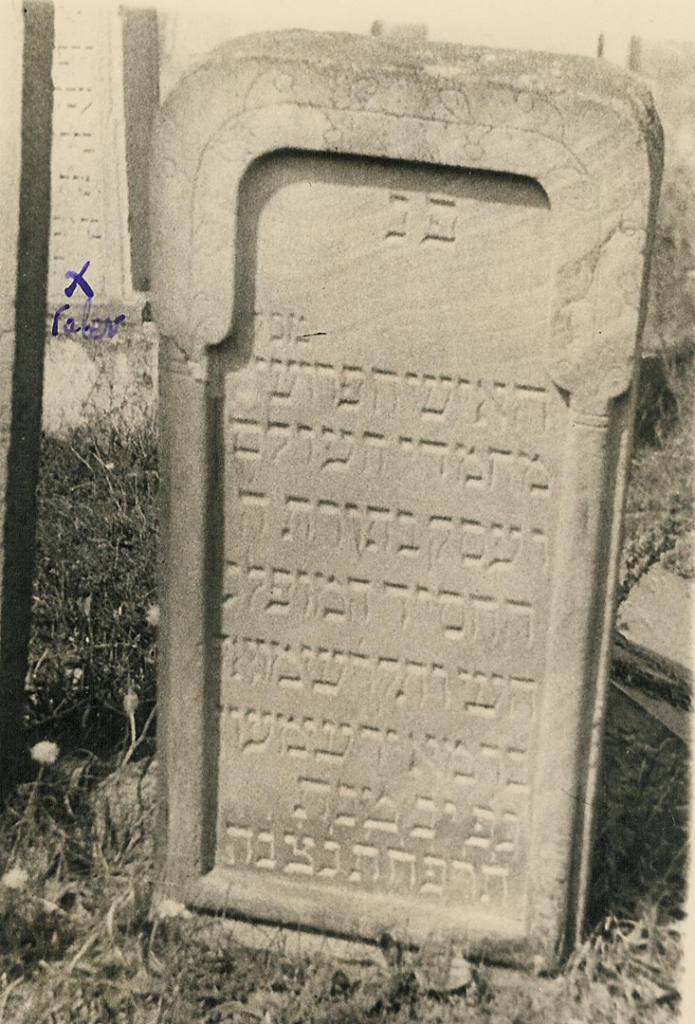
On his gravestone, which still stood in the spring of 1944 after the destruction of the entire Jewish settlement and cemetery, was written: “Reb Shmuel son of Reb Meir, the Silent One.”
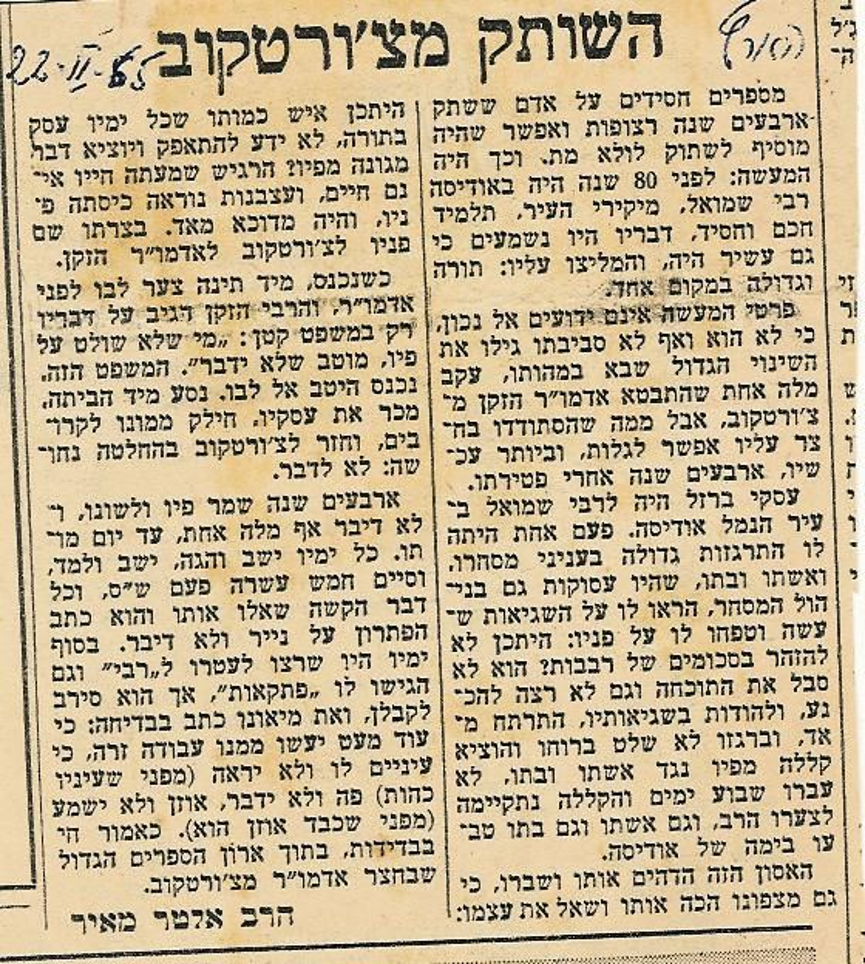
A press clipping about “The Silent One” with a slightly different version of the story.
[1] “And it is the Chancellor’s wish that only Frankish Jews settle here. He does not want local Jews in any way” (Letter to Turkey, Moshe HaCohen – 5347/1586-7, Zamość). For eight years, a Sephardic community existed in this city, with the support of Chancellor Jan Zamoyski, but this community quickly disintegrated in favour of a large and flourishing Eastern European Jewish community. In 5408 (1647-8), many Jews were already living in Zamość, in addition to refugees from surrounding cities and towns who fled to the Zamość fortress from the fear of pogroms.