The Fascinating Testimony of Elka Borenstein
Adapted by Faigy Schiff from the original testimony in Ganzach Kiddush Hashem’s database
Children and adults alike experienced the horrors of the Holocaust firsthand, whether in the ghetto and camps, or in hiding places. But the story of Elka Borenstein, who gave her testimony to Ganzach Kiddush Hashem – took a different turn and seemed almost unbelievable. The believable is also unbelievable – the story is not imaginary, but completely true.
Elka was born in 1930 in Obervisha, Romania. She, her father Shmuel, her mother Rosa, and her four siblings lived peacefully. The father ran a store. After the death of his parents, the family moved to the town of Schiff, where they made a living farming and had good relations with their gentile neighbors. The father also taught Torah, the older sons studied at the yeshiva in Sziget, and the younger girls and boys studied at the gentile school, where they suffered from antisemitism. On Shabbat, they completed their Jewish studies.
At the birth of the fifth daughter, the mother passed away due to complications. The gentile doctor from the nearby town refused to come to treat her despite the entreaties of all the community’s dignitaries. After the mother’s death, the children scattered throughout the extended family. Elka and her sister returned to their home just as the war broke out. While in another town with her aunt, Elka remembers that trains from Hungary passed by on their way to Auschwitz, and her brother told them that the Jews were asking for water and that it was forbidden to approach and give them water. The town still did not believe what was happening and did not even try to hide or build bunkers.
The fear began when they were forced to wear a yellow badge and were not allowed to leave the house in the evenings. A month later, they were already concentrated in the ghetto. The girls packed a few personal belongings. Food was already being given sparingly in the ghetto, and fear took root in their hearts. Shortly thereafter, the town’s Jews were taken to Auschwitz. The uncle told them in Yiddish: “Children, say goodbye, this is our last journey.”
In Auschwitz, Elka and her cousin Esther were sent to Camp A. The infamous Nazi Irma Grese, who was later hung Nuremberg, miraculously sent Elka to rescue her. “You can’t stay here,” she said, and sent her to Camp C, Block 8 – a children’s block. The girls and young women who had been cruelly separated from their parents cried all night. The head of the block was kind and gave them paper and pens to write to their parents. Elka refused. “Something is wrong here. People are disappearing,” she said.
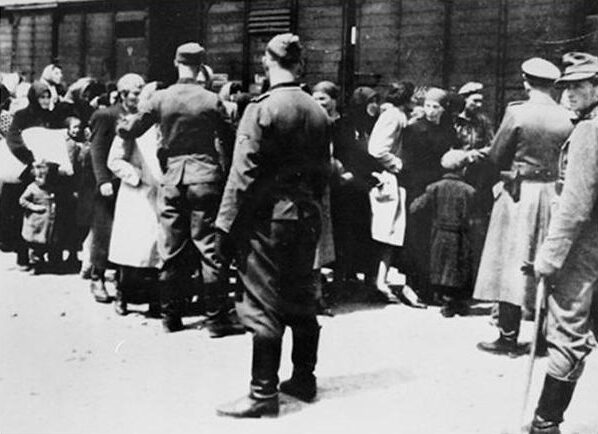
Jews who have just been unloaded from cattle cars at the Auschwitz death camp. Gestapo soldiers receive them.
Elka approached the sonderkommando who had come to take care of the sewers and asked him: “Where are our parents?”
He answered her: “Dead. At two o’clock they were all in the chimney. If you’re here in the morning – you’ll go too.” And he added: “Run away!”
In this block, the girls were not numbered. Elka had a clear idea that she had to run away. “My mother died at home – they’ve done a purification ritual for her,” she told herself, “and I have to do everything possible to fight for my life and run away.” Elka did not cry. Her heart was hardened and she could not cry. She moved in hiding from block to block until, in block 14, she recognized her aunts and cousins and stayed with them. She tried to maintain her health and bathe in the snow.
Elka spent a short time in the hospital ward due to an ear infection and was almost taken to the crematorium. At the last moment, her aunt managed to get her out. She realized: “G-d, miracle after miracle. I see that I have to stay alive.”
Her aunt befriended the head of the block and cooked food for her, and so they were given a little more than the minimum rations… Not long after, the aunts were taken away, and Elka was left alone again. Upheavals took place – the family camp, an object of envy, was destroyed, as was the gypsy camp. An attempt at rebellion was made, which failed.
In the camp, the girls tried to maintain Jewish symbols – “I recited the Shema (Hear Oh Israel prayer), the girls prayed, they tried to calculate when Shabbat was…”
On one of the transports leaving Auschwitz, her cousins asked her to accompany them, but Divine Providence prevented her from doing so, and although they survived the journey, they were killed by rioters. When the Russian bombings began, Elka was sent with a group by train to the Hochweiler camp without food, without beds, and without adequate conditions. In this camp, there was a Wehrmacht officer who was more humane than the SS men, who let the girls peel potatoes and turned a blind eye when they peeled them thickly. “The war will soon be over and you will be freed,” he told them.
They worked cutting wood in the forest. Elka repaired the officer’s shoes and got some of his leftover food to lick… They slept in a stone structure, one on top of the other, and suffered from severe malnutrition.
“I tried to save bread for the death march we knew we were going to go on,” Elka said, “and I saved it, but at the last minute they stole it from me.” When they set out on the death march, a slow death march, the camp commander offered those who wanted to to stay in the infirmary. Elka saw the dogs and the typhus and decided to leave while she had the strength, a heavy coat, and wooden shoes. A month of terrible marching without food, in wooden shoes, in the snow. Elka became very weak. At one point, they chewed coal they found in a coal wagon just to have something to chew on. Elka lost strength and almost fainted.
Her friends tried to hide in the village, but she was afraid they would catch her and kept walking. At night her friends dug a hole, laid her down and covered her with leaves. Her heart still beat. “We don’t want them to kill you,” they said goodbye to her. The bell rang, and she didn’t hear, everyone set off, and she was left there alone in the threshing floor, a shadow of a person, like an animal.
In the morning a villager found her, demanded that she get up, and she couldn’t. He brutally brought her to the Gestapo. There was already a mess and the Germans didn’t bother to kill… She fainted and woke up in a hospital. Nuns took care of her, and then she was sent to a camp with soldiers because the Nazis no longer wanted to kill in the village itself. Somehow she ended up in a camp in the town of Neuhoff, and two Hungarian girls said to each other: “She’s from the concert” – a nickname for a concentration camp – and tried to scare her and extract information from her about her Jewishness.
Elka was transported with German refugees to a refugee camp, a huge school, where she received food and care. An SS nurse pampered her, gave her food and chocolate, and asked her: “Why are you crying? I’ll put you in an orphanage.” She sent her there with a boy from the Hitler Youth. There they interrogated her about her origins, and Elka managed to escape. They returned her to the camp, to the nurse. Elka was very afraid of the Hitler Youth and did not want to stay in the camp. “G-d, I’m afraid of these boys.”
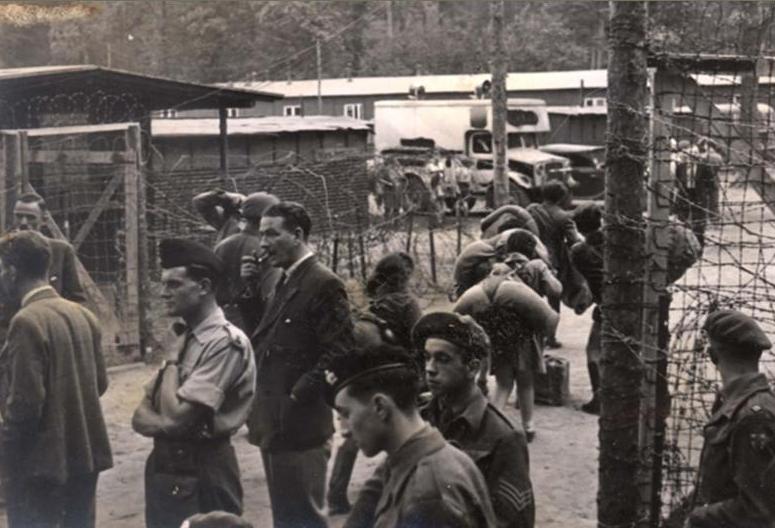
Refugees arriving in the Poppendorf DP camp, Germany
The German nurse told her: “It’s nothing, we live in a remote village. I’ll take you home.”
And here comes the dramatic and unbelievable turn!
Hildegard, the German nurse, took her to her home without the permission of her superiors, thinking that Elka would make her happy – entertain her, sing, and dance. Her husband was drafted. She was a young woman after her wedding and was looking for a companion. For the first two weeks, Elka suffered from nightmares and fears from every bell ringing. Hildegard’s father, in whose house they lived, was an antisemite. The father told Elka about the Jewish fraudsters… The grandmother sewed a dress for her, the woman tried to amuse her, but she was afraid to go out in case someone recognized her. “My head hurts, my ears hurt,” she said.
In the end, she was forced to go out and, to her horror, they even enrolled her in the Hitler Youth… “Can you imagine how I felt there?” Elka was forced to go to Hitler Youth meetings. There, they recycled cans and bottles to help with the war, they reported on anyone who listened to foreign media and didn’t believe in Hitler, and they put up placards saying “We will win! We will fight to the last drop of our blood!”
The biggest trauma Elka remembers was on Sundays when family members came for a festive meal and she had to face a group of Nazis. One day while walking with the baby, she had a breakdown and panicked. The woman said to her: “Ellie (her name there), I thought you would entertain me when my husband is not here, but you are sad…” Elka lost her parents, could she have been happy?