A Town Named Yendzshev (Jędrzejów)
On the road between Kielce and Krakow lies Yendzshev, a town that is now unknown to all of us, but until the Holocaust, a warm and pleasant Jewish community lived there. It was a lively and vibrant town, and its Jews were always proud to be “Yendzshever Yidden”.
Sadly, the fellers fell upon this town, its fate was no better than that of the cities and towns of Poland, and of the 4,500 Jews who lived there, only a few remained.
A vibrant and interesting Jewish life flourished in this town for only a few decades. Life there was not easy, but the difficulties of making a living that had always been the lot of Polish Jews and had intensified between the two wars due to many reasons, in addition to the effects of hatred and antisemitism from Polish neighbours, could not dampen the spirited and stubborn character of the Polish chassidic Jew – in the positive sense of the term.
The Jews of Yendzshev were happy in their lot, kind-hearted and good; some were great scholars of Torah and chassidism, some were simple folk, possessing faith and closeness to God, and all were diligent, energetic, witty and active, and the synagogues and shtetls there were filled with them at any time of need. Shabbat in Yendzshev was full of grace and rest, its holidays were full of ancient and deep-rooted Jewish life, a life of kindness and mutual assistance was in its name and the noble Jewish festivities; the “tannaim” (engagements), weddings, the Chumash (Pentateuch) feasts and the bar mitzvahs, always left a pleasant trail of memories and hope. They gave strength to fight the battle of life, under impossible conditions.
Jewish Yendzshev is no more. The houses exist, the streets are paved, and the landscape remains almost the same, but there are gentiles walking around; the descendants of those who murdered, or in any case helped to murder and certainly did not hide their pleasure in murder, those who inherited the houses and shops, the labour of generations of holy and pure Jews who breathed life into everything that was, and made every wasteland flourish on earth.
The Jews of this town, for the most part, ascended to holy and pure heights and left behind a region devoid of life, a town devoid of vitality and activity. There are gentiles walking around, sleepy and living their dreary routine, and no one there would ask himself, for what and why.
Ganzach Kiddush Hashem researches and documents the wonderous existence of Jewish towns that have almost been forgotten, and in this context, it now presents a few of the sources of life of this magical town, a Jewish town that fought bravely for its image until the very last moments. Here, three chapters will tell of the peaceful days of Yendzshev and the bitter end that befell it, during the years of the terrible Holocaust that wiped out the Jewish refugees in Europe, until almost nothing remained of it.
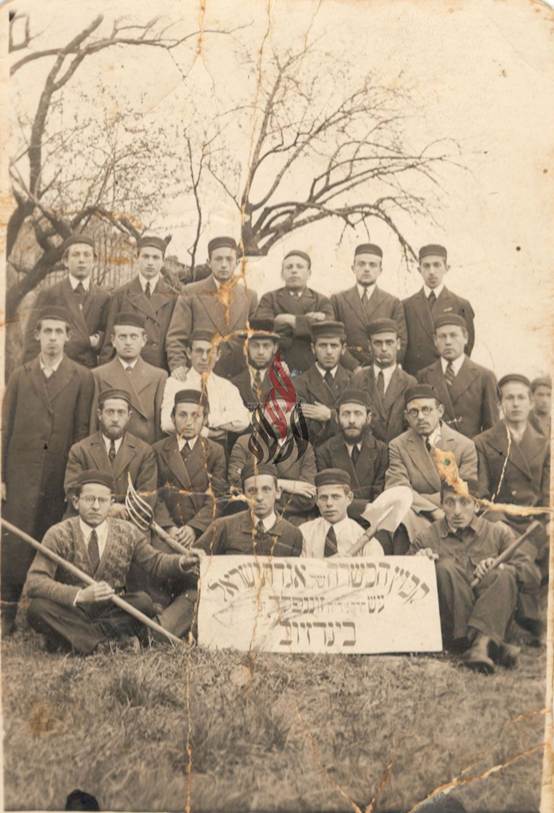
An Agudath Israel hachshara (agricultral training for immigration to Israel) group in Yendzshev
Historical Yendzshev expelled Jews from the city en masse. Until 1842, no Jews lived in this city, which was among the “holy” cities for the Catholic clergy.
Thus, in the statistical data published by the Ministry of Internal Affairs in 1840 (around 5600), there was not a single Jew in Yendzshev. In 5657 (1897), Yendzshev had 4,717 residents, including 2,050 (!) Jews, and throughout this district (which also included Władysław, Malogoszcz, and more) there were 8,102 Jews.
The relatively young community was built very beautifully and flourished both materially and spiritually. Jewish commerce was bustling, and its weekly fair was something special. There was no shortage of hardships, riots, and economic decrees for the Jews of this city – 4,500 in number between the two wars – but joy and activity, Torah, chassidism, and creativity breathed a cheerful spirit of life into the good and peaceful Jews, who, as everywhere they went, made deserts flourish and abandoned villages grow. The Jews of Yendzshev, of course, never imagined that within a short period of time they would be exterminated in unusually cruel ways and that only eighty people would survive from their entire beautiful community…
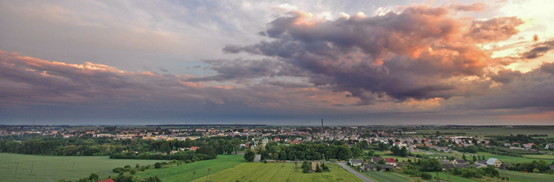
The view of the city today (courtesy of the Yendzshev municipality)
“Gentile Yendzshev was not destroyed. On the ruins of Jewish Yendzshev stands a whole city, inhabited only by Poles, whose hands are not completely clean of Jewish blood. They fulfilled, without any morals, the notion: ‘You have murdered and you will inherit’…”
“Everything we had there, in this city of ours, they robbed us of, but they cannot deprive us of our memory too… We are obliged to preserve this sacred memory within ourselves and to instill it in the hearts of our sons and daughters…”
From the “Yendzshever Yizkor Book”
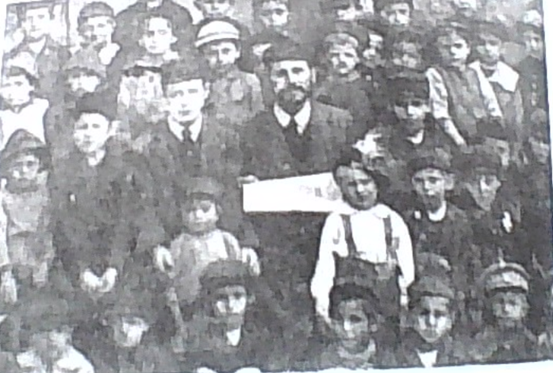
Rabbi Meir Yechiel Genat and his class in the Yendzshev cheder, 5682 (1922)
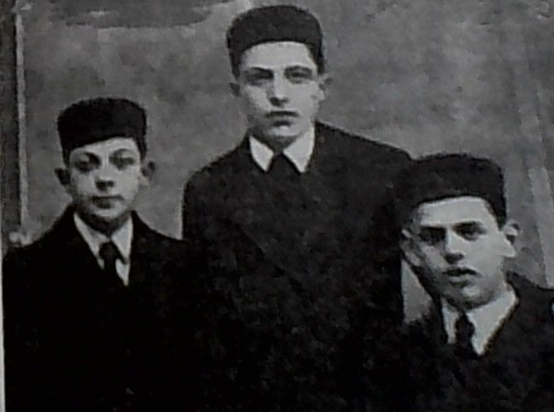
Meir Shalom Niedwietzki, Kozlowski, and Yosef Ritterband, students of the aforementioned cheder
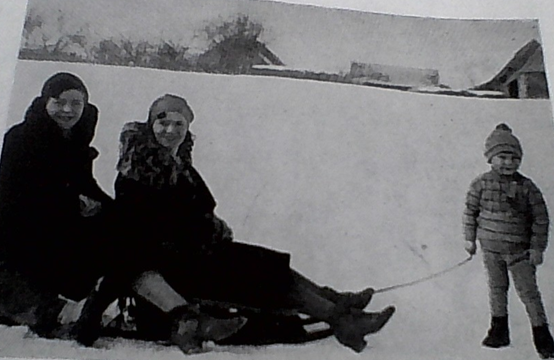
Youthful joy. The children of Yendzshev enjoy themselves in the snow a short time before the terrible years. The Wolfstadt family, may G-d avenge their blood
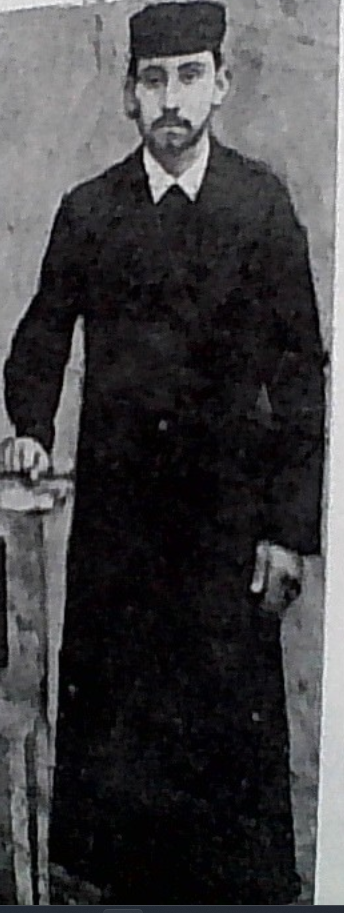
The holy young man, Shmuel the son of Shalom Heilprin, may G-d avenge his blood
Rabbi Shmuel was a Torah scholar and a businessman. He was considered a great philanthropist, and after the death of his young wife, Frieda, daughter of Shmuel Aharon Rosenthal, he was left with his three orphans, whom he raised with love and devotion.
After the Holocaust, his daughter Chana found her father’s picture buried in the ground.
The Town and Its Figures
1
“The Thursday Fair”
The weekly fair of Yendzshev, according to the testimony of a survivor from the town, Moshe Weitzman.
On Wednesday night, the merchants and shopkeepers would raise their eyes to the sky. If clouds were visible, they would say with pain and a heavy heart, “liber Gott!” (Beloved G-d!), “Yidden dorfen oif Shabbos!” (Jews need for Shabbat), “Halt hop der regen biz freitig” (Please stop the rain until Friday).
“Der mark zol chalila nisht farsheret veren!” (So that the market will, G-d forbid, not be distrupted).
And when G-d heard their prayer, and on Thursday morning the sun appeared, the merchants and craftsmen would raise their hands to the sky and “shtil gegebin” (whisper) a silent thanks to G-d for not abandoning His people, Israel.
Early in the morning, the streets are still dark and empty, and behold, in the distance a donkey’s braying is heard. This is the first news, “they are coming”… From all directions in the city, villagers can be seen, men and women, with their wares of every kind, chickens and eggs, fruits and vegetables, and the seller and her household…
And then the creaking of door hinges is heard, the Jews of Yendzshev have woken up… Jews are running with their tallises (prayer shawls) and tefillin (phylacteries), wanting to finish praying in the minyan (prayer quorum of ten men). Everyone is rushing to the first minyan, there is no time today, everyone is rushing…
“The people of Israel need a livelihood” and may the good G-d forgive the haste…
At about ten in the morning, the fair is already in full swing. Happy and cheerful in the town.
That’s how it was until noon.
It was already noon, the villagers had already bought, those who had a little money left went to the inn for a drink, and the Jews, they were also counting their bundles… They were doing their calculations. What would go straight to the treasury, to pay off the debt, and what would wait for the next fair, to the next town.
This is how Jews lived, marrying off children and giving handsome dowries, until the oppressor came and uprooted everything.
2
Full carts from the home of the “poritz” (wealthy landowner) for the poor of Yendzshev
From the story of the elderly chassid Rabbi Lemil Rubinstein, one of the great figures, who died at the age of 106 in the town of Yendzshev. The story took place exactly a hundred years ago, and its fragrance is full of old Polish town nostalgia.
“A Poylishe kerabieh” (In Polish Yiddish – A Polish nobleman, wealthy person. A Yiddish term that is no longer in use today)
5686 (1926), through my grandfather’s window, a luxurious carriage, drawn by four horses, is seen, and it stops in front of my grandfather’s house, and from it comes a handsome poritz, about fifty years old, who knocks on the door of the house…
He asks, does the scholar Lemil Rubinstein live here?
And my grandfather, shaken by the unexpected visit, waited impatiently to understand what the important guests wanted.
“We travel from city to city, and from town to town,” said the poritz, “and collect details about the elders of the town, you, the ‘birger’ (literally translated as ‘citizen’), are the oldest citizen here, and we got your address.”
My grandfather was amazed.
He never revealed his age, he was always afraid of the “evil eye”, and in this case he didn’t know what to do, how to disappear. The poritz understood the business well, and immediately said to my grandfather:
We already know your age from the official documents of the authorities’ records, we didn’t come here for you to tell us how old you are, we just want to hear stories from your long life.
Without a choice, he said:
At the age of 15 I was already drafted into the army. I fought in the Russo-Turkish War. While I was serving in the army, I married my wife, who was then 12 years old…
That’s how he told them the fairy tales, and the couple of poritzes enjoyed every moment.
At the end they stood up and said: You won’t regret telling us these stories.
Months passed, and here were three luxurious wagons stopping near my grandfather’s house, all filled with boxes and sacks, and in charge of was some respectable “manager.” A manager of some rich poritz, he seemed to be, and in his hand was a letter from the “meshugener kerabieh” (the crazy nobleman) on which was written: “As a thank you for the important information about the Russo-Turkish War, I am sending you and your family some products.”
My grandfather, a hundred-year-old Jew, was forced to rent a special storage space to store the enormous quantity he received from the poritz: many sacks of flour, a whole cart of potatoes, beets and cabbage, various fruits, apples, pears and plums, even a few bales of hay for “shenikess” (animal food)…
There was so much there, not only was it distributed to the family but many poor and needy people received from the same shipment. My grandfather was a hundred years old at the time, and he lived to be a hundred and six!
3
Longings for the Beit Midrash (Study Hall) – From the testimony of Chaim Yehoshua Willageh, Miami Beach, Florida
Standing in front of my eyes, and will stand forever, the figure of Hersh Ber Mordechai Reubens. He was a young man of about 20 years old, and his face was simply smeared with grace. He was clothed in silk and velvet, a great scholar, well versed in the most difficult and profound issues. From his mouth he spoke the words of the Tosafot, Rambam, Maharsha, and what not.
In the beit midrash, one saw heavy tables: At each table there are several young men who are studying under the supervision of an “adult man”. First the Talmud, then the interpretations, and then the four parts of the Shulchan Aruch. First, Yoreh De’ah.
Hersh Ber was already well-versed in all aspects of the Shulchan Aruch – and to sit with him at the same table – this was a privilege that not everyone deserves, not every “beit midrash bachur” (unmarried man in the beit midrash) was allowed to sit at this table.
Hersh Ber moved between the tables, and when he noticed a group of young men arguing over a question and not arriving at the correct interpretation, he immediately, with a smile on his face, put them on the correct path. At the same time, he took an interest in the situation of each of them, and with great joy advised and assisted with every request, every question, standing by their side in every difficulty.
He stands before my eyes as in those moments, that moment before I left Yendzshev. I see him wearing a gold watch with a double chain. He received the watch for his engagement, but unfortunately his life was a dream. He and all the people of the beit midrash were killed. “Chaval al davdin” (what a shame to lose him).
To read part 2 in the series, please click here.