An Everlasting Edifice
The Lives of the Chassidim and Influential Jewish Men in Yendzshev (Jędrzejów)
Part 2 in the series on Yendzshev, by Yaakov Rosenfeld
To read part one in the series, please click here.
I will open with a quote from the memoirs of a survivor from the city:
The mitzvah (commandment) “Serve G-d with joy” has been preserved in all the houses of the chassidim in our city.
Who among us does not remember the sounds of singing and chanting that emanated from these houses of prayer? And who among us does not still hear those wonderful melodies in which there was enthusiasm and holiness, the elevation of the soul, and adherence to G-d and His commandments, like a threefold thread that will not be broken from generation to generation.
I recall Shabbat and the holidays, especially the High Holidays in the shtiblach (small prayer houses), and those wonderful Jews who flocked in droves to their houses of prayer, adorned with their silk garments and the samet or streimel hats on their heads, and with them their sons and sons-in-law, the young men, who form one community to fulfill the will of G-d and serve Him wholeheartedly.
And I also recall those conversations, the conversations of scholars of Torah and guardians of the ways of chassidism, whose elders would often speak in praise of the righteous and their wonders, and the young would drink their words with thirst, especially those who had returned from the houses of the Rebbes, and who had only now been privileged to be infused with their Torah and their ways of chassidism.
How beautiful those times were, and how wonderful the spectacle was on the night and day of Simchat Torah in the homes of the chassidim, and how they thrilled the hearts of the hundreds of Jews, men, women and children, from among the multitudes of Jews in our city who flocked to witness their prayers and hear their singing and watch their dancing, as they clung to the Torah scrolls in their hands and rejoiced together in the joy of the Torah…
(Shaul Greenberg, Holon, Sefer HaZikaron, pg. 207)
“Sweetness Mixed With Heartache”
They have a sweet taste for the memories of the city of Yendzshev that are scattered in the archives of Ganzach Kiddush Hashem. There is no doubt that it is a sweetness mixed with heartache, because all this beauty went to ruin in the years of wrath, but sometimes it is good to remember the experiences of those days and try to compare.
Let us look at the life of the Gur chassid, Rabbi Henich Waxbaum, may G-d avenge his blood, who was a genius in Torah, a worshiper of G-d, and a successful businessman. His name was Chanoch, and among chassidim, Chanoch becomes Henich, as is known and recognized to this day.
A Hidden Experience
Rabbi Chanoch was born in 5637 (1876-7) in the town of Bilgoraj, Lublin province, in a warm chassidic home. As was the custom of those days, a father who was blessed with sons with a good measure of Torah and chassidism would take them with him on his journey to the Rebbe, so that they might absorb the holiness of the Torah, the chassidic meal gatherings, and the prayers in the shadow of the holiness. However, another goal was to bring the good children to the Rebbe, and this was hidden in his heart and never came out…
Quietly, a very expensive grooms’ market was held, involving wealthy businessmen with their “partners,” staunch chassidim, but also the downtrodden poor who would sell their wealth at a high price, and there was always a lively demand for good and fine merchandise. It was a common sight at that time to see a young man being dragged from the town of Gur along with a large and heavy Vilna Shas (Talmud printed in Vilna). He traveled to the Rebbe as a young boy, and returned home a groom. In the worst case scenario, the groom would return home with a valuable gold watch hidden in his suit pocket.
At that time, the glorious chassid Rabbi Alter, who was known as Rabbi Alter the Great (der Groisser Rabbi Alter), was staying in Gur, and his eyes wandered over good young men who came to the holy court, until his eyes rested on a young, charming, worshiper of G-d, who was knowledgeable in Torah. He held serious negotiations with his father, and after the holy blessing, the matter was finalized.
Rabbi Alter was the chief slaughterer of Yendzshev, and with God’s help, within a short period of time, seventeen-year-old Chanoch came and married his daughter Pearl, and began to live in the city where his father-in-law lived, as was customary and accepted at the time.
A short time after the wedding, and the young couple brought pride and happiness to the whole family, when the typhus epidemic broke out in Yendzshev and, to his great sorrow, Pearl became infected and became seriously ill. She did not survive the violent disease, and passed away.
Rabbi Alter could not bear the idea that in addition to the death of his daughter, he would also lose his beloved, perfect son-in-law, and took Chanoch as son-in-law for his youngest daughter, Bracha. The poor man remained in the family, and continued to do his best in Torah and the service of God.
A Broadly Knowledgeable Man
The poor man was quickly drawn into the timber business that was thriving at the time, a type of livelihood that could provide financial well-being along with the opportunity to stay in the study hall and meditate on Torah day and night, and this is exactly what the poor man did together with his partners, the timber merchants in the forests of Rabbi Bunim, the father of Rabbi Mordechai Yosef Werdiger, the Gerrer chassid, a broadly knowledgeable man, about whom we wrote in the previous article.
The partners, Rabbi Henich Waxbaum, Rabbi Yisrael Rosenberg, and Rabbi Henich Teitelbaum, saw success in their work and were considered pillars of the Gur chassidic community in their city, but Rabbi Henich Waxbaum became a impressive person in all areas of life, their difficulties, and their problems, not necessarily just among the Ger chassidic community.
He embodied a rare combination in his personality: immense greatness in Torah, fear of G-d and joy of life, along with a wonderful knowledge of trade and worldly affairs, with great wisdom of life. These facts brought him business disputes that the greatest arbitrators were unable to settle. Merchants from all over the world would come to him with unresolved problems, and all parties would leave satisfied. This is a “heichi timtzi” (practicalness that enables the existance of a Jewish law, i.e. that he was practical) that almost does not exist.
Rabbi Bunim Werdiger, who had a keen sense of smell, convinced him to leave the lumber business and move to manage the large and modern flour mill on Pinczow Street. As the Werdiger family’s business grew and prospered, encompassing many areas, such as the iron casting plant of the municipal electric power plant, there was hardly a business venture in the city that Rabbi Henich did not stand behind with advice, wisdom, and action.
House of the Sages
His apartment was in the flour station house, where he raised his family and toiled in Torah day and night. His best friend was the sharp Ger chassidic dayan (rabbinical court judge), the genius Rabbi Shimshon (Shimshi) Birnstock, who was a “heyser (warm) gerrer chassid” and served as rabbinical decisor for all the communities of the city. He was a genius of great stature and many questions were directed to him, and he felt like a “member of the house” of Rabbi Henich. Their conversation was a witty and sharp conversation of Torah scholars. It encompassed all parts of the Torah and the deeds of the righteous. And when the two geniuses would sit together during the Mincha and Maariv prayer services and bask in the world, they would surround the table with chassidim and scholars and greatly enjoy, delving delight from the joy of Torah and chassidism.
This is how things went until the outbreak of the terrible war, which put an end to the beautiful and pure Jewish town, who will replace it? Rabbi Shimshon Birnstock, since we mentioned him, we will say that he was the only one from this elite group who was granted a proper Jewish grave during the war years. May G-d avenge their blood.
In addition to the Rabbi Shimshon, who left a pleasant memory even in the hearts of those who are not exactly chassidim (“He was a great scholar and wise even in worldly affairs, one of the best Gur chassidim in our city” -Shaul Greenberg, Holon, Sefer Yizkor, pg. 210), another ger chassidic rabbi served in Yendzshev – the genius Rabbi Gavriel Teichholz, may G-d avenge his blood, who was crowned as a rabbinical decisor in 5698 (1937-8), “land, do not cover his blood.”
Rabbi Hirsch Natan Willageh and a Wonderous Story of Respecting Parents
Hirsch Natan was the most famous jokester and rhymer (“grammer”) in Poland before the Holocaust. He was not just a jokester, but a clever man, a learned scholar full of chassidic content, who knew how to incorporate Torah verses, profound parables and chassidic ideas into his jokes that delighted hearts and stirred the audience to repentance and joy at weddings.
In his youth, Rabbi Hirsch Natan was a student of the genius Rabbi Yerachmiel Moshe Mintzberg, known as “the Łukówer Rebber”, and when Rabbi Yerachmiel Moshe served as rabbi of the city of Yendzshev, his student Rabbi Hirsch Natan came with him, and here the nagid (lay leader or benefactor), the magnificent chassid Rabbi Akiva Bakar (originally Becker), set his eyes on him, and after a warm recommendation from the genius Rabbi Yerachmiel Moshe, they took him as a son-in-law for his daughter, and so he settled in this town.
Officially, his home was in Yendzshev, but apart from the holidays, Sfirat HaOmer (the period between Passover and Shavuot), and the Three Weeks (between the 17th of Tammuz and Tisha B’Av fast days), Hirsch Natan was never seen in the city at all. He would travel from city to city and from one holy court to another, equipped with various luxurious clothes, all according to the occasion, and he was amazing in his sayings and refinements, and all the rebbes, rabbis, and nagids of Poland invited him to weddings and major events. He instantly knew gematria and acronyms and unknown sages’ sayings, stories, and parables. With a wonderful knowledge of all the Torah, Prophets, Writings and the sages’ sayings, he would recite rhymes and “prove” that this pairing would go well and that righteous generations would come from the bride and groom’s lineage. After he finished speaking, the rebbe or rabbi would call over Hirsch Natan and shower him with his blessings.
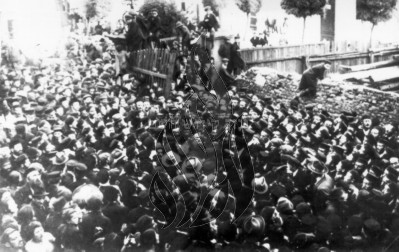
A wedding of a rebbe’s family member in Poland
His son, Chaim Yehoshua z”l of Miami Beach, told of a miracle that happened to him thanks to the blessing of the holy rebbe, Rabbi Shraga Yair Rabinowitz z”l, who in the introduction to the book Eran Edut writes about him that “he would strive for the good of the whole world in general and in particular, until the last moment, never wavering from his ideas – the troubles of the general and the individual.”
At the age of 18, Chaim Yehoshua Willageh was in America, where he arrived after a stay in Paris. At that time, he learned that a draft order had arrived for him at his home in Yendzshev. It was easiest for him to ignore it and continue his life in the US, but he knew that the fine that would be imposed on his parents would be heavy. (According to research I did, such a fine was equivalent to the price of a small house, or, unfortunately, like the salary for six months of work… Y.R.) To spare his father this grief, he left America and returned home to enlist.
His father, Rabbi Hirsch Natan, took him to the Rebbe, Rabbi Shraga Yair of Bialobrzegi (son of the Rebbe, Rabbi Nathan David of Szydlowiec and grandson of the Rebbe Yerachmiel of Peshischa) so that they could bless him before enlisting.
The Rebbe looked at him and said: “Shalom Aleichem! You are doing a great mitzvah! Honouring one’s parents! To come from America straight to report for duty! Now, therefore, you wear glasses, you will certainly be discharged (“Du targest dach brillen, du vest gevist baafrei veren”).
And as he said, he very quickly received a blue card from the army (an exemption). After a short period of time, he returned to America, where his parents later also came and where they passed on.
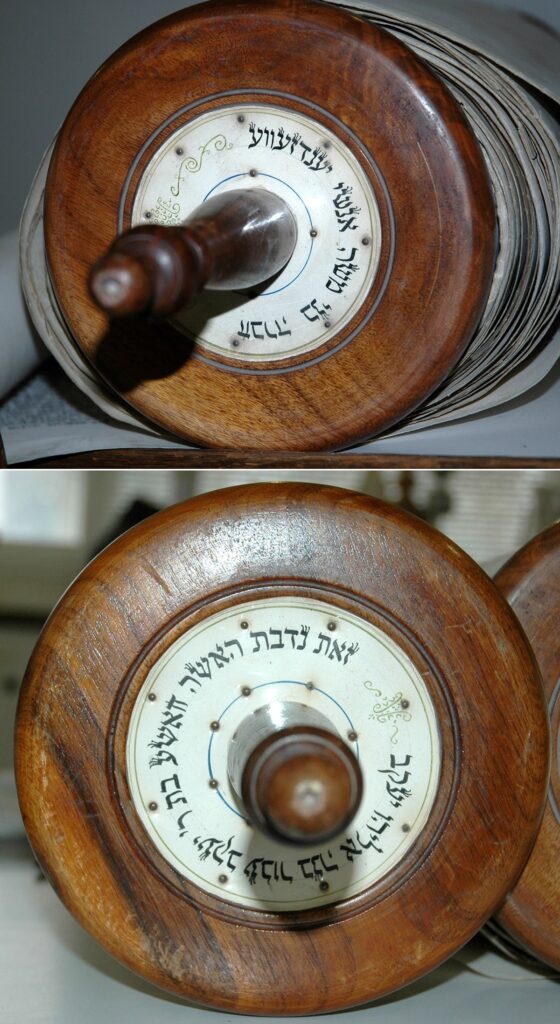
A Torah from Yendzshev

The Jewish cemetery of Yendzshev
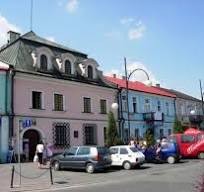
The town today – stolen Jewish homes